
The Angel’s Voices

Mt. Baker, WA, from Artist Point, Photo by Ruth Jewell, 14.09.15
Mt. Baker, WA, from Artist Point,
Photo by Ruth Jewell, 14.09.15

Prepared for a Sermon at Queen Anne Christian Church, Seattle WA
January 18th, 2015

Scripture: Psalm 139:1-6, 13-18

Have you ever had that feeling you are being watched and you turn around and around to see who is there?   I have and I must admit it often feels creepy!  Someone is watching me, why, who are they, what do they want, will they hurt me?  Some might say these are the questions of a paranoid mind, but, given the status of our world today, not uncommon in these days of uncertainty, fear, and, let’s be honest, at least a little hate, ok a lot of hate.

So when I read the Psalm for this week I had to really think what it means to be “watched,” “known,” by God.  This Psalm is telling me that I am being watched, by God no less.  Is that a good thing or should I be afraid, really afraid.  As I was contemplating these verses I remembered an incident out of my childhood.  It was a memory of being known by God and knowing it was keeping me safe.

Nearly 62 years ago I was severely burnt and spent 6 months in hospital healing and having reconstructive surgery.   In reality I am blessed to be here, because I should have died that summer, but didn’t.  However, I did spend a great deal of time on a children’s ward of a Cleveland Hospital.  There were number of other children there as well, just as injured and ill as me and one little boy and I became good friends.  I do not remember his name; I do remember he was dying.   He was a little older than I was but could not walk; I could get up and walk a little but couldn’t read as well as he could.  I would get books and games to play with and he would read the harder books.

Children will often tell another child something important when they aren’t sure their parents would understand or listen.  So one day he told me that he knew he didn’t have long to live and he wanted me to tell his parents he was ok with it.  You see he had a guardian angel who stayed by his side and the angel had told him he would be going soon and no longer in pain, his parents would be sad for awhile but they would remember him forever.

One night I awoke to a great deal of crying and saw the mother holding the little boy.  I remembered what he had asked me to do so I crawled out of my bed and tried to tell them that the boy was OK, and that he was with his angel now.  However, before I got very far with that a nurse scooped me up and put me back in my bed saying something patronizing.  I never really talked about that incident again; I understood what I had to say was pretty unimportant to adults and not worth listening to. It was the thought of the time that children didn’t understand death or God and it was, and is, a wrong thought.

Being known by God, being watched by God, children understand that, after all they are always being watched.  By parents, teachers, friends, family members who want to keep them safe.  So knowing God is watching them is no big deal, just one more person on the list to keep them safe.  Besides isn’t there something comforting knowing you have a guardian angel nearby, how cool is that.

From the time they are formed in the dark, cavern of their mother’s womb they are cradled and whispered to by angels.  By 18 weeks of pregnancy the embryo begins to hear his first sounds, Mom’s heart beat, the movement of her blood, and bowel sounds.  He also hears His Mom’s and Dad’s voice, music, laughter, and tears.  To him it’s, Angels voices coming from, everywhere.  Children know they are being watched, searched out as they are being formed in the dark.

After birth we are still connected to those angels, only now they have blurry faces, but they can see the angels smile at them and hear their whispers and while breast feeding they still hear the comforting sound of Mom’s heartbeat.

It is a sad fact that as we grow we forget those connections to the mystery of our beginnings.  We let other sounds carry us away from the angel’s voices, the whispers that we are beloved and we are watched over. We, who were made so carefully, struggle to be free of the binders, free of being hemmed in from behind and before. We, who in secret were made so wonderfully and woven of star dust and love, want to run free of the restrictions of God, angels, or anyone else.

Yet there is a part of us that yearns to be known.  Oh we may fight it, rebel and run away because we want to “do it our way.”  But really, at some level, isn’t it comforting to know just how beloved we are?  The Psalmist said “My days are all inscribed in Your Ledger; Days not yet shaped—each one of them is counted.”[1] Those counted days are from the moment we are conceived in flesh to the moment we let go of this body and return to God.  Yes we still have days that God has counted that we know nothing about, yet.  But God is still watching and still planning, or more likely, revising our life plan based on our latest actions.

You see I’ve never been a big proponent of predestination, were God has planned our lives out before we are born.  No I am a firm believer in free will and our obligation to choose life over death.  We, you and I, must choose to follow one path over another and depending on our choices our life is rewritten again and again.  I know that because I have had my life rewritten all because I’ve made some rather dumb choices in my life.  My guess is we all have, because we are human, we are embodied; we are separated from that light of God and God deliberately put us on our own resources for a purpose we do not know.  (My first question for God when I return is “what were you thinking.”)

What the Psalmist tells us is even in our bad choices we are watched, cared for, beloved, held safe, and not alone.  God keeps us in God’s thoughts; we are never far from the Divine mind.  “How weighty to me are your thoughts, O God! How vast is the sum of them! I try to count them—they are more than the sand; I come to the end—I am still with you.”  “I am still with You,” God is with me.  Matthew writes that Jesus’ last words to his disciples were, “And remember, I am with you always, to the end of the age.”  We have that promise.  God has not left us alone, Jesus has not left us alone, the angels are still whispering, if, only we listen.

Rabbi Schachter-Shalomi translated verse 14 as follows, “I am overcome with thanks at Your awesome wonders, Your astonishing works, of which my soul is aware.”  Our souls know what God does, what Jesus does, even when we are unconscious to those actions.  Our souls know even when we reject God’s call that we are not alone.  That we are watched over and having our lives rewritten again and again based on whether we chose life or death.

Those angel whispers, messages of comfort from the Holy, still hold for each and every one of us.   That first sound we heard in our mothers’ wombs, the first whisper of life from the sacred, was a heartbeat.  It still is the whisper of life for all of us.  Without our hearts beating strong and level life will fade.  But it is not just the heart of our flesh that we need.  We also need the voice of the heart of our souls, our spirit, to truly live life as God intended.  Remember Moses’ last words “choose life.”  The messengers of God, the angels voices all whisper, “choose life.”

Ruth Jewell, ©January 17, 2015

[1] Schachter-Shalomi, Rabbi Zalman, Psalms in a translation for praying, Alliance for Jewish Renewal, Philadelphia, PA, 2014.
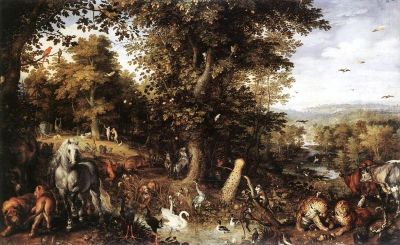
It is Good?—Prayerful Tuesday

Garden of Eden, Jan Brueghel, 1612

“And God saw that it was good.” Genesis 1:10b

In the last weeks God’s creation has seemed anything but good.  Terrorist attacks, ambushing of police, and police shootings of unarmed young men continue to rent the very fabric of our society.  Yet God did not create an evil world, in fact God proclaims this world a good world where everyone, and I mean everyone, has what they need to live and be the person they are meant to be.  It is our choice’s, not God’s, that have created a world that is unsafe.

Spending time in silent contemplation with a focus on what we could have been, and still could be, seemed the only way for me to center myself and see the world as good.  So today I offer as our prayer of the week another Visio Divina using the above painting of the Garden of Eden by Jan Brueghel.

Prayer Practice:

1. Study the picture slowly, taking a first glance noting the colors, the placement of the plants, animals and, people.  Remain with the image for one to two minutes. If you would like, jot down a few words about the image.

  1. Take a second, deeper, look. Where is there movement? What relationships do you see? Engage your imagination. Where are you in the artwork? What do you see from that perspective? What deeper meaning emerges? What feelings about the world rise in you? Are there any images that you are particularly drawn too?
  2.  Respond to the image with prayer for the world. Did the image remind you of an experience, person or issue for which you’d like to offer thanksgiving or intercession? Offer that prayer to God.
  3. Find your quiet center. Breathe deeply. Relax your shoulders, arms and legs. Rest in this quiet. Let God pray in you. God prays beyond words.

Please do not let your belief, or non-belief, in the Garden of Eden and the subsequent fall from grace prevent you from seeing the good things in creation. Our world is in need of prayer right now.  All of our people, all of creation is crying and in pain.  Let your prayers go out into the world and let them lead you to be the person God has always wanted you to be.

Peace, Blessings

Ruth Jewell, ©January 13, 2015


For Unto Us – Prayerful Tuesday

John 1:1-5  In the beginning was the Word, and the Word was with God, and the Word was God. He was in the beginning with God. All things came into being through him, and without him not one thing came into being. What has come into being in him was life, and the life was the light of all people. The light shines in the darkness, and the darkness did not overcome it.

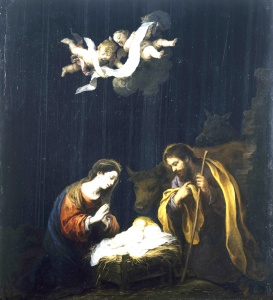
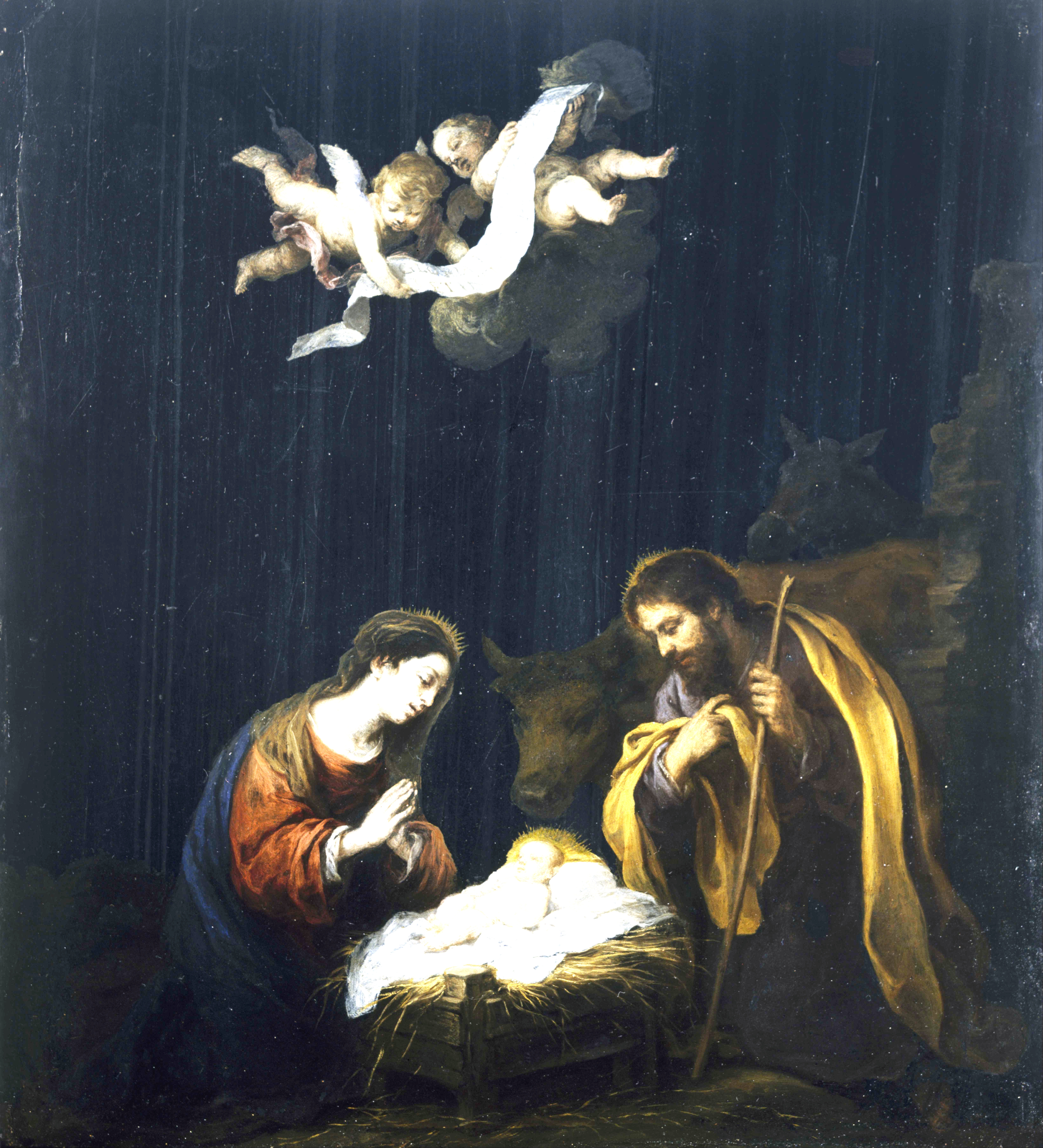
The Nativity, Bartolomé Estaban Murillo, (1617-1682)
The Nativity,
Bartolomé Estaban Murillo, (1617-1682)


This is one of my favorite paintings of the birth of Jesus.  There is just something about the expressions on Mary and Josephs faces as they look at the new small being in their life that draws me in.  I once saw the original in the Boston Museum of Art and this tiny painting on black slate captivated me as no others have.

However, I must admit that despite loving this painting, I don’t see the nativity as an actual historical event.  It has been a long time since I believed in the virgin birth. I am a scientist by training and I know that while ‘virgin’ births do happen in nature, it’s called parthenogenesis, they only occur in certain species of worms and small crustaceans called daphnids.   So this event was a no go for me not long after my first serious biology class. But the importance of the birth story is not in history, it is in the symbolism of new life breaking into the world in the form of God within the person of Jesus of Nazareth.  New life, not of a baby’s, rather a new life lived in a world where all achieve their God given potential. Living in the world as Jesus did, with limitless love and compassion, offering justice and mercy to those who are in need, and offering a peace that fills the soul. Well then again maybe it is like the birth of a baby, for we all experience new insights as new birth within us.

So why I may not believe Jesus was born in an actual stable I do believe he was been born in the stables, and dark corners of our minds, societies, and cultures.  Jesus is the one who birthed new life in those dark recesses of our hearts and minds.  Who lit up the alley ways where suffering, pain, and violence reside bringing the light of love to those who were the unlovable.  In prayer and action we, you and I, continue to carry that light.  We take it to prisons, hospitals, hospice rooms, to the homeless, to the hungry, to anyone in need of the light provided by “The Way.”  At least we are supposed to.

Today I ask you to use the above painting for your Prayerful Tuesday Meditation using Visio Divina.

Visio Divina

  1. Look at the painting slowly, taking a first glance and noting the colors, people, places and things.  Remain with the image for one to two minutes. If you would like, jot down a few words about the image.
  2. Take a second, deeper, look. Where is there movement? What relationships do you see? Engage your imagination. Where are you in the artwork? What do you see from that perspective? What deeper meaning emerges? What moves you in this painting? Does it draw you in or call to you in any particular way?
  3.  Respond to the image with prayer. Did the image remind you of an experience, person or issue for which you’d like to offer thanksgiving or intercession? Offer that prayer to God.
  4. Find your quiet center. Breathe deeply. Relax your shoulders, arms and legs. Rest in this quiet. Let God pray in you. God prays beyond words.

May you be blessed with the birthing of new life within you.  Merry Christmas everyone.

Ruth Jewell, ©December 23, 2014

A Conversation with a Psalmist –Prayerful Tuesday

Come Lord Jesus, hear our prayer
Come Lord Jesus,
hear our prayer

As I am personally preparing for  Christmas I have been disturbed by the amount of violence and death around the world.  Peace on earth does not seem near. So as part of my morning ritual I have been doing Lectio Divina with the Psalms.  They have brought me some comfort but this Psalm struck a chord within me and I wanted to share that with you.  So this is a little different from most of my postings, as it is part of my journaling during my meditation. I am letting you in on a small part of my conversations I held with the Psalmist and God.  They are my insights of the moment, so if I say something you disagree with please be gentle, it is after all a private conversation you are overhearing.  At the end of my journaling you will find the steps for Lectio Divina.  For your own Lectio Divina meditation you may use the whole Psalm, as I did, or only a verse or two.

Psalm 10, The Message (MSG)

 1-2 God, are you avoiding me?
    Where are you when I need you?
Full of hot air, the wicked
    are hot on the trail of the poor.
Trip them up, tangle them up
    in their fine-tuned plots.

I am in the process of preparing for a Longest Night worship service and in reading this Psalm I was struck by how it matched my gut feelings this Advent.   Every day the news is filled with stories from around the world of someone killing someone one else, often many someone’s.  Just last night news came of a hostage situation in Sidney, Australia, just one more story to add to the Ferguson, New Town, Cleveland, Seattle, Portland, Houston, Afghanistan, and Iraq stories of the last number of years.  The list is too long, too many people have died, and too many children have died.  Like the Psalmist I am left wondering “where are you God.”

3-4 The wicked are windbags,
    the swindlers have foul breath.
The wicked snub God,
    their noses stuck high in the air.
Their graffiti are scrawled on the walls:
    “Catch us if you can!” “God is dead.”

This is supposed to be a time of joy and celebration but I do not feel like celebrating.  Our elected leader’s mouth words from the Bible I read every day, yet, their actions tell me they do not believe what they speak.  Are they wicked?  Are they windbags?  Well the wicked part can only be determined by God but the windbag part . . ..  Yes they are windbags, hoping that we who at least try to live a life of compassion will not notice their plans to take the last ounce of God’s abundance all for themselves.  They write bills and say “try and stop me, from denying the basic necessities to those who cannot help being poor, sick, elderly, or a child.

5-6 They care nothing for what you think;
    if you get in their way, they blow you off.
They live (they think) a charmed life:
    “We can’t go wrong. This is our lucky year!”

These insufferable, so called leaders lie and twist the truth until even the best of us are confused and dazed by the avalanche of untruths they let loose on the public. Whether they are religious fundamentalist, political leaders, in the United States, Afghanistan, Syria, Iraq, British Isles or anywhere they claim the spotlight and they believe no one can stop them.  They are on a role and the rest of us “be damned.”

7-8 They carry a mouthful of hexes,
    their tongues spit venom like adders.
They hide behind ordinary people,
    then pounce on their victims.

They mark the luckless,
    then wait like a hunter in a blind;
When the poor wretch wanders too close,
    they stab him in the back.

10-11 The hapless fool is kicked to the ground,
    the unlucky victim is brutally axed.
He thinks God has dumped him,
    he’s sure that God is indifferent to his plight.

The words they spit from their mouths cause fear in those who have minds that are weak and malleable. Letting these poor souls do the violence they pretend to abhor only to turn on them when they caught in their snares.

12-13 Time to get up, God—get moving.
The luckless think they’re Godforsaken.
They wonder why the wicked scorn God
and get away with it,
Why the wicked are so cocksure
they’ll never come up for audit.

We wait for you O God to respond, to let us know you haven’t forgotten us.  We wait and we wait.

14 But you know all about it—
    the contempt, the abuse.
I dare to believe that the luckless
    will get lucky someday in you.
You won’t let them down:
    orphans won’t be orphans forever.

The Psalmist sings of your knowledge of the violence we see every day.  But do you really hear the cries of the children who have lost limbs to bombs, to parents who have watched as their children are killed in front of them, as ISIS hangs those with different beliefs, as children shoot children?  Have we not sent enough children, parents, loved ones to you to serve as a sacrifice?  Do you care?

15-16 Break the wicked right arms,
    break all the evil left arms.
Search and destroy
    every sign of crime.
God’s grace and order wins;
    godlessness loses.

My heart wants to believe as the Psalmist did that you will intervene in the bloodletting of this world, but I know you will not.  It is not up to you, O God, to set this world back on the track of compassion, justice and peace.  That really is our job.  We are the ones who created these people who mock everything you have wanted for all.  We are the ones who must “gird up our loins” and speak out against injustice, violence, hatred, and war.  Only we who believe in justice, mercy, kindness, peace, compassion will change the lives of those who are oppressed, abused, injured, and starved by those who mock the world as you, O God, planned it.  We must stop cowering in our homes and our places of faith and become the prophets, the messengers, the hands, feet and voice that will bring down those who would enslave us to a life of poverty and misery.  Then, and only then, will the Psalmist’s dream come true.

17-18 The victim’s faint pulse picks up;
    the hearts of the hopeless pump red blood
    as you put your ear to their lips.
Orphans get parents,
    the homeless get homes.
The reign of terror is over,
    the rule of the gang lords is ended.

Gracious Spirit I thank you for this time of blessed meditation.  May the words and images I have seen transform my actions into walking with you in greater joy.  AMEN

Practicing Lectio Divina

  1. Choose the portion of the Scripture you wish to pray.
  2. Place yourself in a comfortable position and allow yourself to become silent, focus for a few moments on your breathing.
  3. Read the chosen text through, slowly and gently. Listen to yourself read, let yourself to savor each word and phrase.
  4. Read the text a second time. What words or phrases stick out for you? Remember God speaks to us in silence and in our listening. The words that pop out do so for a reason, pay attention to them.
  5. Read the text a third time. Are there any other words that speak to you?
  6. Sit now in silence, letting the words you have heard, speak to you and for you in your prayer, your conversation with God. What images, ideas, words spring forward?  Or maybe all of them are present in mediation.  Sit with those insights as you experience the presence of God.  Give your insights to God.  Do the insights give you new meaning or transformation of your actions, or prayer life?
  7. Now rest in God’s arms. Let God’s presence give you comfort. Do you feel the pull to return to your meditations? Then begin again. If not close with a prayer of gratitude for the time you have spent in God’s presence and the insights you have received.

Ruth Jewell, ©December 16, 2014

Prepare — Prayerful Tuesday

Preparing Split Pea Soup

3 A voice cries out:
‘In the wilderness prepare the way of the Lord,
make straight in the desert a highway for our God. Isaiah 40:3

The other Sunday I and a friend of mine were in charge of the coffee hour after worship.  It was going to be a cold November day and I wanted to do something different and special for people I care about.  Cherry and I talked it over and decided, since there was an Elders meeting after worship, a light meal of homemade soup, salad and bread would be a perfect offering. Cherry decided on making a chicken soup and bringing the rolls.  I decided on a vegetarian split pea soup and also brought the salad.

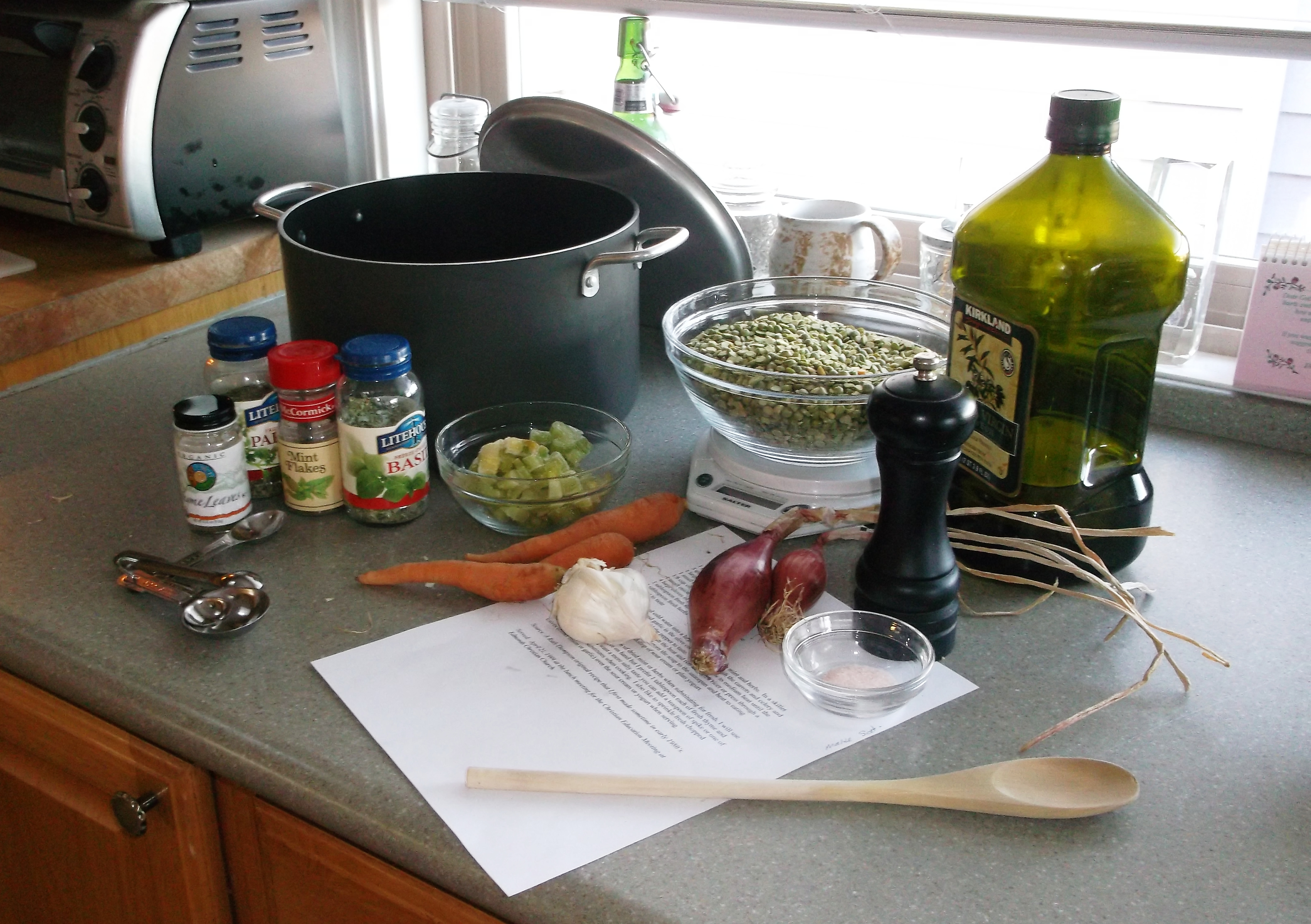
I have read and heard the words of the prophet Isaiah all of my life and have loved many of the songs and chants written around this verse.  But as I was preparing the soup for Sunday the words struck me a little deeper.  The picture above is the ingredients for my soup.  Simple wholesome ingredients; dried split peas, herbs, and garlic and onions, from my own garden, and fresh carrots and celery from the farmers market go into making this really simple soup. (Recipe Below)  As I scrubbed the carrots and celery I thought about who would eat my soup and in the process of browning chopped onions and garlic in olive oil the act of making the soup became an act of prayer.

The people who would share in my offering were the people of my faith community and any visitors we might have.  People I love and care about, but, more than that, it was an extended sharing from the communion table. The breaking of bread, the ladling of hot soup all became part of the feast Christ sets before us every Sunday.

As a member of the Christian Church (Disciples of Christ) we prepare and offer communion every Sunday.  We carefully set out bread and cup and share it with each other and as I prepared this simple meal that would be served after worship we were continuing a 2000 year old tradition of breaking bread and pouring cup then going in to share a common meal.  That is what the first followers of Jesus did.  They shared more than just a piece of bread and thimble full of wine.  They shared a whole meal together, rich or poor, aristocrat or tent maker, all ate from the same serving bowl.

I have helped prepare and serve hot meals for the homeless, and I routinely make up food bags to give to the homeless I see on the streets and while I may not sit down with each person I offer food too it is still communion.  It is a sharing of food, and drink, and recognizing that what I give doesn’t come from me, but from God, Christ, and Holy Spirit.  I am only the servant who is trying to fulfill Christ’s commandment; “for I was hungry and you gave me food, I was thirsty and you gave me something to drink, I was a stranger and you welcomed me. (Matthew 25:35)

In the process of preparing to serve others I am preparing to serve Jesus, to follow, as faithfully as possible, the path Jesus leads me on.  I know I will stumble, but Jesus will be there to pick me up; I will wander off the path, but the Holy Spirit will be there to lead me back; and I will grow weary, but God will be there to cradle me in her arms until I am rested.

The spiritual practice I am inviting you to share in this Advent season is to find the sacred in all that you are preparing for your own celebrations.  In what ways are you preparing for the Lord in your everyday life?  With whom will you celebrate the feast of God?  As you await the birth of the Christ child let your preparations become an act of prayer, for those you love and those you may not know.

May the peace of Christ be with you, always

Ruth’s Pea Soup
about 8 servings

1 lb. dry green or yellow peas
3 quarts of cold water (or 1 qt vegetable stock and 2 quarts cold water)
1 large carrot, sliced in to small pieces
1 small celery stick chopped
1/8 cup olive oil
1 small onion or 4 large green onions
4 large cloves of garlic, pressed or chopped fine
¼ teaspoon turmeric
1 tablespoon fresh mint
1 tablespoon fresh herbs (I like fresh rosemary, summer savory, and thyme)
¼ teaspoon sea salt
Pepper to taste

In the bottom of a large pot sauté the onions and garlic in the olive oil until soft.  Add the turmeric, stir then add the carrots and celery. Add the peas and cold water into a large saucepan; add the herbs and salt to the saucepan; add the pepper to taste.  Cook over low to medium heat until the peas are very soft.  Remove from the heat and run through a ricer or press through a colander to remove the hulls.  Return the soup to the saucepan and heat to eating temperature.  Serve with a dollop of sour cream or plain yogurt.

Notes:  Use only 1 teaspoon of dried mint or herbs when substituting for fresh. I will use whatever fresh herbs I have on hand but I prefer 1 tablespoon each of fresh thyme and summer savory.  If you want a more salty taste you can add a teaspoon of spike or one of the other herbal salt substitutes when cooking.  I also like to sprinkle fresh chopped chives (either onion or garlic) over the sour cream or yogurt when serving.

Source: A Ruth Thompson original recipe that I first made sometime in early 1980’s.

Ruth Jewell, ©November 25, 2014

The Spiritual Practice of Giving – Prayerful Tuesday

Being, A Light  In The Darkness
Being, A Light
In The Darkness

I am one of many people who do not look forward to Thanksgiving or Christmas.  To me this time of the year represents the loss of way to many people I have cared about.  So I usually don’t do much celebration and what I do is forced and tiring.  Instead of celebrating the way most people do I have always used this time of year for reflection and giving to those in need.

All year round I practice the Spiritual Practice of giving, donating to those who are in need, but at this time of the year it takes on new meaning and helps with the depression I get every year. I practice this in many different ways; collecting food for the Food Bank, going through my closet and donating clothes I haven’t worn all year to Goodwill or the Salvation army, volunteer at a shelter, gather up grocery bags of food that includes dog food, blankets, caps, gloves and socks and hand them out to the homeless I encounter on the street. All of my giving is anonymous with no concern for what the gift is used for or any expectation of being repaid.  And, while I know my small efforts won’t change much doing something for someone else helps me remember how good my life is and that despite feeling depressed I actually have a life worth sharing.

This week’s Spiritual Practice is the Practice of Giving, of sharing from your abundance without strings attached, just giving out of the love you have of God, Christ, Holy Spirit, and all of humanity.  I would also like to recommend that this Spiritual Practice of Giving extend through the New Year.  Do something each week where you give to those who need it in some way; the food bank, shelters, or someone on the street.  Even if all you give is a welcome and a smile that acknowledges the humanity of all people that is more than some people will get all year.

May you find new ways to share your compassion for those in need, giving out of your abundant life to ensure others will have life.

Ruth Jewell, ©November 18, 2014

Visio Divina, a prayer – Prayerful Tuesday

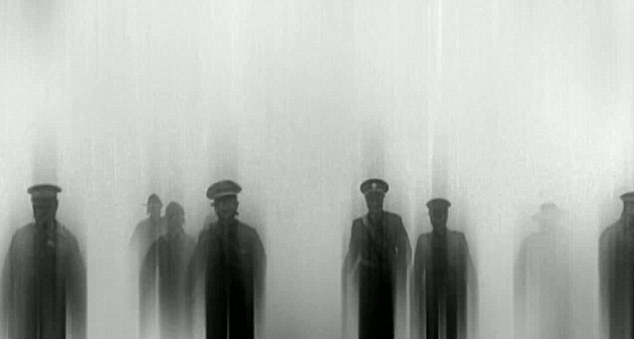
sodiers in mist

Today is Veterans Day and I would like us to practice Visio Divina using the above pictures by David Bowie of the United Kingdom of Soldiers in the mist that touched me deeply.  Take a few moments to study the picture, breathing deeply and begin your Divine Reading. Think of Visio Divina like this–putting on God-glasses to see how an image illuminates Christ for you.

  1. Study the picture slowly, taking a first glance noting the colors or lack of color, people, places and things.  Remain with the image for one to two minutes. If you would like, jot down a few words about the image.
  2. Take a second, deeper, look. Where is there movement? What relationships do you see? Engage your imagination. Where are you in the artwork? What do you see from that perspective? What deeper meaning emerges?
  3.  Respond to the image with prayer. Did the image remind you of an experience, person or issue for which you’d like to offer thanksgiving or intercession? Offer that prayer to God.
  4. Find your quiet center. Breathe deeply. Relax your shoulders, arms and legs. Rest in this quiet. Let God pray in you. God prays beyond words.

I offer the poem below as a testament to what I “heard and saw” within the photo and my heart; and as an offering to all who have served, fought, and died in conflicts across time and the globe.  Peace be unto all

a prayer

They walk
into the smoke
filled
mist

The wounded,
the dead,
the lost,
walking to their destiny

They fought
they gave their all
for love
of wife and child
of Parent and sibling

The mist is filled with voices
well done,
thank you,
I love you
I miss you

Each voice a prayer
to send them on their way
to let them know
they are not forgotten
they are loved
that all is OK
despite they suffering
despite their sacrifice

Poppy’s held
music plays
hearts send love
no you are not forgotten
you are always with us
in our hearts
in our souls
in the lives you died to protect
go to your rest
knowing we are
grateful for
the love you gave
the life you gave

We who remain
are blessed by
You who walk
yesterday, today and tomorrow
it is not good-by
it is only until we meet again

Ruth Jewell, ©November 11, 2014

Visio Divina – Life’s Entrances – Prayerful Tuesday

Entryway to . . .
Entryway to . . .

God has many ways to speak to us, through relationships, our experience, what we read and in the images we see every day.  Visio Divina, Latin for divine seeing, is praying with an image and listening for what God may say to us through that image.

  1. The above image is an entry, a rather nice entry but just an entrance to some place. Spend 2 or 3 minutes just gazing at the image. Does the picture raise any memories, good or bad? Does it look familiar to someplace you’ve been? Would you like to walk down this hallway? Jot down any words that come to you.
  2. Look deeper into the image is there movement, or do you see artwork? From this perspective where might you believe this entryway leads?  What lies at the end of the hallway? Who might you meet? Who would you like to see as you round the corner?
  3. Respond to the image in prayer. Does the image remind you of an experience, person or issue for which you like to offer a prayer of thanksgiving or intercession?  Is there someone who needs your forgiveness, or you need there’s waiting for you? Offer a silent prayer offering your sorrow, or giving your forgiveness.  Let God carry your hearts message.
  4. Sit quietly and find your quiet center. Breathe deeply; relax your shoulders, arms and legs.  Rest in this still moment and let God pray in you; remember God prays beyond words, in sighs and warming of the heart.

As you return to the present, let the prayers go with you throughout your day.

Peace and Blessings

Ruth Jewell, ©November 4, 2014

The Spiritual Gift of Slowing Down – Prayerful Tuesday

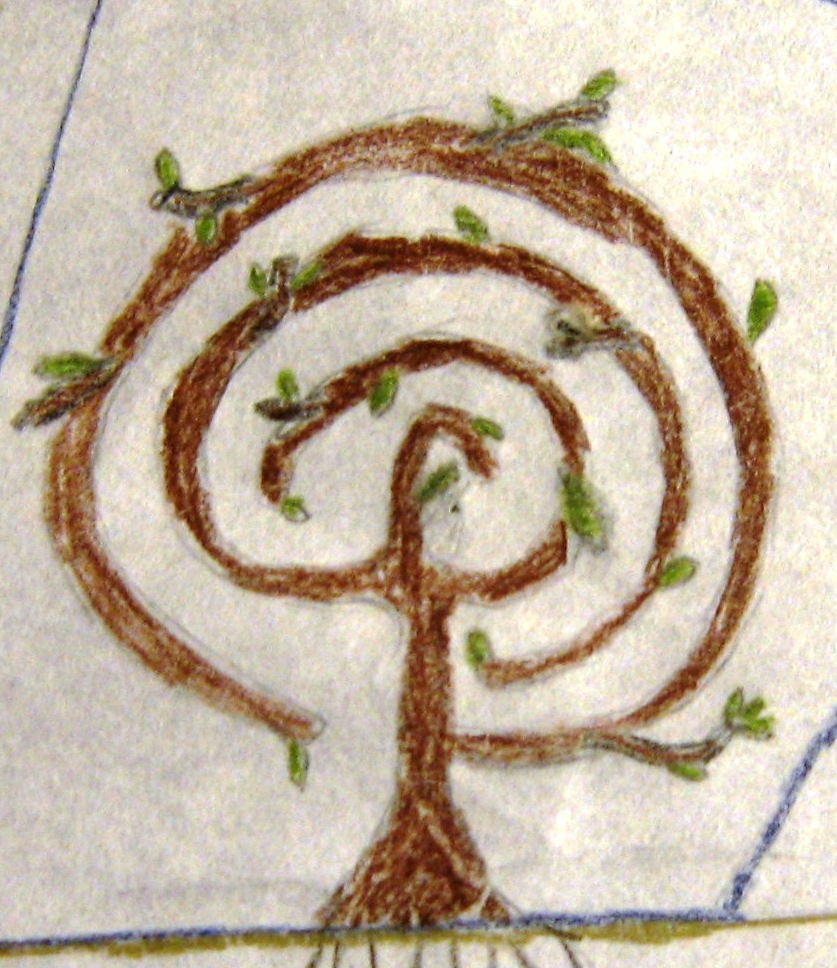
tree of life labyrinth


Last Friday I had foot surgery to correct arthritis damage to two toes.  I have had day surgeries before and in general they go well, just as this one did. But as I waited to be taken in to surgery I began to think of the consequences of my doing this. The benefits are easy to name, the primary ones are, being able to wear my shoes comfortably again and being able to walk without pain in my feet.  But there are also consequences and benefits I hadn’t considered.

For example, I wasn’t going to make an InterPlay group on Saturday that I really wanted to attend, and I wouldn’t be able to make it to church on Sunday.  In fact not until next Thursday will I be able to leave the house.

In addition to being stuck in the house my foot hurts, a lot, and because I can’t take the more popular pain killers, I have a pain medicine that, while it works well, has some drawbacks like extreme dizziness and fatigue. However, I have begun to see some real benefits, other than walking, that I hadn’t taken into consideration.

First of all I have to slow down, something I don’t often do, and think if what I want to do is really important and necessary.  I have been surprised at how much I do during the day that really is busy work. Simply letting go of those fussy details has been a great relief and I think I am going to continue with that. The things I am able to do right now have real importance, mean something to me, and are getting done better and with less effort.

I also have to say “no” to extra tasks when I am asked for “help.” Setting of boundaries has always been complicated for me.  I never want to “offend” anyone and so often take on tasks that I know I don’t have the time to do nor the energy and strength to do them. Saying no is one of the hardest things I am trying to learn.  I overextend myself all the time all because I can’t set boundaries and tell someone “no, not today.”

There are benefits of saying no such as more the time for meditation, and pausing to take the time for myself.  I don’t mean a short meditation I mean sitting down, which is all I can do anyway right now, for a couple of hours and meditating over a passage of scripture, or something I’ve just read.  Instead of worrying about what I can’t do I have been rediscovering the joy of what I can do in the moment, the return of silence and quiet peace.  Holding Suzie, my Chihuahua, in my lap I have been reconnecting with the Divine in art, literature and music and letting all of it wash over me and renew me.

I have also relearned the joy of receiving the generosity from others.  From hospital staff, to friends, to family, especially my beloved husband John, I have been graced with an amazing amount of love and care. These lovely people have helped me slow down and have given me the space to be right here, right now without feeling guilty.

I am grateful that I am not seriously handicapped or so ill I am unable to learn from this slow time. I am learning to accept with joy the gifts others give me and not feel embarrassed or feel I don’t deserve such grace. I know at some point I will grow impatient with being unable to do exactly what I want, but right now I am grateful for this time of rest and recovery.

Now I know I am not the only one out there who has difficulty in accepting gifts. Therefore, I offer this spiritual practice of saying “thank you” for the gifts you receive this week.  Simply say thank you, don’t elaborate, just accept.  Allow someone to do something for you, or do something for someone else and receive their gratitude with grace.  Recognize the joy of being in the moment and offer a thank you.  Offer your gratitude to the Holy for this time, this place, the people, creation that is the now.  Let the gifts of others to you renew your spirit and let the grace shine out from your heart to those around you.

May your week be filled with joy of gifts unforeseen, and may they bring you peace.

Ruth Jewell, ©October, 28, 2014

Pray Everywhere, Anytime

Prayer, A Light In The Darkness

16Rejoice always, 17pray without ceasing, 18give thanks in all circumstances; for this is the will of God in Christ Jesus for you. –                                  1 Thessalonians 5:16-18, (NRSV)

To pray always, without ceasing, seems like an impossible task.  Seeing God in every thing, every action we do, every moment of our lives opens doors of our hearts, and the Spirit of God moves in.  We don’t become Pollyanna’s seeing only the good in people.  We see the suffering and trials of those around us and in seeing God in their faces we open our hearts and let God’s compassion move us to be the arms and legs, the body, of the Holy Spirit.  We are motivated to give the solace, love, support to those who are in need just as Jesus did on the streets and fields of Judea.

The suffering of our communities, nation and world overwhelms, frightens us and as the troubles increase exponentially we ask does prayer really do any good. Offering a prayer for someone walking in the dark places of life, does let them know they aren’t alone, that someone, somewhere is keeping them in their hearts.  But even more important is the prayer that motivates us to be the Christ on the street, to offer food, and help find shelter.  To care for the sick and injured in even small ways that often are not seen in the mad rush to send massive aid.  In fact many times it is the small things we do that mean the most to the recipients.  Each act is an act of prayer, it is an offering, it is remembering to feed the hungry, care for the sick, visit the incarcerated, and give mercy to the stranger, which all God and Jesus asked us to do.

What does prayer do for us who offer the prayers, perform the actions of prayer?  Well prayer draws us r into the arms of God.  Prayer opens our hearts to the love God and our ears to the words of God calling us to be the Beings we are meant to be.  Below is a lovely video by Lisa Maria Cameron (www.whisperingstars.com ©2007)

As you listen to song and watch the pictures pass before you.  Let your hearts turn to prayer, where ever you are, you don’t even have stop what you are doing and offer a prayer for what lies closest in heart.  Listen; listen carefully in a moment of silence, and throughout your day, for words of encouragement from God.  Look into the faces of each person you meet and see the face of God.  Each of you, all of you, no matter what you do, or have done, is beloved by God.  Let your eyes be opened to love that shines in the eyes of each other, and ears be opened to the voice of God in the voice of the next person you meet.

May the peace of God be with you, now and forever more.

Ruth Jewell, ©October 20, 2014