The Good Samaritan – Prayerful Tuesday


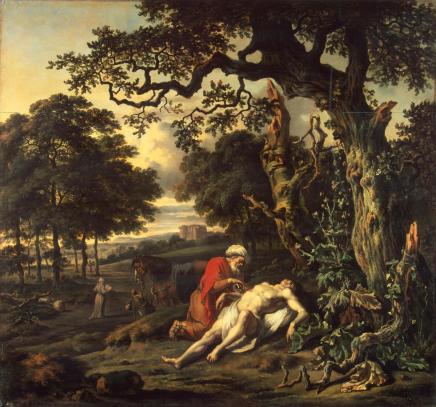
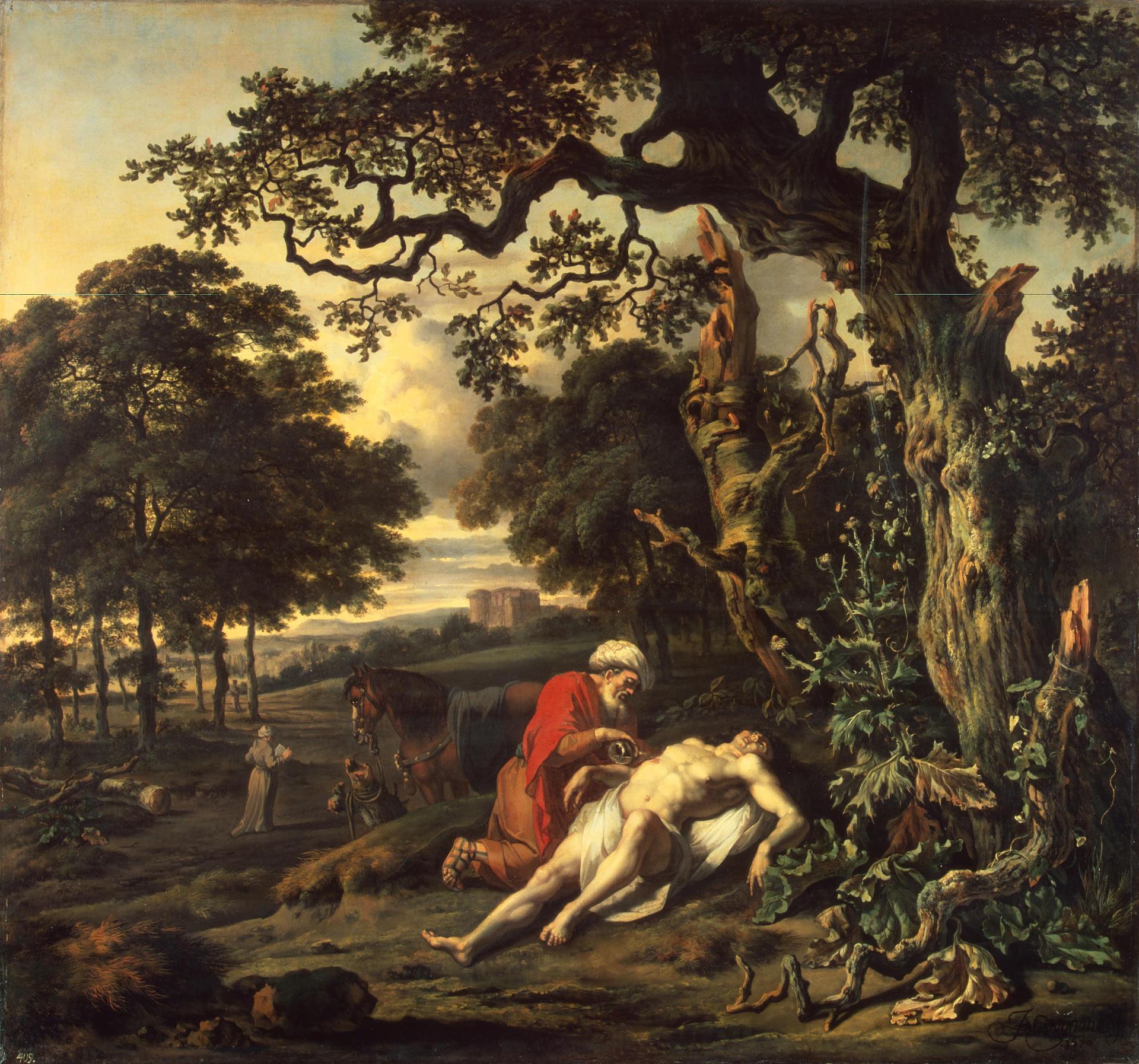
Jan Wijnants, Parable of the Good Samaritan, 1670
              Jan Wijnants, Parable of the Good Samaritan, 1670

Luke 10:33-35 “A Samaritan traveling the road came on him. When he saw the man’s condition, his heart went out to him. He gave him first aid, disinfecting and bandaging his wounds. Then he lifted him onto his donkey, led him to an inn, and made him comfortable. In the morning he took out two silver coins and gave them to the innkeeper, saying, ‘Take good care of him. If it costs any more, put it on my bill—I’ll pay you on my way back.’ The Message)

I have watched the news media’s reports on desperate flights of Syrian’s and Iraqi’s to Europe with a breaking heart.  I have donated funds to the Week of Compassion for their relief drive but it hasn’t helped the pain in my chest.  This morning’s meditation scripture was the Good Samaritan and it seeded so appropriate for me right now as I am trying to discern what else I can do for people half the world away.  So today my prayer practice for you is to sit down with this painting and this scripture and let God speak to you maybe together we can find our way on this difficult road.

Directions for Lectio Divina

  • Place yourself in a comfortable position and allow yourself to become silent. Focus for a few moments on their breathing; or use a “prayer word” or “prayer phrase” you gently recite to gradually center your thoughts. Use whatever method is best for you and allow yourself to enjoy silence for a few moments.
  • Turn to the text and read it slowly, gently. Savor each portion of the reading, constantly listening for the “still, small voice” of a word or phrase that somehow says, “I am for you today.” Do not expect lightning or ecstasies. In Lectio Divina, God is teaching us to listen to him, to seek him in silence. He does not reach out and grab us; rather, he gently invites us ever more deeply into his presence.
  • Take the word or phrase into you center. Hold it in your thoughts and slowly repeat it to yourself, allowing it to interact with your inner world of concerns, memories, and ideas. Do not be afraid of distractions. Memories or thoughts are simply parts of yourself that, Allow this inner pondering, this rumination, to invite you into dialogue with God.
  • Speak to God. Whether you use words, ideas, or images–or all three–is not important. Interact with God as you would with one who you know loves and accepts you. And give to him what you have discovered during your experience of meditation. Experience God by using the word or phrase he has given you as a means of blessing and of transforming the ideas and memories that your reflection on his word has awakened. Give to God what you have found within your heart.
  • Rest in God’s embrace. And when he invites you to return to your contemplation of his word or to your inner dialogue with him, do so. Learn to use words when words are helpful, and to let go of words when they no longer are necessary. Rejoice in the knowledge that God is with you in both words and silence, in spiritual activity and inner receptivity.

Sometimes in Lectio Divina, you may return several times to the printed text, either to savor the literary context of the word or phrase that God has given or to seek a new word or phrase to ponder. At other times, only a single word or phrase will fill the whole time set aside for Lectio Divina. It is not necessary to assess anxiously the quality of your Lectio Divina, as if you were “performing” or seeking some goal. Lectio Divina has no goal other than that of being in the presence of God by praying the Scriptures.

Directions for Visio Divina

  • Study the picture slowly, taking a first glance noting the colors, people, places and things.  Remain with the image for one to two minutes. If you would like, jot down a few words about the image.
  • Take a second, deeper, look. Where is there movement? What relationships do you see? Engage your imagination. Where are you in the artwork? What do you see from that perspective? What deeper meaning emerges?
  • Respond to the image with prayer. Did the image remind you of an experience, person or issue for which you’d like to offer thanksgiving or intercession? Offer your thoughts as prayer to God.
  • Find your quiet center. Breathe deeply. Relax your shoulders, arms and legs. Rest in this quiet. Let God pray in you. God prays beyond words.

May compassion fill our hearts and like the Good Samaritan care for our fellow travelers in the world.

Ruth Jewell, ©September 15, 2015


The Voice in the Wind – Prayerful Tuesday

“. . . a wind from God swept over the face of the waters.” Genesis 1:2b, NRSV

Photo, Ruth Jewell, 2014

I am sure all of you noticed we had a big windstorm 2 weeks ago.  John and I lost our power on Saturday just before noon and didn’t get it back until after 3 pm on Sunday.  For those of us in Edmonds that was a really long time.  Normally our power losses are quite short due to the presence of the Hospital and the transit center so close to us, but not this time.  What has been most frustrating for John and me is the lost of our internet, which we still don’t have, because we both have things to do.  While I gladly gave up internet access when we were on Holiday in the spring I was not quite so happy without this time.  I have things to do such as writing for my blogs, ordering pet food, doing activities for the committees I am on, you know the daily little things that we don’t normally think about but just do.  However, we have finally been reconnected to the rest of the electronic  world and so I am back at writing.

However, despite my irritation with the loss of technology, I have been thinking about the wind how strong it was, how persistent, and how loud.  Wind, spirit, ruach, the Breath of G-d made me listen whether I wanted to or not.  G-d made me stop and listen.  I slowed down, and I listened to God speak. I heard tears in the wind for those whose lives were lost, in the storm, in the wild fires, in world conflict, and in the madness we call a gun culture. I heard laughter for those who thought technology was everything and, like John and I were, ‘forced’ to read by oil lamp or candle light.

Sometimes we need to stop and listen to the wind.  Sometimes we need to slow down.  Two lives were lost in that storm and we need to stop and offer a prayer.  But for the rest of us our lives will go on with few changes to our daily routine. Saturday was an interruption nothing more unless we choose to learn from slowing down.  Walk outside, or open a door or window, listen to the wind, take in the breath of G-d, listen for the sound of tears and laughter.\

May you feel the breath of G-d as it kisses your cheek, may your hear the still small voice in the gentle breeze, and in your moment of stillness may you know the presence of G-d.

Ruth Jewell, ©September 9, 2015

Prayers, Wildfires in Washington and Oregon – Prayerful Tuesday

Even though I walk through the darkest valley,
I fear no evil; for you are with me; your rod and your staff— they comfort me.
Psalm 23:4

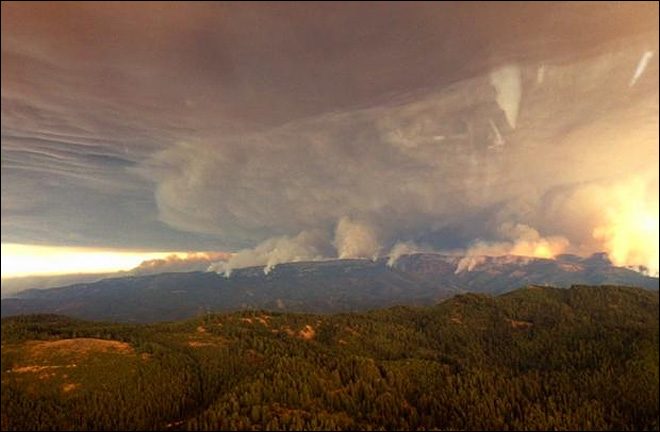
Table Mountain, Smoke Plume, KOMO TV
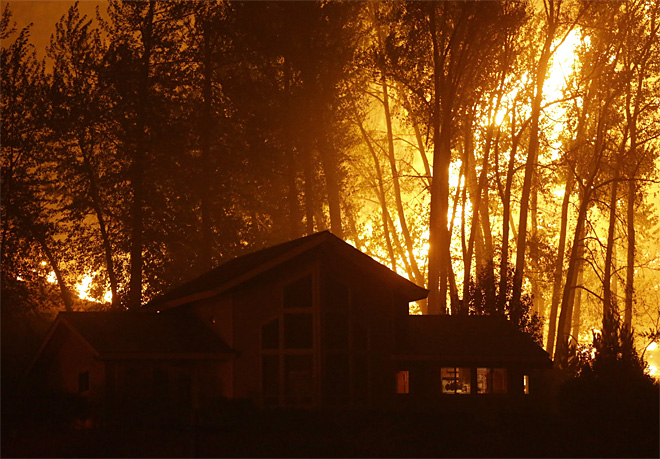
A wildfire burns behind a home on Twisp River Road, Thursday, Aug. 20, 2015 in Twisp, Wash. Authorities on Wednesday afternoon urged people in the north-central Washington town to evacuate because of a fast-moving wildfire. (AP Photo/Ted S. Warren)
A wildfire burns behind a home on Twisp River Road, Thursday, Aug. 20, 2015  (AP Photo/Ted S. Warren)
Hotshot Firefighters Pausing to Honor Fallen Firefighters Okanagan Co. WA ABC TV, August 19, 2015
Hotshot Firefighters Pausing to Honor
Fallen Firefighters, Okanagan Co. WA
ABC TV, August 19, 2015

Today I am asking you to offer prayers for those in the fire zones in Washington and Oregon and for the families and friends of the three firefighters who lost their lives in a fire storm August 19, 2015.  These men and women turn and run into the fire to protect, our homes, our loved ones, and the forests and animals that live there.  To them we owe our gratitude and prayers.

So today I ask you to offer a prayer for our all our fire fighters many who come from across the country and the globe to help protect our homes and planet, May the Holy Spirit keep them safe. Offer prayers of comfort for those who live in the fire zone and have lost their homes to the flames.  Offer a prayer for the environment and the creatures who live there. And finally pray for rain, soaking rain, without lightening, to give our land rest.

Ruth Jewell, ©August 25, 2015

Stand up and say NO MORE – Prayerful Tuesday

We are all Homo Sapiens sapiens but we will never be Human Beings until we stop just surviving and begin to live in harmony with each other and all creation.  

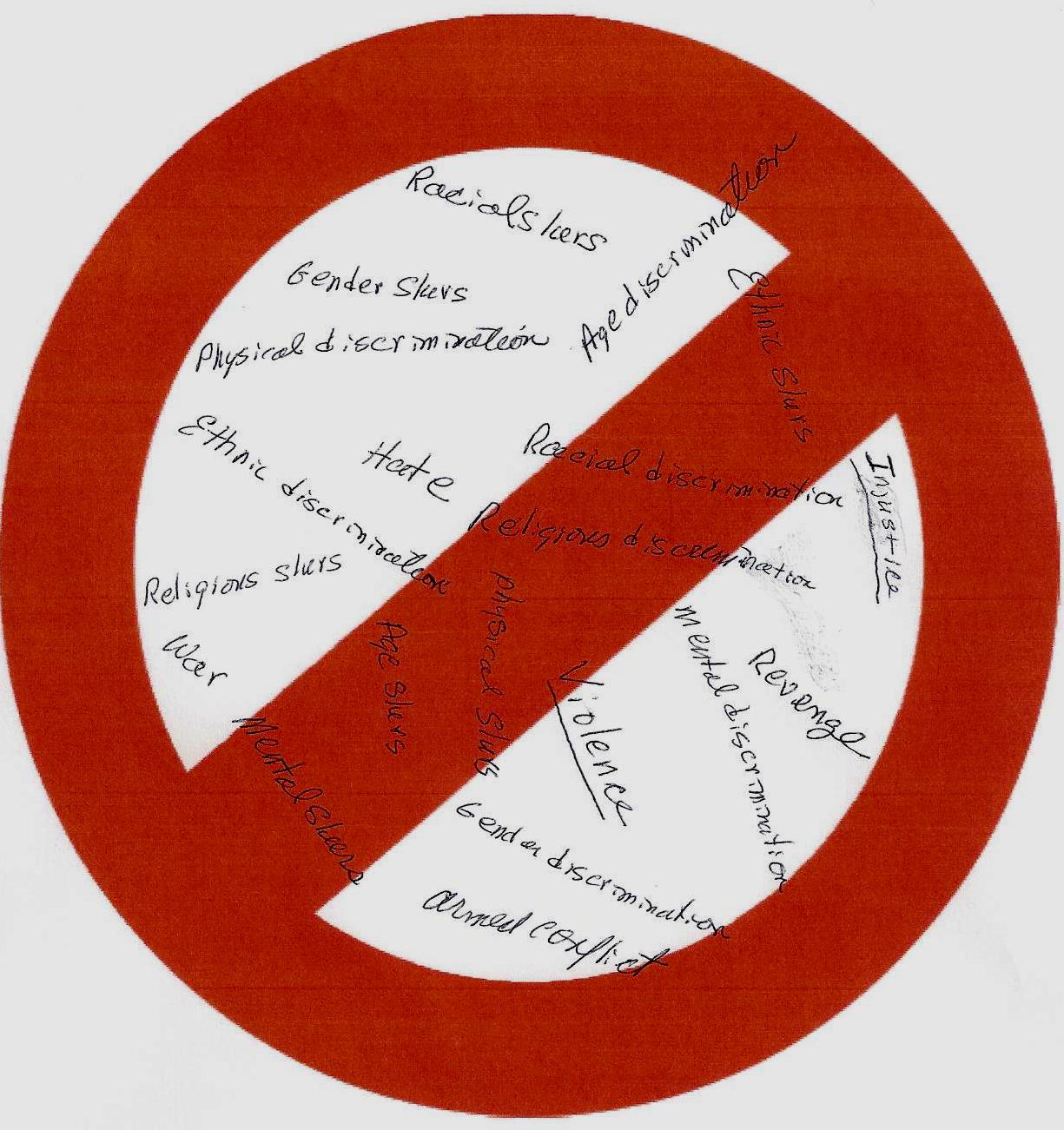
NO MORE
NO MORE

I have been trying to comprehend the shootings in South Carolina at the First Emanuel AME Church.  Just as the acts in other mass shootings I simply can’t get my mind around a hatred that produces such evil.  I have listened to the prayers for comfort and supplication.  I have listened, unwillingly, to the NRA and other public speakers who blame the church pastor and members, or minimize the acts of the shooter.  I can’t, or won’t, believe that 9 innocent people were the cause nor can I believe the shooter acted without encouragement.

You see, I believe we, you and I,  are to blame for what happened in South Carolina.  You and I, and everyone else regardless of skin color, privilege, ethnicity, or any other cultural classification are equally responsible for pulling the trigger and this is why I believe this.

We refuse to stand against acts of injustice, violence, discrimination, or the use of degrading speech.  We listen politely and shake our heads and tell ourselves that offering a prayer that people will change is enough.  We are afraid of what others might say about us if we stop someone in mid speech and tell them NO, I will not listen to this.  We look the other way when someone abuses another.  We tolerate public servants who degrade people of color, are poor, elderly, or have a religion they don’t follow.  We have tolerated public servants who have spoken as if they are the only ones who matter, who have verbally abused our President and anyone else they disagree with or disagree with them.

We have created this atmosphere of hate and violence found in country today.  Yes, I admit I am right there along with the rest of us.  Have I stood up and defended someone being abused, sometimes yes but not always.  I do it when it is convenient for me and that is not what we are called to do.  We, you and I, are called by the Divine to be better than that.

This week I am recommending a spiritual practice of standing up and defending the voiceless.  I am asking each of you to speak up when you hear someone abusing or degrading someone else.  I am pleading with each of you to stand and be counted when you see injustice happening.  As you go through this week remember this:

8 But he’s already made it plain how to live, what to do,
    what God is looking for in men and women.
It’s quite simple: Do what is fair and just to your neighbor,
    be compassionate and loyal in your love,
And don’t take yourself too seriously—
    take God seriously.” Micah 6:8 The Message (MSG)

Ruth Jewell, ©June 23, 2015

on being human—Prayerful Tuesday

Nursing an Ebola Victim Picture by Dr. Rudyard, Health Pictures
Nursing an Ebola Victim
Picture by Dr. Rudyard, Health Pictures

Matthew 25: 36 “I was naked and you gave me clothing, I was sick and you took care of me, I was in prison and you visited me.”

One of the books I read while I was on my sabbatical was Fields of Blood, Religion and the History of Violence by Karen Armstrong.[1]  As always I was impressed with her writing and level of scholarship but more than that in this book Ms Armstrong lays out the reasons for our love of violence and power.

Right at the beginning she identifies one of the factors in our continuing struggle between living in a harmonious world or living in a power driven world, the construction of our brains.  We have 3 brains, the old brain or reptilian brain is responsible for our fight or flight actions. It drives us to defend our territory for food and other resources, it is the self-centered part of the brain, most concerned with keep ourselves safe; the mammalian limbic system, which formed over the core of the reptilian brain is our second brain. It is responsible for new behaviors such as care of our young and the formation of allies with others; and the new brain, the third brain, the neocortex, is responsible for our “reasoning and self awareness that enables us to stand back from the instinctive, primitive passions.” (pg 4-5)

Ms. Armstrong proposes that the reptilian brain and limbic system are dominant within power systems that manipulate and control others.  The limbic system extended the actions of the reptilian brain to include family or a community unity but, still, this drive for power and control of others for territory and resources requires violence.  It wasn’t until about 20,000 years ago when the neocortex evolved did the idea of standing back and evaluating actions was there any question about the use of violence. Humanity really didn’t have a chance of becoming a reality until after the evolution of the neocortex and we have yet to learn how to  use the “new brain” to begin to evolve into who we are meant to be.  By this I mean most of us haven’t learned to overcome the impulses of the reptilian brain and limbic system and use our neocortex to evaluate our surroundings or our actions.  In general we humans are “subject to conflicting impulses of [our] three distinct brains.” (pg. 5)

Fortunately there is hope for us all.  A few of us are developing our neocortex’s and discovering what it means to be truly human.  I was listening to NPR this past Sunday morning when a story about Dr. Kent Brantly was broadcast. Dr. Brantly was one of the American Doctors who contracted Ebola last year and survived.  He was asked to deliver the graduating speech to the 2015 graduating class of the Indiana University School of Medicine.  What he says about compassion is important for all of us to hear (italics are mine):

“In the first seven weeks of treating patients with Ebola, we had only one survivor; one survivor and nearly 20 deaths. Losing so many patients certainly was difficult. But it didn’t make me feel like a failure as a physician because I had learned that there’s a lot more to being a physician than curing illness. In fact, that isn’t even the most important thing we do. The most important thing we do is to enter into the suffering of others. And in the midst of what was becoming the worst Ebola epidemic in history, we were showing compassion to people during the most desperate and trying times of their lives. Through the protection of Tyvek suits and two pairs of gloves, we were able to hold the hands of people as they died to offer dignity in the face of humiliating circumstances, to treat with respect the dying and the dead. And in my opinion, that made those weeks, those difficult weeks of my career a success.”[2]

Compassion isn’t offering help, it is being with the suffering of others, it is living the suffering, walking together down a road you may or may not know where it leads.  That is what Jesus did.  He entered into the suffering of others, he walk the road to where ever they were headed, that is one, maybe the first, step to becoming human.  Dr. Brantly has taken a step on a road most of us are afraid to even look at let along step onto.  The Prophet Micah tells us “He has told you, O mortal, what is good and what does the Lord require of you but to do justice and to love mercy and to walk humbly with your God?” (Micah 6:8). To do justice, to love mercy, to walk humbly with God, sounds easy does it not?  Ask Dr. Brantly how easy it was for him and he will tell you it is the hardest road you will ever walk, but if we wish to be the humans God has always wanted us to be it is a road we must walk.

This week my spiritual practice is more of a spiritual way of life.  I would like to invite you on a journey with me to become the “human” God wants us all to be.  To look at our actions by taking a step back and asking ourselves the following questions (I am sure there are more than these and please let me know what you would ask):

  1. Does this action support justice or impede justice?
  2. Is this action a loving act?
  3. Does that action move me closer to God or does it separate me from God?

Simple questions, but, sometimes hard to answer.  Our lives are filled with gray areas and we will need to determine how those gray, in between, spaces fit into our lives and either nurture or kill the life we want with God. This is not an easy practice or an easy way to live but I believe, at least for myself, a profitable one.  I know I will stumble and so will you.  That’s OK, just pick yourself up and start over again.  Failure is a lesson in how not to do something.  Loving life as God meant it to be was and is never easy.  Just remember you are not alone.

Ruth Jewell ©May 19, 2015

[1] Armstrong, Karen’ Fields of Blood, Religion and the History of Violence, The Bodley Head, London, UK, 2014.

[2] National Public Radio: Rachel Martin interview Dr. Kent Brantly, May 17, 2015, All Things Considered Sunday Edition.

The Angel’s Voices

Mt. Baker, WA, from Artist Point, Photo by Ruth Jewell, 14.09.15
Mt. Baker, WA, from Artist Point,
Photo by Ruth Jewell, 14.09.15

Prepared for a Sermon at Queen Anne Christian Church, Seattle WA
January 18th, 2015

Scripture: Psalm 139:1-6, 13-18

Have you ever had that feeling you are being watched and you turn around and around to see who is there?   I have and I must admit it often feels creepy!  Someone is watching me, why, who are they, what do they want, will they hurt me?  Some might say these are the questions of a paranoid mind, but, given the status of our world today, not uncommon in these days of uncertainty, fear, and, let’s be honest, at least a little hate, ok a lot of hate.

So when I read the Psalm for this week I had to really think what it means to be “watched,” “known,” by God.  This Psalm is telling me that I am being watched, by God no less.  Is that a good thing or should I be afraid, really afraid.  As I was contemplating these verses I remembered an incident out of my childhood.  It was a memory of being known by God and knowing it was keeping me safe.

Nearly 62 years ago I was severely burnt and spent 6 months in hospital healing and having reconstructive surgery.   In reality I am blessed to be here, because I should have died that summer, but didn’t.  However, I did spend a great deal of time on a children’s ward of a Cleveland Hospital.  There were number of other children there as well, just as injured and ill as me and one little boy and I became good friends.  I do not remember his name; I do remember he was dying.   He was a little older than I was but could not walk; I could get up and walk a little but couldn’t read as well as he could.  I would get books and games to play with and he would read the harder books.

Children will often tell another child something important when they aren’t sure their parents would understand or listen.  So one day he told me that he knew he didn’t have long to live and he wanted me to tell his parents he was ok with it.  You see he had a guardian angel who stayed by his side and the angel had told him he would be going soon and no longer in pain, his parents would be sad for awhile but they would remember him forever.

One night I awoke to a great deal of crying and saw the mother holding the little boy.  I remembered what he had asked me to do so I crawled out of my bed and tried to tell them that the boy was OK, and that he was with his angel now.  However, before I got very far with that a nurse scooped me up and put me back in my bed saying something patronizing.  I never really talked about that incident again; I understood what I had to say was pretty unimportant to adults and not worth listening to. It was the thought of the time that children didn’t understand death or God and it was, and is, a wrong thought.

Being known by God, being watched by God, children understand that, after all they are always being watched.  By parents, teachers, friends, family members who want to keep them safe.  So knowing God is watching them is no big deal, just one more person on the list to keep them safe.  Besides isn’t there something comforting knowing you have a guardian angel nearby, how cool is that.

From the time they are formed in the dark, cavern of their mother’s womb they are cradled and whispered to by angels.  By 18 weeks of pregnancy the embryo begins to hear his first sounds, Mom’s heart beat, the movement of her blood, and bowel sounds.  He also hears His Mom’s and Dad’s voice, music, laughter, and tears.  To him it’s, Angels voices coming from, everywhere.  Children know they are being watched, searched out as they are being formed in the dark.

After birth we are still connected to those angels, only now they have blurry faces, but they can see the angels smile at them and hear their whispers and while breast feeding they still hear the comforting sound of Mom’s heartbeat.

It is a sad fact that as we grow we forget those connections to the mystery of our beginnings.  We let other sounds carry us away from the angel’s voices, the whispers that we are beloved and we are watched over. We, who were made so carefully, struggle to be free of the binders, free of being hemmed in from behind and before. We, who in secret were made so wonderfully and woven of star dust and love, want to run free of the restrictions of God, angels, or anyone else.

Yet there is a part of us that yearns to be known.  Oh we may fight it, rebel and run away because we want to “do it our way.”  But really, at some level, isn’t it comforting to know just how beloved we are?  The Psalmist said “My days are all inscribed in Your Ledger; Days not yet shaped—each one of them is counted.”[1] Those counted days are from the moment we are conceived in flesh to the moment we let go of this body and return to God.  Yes we still have days that God has counted that we know nothing about, yet.  But God is still watching and still planning, or more likely, revising our life plan based on our latest actions.

You see I’ve never been a big proponent of predestination, were God has planned our lives out before we are born.  No I am a firm believer in free will and our obligation to choose life over death.  We, you and I, must choose to follow one path over another and depending on our choices our life is rewritten again and again.  I know that because I have had my life rewritten all because I’ve made some rather dumb choices in my life.  My guess is we all have, because we are human, we are embodied; we are separated from that light of God and God deliberately put us on our own resources for a purpose we do not know.  (My first question for God when I return is “what were you thinking.”)

What the Psalmist tells us is even in our bad choices we are watched, cared for, beloved, held safe, and not alone.  God keeps us in God’s thoughts; we are never far from the Divine mind.  “How weighty to me are your thoughts, O God! How vast is the sum of them! I try to count them—they are more than the sand; I come to the end—I am still with you.”  “I am still with You,” God is with me.  Matthew writes that Jesus’ last words to his disciples were, “And remember, I am with you always, to the end of the age.”  We have that promise.  God has not left us alone, Jesus has not left us alone, the angels are still whispering, if, only we listen.

Rabbi Schachter-Shalomi translated verse 14 as follows, “I am overcome with thanks at Your awesome wonders, Your astonishing works, of which my soul is aware.”  Our souls know what God does, what Jesus does, even when we are unconscious to those actions.  Our souls know even when we reject God’s call that we are not alone.  That we are watched over and having our lives rewritten again and again based on whether we chose life or death.

Those angel whispers, messages of comfort from the Holy, still hold for each and every one of us.   That first sound we heard in our mothers’ wombs, the first whisper of life from the sacred, was a heartbeat.  It still is the whisper of life for all of us.  Without our hearts beating strong and level life will fade.  But it is not just the heart of our flesh that we need.  We also need the voice of the heart of our souls, our spirit, to truly live life as God intended.  Remember Moses’ last words “choose life.”  The messengers of God, the angels voices all whisper, “choose life.”

Ruth Jewell, ©January 17, 2015

[1] Schachter-Shalomi, Rabbi Zalman, Psalms in a translation for praying, Alliance for Jewish Renewal, Philadelphia, PA, 2014.

It is Good?—Prayerful Tuesday

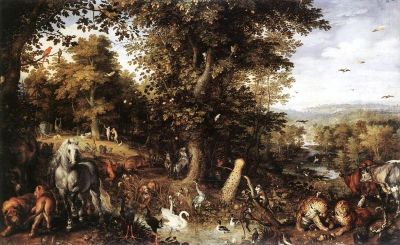
Garden of Eden, Jan Brueghel, 1612

“And God saw that it was good.” Genesis 1:10b

In the last weeks God’s creation has seemed anything but good.  Terrorist attacks, ambushing of police, and police shootings of unarmed young men continue to rent the very fabric of our society.  Yet God did not create an evil world, in fact God proclaims this world a good world where everyone, and I mean everyone, has what they need to live and be the person they are meant to be.  It is our choice’s, not God’s, that have created a world that is unsafe.

Spending time in silent contemplation with a focus on what we could have been, and still could be, seemed the only way for me to center myself and see the world as good.  So today I offer as our prayer of the week another Visio Divina using the above painting of the Garden of Eden by Jan Brueghel.

Prayer Practice:

1. Study the picture slowly, taking a first glance noting the colors, the placement of the plants, animals and, people.  Remain with the image for one to two minutes. If you would like, jot down a few words about the image.

  1. Take a second, deeper, look. Where is there movement? What relationships do you see? Engage your imagination. Where are you in the artwork? What do you see from that perspective? What deeper meaning emerges? What feelings about the world rise in you? Are there any images that you are particularly drawn too?
  2.  Respond to the image with prayer for the world. Did the image remind you of an experience, person or issue for which you’d like to offer thanksgiving or intercession? Offer that prayer to God.
  3. Find your quiet center. Breathe deeply. Relax your shoulders, arms and legs. Rest in this quiet. Let God pray in you. God prays beyond words.

Please do not let your belief, or non-belief, in the Garden of Eden and the subsequent fall from grace prevent you from seeing the good things in creation. Our world is in need of prayer right now.  All of our people, all of creation is crying and in pain.  Let your prayers go out into the world and let them lead you to be the person God has always wanted you to be.

Peace, Blessings

Ruth Jewell, ©January 13, 2015


My 2015 New Years Resolution – Prayerful Tuesday

Cape Cod, Ruth Jewell 2008
Cape Cod, Ruth Jewell
2008

I have been contemplating making a resolution this year.  My track record for keeping resolutions is poorer at best as I rarely make it past Jan 2nd but, maybe this year will be different. You see I am actually thinking about a resolution that fits my life style rather than dramatically changing it. Keeping expectations low can’t hurt this process.

My 2015 resolution is to deepen my prayer life.

I am going to accomplish in two steps.  First I am going to carry a small blank book with me at all times where I can record names of people I am asked to hold in prayer.  That way I won’t forget the name of the person needing prayer even if I don’t know them well or not at all.  I already set aside a portion of my meditation time for intercessory prayers but I often forget the names of those who have asked for prayer.  When that happens the best I can do is a general prayer that holds up everyone who is ill and suffering, while this is lovely and includes the individual it has lost the personal feeling for my prayer.

The second act is to begin practicing a new spiritual practice called “Dedicated Suffering”[1] presented by Jane Marie Thibault in her book Pilgrimage into the Last Third of Life, co-authored by Richard L. Morgan.  The purpose is to take the energy surrounding my suffering and asking Christ to ‘transform it into loving-kindness for the chosen person or group being held in prayer.

In the last few years I have had an increasing amount of physical pain in my life and a lot of my life energy is involved with minimizing that pain.  Ms Thibault developed a way to dedicate that energy to Jesus as a gift, then asking Jesus to change that gift into love for a person being held in prayer.

Since I have been doing this only a few days I can’t say I notice major any changes in my life but like all spiritual practices you have to do for a while before you see anything new.  That is why it is called ‘practice.’

As we grow older chronic pain and suffering increases and often limits what we can accomplish each day.  The practice of Dedicated Suffering offers a way to extend our prayers to others and puts the energy of our pain and suffering to good purpose. I offer the following instructions so you may try it for yourselves.  Maybe at the end of 2015 we can compare notes and see how gifting our energy to Christ to provide loving-kindness to those in need has changed our lives.

Dedicating Your Pain and Suffering to Help Others

  1. Find yourself a quiet corner where you may sit silence for a few minutes. Focus on your pain and the energy you are expending to minimize it.
  2. Offer your suffering energy to Jesus as a gift.
  3. Select a person or group in need of your prayers then ask Jesus to accept the energy of you suffering and change it into love for that person or group.
  4. Spend a minute or two imagining Jesus sending love and help to the person or group.
  5. End by offering Jesus a word of gratitude.[2]

While I haven’t been doing this practice for a long time yet I do find that I feel less encumbered by my chronic pain and have just a bit more energy to be the person I am meant to be.

Ruth Jewell, ©January 6, 2015


[1] Thibault, Jane Marie and Richard L. Morgan: Pilgrimage into the Last Third of Life, Upper Room Books Nashville TN, 2012, Pgs 112-115.

[2] Ibid. pg. 113

A Conversation with a Psalmist –Prayerful Tuesday

Come Lord Jesus, hear our prayer
Come Lord Jesus,
hear our prayer

As I am personally preparing for  Christmas I have been disturbed by the amount of violence and death around the world.  Peace on earth does not seem near. So as part of my morning ritual I have been doing Lectio Divina with the Psalms.  They have brought me some comfort but this Psalm struck a chord within me and I wanted to share that with you.  So this is a little different from most of my postings, as it is part of my journaling during my meditation. I am letting you in on a small part of my conversations I held with the Psalmist and God.  They are my insights of the moment, so if I say something you disagree with please be gentle, it is after all a private conversation you are overhearing.  At the end of my journaling you will find the steps for Lectio Divina.  For your own Lectio Divina meditation you may use the whole Psalm, as I did, or only a verse or two.

Psalm 10, The Message (MSG)

 1-2 God, are you avoiding me?
    Where are you when I need you?
Full of hot air, the wicked
    are hot on the trail of the poor.
Trip them up, tangle them up
    in their fine-tuned plots.

I am in the process of preparing for a Longest Night worship service and in reading this Psalm I was struck by how it matched my gut feelings this Advent.   Every day the news is filled with stories from around the world of someone killing someone one else, often many someone’s.  Just last night news came of a hostage situation in Sidney, Australia, just one more story to add to the Ferguson, New Town, Cleveland, Seattle, Portland, Houston, Afghanistan, and Iraq stories of the last number of years.  The list is too long, too many people have died, and too many children have died.  Like the Psalmist I am left wondering “where are you God.”

3-4 The wicked are windbags,
    the swindlers have foul breath.
The wicked snub God,
    their noses stuck high in the air.
Their graffiti are scrawled on the walls:
    “Catch us if you can!” “God is dead.”

This is supposed to be a time of joy and celebration but I do not feel like celebrating.  Our elected leader’s mouth words from the Bible I read every day, yet, their actions tell me they do not believe what they speak.  Are they wicked?  Are they windbags?  Well the wicked part can only be determined by God but the windbag part . . ..  Yes they are windbags, hoping that we who at least try to live a life of compassion will not notice their plans to take the last ounce of God’s abundance all for themselves.  They write bills and say “try and stop me, from denying the basic necessities to those who cannot help being poor, sick, elderly, or a child.

5-6 They care nothing for what you think;
    if you get in their way, they blow you off.
They live (they think) a charmed life:
    “We can’t go wrong. This is our lucky year!”

These insufferable, so called leaders lie and twist the truth until even the best of us are confused and dazed by the avalanche of untruths they let loose on the public. Whether they are religious fundamentalist, political leaders, in the United States, Afghanistan, Syria, Iraq, British Isles or anywhere they claim the spotlight and they believe no one can stop them.  They are on a role and the rest of us “be damned.”

7-8 They carry a mouthful of hexes,
    their tongues spit venom like adders.
They hide behind ordinary people,
    then pounce on their victims.

They mark the luckless,
    then wait like a hunter in a blind;
When the poor wretch wanders too close,
    they stab him in the back.

10-11 The hapless fool is kicked to the ground,
    the unlucky victim is brutally axed.
He thinks God has dumped him,
    he’s sure that God is indifferent to his plight.

The words they spit from their mouths cause fear in those who have minds that are weak and malleable. Letting these poor souls do the violence they pretend to abhor only to turn on them when they caught in their snares.

12-13 Time to get up, God—get moving.
The luckless think they’re Godforsaken.
They wonder why the wicked scorn God
and get away with it,
Why the wicked are so cocksure
they’ll never come up for audit.

We wait for you O God to respond, to let us know you haven’t forgotten us.  We wait and we wait.

14 But you know all about it—
    the contempt, the abuse.
I dare to believe that the luckless
    will get lucky someday in you.
You won’t let them down:
    orphans won’t be orphans forever.

The Psalmist sings of your knowledge of the violence we see every day.  But do you really hear the cries of the children who have lost limbs to bombs, to parents who have watched as their children are killed in front of them, as ISIS hangs those with different beliefs, as children shoot children?  Have we not sent enough children, parents, loved ones to you to serve as a sacrifice?  Do you care?

15-16 Break the wicked right arms,
    break all the evil left arms.
Search and destroy
    every sign of crime.
God’s grace and order wins;
    godlessness loses.

My heart wants to believe as the Psalmist did that you will intervene in the bloodletting of this world, but I know you will not.  It is not up to you, O God, to set this world back on the track of compassion, justice and peace.  That really is our job.  We are the ones who created these people who mock everything you have wanted for all.  We are the ones who must “gird up our loins” and speak out against injustice, violence, hatred, and war.  Only we who believe in justice, mercy, kindness, peace, compassion will change the lives of those who are oppressed, abused, injured, and starved by those who mock the world as you, O God, planned it.  We must stop cowering in our homes and our places of faith and become the prophets, the messengers, the hands, feet and voice that will bring down those who would enslave us to a life of poverty and misery.  Then, and only then, will the Psalmist’s dream come true.

17-18 The victim’s faint pulse picks up;
    the hearts of the hopeless pump red blood
    as you put your ear to their lips.
Orphans get parents,
    the homeless get homes.
The reign of terror is over,
    the rule of the gang lords is ended.

Gracious Spirit I thank you for this time of blessed meditation.  May the words and images I have seen transform my actions into walking with you in greater joy.  AMEN

Practicing Lectio Divina

  1. Choose the portion of the Scripture you wish to pray.
  2. Place yourself in a comfortable position and allow yourself to become silent, focus for a few moments on your breathing.
  3. Read the chosen text through, slowly and gently. Listen to yourself read, let yourself to savor each word and phrase.
  4. Read the text a second time. What words or phrases stick out for you? Remember God speaks to us in silence and in our listening. The words that pop out do so for a reason, pay attention to them.
  5. Read the text a third time. Are there any other words that speak to you?
  6. Sit now in silence, letting the words you have heard, speak to you and for you in your prayer, your conversation with God. What images, ideas, words spring forward?  Or maybe all of them are present in mediation.  Sit with those insights as you experience the presence of God.  Give your insights to God.  Do the insights give you new meaning or transformation of your actions, or prayer life?
  7. Now rest in God’s arms. Let God’s presence give you comfort. Do you feel the pull to return to your meditations? Then begin again. If not close with a prayer of gratitude for the time you have spent in God’s presence and the insights you have received.

Ruth Jewell, ©December 16, 2014

What would you do? – Prayerful Tuesday

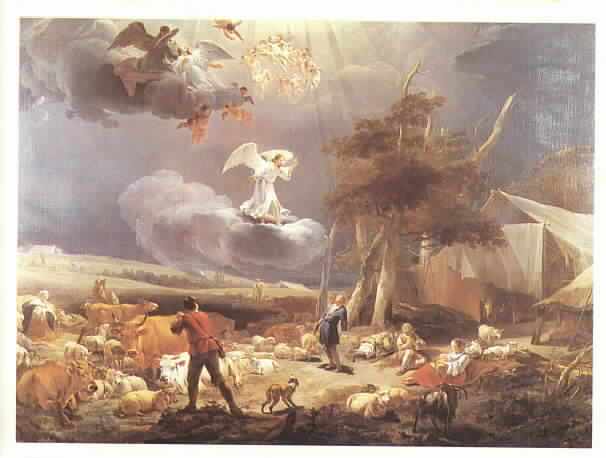
  13And suddenly there was with the angel
a multitude of the heavenly host,* praising God and saying,
14 ‘Glory to God in the highest heaven,
and on earth peace among those whom he favours!’*

Luke 2:13-14

Nicolaes Berchem, Annunciation to the Shepherds, 1656

God speaks to us in many ways–through relationships, our experiences, sacred texts such as the Bible and many more. Like Lectio Divina is Latin for divine reading, Visio Divina is Latin for divine seeing, praying with images to listen to God’s words. Think of Visio Divina as if you were putting on God-glasses to see how an image illuminates the Christ within you.  Like Lectio Divina, Latin for divine reading, Visio Divina has four steps: Use the  above painting by a Dutch artist Nicolaes Berchem painted around 1650, titled Annunciation to the Shepherds.

  1. Look slowly and carefully at the painting, taking a first glance noting the colors, people, places and things.  Remain with the image for one to two minutes. We are preparing for the celebration of the birth of the Christ Child, how does the paint help you prepare? If you would like, jot down a few words about the image in your journal.
  2. Now take deeper second look. Where is there movement? What relationships do you see? Engage your imagination. Place yourself in the painting; are you a shepherd, a sheep, or angel? What do you see from that perspective? What emotions rise up for you? If you were a sheep what might you feel? If you were a shepherd how would you respond to the message of the angels? What else do you feel, or see in the painting? If you would like jot down your thoughts and feelings in your journal
  3.  Respond to the image with prayer. Did the image remind you of an experience, person or issue for which you’d like to offer thanksgiving or intercession? Offer that prayer to God.
  4. Find your quiet center. Breathe deeply. Relax your shoulders, arms and legs. Rest in this quiet. Let God pray in you. God prays beyond words.

May the song of the angels be with you as you go about your preparations for Christmas.

Ruth Jewell, ©December 9, 2014