Psalm 19:1 The heavens are telling the glory of God:
and the firmament proclaims his handiwork.
Dawn, July 5, 2013, 5:45 AM
I was going through some of my video files this week a came across this one at dawn on July 5, 2013. I had forgotten how peaceful it can be in the morning. It has been a while since I’ve been up early to watch the dawn turn into sunrise and I realized how much I miss having that quite time for myself.
So today I give you a gift of a few minutes of peace from a day long past. May you find it as restful and enlightening as I did on that long ago morning.
Psalm 95:7 For he is our God, . . . O that today you would hearken to his voice!
In the last couple of weeks as I have been recuperating from back surgery I have listened to a fair amount of music. Music centers me and reduces the amount of pain I have which means I can take fewer pain meds and that means fewer side effects.
As I was listening one day to Barbers “Adigio for Strings” I realized I was practicing a form of Lectio Divina, I hadn’t noticed doing that before and since then have purposely practiced what I call Audientes (that’s Latin for hearing) Divina. I have discovered some interesting insights and, I must admit, a greater sense of being as I went deeper into the music, or rather the music went deeper into me.
So I don’t know if anyone else has ever practiced this before, or have thought about it like this, but I am offering what I have been doing as a gift of my recuperation. Below you will find a clip of Samuel Barber’s Adigio for Strings and the instructions for my practice. I usually listen to chants, or instrumental pieces but I am sure there are other genres that produce the same meditative moments. If you find this useful, since this is a new way to “Hear God” as a practice at least from this perspective, please, let me know what types of music you use to enter into the quite center. Who knows maybe I too will hear the still small voice in something I haven’t tried before.
Samuel Barber – Adagio for Strings, op.11. Uncut
Original broadcast from the Albert Hall in London September 15 2001.
Leonard Slatkin conducts the BBC Orchestra.
Instructions for Audientes Divina
With your eyes closed listen to the music and let the music wash over you, entering deeply into your consciousness; what images does the music bring up for you? Remain with the image for one to two minutes. If you would like, jot down a few words about the image.
Listen for a second time, with your eyes closed, as you listen let the music carry you deeper into your center. What in the music moves your closer to your inner center? What do you feel as you listen? Engage your imagination. Where are you in the music, or has it transported you to somewhere else? What do you see from that perspective? What deeper meaning emerges?
Respond to what you are feeling and your images with prayer. Did your experience of the music remind you of, a particular experience, person or issue for which you’d like to offer thanksgiving or intercession? Or, as you listened to the music did it offer a deeper understanding of being part of the universe, life itself. Offer your thoughts to the Divine as an offering of who you, where you are at this moment and as a blessing for the journey you will continue on.
Rest in your quiet center. Breathe deeply. Relax your shoulders, arms and legs. Let your body relax and set your mind free to hear what the God has to say to you words that have no sound.
May you hear the voice of the Divine in the music of life.
Stopping by Woods on a Snowy Evening By Robert Frost
Whose woods these are I think I know. His house is in the village though; He will not see me stopping here To watch his woods fill up with snow.
My little horse must think it queer To stop without a farmhouse near Between the woods and frozen lake The darkest evening of the year.
He gives his harness bells a shake To ask if there is some mistake. The only other sound’s the sweep Of easy wind and downy flake.
The woods are lovely, dark and deep, But I have promises to keep, And miles to go before I sleep, And miles to go before I sleep.
Yost Park, Edmonds WA March 1, 2007
You probably are thinking the heat has gotten to my brain, or maybe it’s the pain pills for my back pain. But, on one of the recent warm summer days I picked up a book of poetry and it opened up to one of my favorite poems by Robert Frost. So in all this heat we’ve been having here in the Northwest I thought this might make for a peaceful, cool meditation using either Lectio Divina with the poem or Visio Divina with the photograph, or do both.
Lectio Divina with Poetry, using poetry to hear God in the silence
Choose either a single verse or the whole poem portion you wish to focus your meditation on.
Place yourself in a comfortable position and allow yourself to become silent, focus for a few moments on your breathing.
Read the chosen text through, slowly and gently. Listen to yourself read, let yourself to savor each word and phrase.
Read the text a second time. What words or phrases stick out for you? Remember God speaks to us in silence and in our listening. The words that pop out do so for a reason, pay attention to them.
Read the text a third time. Are there any other words that speak to you?
Sit now in silence, letting the words you have heard, speak to you and for you in your prayer, your conversation with God. What images, ideas, words spring forward? Or maybe all of them are present in mediation. Sit with those insights as you experience the presence of God. Give your insights to God. Do the insights give you new meaning or transformation of your actions, or prayer life?
Now rest in God’s arms. Let God’s presence give you comfort. Do you feel the pull to return to your meditations? Then begin again. If not close with a prayer of gratitude for the time you have spent in God’s presence and the insights you have received.
Visio Divina with a Photograph
Study the picture slowly, taking a first glance noting the colors, people, places and things. Remain with the image for one to two minutes. If you would like, jot down a few words about the image.
Take a second, deeper, look. Where is there movement? What relationships do you see? Engage your imagination. Where are you in the photo? What do you see from that perspective? What deeper meaning emerges?
Respond to the image with prayer. Did the image remind you of an experience, person or issue for which you’d like to offer thanksgiving or intercession? Offer your thoughts as prayer to God.
Find your quiet center. Breathe deeply. Relax your shoulders, arms and legs. Rest in this quiet. Let God pray in you. God prays beyond words.
May the presence of the Holy Spirit blow through your heart cooling your spirit and giving you new strength.
This week I am offering a meditation from Monday’s FaceBook (FB) page A Way In: Jewish Mindfulness Program. I have used these FB daily meditations, and the Rabbi Yael Levy’s Jewish Mindfulness web page, Mishkan Shalom, for my own use for some time now. I wanted to share with you the beauty of their posts and suggest you explore Rabbi Levy’s web page as a resource for mindfulness and meditation.
Let today’s meditation be your reminder to look for the Divine in all of creation.
Fulfilled is the person who knows that in each moment she dwells in the Divine presence
Fulfilled is the person who knows that in each moment the Divine presence dwells within her.
Always she offers praise.
-Psalm 84:5
May we have the strength and humility to look for the Divine within ourselves.
May we have the courage and faith to recognize the Divine in others.
Genesis 2:1-3 Thus the heavens and the earth were finished, and all their multitude. And on the seventh day God finished the work that he had done, and he rested on the seventh day from all the work that he had done. So God blessed the seventh day and hallowed it, because on it God rested from all the work that he had done in creation.
Sunset at the Bay of Islands, New Zealand April 2, 2015, by Ruth Jewell
‘Resting from our labors’, this is such a lovely phrase. Even God knew when to rest and let his new creation be. He even made it a sacred moment in time. While scripture identifies the seventh day as a time of rest for most of us there is no real strict rule as to when to take a day of rest, a time of Sabbath. Nor is there a set time limit for how long our rest should be.
Today is Tuesday and most likely you are in the midst of your busy lives. But, even when we are at our busiest we need, yes need, to take a moment out of our day to center ourselves in order for us to be the people of the Divine. So I am offering you those few moments. Take a few minutes and using the Visio Divina instructions below, let yourself rest in your quiet place. Find your center and spend a moment of rest with God.
Study the picture slowly, taking a first glance noting the colors, people, places and things. Remain with the image for one to two minutes. If you would like, jot down a few words about the image.
Take a second, deeper, look. Where is there movement? What relationships do you see? Engage your imagination. Where are you in the artwork? What do you see from that perspective? What deeper meaning emerges?
Respond to the image with prayer. Did the image remind you of an experience, person or issue for which you’d like to offer thanksgiving or intercession? Offer your thoughts as prayer to God.
Find your quiet center. Breathe deeply. Relax your shoulders, arms and legs. Rest in this quiet center. Let God pray in you. God prays beyond words.
Sunset in the South Pacific April 23, 2015 (Ruth Jewell)
While I was traveling in April I carried a small book with me by Mark E. Thibodeaux, SJ titled Reimagining the Ignatian Examen.[1] On our sea days when I would sit on the deck of our cruise ship and watch the ocean go by I various meditations for my daily prayer time.
Thibodeaux’s book takes the traditional Examen and includeds a specific focus to use within the prayer practice. There are 34 different themes and I discovered a number of them to be very helpful for me as I sat in stillness. Over the next several months I will occasionally offer one of the meditations from the book for our Prayerful Tuesday. As today follows Memorial Day when we honor those who have died in service I would like to offer the meditation for Gratitude.
First let me offer a few hints from the book to get you started.
Keep it short. Keeping your Examen under 15 minutes will keep your prayer in the moment and a reminder that this is a check-in with God that reorients your toward the Divine.
Skip to the good parts and don’t get hung up on sin. You only want to dwell on the steps and you want to get to the point rather than linger for an extended period of time. Nor do you want to dwell on all the things that have gone bad or at least you think have gone bad. God has the facts you don’t have to bore him with a lot of details.
Sometimes, break all the rules. If you feel like it, skip over parts of the Examen you don’t feel you need to do or change them around.
Experiment with different ways of journaling. Tweet-sized, or drawing, or video yourself dancing. Do whatever moves you in prayer.
Keep it prayerful. Keep the prayer God centered and don’t let your meditation drift into your shopping list or your latest aggravation. Extra hints: A. ask God to take the lead, ask God to do your Examen for the day; B. Talk to God instead of yourself; C. listen for God’s voice, sit in silence for a moment and let God enter you
Here is how I began and closed my ritual, you may choose something totally different that fits you and the place you’re in spiritually right now:
I stand still for a moment and let my mind quiet.
I repeat Micah 6:8 as I sit down
I place my hands in my lap, palms up, in a gesture of being open to God’s love and grace
I slow my breathing and clear my mind, sitting very still for a moment
I welcome God in to my heart and spirit
Then I begin my Examen
Closure:
I take several very deep breaths as a way to bring myself back to moment
I place my hand on heart and repeat Matthew 28:20b
I journal for a short while before rising from my chair.
Note: I change scriptures from time to time, substituting poetry and prayers. Remember nothing is written in concrete.
Examen theme of GRATITUDE
Begin in your usual way
Ask God to reveal special blessing in your life this day. As yesterday was Memorial Day, ask God to also reveal the special blessing you’ve received from someone you loved who has passed on.
Ask yourself ‘what am I grateful for today? “Who am I grateful for?’ Name the person(s) gift and offer the following “Lord, I am so grateful for your gift to me of _____.” Repeat this as many times as you need to
Relish each gift in turn, letting them warm your heart. Using prayerful imagination see, feel, hear, touch, sense the gift again
Let the gifts you have received dance in your memory offering your gratitude to God for each one. Offer the following; “Thank you Lord for (neighbor, family, laughter, shared meal, etc.)
End in your usual way.
I truly enjoyed Thibodeaux’s focuses on my trip, they helped me retain a pilgrim attitude to the whole trip and I hope you find today’s focus helpful as much as I did.
Nursing an Ebola Victim Picture by Dr. Rudyard, Health Pictures
Matthew 25: 36 “I was naked and you gave me clothing, I was sick and you took care of me, I was in prison and you visited me.”
One of the books I read while I was on my sabbatical was Fields of Blood, Religion and the History of Violence by Karen Armstrong.[1] As always I was impressed with her writing and level of scholarship but more than that in this book Ms Armstrong lays out the reasons for our love of violence and power.
Right at the beginning she identifies one of the factors in our continuing struggle between living in a harmonious world or living in a power driven world, the construction of our brains. We have 3 brains, the old brain or reptilian brain is responsible for our fight or flight actions. It drives us to defend our territory for food and other resources, it is the self-centered part of the brain, most concerned with keep ourselves safe; the mammalian limbic system, which formed over the core of the reptilian brain is our second brain. It is responsible for new behaviors such as care of our young and the formation of allies with others; and the new brain, the third brain, the neocortex, is responsible for our “reasoning and self awareness that enables us to stand back from the instinctive, primitive passions.” (pg 4-5)
Ms. Armstrong proposes that the reptilian brain and limbic system are dominant within power systems that manipulate and control others. The limbic system extended the actions of the reptilian brain to include family or a community unity but, still, this drive for power and control of others for territory and resources requires violence. It wasn’t until about 20,000 years ago when the neocortex evolved did the idea of standing back and evaluating actions was there any question about the use of violence. Humanity really didn’t have a chance of becoming a reality until after the evolution of the neocortex and we have yet to learn how to use the “new brain” to begin to evolve into who we are meant to be. By this I mean most of us haven’t learned to overcome the impulses of the reptilian brain and limbic system and use our neocortex to evaluate our surroundings or our actions. In general we humans are “subject to conflicting impulses of [our] three distinct brains.” (pg. 5)
Fortunately there is hope for us all. A few of us are developing our neocortex’s and discovering what it means to be truly human. I was listening to NPR this past Sunday morning when a story about Dr. Kent Brantly was broadcast. Dr. Brantly was one of the American Doctors who contracted Ebola last year and survived. He was asked to deliver the graduating speech to the 2015 graduating class of the Indiana University School of Medicine. What he says about compassion is important for all of us to hear (italics are mine):
“In the first seven weeks of treating patients with Ebola, we had only one survivor; one survivor and nearly 20 deaths. Losing so many patients certainly was difficult. But it didn’t make me feel like a failure as a physician because I had learned that there’s a lot more to being a physician than curing illness. In fact, that isn’t even the most important thing we do. The most important thing we do is to enter into the suffering of others. And in the midst of what was becoming the worst Ebola epidemic in history, we were showing compassion to people during the most desperate and trying times of their lives. Through the protection of Tyvek suits and two pairs of gloves, we were able to hold the hands of people as they died to offer dignity in the face of humiliating circumstances, to treat with respect the dying and the dead. And in my opinion, that made those weeks, those difficult weeks of my career a success.”[2]
Compassion isn’t offering help, it is being with the suffering of others, it is living the suffering, walking together down a road you may or may not know where it leads. That is what Jesus did. He entered into the suffering of others, he walk the road to where ever they were headed, that is one, maybe the first, step to becoming human. Dr. Brantly has taken a step on a road most of us are afraid to even look at let along step onto. The Prophet Micah tells us “He has told you, O mortal, what is good and what does the Lord require of you but to do justice and to love mercy and to walk humbly with your God?” (Micah 6:8). To do justice, to love mercy, to walk humbly with God, sounds easy does it not? Ask Dr. Brantly how easy it was for him and he will tell you it is the hardest road you will ever walk, but if we wish to be the humans God has always wanted us to be it is a road we must walk.
This week my spiritual practice is more of a spiritual way of life. I would like to invite you on a journey with me to become the “human” God wants us all to be. To look at our actions by taking a step back and asking ourselves the following questions (I am sure there are more than these and please let me know what you would ask):
Does this action support justice or impede justice?
Is this action a loving act?
Does that action move me closer to God or does it separate me from God?
Simple questions, but, sometimes hard to answer. Our lives are filled with gray areas and we will need to determine how those gray, in between, spaces fit into our lives and either nurture or kill the life we want with God. This is not an easy practice or an easy way to live but I believe, at least for myself, a profitable one. I know I will stumble and so will you. That’s OK, just pick yourself up and start over again. Failure is a lesson in how not to do something. Loving life as God meant it to be was and is never easy. Just remember you are not alone.
Artist Point, Mount Baker, Washington, Photo taken by Ruth Jewell September 5, 2014
To all of my wonderful readers and followers of my Blogs on A Quiet Walk, and Beguine Again, this will be my last post for awhile as I am taking a sabbatical from electronic media until Mid-May. I will be traveling to new and exciting places, taking time for quiet reflection and renewal. I will return to the Blogosphere May 19th with new stories, maybe new prayer practice or and new insights. As I travel please keep me and my husband, John, in your prayers.
I wish each and every one of you a meaningful Holy Week and a celebratory Easter. Peace be with you all.
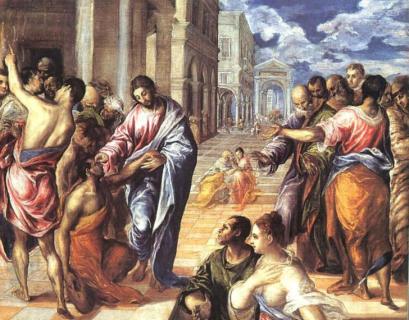
Mark 10:46-52 46They came to Jericho. As he and his disciples and a large crowd were leaving Jericho, Bartimaeus son of Timaeus, a blind beggar, was sitting by the roadside. 47When he heard that it was Jesus of Nazareth, he began to shout out and say, “Jesus, Son of David, have mercy on me!” 48Many sternly ordered him to be quiet, but he cried out even more loudly, “Son of David, have mercy on me!” 49Jesus stood still and said, “Call him here.” And they called the blind man, saying to him, “Take heart; get up, he is calling you.” 50So throwing off his cloak, he sprang up and came to Jesus. 51Then Jesus said to him, “What do you want me to do for you?” The blind man said to him, “My teacher, let me see again.” 52Jesus said to him, “Go; your faith has made you well.” Immediately he regained his sight and followed him on the way.
Jesus Healing Blind Bartimaeus El-Greco, 1578
We are rapidly approaching Holy Week and all of the exciting and heartbreaking moments the weeks brings. In Mark the last story before the Triumphal Entry is of the Healing of Blind Bartimaeus that takes place as Jesus is traveling through Jericho to Jerusalem and his appointed fate. I am offering the above painting by El-Greco for you to contemplate with the prayer practice of Visio Divina. I have always found this story from the Gospel of Mark one of the most moving story of courage and faith in scripture. Bartimaeus doesn’t know how close he is to Jesus; he simply calls out and has faith Jesus will answer him. The questions Jesus asks of Bartimaeus also draw me into a deeper understanding of sight and I hope you will consider those questions and the responses as well.
May your sight be deepened in preparation for the coming week as your contemplate El‑Greco’s painting and the scripture lesson.
VISO DIVINA
Study the picture slowly, taking a first glance and noting the colors, people, places and things. Remain with the image for one to two minutes. If you would like, jot down a few words about the image.
Read the Scripture lesson slowly and in meditation. Return to the painting does the scripture alter your perspective of the painting in anyway? Do the questions and responses open new doors as you gaze at the painting?
Take a second, deeper, look. Where is there movement? What relationships do you see? Engage your imagination. Where are you in the artwork? What do you see from that perspective? What deeper meaning emerges?
Respond to the image with prayer. Did the image remind you of an experience, person or issue for which you’d like to offer thanksgiving or intercession? Place yourself in the place of Bartimaeus, and then in the place of a spectator, or one of the Disciples. Does your perspective Change? What do you feel when you become Bartimaeus or a spectator? Offer your thoughts as prayer to God.
Find your quiet center. Breathe deeply. Relax your shoulders, arms and legs. Rest in this quiet. Let God pray in you. God prays beyond words.
May the Peace of God be with you as you travel the Holy Week Journey.
This week’s prayer practice is one a friend of mine taught me in the last couple of weeks. It is one of Thich Nhat Hanh’s practices called “Letgo.” After I began the practice I realized ‘Letgo’ has many similarities with the Examen and found that I was experiencing some of the same benefits. As I have begun to settle into this practice I have discovered my days to be calmer and more centered even when the world gets busy. I am able to separate what is important from what it is not. The most amazing thing is of the many of events and things I thought were important they just are not priorities any longer. Instead I am able to focus on what makes my life more enjoyable, beautiful and to just BE. So I offer this practice as my gift to your well Being.
Letgo Practice
I usually pick a time of day when things are quiet, either early in the morning or just before I go to bed. I like both times. The morning time energizes me and the evening time centers me and quiets my mind so that I sleep much better. But select a time that works best for you. I do set aside 20 to 25 minutes for each session.
Begin by sitting quietly, concentrating on your breath. Reflect on those things you have let go of in the past. You many begin your ‘list’ as early in your life as you wish.
Be aware that our conscious attention only catches a small portion of what goes on in lives.
Start with small steps first. Accept that events such as rush hour traffic, broken washers, and burnt dinners will always be there to annoy and frustrate you. Use these events to practice an acceptance of those things that just happen because it’s life.
Be mindful of those times when you pick up old burden or worry’s and begin to carry them around again. Learn to recognize the old resentments and anger that emerges and ask yourself if you want to continue to hold space in head and heart for them.
Take deep breaths and let the burdens, anger, and resentment flow out with each exhale.
Repeat step 5 as often as necessary until you are able to bring your mindfulness back to the now.










 A Quiet Walk