A Moment of Silence – Prayerful Tuesday

Numbers 23:9a for from the top of the mountains I see him, from the hills I behold him;

Mt. Baker, 9/15/14
Mt. Baker, 9/15/14

On this beautiful Tuesday I ask only that you take a moment of silence. Hold in your hearts, the pain, suffering and loss from the deaths in Charleston North Carolina, Chattanooga TN.  To remember the loss of so many who have needlessly died from Sandy Hook, to Marysville.  As we lift up our eyes to the mountains open our hearts to those who suffer; the victims, the families. Hold the perpetrators in your heart as well, pray that light will enter the dark well they live in and bring them out of the darkness of their own making.   Amen

Ruth Jewell, ©July 21, 2015

Seeing the Divine – Prayerful Tuesday

Photo by Rabbi Yael Levy, www.mishkan.org/awi, June 29, 2015
Photo by Rabbi Yael Levy, http://www.mishkan.org/awi, June 29, 2015

This week I am offering a meditation from Monday’s FaceBook (FB) page A Way In: Jewish Mindfulness Program.  I have used these FB daily meditations, and the Rabbi Yael Levy’s Jewish Mindfulness web page, Mishkan Shalom, for my own use for some time now.  I wanted to share with you the beauty of their posts and suggest you explore Rabbi Levy’s web page as a resource for mindfulness and meditation.

Let today’s meditation be your reminder to look for the Divine in all of creation.

Fulfilled is the person who knows that in each moment she dwells in the Divine presence
Fulfilled is the person who knows that in each moment the Divine presence dwells within her.
Always she offers praise.
-Psalm 84:5

May we have the strength and humility to look for the Divine within ourselves.
May we have the courage and faith to recognize the Divine in others.

More mindfulness resources: www.mishkan.org/awi

Ruth Jewell, ©June 30, 2015

What will be, will be – Prayerful Tuesday

Psalm 131:1-2 God, I’m not trying to rule the roost,
I don’t want to be king of the mountain.
I haven’t meddled where I have no business
or fantasized grandiose plans.

I’ve kept my feet on the ground,
I’ve cultivated a quiet heart.
Like a baby content in its mother’s arms,
my soul is a baby content. (MSG)

Akaroa, New Zealand, April 9, 2015 taken by Ruth Jewell©
Akaroa, New Zealand, April 9, 2015
taken by Ruth Jewell©

One of the benefits of a sabbatical is having the time to stop and let the world go by. In fact I have begun to practice an extension of stopping that I call “what will be, will be.” On my trip I would wake in the morning and intentionally decided to let the day unfold as God intended for it to happen, making few plans, being open to opportunities to meet people or visit a place I hadn’t been before, taking the time to really listen to the person I just met, stopping and really seeing the world around me and the hardest of all, trying not to control my days events.  What I discovered was I was more relaxed and rested at the end of the day than this normally anxious introvert is.

This is more than mindfulness or being in the moment.  It is letting the Divine control the day, opening my eyes to the Good in each person I meet and greeting them with the Good within me.  This is an intense letting go of my expectations of how things ‘should’ be and seeing how they are/can be beautiful and insightful.

Of course I couldn’t do this every day.  Sometimes we had already made plans in advance so those intentional days weren’t every day, even on a vacation.  But I did make them happen often, and probably more often than I will be able to do now that I am home. However, I do wish to maintain this spiritual practice and hope my ability to let go and let God control my days increase. Here are a few suggestions to help you, and me, get started.  As I get better at this, or you, we might add suggestions or take some away, we will just have to wait and see how God unfolds this practice.

  1. Begin the day with silent prayer ending with a prayer for patience and openness
  2. As you start your day and continue through your tasks really notice what you are doing, see the people you are with, taste the food you eat, notice your surroundings, even the ugliest of areas has beauty if you look.
  3. As time allows stop for a moment and breathe deeply, if possible sit and let God into your day, your heart
  4. Let God into the moments of confusion and frustration, breathe deeply, say a prayer, let others express themselves and be aware of their hurt and pain, or joy and celebration. Recognize they too have the Divine within and welcome them.  (This is the hardest part, so do not be surprised if you fail, just keep trying)
  5. At the end of your day, sit again in silence; let your heart and mind reflect on your day, the good and the bad hold those you meet that are hurting in prayer, and offer gratitude for those who are celebrating.
  6. End by offering your own prayer of gratitude.

We all can’t take 6 weeks or even a day of sabbatical, but we all can let the Divine into our daily lives. We can offer one of our ‘normal’ busy days to God, and changing how we see our tasks and the people we interact with helps us change how we see the world.  It costs nothing to offer praise or condolences, or to sit and listen to someone’s story but the gift is priceless.

Blessings on your Journey

Ruth Jewell, ©June 2, 2015

on being human—Prayerful Tuesday

Nursing an Ebola Victim Picture by Dr. Rudyard, Health Pictures
Nursing an Ebola Victim
Picture by Dr. Rudyard, Health Pictures

Matthew 25: 36 “I was naked and you gave me clothing, I was sick and you took care of me, I was in prison and you visited me.”

One of the books I read while I was on my sabbatical was Fields of Blood, Religion and the History of Violence by Karen Armstrong.[1]  As always I was impressed with her writing and level of scholarship but more than that in this book Ms Armstrong lays out the reasons for our love of violence and power.

Right at the beginning she identifies one of the factors in our continuing struggle between living in a harmonious world or living in a power driven world, the construction of our brains.  We have 3 brains, the old brain or reptilian brain is responsible for our fight or flight actions. It drives us to defend our territory for food and other resources, it is the self-centered part of the brain, most concerned with keep ourselves safe; the mammalian limbic system, which formed over the core of the reptilian brain is our second brain. It is responsible for new behaviors such as care of our young and the formation of allies with others; and the new brain, the third brain, the neocortex, is responsible for our “reasoning and self awareness that enables us to stand back from the instinctive, primitive passions.” (pg 4-5)

Ms. Armstrong proposes that the reptilian brain and limbic system are dominant within power systems that manipulate and control others.  The limbic system extended the actions of the reptilian brain to include family or a community unity but, still, this drive for power and control of others for territory and resources requires violence.  It wasn’t until about 20,000 years ago when the neocortex evolved did the idea of standing back and evaluating actions was there any question about the use of violence. Humanity really didn’t have a chance of becoming a reality until after the evolution of the neocortex and we have yet to learn how to  use the “new brain” to begin to evolve into who we are meant to be.  By this I mean most of us haven’t learned to overcome the impulses of the reptilian brain and limbic system and use our neocortex to evaluate our surroundings or our actions.  In general we humans are “subject to conflicting impulses of [our] three distinct brains.” (pg. 5)

Fortunately there is hope for us all.  A few of us are developing our neocortex’s and discovering what it means to be truly human.  I was listening to NPR this past Sunday morning when a story about Dr. Kent Brantly was broadcast. Dr. Brantly was one of the American Doctors who contracted Ebola last year and survived.  He was asked to deliver the graduating speech to the 2015 graduating class of the Indiana University School of Medicine.  What he says about compassion is important for all of us to hear (italics are mine):

“In the first seven weeks of treating patients with Ebola, we had only one survivor; one survivor and nearly 20 deaths. Losing so many patients certainly was difficult. But it didn’t make me feel like a failure as a physician because I had learned that there’s a lot more to being a physician than curing illness. In fact, that isn’t even the most important thing we do. The most important thing we do is to enter into the suffering of others. And in the midst of what was becoming the worst Ebola epidemic in history, we were showing compassion to people during the most desperate and trying times of their lives. Through the protection of Tyvek suits and two pairs of gloves, we were able to hold the hands of people as they died to offer dignity in the face of humiliating circumstances, to treat with respect the dying and the dead. And in my opinion, that made those weeks, those difficult weeks of my career a success.”[2]

Compassion isn’t offering help, it is being with the suffering of others, it is living the suffering, walking together down a road you may or may not know where it leads.  That is what Jesus did.  He entered into the suffering of others, he walk the road to where ever they were headed, that is one, maybe the first, step to becoming human.  Dr. Brantly has taken a step on a road most of us are afraid to even look at let along step onto.  The Prophet Micah tells us “He has told you, O mortal, what is good and what does the Lord require of you but to do justice and to love mercy and to walk humbly with your God?” (Micah 6:8). To do justice, to love mercy, to walk humbly with God, sounds easy does it not?  Ask Dr. Brantly how easy it was for him and he will tell you it is the hardest road you will ever walk, but if we wish to be the humans God has always wanted us to be it is a road we must walk.

This week my spiritual practice is more of a spiritual way of life.  I would like to invite you on a journey with me to become the “human” God wants us all to be.  To look at our actions by taking a step back and asking ourselves the following questions (I am sure there are more than these and please let me know what you would ask):

  1. Does this action support justice or impede justice?
  2. Is this action a loving act?
  3. Does that action move me closer to God or does it separate me from God?

Simple questions, but, sometimes hard to answer.  Our lives are filled with gray areas and we will need to determine how those gray, in between, spaces fit into our lives and either nurture or kill the life we want with God. This is not an easy practice or an easy way to live but I believe, at least for myself, a profitable one.  I know I will stumble and so will you.  That’s OK, just pick yourself up and start over again.  Failure is a lesson in how not to do something.  Loving life as God meant it to be was and is never easy.  Just remember you are not alone.

Ruth Jewell ©May 19, 2015

[1] Armstrong, Karen’ Fields of Blood, Religion and the History of Violence, The Bodley Head, London, UK, 2014.

[2] National Public Radio: Rachel Martin interview Dr. Kent Brantly, May 17, 2015, All Things Considered Sunday Edition.

Covenant – Prayerful Tuesday

Genesis 9:12-13  12God said, “This is the sign of the covenant that I make between me and you and every living creature that is with you, for all future generations: 13I have set my bow in the clouds, and it shall be a sign of the covenant between me and the earth. 

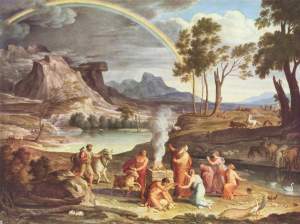
Joseph Anton Koch, 1803

The Hebrew Scripture for Sunday was from Genesis 9, the covenant between God and the earth.  Following the Flood, God voluntarily disarms, self-limits, herself by making a promise between Noah’s descendents and all creation never to destroy the earth again.  It is promise made to all of creation not just humans. God’s promise means we are to be in relation with each other and all of creation. (If you are not familiar with God’s promise please read Genesis 9:8-17.) Above is the painting by Joseph Anton Koch of Noah’s Thanksgiving Offering, which we will be using for today’s Visio Divina.

  1. Study the picture slowly, taking a first glance noting the colors, people, places and things.  Remain with the image for one to two minutes. If you would like, jot down a few words about the image.
  2. Take a second, deeper, look. Where is there movement? What relationships do you see? Engage your imagination. Where are you in the artwork? What do you see from that perspective? What deeper meaning emerges?
  3.  Respond to the image with prayer. Did the image remind you of an experience, person or issue for which you’d like to offer thanksgiving or intercession? In what way does God’s promise change, or not change how you visualize your relationship with the earth, each other, and God? Offer your thoughts as prayer to God.
  4. Find your quiet center. Breathe deeply. Relax your shoulders, arms and legs. Rest in this quiet. Let God pray in you. God prays beyond words.

Rainbows are symbols of hope, and renewal following a crisis.  May this day bring you your own personal rainbow.

Ruth Jewell, ©February 24, 2015

Hope

Sermon Given at Lake Washington Christian Church
February 22, 2015

rainbow-landskape

Genesis 9:12-17  12God said, “This is the sign of the covenant that I make between me and you and every living creature that is with you, for all future generations:13I have set my bow in the clouds, and it shall be a sign of the covenant between me and the earth. 14When I bring clouds over the earth and the bow is seen in the clouds, 15I will remember my covenant that is between me and you and every living creature of all flesh; and the waters shall never again become a flood to destroy all flesh. 16When the bow is in the clouds, I will see it and remember the everlasting covenant between God and every living creature of all flesh that is on the earth.” 17God said to Noah, “This is the sign of the covenant that I have established between me and all flesh that is on the earth.”

Psalm 25:5-6 5Lead me in your truth, and teach me, for you are the God of my salvation; for you I wait all day long. 6Be mindful of your mercy, O Lord, and of your steadfast love, for they have been from of old.

1 Peter 3:21  21And baptism, which this prefigured, now saves you—not as a removal of dirt from the body, but as an appeal to God for a good conscience, through the resurrection of Jesus Christ,

Mathew 1:15-15 14Now after John was arrested, Jesus came to Galilee, proclaiming the good news of God, 15and saying, “The time is fulfilled, and the kingdom of God has come near; repent, and believe in the good news.”

Awhile back a friend asked me what was my favorite scripture and without hesitation I said Micah 6:8 “He has told you, O mortal, what is good; and what does the Lord require of you but to do justice, and to love kindness, and to walk humbly with your God?”  Then she asked the question … Why? I had to think about that for awhile.  I could have said that it was how my Father ended all of our dinner prayers and hearing it always brings back wonderful memories.  Or, I might have told her my Disciples tradition has based its mission and vision statement on it and those statements have opened the door to a witness in social justice and peace in the greater world.  But while each of those reasons are truth the real reason is this one verse from Hebrew scripture gives me Hope.

It is the hope of the rainbow that symbolizes the covenant between God, one-another and all creation.  It is the cry of the Psalmist who says “O, Lord, Teach me your paths, Lead me in your truth and teach me,” and the voice of the Gospel writer of Mark who writes “Jesus came to Galilee, proclaiming the good news of God.”

In our world today hope seems to be too little and too late.  We watch the news and it’s filled with killing, greed, anger, hate, and very little that would give us hope for a better world.  Killing, whether of the body or spirit, disrupts God’s purpose for our lives. To kill a human being  made in the divine image is to subvert our lives which were purposely created to be lived in mutuality, support and respect, to live in right relationship with each other, God, and creation.  Killing for greed, hate, and anger is to kill a little of ourselves and build a wall, brick by terrible brick, between us and God.

So what does the word “Hope” mean for us then? Those who define words say it is to expect with confidence.  For others it means to expect things will get better, not only to get us through the difficult times in our lives, but also for our world, we will have a place of peace and justice for all creation, not tomorrow, or sometime in the far future but NOW, today.  We in all of our faith communities across the globe are called to seek justice, offer kindness, and be examples of living in peace to the world, to be a living hope.

God promised the descendants of Noah, and all creation that God would no longer destroy the world.  As a covenantal symbol of God’s own self-limiting, God’s disarmament, God placed a rainbow in the sky. In Noah’s time bows were symbols of violence just as guns are for us today.  So God laid down his weapon of mass destruction and placed it in the sky and said ‘I will no longer destroy what I have created.’  I wonder what God would place in the sky today, a nuclear bomb maybe?

Don’t get me wrong, I haven’t forgotten all of the killing done in the name of God in Scripture.  And, I must admit I have difficulty with the genocidal practices of Joshua when the Israelites crossed the Jordan River into the Promised Land.  But I also know that just because a practice is in the Bible doesn’t make it an acceptable practice for today.  And, that is the reason I so firmly believe in God’s promises of hope.

You see God’s covenant of the rainbow means that we, you and I, all humans, are in a covenantal relationship with God, each other, and creation and that means that all life matters, my life, your life, white, black, yellow and brown life, furred and feathered life and (much to my discomfort) insect and spider life.  The Psalmist makes a claim of hope and trust in God and tells us that God’s protection flows from the mouths of those who have no hope or trust in systems of violence, injustice, and oppression. Not just overt physical acts of injustice but injustice and violence and oppression brought about by attitudes, social structures, and any other “isms” that threatens the peace and justice of God’s Kingdom.

God’s rainbow of hope spoken in the Good News of the Gospels goes beyond a “me-centered” interpretation of the world. God’s hope reaches out across our selfish desires to those who need hope, justice, and mercy. Where do you find God’s hope? It is placed where there is justice and peace and there you will find Kingdom of God. Jesus preached the Good News of hope. Hopeful news that leads not only to the salvation of those who accept the gift freely given, but is also the promise of something more, a new and different life for those who are the most victimized.  All faith communities are called to be participants in our own salvation by working for justice, now, in the context of our present world, thereby helping to bring the good news to those who need it, where ever and whenever it is needed.

We as believing members of our faith communities are to point the way to the kingdom breaking into our world right now. The kingdom of God isn’t a future event it is happening right now. Every time we offer a helping hand to someone who is hungry, or cold, or afraid the door to God’s Kingdom opens just a bit more.  Every time we stand up to those who would harm one of God’s children, the kingdom shines a bit brighter.  Every time we stand between victims of injustice and the perpetrators God let’s a little more light out of the door.   Every time we speak out when we see an injustice God smiles and sends another rainbow.

You know the Irish tell us that there is gold at the end of the rainbow, and I believe that is true.  Because I believe that God’s kingdom is that golden treasure and we are to seek it just as the man who sought out the pearl of great price.  What could be more beautiful than walking across the rainbow into the Golden Kingdom?

Yes, on the first Sunday in Lent, all of the Lectionary scriptures are about hope.  Whether you read Genesis, Psalm 25, 1 Peter, or Mark each of them has an element of hope for dark times, in a dark world.  Each one offers a ray of light to bring us out of darkness. The light calls us, bright and shinning, multicolored, and golden with hope and promise.  God first gave the rainbow as a promise that She would never forget any of her children.  The Psalmist tells us that God will always be there to sustain us.  And, Jesus, rekindled the hope in the hopeless that a better life was there for them.  Jesus reminds all of us that God will sustain us as we work to be the witness’ against injustice, violence and oppression.

God said, “When the bow is in the clouds, I will see it and remember the everlasting covenant between God and every living creature of all flesh that is on the earth.”  How does Micah fit into this, well Micah reminds us which path we are to take, “what does the Lord require of you but to do justice, and to love kindness, and to walk humbly with your God?”  We are called to be living communities of hope, of God’s promise in every moment of our individual and communal lives.

AMEN

Ruth Jewell, ©February 23, 2015
The Angel’s Voices

Mt. Baker, WA, from Artist Point, Photo by Ruth Jewell, 14.09.15
Mt. Baker, WA, from Artist Point,
Photo by Ruth Jewell, 14.09.15

Prepared for a Sermon at Queen Anne Christian Church, Seattle WA
January 18th, 2015

Scripture: Psalm 139:1-6, 13-18

Have you ever had that feeling you are being watched and you turn around and around to see who is there?   I have and I must admit it often feels creepy!  Someone is watching me, why, who are they, what do they want, will they hurt me?  Some might say these are the questions of a paranoid mind, but, given the status of our world today, not uncommon in these days of uncertainty, fear, and, let’s be honest, at least a little hate, ok a lot of hate.

So when I read the Psalm for this week I had to really think what it means to be “watched,” “known,” by God.  This Psalm is telling me that I am being watched, by God no less.  Is that a good thing or should I be afraid, really afraid.  As I was contemplating these verses I remembered an incident out of my childhood.  It was a memory of being known by God and knowing it was keeping me safe.

Nearly 62 years ago I was severely burnt and spent 6 months in hospital healing and having reconstructive surgery.   In reality I am blessed to be here, because I should have died that summer, but didn’t.  However, I did spend a great deal of time on a children’s ward of a Cleveland Hospital.  There were number of other children there as well, just as injured and ill as me and one little boy and I became good friends.  I do not remember his name; I do remember he was dying.   He was a little older than I was but could not walk; I could get up and walk a little but couldn’t read as well as he could.  I would get books and games to play with and he would read the harder books.

Children will often tell another child something important when they aren’t sure their parents would understand or listen.  So one day he told me that he knew he didn’t have long to live and he wanted me to tell his parents he was ok with it.  You see he had a guardian angel who stayed by his side and the angel had told him he would be going soon and no longer in pain, his parents would be sad for awhile but they would remember him forever.

One night I awoke to a great deal of crying and saw the mother holding the little boy.  I remembered what he had asked me to do so I crawled out of my bed and tried to tell them that the boy was OK, and that he was with his angel now.  However, before I got very far with that a nurse scooped me up and put me back in my bed saying something patronizing.  I never really talked about that incident again; I understood what I had to say was pretty unimportant to adults and not worth listening to. It was the thought of the time that children didn’t understand death or God and it was, and is, a wrong thought.

Being known by God, being watched by God, children understand that, after all they are always being watched.  By parents, teachers, friends, family members who want to keep them safe.  So knowing God is watching them is no big deal, just one more person on the list to keep them safe.  Besides isn’t there something comforting knowing you have a guardian angel nearby, how cool is that.

From the time they are formed in the dark, cavern of their mother’s womb they are cradled and whispered to by angels.  By 18 weeks of pregnancy the embryo begins to hear his first sounds, Mom’s heart beat, the movement of her blood, and bowel sounds.  He also hears His Mom’s and Dad’s voice, music, laughter, and tears.  To him it’s, Angels voices coming from, everywhere.  Children know they are being watched, searched out as they are being formed in the dark.

After birth we are still connected to those angels, only now they have blurry faces, but they can see the angels smile at them and hear their whispers and while breast feeding they still hear the comforting sound of Mom’s heartbeat.

It is a sad fact that as we grow we forget those connections to the mystery of our beginnings.  We let other sounds carry us away from the angel’s voices, the whispers that we are beloved and we are watched over. We, who were made so carefully, struggle to be free of the binders, free of being hemmed in from behind and before. We, who in secret were made so wonderfully and woven of star dust and love, want to run free of the restrictions of God, angels, or anyone else.

Yet there is a part of us that yearns to be known.  Oh we may fight it, rebel and run away because we want to “do it our way.”  But really, at some level, isn’t it comforting to know just how beloved we are?  The Psalmist said “My days are all inscribed in Your Ledger; Days not yet shaped—each one of them is counted.”[1] Those counted days are from the moment we are conceived in flesh to the moment we let go of this body and return to God.  Yes we still have days that God has counted that we know nothing about, yet.  But God is still watching and still planning, or more likely, revising our life plan based on our latest actions.

You see I’ve never been a big proponent of predestination, were God has planned our lives out before we are born.  No I am a firm believer in free will and our obligation to choose life over death.  We, you and I, must choose to follow one path over another and depending on our choices our life is rewritten again and again.  I know that because I have had my life rewritten all because I’ve made some rather dumb choices in my life.  My guess is we all have, because we are human, we are embodied; we are separated from that light of God and God deliberately put us on our own resources for a purpose we do not know.  (My first question for God when I return is “what were you thinking.”)

What the Psalmist tells us is even in our bad choices we are watched, cared for, beloved, held safe, and not alone.  God keeps us in God’s thoughts; we are never far from the Divine mind.  “How weighty to me are your thoughts, O God! How vast is the sum of them! I try to count them—they are more than the sand; I come to the end—I am still with you.”  “I am still with You,” God is with me.  Matthew writes that Jesus’ last words to his disciples were, “And remember, I am with you always, to the end of the age.”  We have that promise.  God has not left us alone, Jesus has not left us alone, the angels are still whispering, if, only we listen.

Rabbi Schachter-Shalomi translated verse 14 as follows, “I am overcome with thanks at Your awesome wonders, Your astonishing works, of which my soul is aware.”  Our souls know what God does, what Jesus does, even when we are unconscious to those actions.  Our souls know even when we reject God’s call that we are not alone.  That we are watched over and having our lives rewritten again and again based on whether we chose life or death.

Those angel whispers, messages of comfort from the Holy, still hold for each and every one of us.   That first sound we heard in our mothers’ wombs, the first whisper of life from the sacred, was a heartbeat.  It still is the whisper of life for all of us.  Without our hearts beating strong and level life will fade.  But it is not just the heart of our flesh that we need.  We also need the voice of the heart of our souls, our spirit, to truly live life as God intended.  Remember Moses’ last words “choose life.”  The messengers of God, the angels voices all whisper, “choose life.”

Ruth Jewell, ©January 17, 2015

[1] Schachter-Shalomi, Rabbi Zalman, Psalms in a translation for praying, Alliance for Jewish Renewal, Philadelphia, PA, 2014.

It is Good?—Prayerful Tuesday

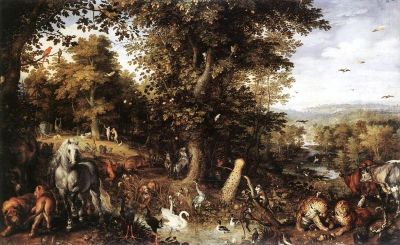
Garden of Eden, Jan Brueghel, 1612

“And God saw that it was good.” Genesis 1:10b

In the last weeks God’s creation has seemed anything but good.  Terrorist attacks, ambushing of police, and police shootings of unarmed young men continue to rent the very fabric of our society.  Yet God did not create an evil world, in fact God proclaims this world a good world where everyone, and I mean everyone, has what they need to live and be the person they are meant to be.  It is our choice’s, not God’s, that have created a world that is unsafe.

Spending time in silent contemplation with a focus on what we could have been, and still could be, seemed the only way for me to center myself and see the world as good.  So today I offer as our prayer of the week another Visio Divina using the above painting of the Garden of Eden by Jan Brueghel.

Prayer Practice:

1. Study the picture slowly, taking a first glance noting the colors, the placement of the plants, animals and, people.  Remain with the image for one to two minutes. If you would like, jot down a few words about the image.

  1. Take a second, deeper, look. Where is there movement? What relationships do you see? Engage your imagination. Where are you in the artwork? What do you see from that perspective? What deeper meaning emerges? What feelings about the world rise in you? Are there any images that you are particularly drawn too?
  2.  Respond to the image with prayer for the world. Did the image remind you of an experience, person or issue for which you’d like to offer thanksgiving or intercession? Offer that prayer to God.
  3. Find your quiet center. Breathe deeply. Relax your shoulders, arms and legs. Rest in this quiet. Let God pray in you. God prays beyond words.

Please do not let your belief, or non-belief, in the Garden of Eden and the subsequent fall from grace prevent you from seeing the good things in creation. Our world is in need of prayer right now.  All of our people, all of creation is crying and in pain.  Let your prayers go out into the world and let them lead you to be the person God has always wanted you to be.

Peace, Blessings

Ruth Jewell, ©January 13, 2015


Looking Forward – Looking Back – Prayerful Tuesday

Micah 6: 8 He has told you, O mortal, what is good;
and what does the Lord require of you but to do justice,
and to love kindness, and to walk humbly with your God?

Happy New Year 2015 A

Well the New Year is almost upon us and it has been an eventful, but mostly violent, one.  In 2014 it seems we have had more violence than peace, despite the efforts of many.  We have seen hate take over our streets and increase in our government.  Peace on Earth just doesn’t seem to be in our hearts for this baby New Year.

This last year we have seen too many senseless deaths, demonstrations, hateful rhetoric, and downright meanness.  There has been little peace in our world of late.  But this small online community has been a refuge for some. We have offered moments of personal stillness in the rush of our daily lives.  Yet in the face of so much violence prayer doesn’t always seem adequate does it.

But, every time we take a moment to offer a pray for our own peace and for the peace of others we change a piece of our hearts.  Those changes add up and become the change we see around us. We just celebrated the birth of love breaking into the world.  A love that gives out of its abundance, works for justice for all, and walks a path that honors the world we live in. In the light of that love we too can become love expressed in the world, with every prayer we offer and with every prayer action we take, the light of Love shines just a little brighter.  Yes it may seem inadequate but remember you can’t have a beach with one grain of sand.

So my prayer request for each of you this week, as you contemplate the year past and look forward to the year to come, is to offer a prayer for our community that we will find solace in our hearts and compassion and justice in our actions.  Pray for each other.  Pray for local, national, and international governments.  Pray for the children, elderly, and the sick and disabled who are most affected by hate speech and actions.  Let your prayers spill over into the way you act in the world around you.  Remember others are praying as well, you are not alone.  Let every act you do in the coming year be an act of prayer, and offering to the God or Force that guides your path.  Let this be your New Year’s resolution that you will “do justice, and … love kindness, and … walk humbly with your God? (Micah 6:8 NRSV).

It is my prayer that, we as a people, will change the world by being the Force in the world for compassion, justice, and love.  Let us learn to walk humbly with whatever Divine Energy each of calls to in the dark.  May each of us this year light a candle of hope each day and let our light shine.

Happy New Year Everyone and may the Love of the Divine be with you in the coming year.

Ruth Jewell, ©December 30, 2014

A Conversation with a Psalmist –Prayerful Tuesday

Come Lord Jesus, hear our prayer
Come Lord Jesus,
hear our prayer

As I am personally preparing for  Christmas I have been disturbed by the amount of violence and death around the world.  Peace on earth does not seem near. So as part of my morning ritual I have been doing Lectio Divina with the Psalms.  They have brought me some comfort but this Psalm struck a chord within me and I wanted to share that with you.  So this is a little different from most of my postings, as it is part of my journaling during my meditation. I am letting you in on a small part of my conversations I held with the Psalmist and God.  They are my insights of the moment, so if I say something you disagree with please be gentle, it is after all a private conversation you are overhearing.  At the end of my journaling you will find the steps for Lectio Divina.  For your own Lectio Divina meditation you may use the whole Psalm, as I did, or only a verse or two.

Psalm 10, The Message (MSG)

 1-2 God, are you avoiding me?
    Where are you when I need you?
Full of hot air, the wicked
    are hot on the trail of the poor.
Trip them up, tangle them up
    in their fine-tuned plots.

I am in the process of preparing for a Longest Night worship service and in reading this Psalm I was struck by how it matched my gut feelings this Advent.   Every day the news is filled with stories from around the world of someone killing someone one else, often many someone’s.  Just last night news came of a hostage situation in Sidney, Australia, just one more story to add to the Ferguson, New Town, Cleveland, Seattle, Portland, Houston, Afghanistan, and Iraq stories of the last number of years.  The list is too long, too many people have died, and too many children have died.  Like the Psalmist I am left wondering “where are you God.”

3-4 The wicked are windbags,
    the swindlers have foul breath.
The wicked snub God,
    their noses stuck high in the air.
Their graffiti are scrawled on the walls:
    “Catch us if you can!” “God is dead.”

This is supposed to be a time of joy and celebration but I do not feel like celebrating.  Our elected leader’s mouth words from the Bible I read every day, yet, their actions tell me they do not believe what they speak.  Are they wicked?  Are they windbags?  Well the wicked part can only be determined by God but the windbag part . . ..  Yes they are windbags, hoping that we who at least try to live a life of compassion will not notice their plans to take the last ounce of God’s abundance all for themselves.  They write bills and say “try and stop me, from denying the basic necessities to those who cannot help being poor, sick, elderly, or a child.

5-6 They care nothing for what you think;
    if you get in their way, they blow you off.
They live (they think) a charmed life:
    “We can’t go wrong. This is our lucky year!”

These insufferable, so called leaders lie and twist the truth until even the best of us are confused and dazed by the avalanche of untruths they let loose on the public. Whether they are religious fundamentalist, political leaders, in the United States, Afghanistan, Syria, Iraq, British Isles or anywhere they claim the spotlight and they believe no one can stop them.  They are on a role and the rest of us “be damned.”

7-8 They carry a mouthful of hexes,
    their tongues spit venom like adders.
They hide behind ordinary people,
    then pounce on their victims.

They mark the luckless,
    then wait like a hunter in a blind;
When the poor wretch wanders too close,
    they stab him in the back.

10-11 The hapless fool is kicked to the ground,
    the unlucky victim is brutally axed.
He thinks God has dumped him,
    he’s sure that God is indifferent to his plight.

The words they spit from their mouths cause fear in those who have minds that are weak and malleable. Letting these poor souls do the violence they pretend to abhor only to turn on them when they caught in their snares.

12-13 Time to get up, God—get moving.
The luckless think they’re Godforsaken.
They wonder why the wicked scorn God
and get away with it,
Why the wicked are so cocksure
they’ll never come up for audit.

We wait for you O God to respond, to let us know you haven’t forgotten us.  We wait and we wait.

14 But you know all about it—
    the contempt, the abuse.
I dare to believe that the luckless
    will get lucky someday in you.
You won’t let them down:
    orphans won’t be orphans forever.

The Psalmist sings of your knowledge of the violence we see every day.  But do you really hear the cries of the children who have lost limbs to bombs, to parents who have watched as their children are killed in front of them, as ISIS hangs those with different beliefs, as children shoot children?  Have we not sent enough children, parents, loved ones to you to serve as a sacrifice?  Do you care?

15-16 Break the wicked right arms,
    break all the evil left arms.
Search and destroy
    every sign of crime.
God’s grace and order wins;
    godlessness loses.

My heart wants to believe as the Psalmist did that you will intervene in the bloodletting of this world, but I know you will not.  It is not up to you, O God, to set this world back on the track of compassion, justice and peace.  That really is our job.  We are the ones who created these people who mock everything you have wanted for all.  We are the ones who must “gird up our loins” and speak out against injustice, violence, hatred, and war.  Only we who believe in justice, mercy, kindness, peace, compassion will change the lives of those who are oppressed, abused, injured, and starved by those who mock the world as you, O God, planned it.  We must stop cowering in our homes and our places of faith and become the prophets, the messengers, the hands, feet and voice that will bring down those who would enslave us to a life of poverty and misery.  Then, and only then, will the Psalmist’s dream come true.

17-18 The victim’s faint pulse picks up;
    the hearts of the hopeless pump red blood
    as you put your ear to their lips.
Orphans get parents,
    the homeless get homes.
The reign of terror is over,
    the rule of the gang lords is ended.

Gracious Spirit I thank you for this time of blessed meditation.  May the words and images I have seen transform my actions into walking with you in greater joy.  AMEN

Practicing Lectio Divina

  1. Choose the portion of the Scripture you wish to pray.
  2. Place yourself in a comfortable position and allow yourself to become silent, focus for a few moments on your breathing.
  3. Read the chosen text through, slowly and gently. Listen to yourself read, let yourself to savor each word and phrase.
  4. Read the text a second time. What words or phrases stick out for you? Remember God speaks to us in silence and in our listening. The words that pop out do so for a reason, pay attention to them.
  5. Read the text a third time. Are there any other words that speak to you?
  6. Sit now in silence, letting the words you have heard, speak to you and for you in your prayer, your conversation with God. What images, ideas, words spring forward?  Or maybe all of them are present in mediation.  Sit with those insights as you experience the presence of God.  Give your insights to God.  Do the insights give you new meaning or transformation of your actions, or prayer life?
  7. Now rest in God’s arms. Let God’s presence give you comfort. Do you feel the pull to return to your meditations? Then begin again. If not close with a prayer of gratitude for the time you have spent in God’s presence and the insights you have received.

Ruth Jewell, ©December 16, 2014