Heed the counsel of your own heart, and above all pray to the Most High that you may be guided in the way of truth. Ecclesiasticus 37:13, 15
Caribbean Sea December 16, 2015 Ruth Jewell
I was talking with a friend not long ago and he said his church was reevaluating its mission in the community. One of the questions he asked them was “what do they want to leave behind when they are gone”? What do they want their legacy to be? I thought that was an interesting question that all of us should consider in our lives. What do you want to leave to those who remain after you have passed on to the next world? What do I want to leave?
Contemplating our legacy is a serious question of the spiritual practice of living our lives with intention. Because of that I have been giving this question much thought during my sacred time each day. What is it about my life do I want to pass on to my family, my faith community, the world in general? How will living my life make a difference in this world? I know I don’t want to be remembered for just for doing my job or making a living, for me that is a superficial fact of surviving. I don’t want anyone to say survived the trials of living.
I think I do want to be remembered for being able to listen to a friend in need, for loving even those who I don’t agree with, taking action to right a wrong or feed and clothe the disenfranchised. I want to be remembered for standing and walking those who are growing spiritually and in their relationship with the Divine. I want to be remembered as someone who saw the Great Spirit in all I have met whether they belong to my faith or not, rich and poor, the outcast, the convicted felon, any and all who have been labeled unlovable. The short version is I want to intentionally live my life so that I will be a blessing to all around me. This is what I want, this is how I want my life to be lived and remembered.
I have to admit living into this intention is not easy for me, and I fail more often than I succeed. However, I know that the Great Spirit just says “OK, that didn’t work as you wanted it to, but pick yourself up and start over again, I am still here cheering you on.” So my prayer is for support and guidance and maybe, maybe just maybe I will do better tomorrow.
Each of our lives we are offered a choice of paths to follow. Intentionally choosing the path that leads to a life that grows your Spirit Being is never easy. Choosing an intentional life is always fraught pit falls and road-blocks. But living your life with the intention of being spirit filled and a blessing to those around you will be filled with joy amidst the tears of struggle and dark valleys we all go through. In living an intentional life you are never alone on your journey.
This week ask yourself what legacy do you want to leave? Does the life you live now match up with what you want? What will you do to live a more intentional life?
Psalm 95:7 For he is our God, . . . O that today you would hearken to his voice!
In the last couple of weeks as I have been recuperating from back surgery I have listened to a fair amount of music. Music centers me and reduces the amount of pain I have which means I can take fewer pain meds and that means fewer side effects.
As I was listening one day to Barbers “Adigio for Strings” I realized I was practicing a form of Lectio Divina, I hadn’t noticed doing that before and since then have purposely practiced what I call Audientes (that’s Latin for hearing) Divina. I have discovered some interesting insights and, I must admit, a greater sense of being as I went deeper into the music, or rather the music went deeper into me.
So I don’t know if anyone else has ever practiced this before, or have thought about it like this, but I am offering what I have been doing as a gift of my recuperation. Below you will find a clip of Samuel Barber’s Adigio for Strings and the instructions for my practice. I usually listen to chants, or instrumental pieces but I am sure there are other genres that produce the same meditative moments. If you find this useful, since this is a new way to “Hear God” as a practice at least from this perspective, please, let me know what types of music you use to enter into the quite center. Who knows maybe I too will hear the still small voice in something I haven’t tried before.
Samuel Barber – Adagio for Strings, op.11. Uncut
Original broadcast from the Albert Hall in London September 15 2001.
Leonard Slatkin conducts the BBC Orchestra.
Instructions for Audientes Divina
With your eyes closed listen to the music and let the music wash over you, entering deeply into your consciousness; what images does the music bring up for you? Remain with the image for one to two minutes. If you would like, jot down a few words about the image.
Listen for a second time, with your eyes closed, as you listen let the music carry you deeper into your center. What in the music moves your closer to your inner center? What do you feel as you listen? Engage your imagination. Where are you in the music, or has it transported you to somewhere else? What do you see from that perspective? What deeper meaning emerges?
Respond to what you are feeling and your images with prayer. Did your experience of the music remind you of, a particular experience, person or issue for which you’d like to offer thanksgiving or intercession? Or, as you listened to the music did it offer a deeper understanding of being part of the universe, life itself. Offer your thoughts to the Divine as an offering of who you, where you are at this moment and as a blessing for the journey you will continue on.
Rest in your quiet center. Breathe deeply. Relax your shoulders, arms and legs. Let your body relax and set your mind free to hear what the God has to say to you words that have no sound.
May you hear the voice of the Divine in the music of life.
Matthew 25:36-40 (selected verses): “I was naked and you clothed me, I was sick and you visited me . . . Then the righteous will answer him, “Lord, when did we see you hungry and feed you, or thirsty and give you drink? . . . “Truly, I say to you, as you did it to the one of the least of these by brothers and sisters, you did it to me.”
My Health Care Team Group Photo
I would like to introduce my home health care team. In the last they 5 days since I returned home from the hospital following back surgery they have been an awesome team and they deserve recognition.
John, Mobility and General Care Specialist
First is John, by beloved husband. He has been amazing helping me get out of bed, up from the couch, and fixing for meals more than just macaroni and cheese, or peanut butter and pickle sandwiches. I couldn’t ask for a better person to be my Mobility and General Care Specialist.
Freddie Discomfort Observer
Next up is Freddie, by sweet Zen natured Schipperke. His job is to sit and watch me constantly every day, every hour, every minute. To never leave my side, no matter where I am or what I am doing (get the picture). I must admit he seems to know when I am going to be in a lot of pain a beat before I do and he alerts John, the head of the team. He is a very special fellow with very special talent.
Suzie Pain Control Specialist
Suzie is my Pain Control Specialist. My l little blind Chihuahua is the best comforter when I am struck by a lot of pain. She snuggles up tighter and makes small sounds that fill me with calm. She may be small and she may be blind but she is the love of my life and companion that never wants to leave me. (Even visiting me in the hospital).
George and Cuddles Moral Booster Team
And then there are these two guys, George on the left is a Green Cheeked Amazon, and Cuddles (Aka Carlos the South American Terrorist) on the right is a Cherry Head Conure. They manage to keep me laughing by their silliness and funny calls. Without them our house would a lot quieter but a lot less fun.
Well there they are my Health Care Team. You might not want to hire them but to me they are priceless.
Psalm 126:2a our mouths shall be filled with laughter,
our tongues, with songs of joy
Photographer Unknown
Last Christmas Day my gift from Santa was a pinched nerve in my back. Apparently our dear Santa thought that was either funny or I was really bad last year. Actually the problem is due to the fact that we humans stand upright. If we still walked on our knuckles like other apes we would have fewer problems. But then we wouldn’t be able to see over the tall person, in the tacky Uncle Sam hat, during the 4th of July parade would we.
Any way I digress. What I am trying to say is in order to deal with the pain I have rediscovered the value of laughter as a spiritual practice. Like the little mouse above I have learned the grace of sharing my joy at being alive instead of being the grouch my beloved John says I can be. After all what does he know he only lives with me?
Spending time finding joy in all that is around me, offering that joy as prayer, and letting the response of joyful light to enter deep within does much for my own spiritual well being and for the life of those around me.
I am not the first to promote laughter as a spiritual practice, remember I said I rediscovered this practice. But it is one we forget when life overwhelms us. Taking ourselves seriously is important but it is also important to not go to the extreme. No matter what we do, how we feel, or how badly things have gone there is always something to laugh at, even if it is just ourselves.
Before you all get your knickers in a knot I want you to know I am not making light of those who fight depression every day of their lives. Because depression isn’t a choice it’s an illness that needs to be addressed. Caring for and helping those who fight mental illness is also a spiritual practice and an important one and something we all need to do.
However, for those of us who are fortunate not to experience depression learning to laugh, to find joy in life, and to bring joy to others is a spiritual practice, a spiritual practice that helps us all to not take ourselves too seriously. For me laughing at life in general and discovering the joy in simply living each day brings me closer to God, who, I am sure, is laughing along with me.
Today I challenge each and every one of you to find something that brings you joy. May your joy be your gift others and may it be a door to a deeper inner joy where you and the Holy Spirit have a good laugh.
Psalm 131:1-2 God, I’m not trying to rule the roost,
I don’t want to be king of the mountain.
I haven’t meddled where I have no business
or fantasized grandiose plans.
2 I’ve kept my feet on the ground,
I’ve cultivated a quiet heart.
Like a baby content in its mother’s arms,
my soul is a baby content. (MSG)
One of the benefits of a sabbatical is having the time to stop and let the world go by. In fact I have begun to practice an extension of stopping that I call “what will be, will be.” On my trip I would wake in the morning and intentionally decided to let the day unfold as God intended for it to happen, making few plans, being open to opportunities to meet people or visit a place I hadn’t been before, taking the time to really listen to the person I just met, stopping and really seeing the world around me and the hardest of all, trying not to control my days events. What I discovered was I was more relaxed and rested at the end of the day than this normally anxious introvert is.
This is more than mindfulness or being in the moment. It is letting the Divine control the day, opening my eyes to the Good in each person I meet and greeting them with the Good within me. This is an intense letting go of my expectations of how things ‘should’ be and seeing how they are/can be beautiful and insightful.
Of course I couldn’t do this every day. Sometimes we had already made plans in advance so those intentional days weren’t every day, even on a vacation. But I did make them happen often, and probably more often than I will be able to do now that I am home. However, I do wish to maintain this spiritual practice and hope my ability to let go and let God control my days increase. Here are a few suggestions to help you, and me, get started. As I get better at this, or you, we might add suggestions or take some away, we will just have to wait and see how God unfolds this practice.
Begin the day with silent prayer ending with a prayer for patience and openness
As you start your day and continue through your tasks really notice what you are doing, see the people you are with, taste the food you eat, notice your surroundings, even the ugliest of areas has beauty if you look.
As time allows stop for a moment and breathe deeply, if possible sit and let God into your day, your heart
Let God into the moments of confusion and frustration, breathe deeply, say a prayer, let others express themselves and be aware of their hurt and pain, or joy and celebration. Recognize they too have the Divine within and welcome them. (This is the hardest part, so do not be surprised if you fail, just keep trying)
At the end of your day, sit again in silence; let your heart and mind reflect on your day, the good and the bad hold those you meet that are hurting in prayer, and offer gratitude for those who are celebrating.
End by offering your own prayer of gratitude.
We all can’t take 6 weeks or even a day of sabbatical, but we all can let the Divine into our daily lives. We can offer one of our ‘normal’ busy days to God, and changing how we see our tasks and the people we interact with helps us change how we see the world. It costs nothing to offer praise or condolences, or to sit and listen to someone’s story but the gift is priceless.
Sunset in the South Pacific April 23, 2015 (Ruth Jewell)
While I was traveling in April I carried a small book with me by Mark E. Thibodeaux, SJ titled Reimagining the Ignatian Examen.[1] On our sea days when I would sit on the deck of our cruise ship and watch the ocean go by I various meditations for my daily prayer time.
Thibodeaux’s book takes the traditional Examen and includeds a specific focus to use within the prayer practice. There are 34 different themes and I discovered a number of them to be very helpful for me as I sat in stillness. Over the next several months I will occasionally offer one of the meditations from the book for our Prayerful Tuesday. As today follows Memorial Day when we honor those who have died in service I would like to offer the meditation for Gratitude.
First let me offer a few hints from the book to get you started.
Keep it short. Keeping your Examen under 15 minutes will keep your prayer in the moment and a reminder that this is a check-in with God that reorients your toward the Divine.
Skip to the good parts and don’t get hung up on sin. You only want to dwell on the steps and you want to get to the point rather than linger for an extended period of time. Nor do you want to dwell on all the things that have gone bad or at least you think have gone bad. God has the facts you don’t have to bore him with a lot of details.
Sometimes, break all the rules. If you feel like it, skip over parts of the Examen you don’t feel you need to do or change them around.
Experiment with different ways of journaling. Tweet-sized, or drawing, or video yourself dancing. Do whatever moves you in prayer.
Keep it prayerful. Keep the prayer God centered and don’t let your meditation drift into your shopping list or your latest aggravation. Extra hints: A. ask God to take the lead, ask God to do your Examen for the day; B. Talk to God instead of yourself; C. listen for God’s voice, sit in silence for a moment and let God enter you
Here is how I began and closed my ritual, you may choose something totally different that fits you and the place you’re in spiritually right now:
I stand still for a moment and let my mind quiet.
I repeat Micah 6:8 as I sit down
I place my hands in my lap, palms up, in a gesture of being open to God’s love and grace
I slow my breathing and clear my mind, sitting very still for a moment
I welcome God in to my heart and spirit
Then I begin my Examen
Closure:
I take several very deep breaths as a way to bring myself back to moment
I place my hand on heart and repeat Matthew 28:20b
I journal for a short while before rising from my chair.
Note: I change scriptures from time to time, substituting poetry and prayers. Remember nothing is written in concrete.
Examen theme of GRATITUDE
Begin in your usual way
Ask God to reveal special blessing in your life this day. As yesterday was Memorial Day, ask God to also reveal the special blessing you’ve received from someone you loved who has passed on.
Ask yourself ‘what am I grateful for today? “Who am I grateful for?’ Name the person(s) gift and offer the following “Lord, I am so grateful for your gift to me of _____.” Repeat this as many times as you need to
Relish each gift in turn, letting them warm your heart. Using prayerful imagination see, feel, hear, touch, sense the gift again
Let the gifts you have received dance in your memory offering your gratitude to God for each one. Offer the following; “Thank you Lord for (neighbor, family, laughter, shared meal, etc.)
End in your usual way.
I truly enjoyed Thibodeaux’s focuses on my trip, they helped me retain a pilgrim attitude to the whole trip and I hope you find today’s focus helpful as much as I did.
Nursing an Ebola Victim Picture by Dr. Rudyard, Health Pictures
Matthew 25: 36 “I was naked and you gave me clothing, I was sick and you took care of me, I was in prison and you visited me.”
One of the books I read while I was on my sabbatical was Fields of Blood, Religion and the History of Violence by Karen Armstrong.[1] As always I was impressed with her writing and level of scholarship but more than that in this book Ms Armstrong lays out the reasons for our love of violence and power.
Right at the beginning she identifies one of the factors in our continuing struggle between living in a harmonious world or living in a power driven world, the construction of our brains. We have 3 brains, the old brain or reptilian brain is responsible for our fight or flight actions. It drives us to defend our territory for food and other resources, it is the self-centered part of the brain, most concerned with keep ourselves safe; the mammalian limbic system, which formed over the core of the reptilian brain is our second brain. It is responsible for new behaviors such as care of our young and the formation of allies with others; and the new brain, the third brain, the neocortex, is responsible for our “reasoning and self awareness that enables us to stand back from the instinctive, primitive passions.” (pg 4-5)
Ms. Armstrong proposes that the reptilian brain and limbic system are dominant within power systems that manipulate and control others. The limbic system extended the actions of the reptilian brain to include family or a community unity but, still, this drive for power and control of others for territory and resources requires violence. It wasn’t until about 20,000 years ago when the neocortex evolved did the idea of standing back and evaluating actions was there any question about the use of violence. Humanity really didn’t have a chance of becoming a reality until after the evolution of the neocortex and we have yet to learn how to use the “new brain” to begin to evolve into who we are meant to be. By this I mean most of us haven’t learned to overcome the impulses of the reptilian brain and limbic system and use our neocortex to evaluate our surroundings or our actions. In general we humans are “subject to conflicting impulses of [our] three distinct brains.” (pg. 5)
Fortunately there is hope for us all. A few of us are developing our neocortex’s and discovering what it means to be truly human. I was listening to NPR this past Sunday morning when a story about Dr. Kent Brantly was broadcast. Dr. Brantly was one of the American Doctors who contracted Ebola last year and survived. He was asked to deliver the graduating speech to the 2015 graduating class of the Indiana University School of Medicine. What he says about compassion is important for all of us to hear (italics are mine):
“In the first seven weeks of treating patients with Ebola, we had only one survivor; one survivor and nearly 20 deaths. Losing so many patients certainly was difficult. But it didn’t make me feel like a failure as a physician because I had learned that there’s a lot more to being a physician than curing illness. In fact, that isn’t even the most important thing we do. The most important thing we do is to enter into the suffering of others. And in the midst of what was becoming the worst Ebola epidemic in history, we were showing compassion to people during the most desperate and trying times of their lives. Through the protection of Tyvek suits and two pairs of gloves, we were able to hold the hands of people as they died to offer dignity in the face of humiliating circumstances, to treat with respect the dying and the dead. And in my opinion, that made those weeks, those difficult weeks of my career a success.”[2]
Compassion isn’t offering help, it is being with the suffering of others, it is living the suffering, walking together down a road you may or may not know where it leads. That is what Jesus did. He entered into the suffering of others, he walk the road to where ever they were headed, that is one, maybe the first, step to becoming human. Dr. Brantly has taken a step on a road most of us are afraid to even look at let along step onto. The Prophet Micah tells us “He has told you, O mortal, what is good and what does the Lord require of you but to do justice and to love mercy and to walk humbly with your God?” (Micah 6:8). To do justice, to love mercy, to walk humbly with God, sounds easy does it not? Ask Dr. Brantly how easy it was for him and he will tell you it is the hardest road you will ever walk, but if we wish to be the humans God has always wanted us to be it is a road we must walk.
This week my spiritual practice is more of a spiritual way of life. I would like to invite you on a journey with me to become the “human” God wants us all to be. To look at our actions by taking a step back and asking ourselves the following questions (I am sure there are more than these and please let me know what you would ask):
Does this action support justice or impede justice?
Is this action a loving act?
Does that action move me closer to God or does it separate me from God?
Simple questions, but, sometimes hard to answer. Our lives are filled with gray areas and we will need to determine how those gray, in between, spaces fit into our lives and either nurture or kill the life we want with God. This is not an easy practice or an easy way to live but I believe, at least for myself, a profitable one. I know I will stumble and so will you. That’s OK, just pick yourself up and start over again. Failure is a lesson in how not to do something. Loving life as God meant it to be was and is never easy. Just remember you are not alone.
This last week I heard of the passing of Marcus Borg. I was sadden not just at his passing but because I have learned so much from his writings. I will miss reading his words and having them open up my understanding of Jesus as both human and Divine. Marcus Borg’s writings were instrumental in changing how I came to look at Jesus, the apostles, and the first century Christians. He made me think and doubt what I have always believed to be true and to take that doubt and turn it on its head by searching for answers and being comfortable with finding only more questions.
Because of Marcus Borg I began to read scripture, questioning the standard interpretations, searching for what the words printed in the Bible meant to those they were written to, the first century believers in Jesus. Borg’s books were my first window into the church of the 21st century and why, and how, it is so different from the community of believers in the 1st century. Reading Borg’s books were instrumental in giving me an interest in pursuing a Masters of Divinity degree and looking at the carefully at the path leading to ordination. Yes I will miss this Master of Theology who opened doors and, through his writings, fostered a love of scripture, sacred texts, theology, and history. Whose writing led me on a search for the divine and human Jesus that I wanted in my life.
We do not go through this life alone. There are many people, our mentors, who have walked and are walking with us. Some mentors we know, some mentors we request or go looking for, some we have not known they were mentors but were our companions for a while, showing us us how to live by living their own quiet, faithful lives. Some mentors never know they mentored us at all. Marcus Borg was one of my mentors who never knew he walked with me. I am grateful for his life and his words. I never met him, only read his books, but I felt ‘close’ to this incredible theologian who made Jesus and God accessible to me.
I will never be able to thank him, so, instead I will thank all of my other mentors while I still have time. My parents, my first grade teacher Miss Wooster, they taught me courage and determination. I am grateful for Pastors from childhood to adulthood that listened to my ravings and didn’t belittle me. I am grateful for my current pastor, and friend, Laurie, who has been the most gracious and gentle of mentors as I have grown in my faith. I am grateful for friends who let me be me, inspiring me to be the best friend I could be. I am grateful for my beloved John who has supported me through thick and thin as we have traveled this crazy new journey God has led us both on in the last 15 years.
I am grateful for the love, comfort, and companionship of dogs, cats and birds who have taught me the value of unconditional love. I am grateful for being able to live and work, and play in a world of great beauty, and sorrow. I am grateful for my life as it is and as it will be and I know that whatever life hands me I know I am not alone, there is always someone standing beside me to offer encouragement.
On this Prayerful Tuesday who are you grateful for? Who has walked with you on a difficult path or a path of exploration and great joy? Who walked with you, gave you insights, taught you a lesson of life that you didn’t recognize at the time? We all have people who have brought meaning to our lives, today offer your gratitude, your thanks for your life’s mentors.
Gracious Presence, I am grateful for all who walk, and have walked, with me on my very bumpy life’s journey. I am grateful for your presence as you have been with me always, even though I don’t recognize you. My spirit is grateful for all I have been given, and thankful for all that is yet to come. Amen.
Mt. Baker, WA, from Artist Point, Photo by Ruth Jewell, 14.09.15
Prepared for a Sermon at Queen Anne Christian Church, Seattle WA
January 18th, 2015
Scripture: Psalm 139:1-6, 13-18
Have you ever had that feeling you are being watched and you turn around and around to see who is there? I have and I must admit it often feels creepy! Someone is watching me, why, who are they, what do they want, will they hurt me? Some might say these are the questions of a paranoid mind, but, given the status of our world today, not uncommon in these days of uncertainty, fear, and, let’s be honest, at least a little hate, ok a lot of hate.
So when I read the Psalm for this week I had to really think what it means to be “watched,” “known,” by God. This Psalm is telling me that I am being watched, by God no less. Is that a good thing or should I be afraid, really afraid. As I was contemplating these verses I remembered an incident out of my childhood. It was a memory of being known by God and knowing it was keeping me safe.
Nearly 62 years ago I was severely burnt and spent 6 months in hospital healing and having reconstructive surgery. In reality I am blessed to be here, because I should have died that summer, but didn’t. However, I did spend a great deal of time on a children’s ward of a Cleveland Hospital. There were number of other children there as well, just as injured and ill as me and one little boy and I became good friends. I do not remember his name; I do remember he was dying. He was a little older than I was but could not walk; I could get up and walk a little but couldn’t read as well as he could. I would get books and games to play with and he would read the harder books.
Children will often tell another child something important when they aren’t sure their parents would understand or listen. So one day he told me that he knew he didn’t have long to live and he wanted me to tell his parents he was ok with it. You see he had a guardian angel who stayed by his side and the angel had told him he would be going soon and no longer in pain, his parents would be sad for awhile but they would remember him forever.
One night I awoke to a great deal of crying and saw the mother holding the little boy. I remembered what he had asked me to do so I crawled out of my bed and tried to tell them that the boy was OK, and that he was with his angel now. However, before I got very far with that a nurse scooped me up and put me back in my bed saying something patronizing. I never really talked about that incident again; I understood what I had to say was pretty unimportant to adults and not worth listening to. It was the thought of the time that children didn’t understand death or God and it was, and is, a wrong thought.
Being known by God, being watched by God, children understand that, after all they are always being watched. By parents, teachers, friends, family members who want to keep them safe. So knowing God is watching them is no big deal, just one more person on the list to keep them safe. Besides isn’t there something comforting knowing you have a guardian angel nearby, how cool is that.
From the time they are formed in the dark, cavern of their mother’s womb they are cradled and whispered to by angels. By 18 weeks of pregnancy the embryo begins to hear his first sounds, Mom’s heart beat, the movement of her blood, and bowel sounds. He also hears His Mom’s and Dad’s voice, music, laughter, and tears. To him it’s, Angels voices coming from, everywhere. Children know they are being watched, searched out as they are being formed in the dark.
After birth we are still connected to those angels, only now they have blurry faces, but they can see the angels smile at them and hear their whispers and while breast feeding they still hear the comforting sound of Mom’s heartbeat.
It is a sad fact that as we grow we forget those connections to the mystery of our beginnings. We let other sounds carry us away from the angel’s voices, the whispers that we are beloved and we are watched over. We, who were made so carefully, struggle to be free of the binders, free of being hemmed in from behind and before. We, who in secret were made so wonderfully and woven of star dust and love, want to run free of the restrictions of God, angels, or anyone else.
Yet there is a part of us that yearns to be known. Oh we may fight it, rebel and run away because we want to “do it our way.” But really, at some level, isn’t it comforting to know just how beloved we are? The Psalmist said “My days are all inscribed in Your Ledger; Days not yet shaped—each one of them is counted.”[1] Those counted days are from the moment we are conceived in flesh to the moment we let go of this body and return to God. Yes we still have days that God has counted that we know nothing about, yet. But God is still watching and still planning, or more likely, revising our life plan based on our latest actions.
You see I’ve never been a big proponent of predestination, were God has planned our lives out before we are born. No I am a firm believer in free will and our obligation to choose life over death. We, you and I, must choose to follow one path over another and depending on our choices our life is rewritten again and again. I know that because I have had my life rewritten all because I’ve made some rather dumb choices in my life. My guess is we all have, because we are human, we are embodied; we are separated from that light of God and God deliberately put us on our own resources for a purpose we do not know. (My first question for God when I return is “what were you thinking.”)
What the Psalmist tells us is even in our bad choices we are watched, cared for, beloved, held safe, and not alone. God keeps us in God’s thoughts; we are never far from the Divine mind. “How weighty to me are your thoughts, O God! How vast is the sum of them! I try to count them—they are more than the sand; I come to the end—I am still with you.” “I am still with You,” God is with me. Matthew writes that Jesus’ last words to his disciples were, “And remember, I am with you always, to the end of the age.” We have that promise. God has not left us alone, Jesus has not left us alone, the angels are still whispering, if, only we listen.
Rabbi Schachter-Shalomi translated verse 14 as follows, “I am overcome with thanks at Your awesome wonders, Your astonishing works, of which my soul is aware.” Our souls know what God does, what Jesus does, even when we are unconscious to those actions. Our souls know even when we reject God’s call that we are not alone. That we are watched over and having our lives rewritten again and again based on whether we chose life or death.
Those angel whispers, messages of comfort from the Holy, still hold for each and every one of us. That first sound we heard in our mothers’ wombs, the first whisper of life from the sacred, was a heartbeat. It still is the whisper of life for all of us. Without our hearts beating strong and level life will fade. But it is not just the heart of our flesh that we need. We also need the voice of the heart of our souls, our spirit, to truly live life as God intended. Remember Moses’ last words “choose life.” The messengers of God, the angels voices all whisper, “choose life.”
In the last weeks God’s creation has seemed anything but good. Terrorist attacks, ambushing of police, and police shootings of unarmed young men continue to rent the very fabric of our society. Yet God did not create an evil world, in fact God proclaims this world a good world where everyone, and I mean everyone, has what they need to live and be the person they are meant to be. It is our choice’s, not God’s, that have created a world that is unsafe.
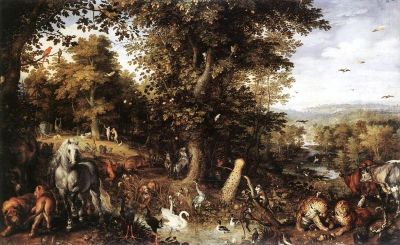
Spending time in silent contemplation with a focus on what we could have been, and still could be, seemed the only way for me to center myself and see the world as good. So today I offer as our prayer of the week another Visio Divina using the above painting of the Garden of Eden by Jan Brueghel.
Prayer Practice:
1. Study the picture slowly, taking a first glance noting the colors, the placement of the plants, animals and, people. Remain with the image for one to two minutes. If you would like, jot down a few words about the image.
Take a second, deeper, look. Where is there movement? What relationships do you see? Engage your imagination. Where are you in the artwork? What do you see from that perspective? What deeper meaning emerges? What feelings about the world rise in you? Are there any images that you are particularly drawn too?
Respond to the image with prayer for the world. Did the image remind you of an experience, person or issue for which you’d like to offer thanksgiving or intercession? Offer that prayer to God.
Find your quiet center. Breathe deeply. Relax your shoulders, arms and legs. Rest in this quiet. Let God pray in you. God prays beyond words.
Please do not let your belief, or non-belief, in the Garden of Eden and the subsequent fall from grace prevent you from seeing the good things in creation. Our world is in need of prayer right now. All of our people, all of creation is crying and in pain. Let your prayers go out into the world and let them lead you to be the person God has always wanted you to be.
















 A Quiet Walk