John 1:1-5 In the beginning was the Word, and the Word was with God, and the Word was God. 2 He was in the beginning with God. 3 All things came into being through him, and without him not one thing came into being. What has come into being 4 in him was life, and the life was the light of all people. 5 The light shines in the darkness, and the darkness did not overcome it.
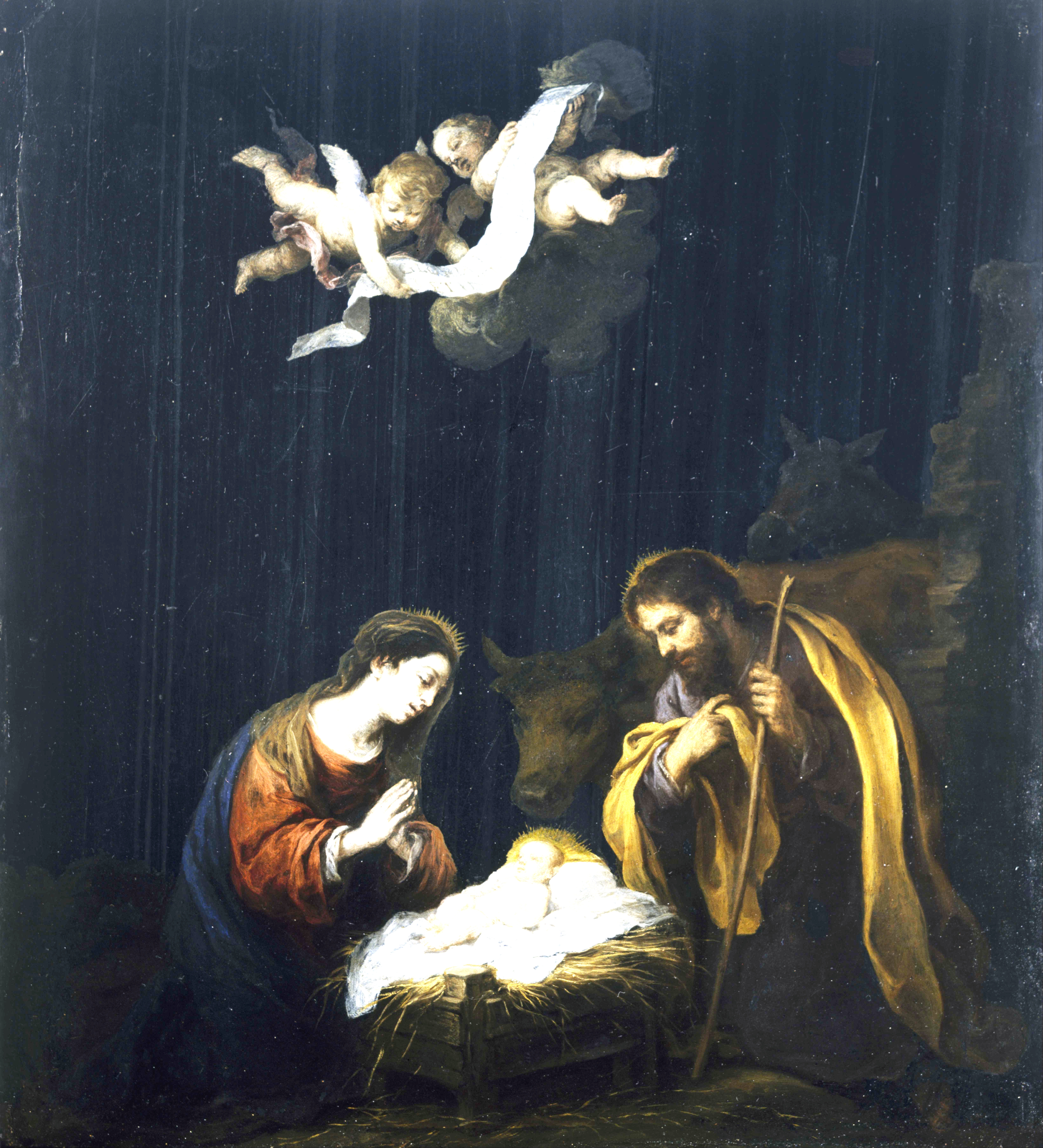
The Nativity, Bartolomé Estaban Murillo, (1617-1682)
This is one of my favorite paintings of the birth of Jesus. There is just something about the expressions on Mary and Josephs faces as they look at the new small being in their life that draws me in. I once saw the original in the Boston Museum of Art and this tiny painting on black slate captivated me as no others have.
However, I must admit that despite loving this painting, I don’t see the nativity as an actual historical event. It has been a long time since I believed in the virgin birth. I am a scientist by training and I know that while ‘virgin’ births do happen in nature, it’s called parthenogenesis, they only occur in certain species of worms and small crustaceans called daphnids. So this event was a no go for me not long after my first serious biology class. But the importance of the birth story is not in history, it is in the symbolism of new life breaking into the world in the form of God within the person of Jesus of Nazareth. New life, not of a baby’s, rather a new life lived in a world where all achieve their God given potential. Living in the world as Jesus did, with limitless love and compassion, offering justice and mercy to those who are in need, and offering a peace that fills the soul. Well then again maybe it is like the birth of a baby, for we all experience new insights as new birth within us.
So why I may not believe Jesus was born in an actual stable I do believe he was been born in the stables, and dark corners of our minds, societies, and cultures. Jesus is the one who birthed new life in those dark recesses of our hearts and minds. Who lit up the alley ways where suffering, pain, and violence reside bringing the light of love to those who were the unlovable. In prayer and action we, you and I, continue to carry that light. We take it to prisons, hospitals, hospice rooms, to the homeless, to the hungry, to anyone in need of the light provided by “The Way.” At least we are supposed to.
Today I ask you to use the above painting for your Prayerful Tuesday Meditation using Visio Divina.
Visio Divina
Look at the painting slowly, taking a first glance and noting the colors, people, places and things. Remain with the image for one to two minutes. If you would like, jot down a few words about the image.
Take a second, deeper, look. Where is there movement? What relationships do you see? Engage your imagination. Where are you in the artwork? What do you see from that perspective? What deeper meaning emerges? What moves you in this painting? Does it draw you in or call to you in any particular way?
Respond to the image with prayer. Did the image remind you of an experience, person or issue for which you’d like to offer thanksgiving or intercession? Offer that prayer to God.
Find your quiet center. Breathe deeply. Relax your shoulders, arms and legs. Rest in this quiet. Let God pray in you. God prays beyond words.
May you be blessed with the birthing of new life within you. Merry Christmas everyone.
As I am personally preparing for Christmas I have been disturbed by the amount of violence and death around the world. Peace on earth does not seem near. So as part of my morning ritual I have been doing Lectio Divina with the Psalms. They have brought me some comfort but this Psalm struck a chord within me and I wanted to share that with you. So this is a little different from most of my postings, as it is part of my journaling during my meditation. I am letting you in on a small part of my conversations I held with the Psalmist and God. They are my insights of the moment, so if I say something you disagree with please be gentle, it is after all a private conversation you are overhearing. At the end of my journaling you will find the steps for Lectio Divina. For your own Lectio Divina meditation you may use the whole Psalm, as I did, or only a verse or two.
Psalm 10, The Message (MSG)
1-2 God, are you avoiding me? Where are you when I need you?
Full of hot air, the wicked are hot on the trail of the poor.
Trip them up, tangle them up in their fine-tuned plots.
I am in the process of preparing for a Longest Night worship service and in reading this Psalm I was struck by how it matched my gut feelings this Advent. Every day the news is filled with stories from around the world of someone killing someone one else, often many someone’s. Just last night news came of a hostage situation in Sidney, Australia, just one more story to add to the Ferguson, New Town, Cleveland, Seattle, Portland, Houston, Afghanistan, and Iraq stories of the last number of years. The list is too long, too many people have died, and too many children have died. Like the Psalmist I am left wondering “where are you God.”
3-4 The wicked are windbags, the swindlers have foul breath.
The wicked snub God, their noses stuck high in the air.
Their graffiti are scrawled on the walls: “Catch us if you can!” “God is dead.”
This is supposed to be a time of joy and celebration but I do not feel like celebrating. Our elected leader’s mouth words from the Bible I read every day, yet, their actions tell me they do not believe what they speak. Are they wicked? Are they windbags? Well the wicked part can only be determined by God but the windbag part . . .. Yes they are windbags, hoping that we who at least try to live a life of compassion will not notice their plans to take the last ounce of God’s abundance all for themselves. They write bills and say “try and stop me, from denying the basic necessities to those who cannot help being poor, sick, elderly, or a child.
5-6 They care nothing for what you think; if you get in their way, they blow you off.
They live (they think) a charmed life: “We can’t go wrong. This is our lucky year!”
These insufferable, so called leaders lie and twist the truth until even the best of us are confused and dazed by the avalanche of untruths they let loose on the public. Whether they are religious fundamentalist, political leaders, in the United States, Afghanistan, Syria, Iraq, British Isles or anywhere they claim the spotlight and they believe no one can stop them. They are on a role and the rest of us “be damned.”
7-8 They carry a mouthful of hexes, their tongues spit venom like adders.
They hide behind ordinary people, then pounce on their victims.
9 They mark the luckless, then wait like a hunter in a blind;
When the poor wretch wanders too close, they stab him in the back.
10-11 The hapless fool is kicked to the ground, the unlucky victim is brutally axed.
He thinks God has dumped him, he’s sure that God is indifferent to his plight.
The words they spit from their mouths cause fear in those who have minds that are weak and malleable. Letting these poor souls do the violence they pretend to abhor only to turn on them when they caught in their snares.
12-13 Time to get up, God—get moving.
The luckless think they’re Godforsaken.
They wonder why the wicked scorn God
and get away with it,
Why the wicked are so cocksure
they’ll never come up for audit.
We wait for you O God to respond, to let us know you haven’t forgotten us. We wait and we wait.
14 But you know all about it— the contempt, the abuse.
I dare to believe that the luckless will get lucky someday in you.
You won’t let them down: orphans won’t be orphans forever.
The Psalmist sings of your knowledge of the violence we see every day. But do you really hear the cries of the children who have lost limbs to bombs, to parents who have watched as their children are killed in front of them, as ISIS hangs those with different beliefs, as children shoot children? Have we not sent enough children, parents, loved ones to you to serve as a sacrifice? Do you care?
15-16 Break the wicked right arms, break all the evil left arms.
Search and destroy every sign of crime.
God’s grace and order wins; godlessness loses.
My heart wants to believe as the Psalmist did that you will intervene in the bloodletting of this world, but I know you will not. It is not up to you, O God, to set this world back on the track of compassion, justice and peace. That really is our job. We are the ones who created these people who mock everything you have wanted for all. We are the ones who must “gird up our loins” and speak out against injustice, violence, hatred, and war. Only we who believe in justice, mercy, kindness, peace, compassion will change the lives of those who are oppressed, abused, injured, and starved by those who mock the world as you, O God, planned it. We must stop cowering in our homes and our places of faith and become the prophets, the messengers, the hands, feet and voice that will bring down those who would enslave us to a life of poverty and misery. Then, and only then, will the Psalmist’s dream come true.
17-18 The victim’s faint pulse picks up; the hearts of the hopeless pump red blood as you put your ear to their lips.
Orphans get parents, the homeless get homes.
The reign of terror is over, the rule of the gang lords is ended.
Gracious Spirit I thank you for this time of blessed meditation. May the words and images I have seen transform my actions into walking with you in greater joy. AMEN
Practicing Lectio Divina
Choose the portion of the Scripture you wish to pray.
Place yourself in a comfortable position and allow yourself to become silent, focus for a few moments on your breathing.
Read the chosen text through, slowly and gently. Listen to yourself read, let yourself to savor each word and phrase.
Read the text a second time. What words or phrases stick out for you? Remember God speaks to us in silence and in our listening. The words that pop out do so for a reason, pay attention to them.
Read the text a third time. Are there any other words that speak to you?
Sit now in silence, letting the words you have heard, speak to you and for you in your prayer, your conversation with God. What images, ideas, words spring forward? Or maybe all of them are present in mediation. Sit with those insights as you experience the presence of God. Give your insights to God. Do the insights give you new meaning or transformation of your actions, or prayer life?
Now rest in God’s arms. Let God’s presence give you comfort. Do you feel the pull to return to your meditations? Then begin again. If not close with a prayer of gratitude for the time you have spent in God’s presence and the insights you have received.
16Rejoice always, 17pray without ceasing, 18give thanks in all circumstances; for this is the will of God in Christ Jesus for you. – 1 Thessalonians 5:16-18, (NRSV)
To pray always, without ceasing, seems like an impossible task. Seeing God in every thing, every action we do, every moment of our lives opens doors of our hearts, and the Spirit of God moves in. We don’t become Pollyanna’s seeing only the good in people. We see the suffering and trials of those around us and in seeing God in their faces we open our hearts and let God’s compassion move us to be the arms and legs, the body, of the Holy Spirit. We are motivated to give the solace, love, support to those who are in need just as Jesus did on the streets and fields of Judea.
The suffering of our communities, nation and world overwhelms, frightens us and as the troubles increase exponentially we ask does prayer really do any good. Offering a prayer for someone walking in the dark places of life, does let them know they aren’t alone, that someone, somewhere is keeping them in their hearts. But even more important is the prayer that motivates us to be the Christ on the street, to offer food, and help find shelter. To care for the sick and injured in even small ways that often are not seen in the mad rush to send massive aid. In fact many times it is the small things we do that mean the most to the recipients. Each act is an act of prayer, it is an offering, it is remembering to feed the hungry, care for the sick, visit the incarcerated, and give mercy to the stranger, which all God and Jesus asked us to do.
As you listen to song and watch the pictures pass before you. Let your hearts turn to prayer, where ever you are, you don’t even have stop what you are doing and offer a prayer for what lies closest in heart. Listen; listen carefully in a moment of silence, and throughout your day, for words of encouragement from God. Look into the faces of each person you meet and see the face of God. Each of you, all of you, no matter what you do, or have done, is beloved by God. Let your eyes be opened to love that shines in the eyes of each other, and ears be opened to the voice of God in the voice of the next person you meet.
May the peace of God be with you, now and forever more.
Galatians 3:26-29 The Message (MSG)25-27 But now you have arrived at your destination: By faith in Christ you are in direct relationship with God. Your baptism in Christ was not just washing you up for a fresh start. It also involved dressing you in an adult faith wardrobe—Christ’s life, the fulfillment of God’s original promise. 28-29 In Christ’s family there can be no division into Jew and non-Jew, slave and free, male and female. Among us you are all equal. That is, we are all in a common relationship with Jesus Christ. Also, since you are Christ’s family, then you are Abraham’s famous “descendant,” heirs according to the covenant promises.
I am traveling this week. I am attending a wedding in Long Beach WA this weekend but my first stop was in Yakima where I attended the Turner Lectures., an interfaith lecture series held every year in the first week of October by the North West Region of the Christian Church (Disciples of Christ) (NWRCC). The NWRCC invites prominent authors and theologians and hosts for three days of a teaching, discussion, good conversation, and meaningful worship. This year Michael Kinnamon and Carol Howard Merrit are our guest lectures and their talks and discussions of the Past and Future Church:From the Ends of the Earth to Our Doorstep are inspiring. I am part of the team that planned the worship services and one of the elements of our morning worships has been guided meditation on the morning’s scripture. Guided meditation is a wonderful spiritual tool that uses our imagination to enter into story, or scripture, in a very personal way. In our imagination we are feel the warmth of the sun, stirring of the wind, all of the natural elements. We can smell food, or feel the presence of crowds or feel emptiness. Using our imagination we “see” the story from a new perspective, not as a distant reader, but as a participant.
Monday I read Galatians 3:26-29 and led the morning’s guided meditation. I invite you to take a few minutes, get comfortable and listen to the scripture and meditation. The full text of the meditation is below
I invite you to get comfortable, with feet on the floor
Take a deep breath and another one.
You have been walking a long time you are tired and covered in road dust
Ahead of you a small village appears at the edge of lake. You have arrived
You have been searching anticipating the end of your journey and now it is in sight
Villagers wave to you and you wave in return the people walk out to greet you the young and the old, people of every color in the human rainbow, people wearing clothes of every cultures all come out to welcome you In front the growing group, God, waits for you with open arms
Someone relieves you of your back pack as God enfolds you in an embrace a flask of water is pressed into your hand Jesus, offers you a place to rest, breaks bread with you and offers you wine. you didn’t know how hungry you were.
They take you to the lake where you bathe in it’s cool, refreshing waters when you step out of the water new clothes await you, new shoes, soft as down for your tired feet.
The villagers celebrate your coming with a great dinner food from every culture, every ethnic group all created for a joyful feast
God dances with joy
You are home a child of the village
You have new clothes
you have eaten food that has fed you deeper than any food possibly could
the villagers hand you your pack, cleaned and freshly filled
God, Jesus, and the villagers shoulder their own packs
together you walk on
Together you complete the journey
But you are not in the flesh; you are in the Spirit, since the Spirit of God dwells in you. Romans 8:9a
Matthew 13:1-9, 18-23
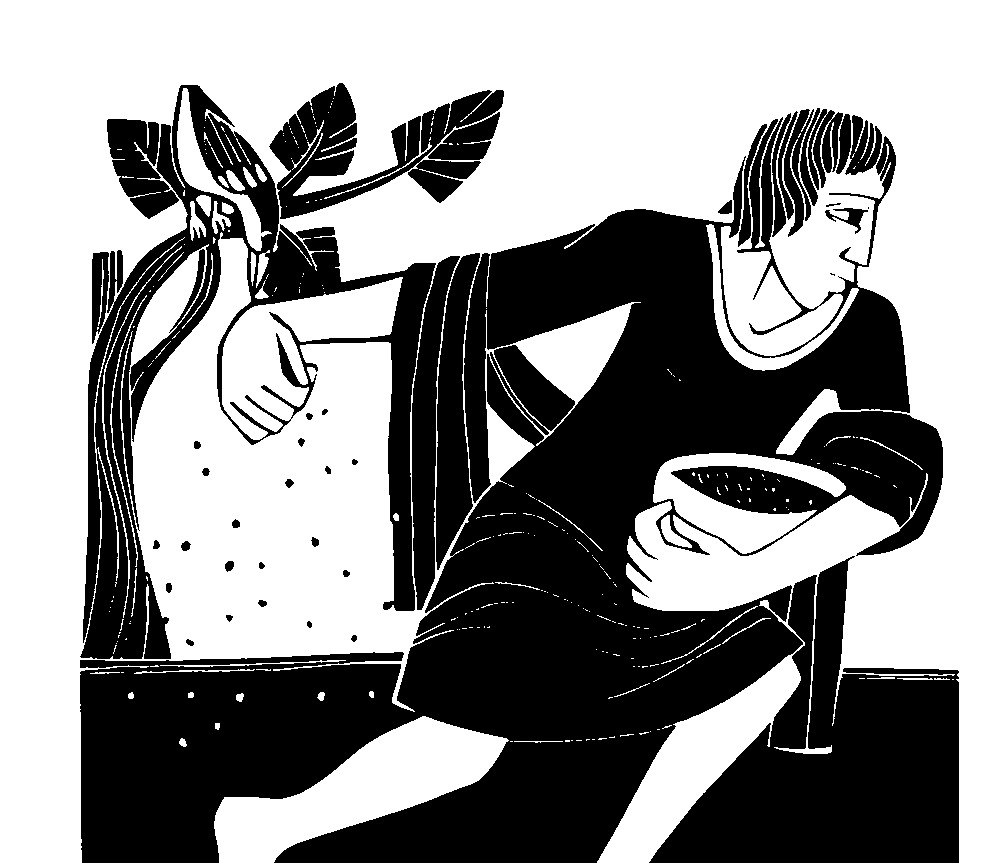
1That same day Jesus went out of the house and sat beside the lake.2Such great crowds gathered around him that he got into a boat and sat there, while the whole crowd stood on the beach.3And he told them many things in parables, saying: ‘Listen! A sower went out to sow.4And as he sowed, some seeds fell on the path, and the birds came and ate them up.5Other seeds fell on rocky ground, where they did not have much soil, and they sprang up quickly, since they had no depth of soil.6But when the sun rose, they were scorched; and since they had no root, they withered away.7Other seeds fell among thorns, and the thorns grew up and choked them.8Other seeds fell on good soil and brought forth grain, some a hundredfold, some sixty, some thirty.9Let anyone with ears – listen!’
18 ‘Hear then the parable of the sower.19When anyone hears the word of the kingdom and does not understand it, the evil one comes and snatches away what is sown in the heart; this is what was sown on the path.20As for what was sown on rocky ground, this is the one who hears the word and immediately receives it with joy;21yet such a person has no root, but endures only for a while, and when trouble or persecution arises on account of the word, that person immediately falls away.22As for what was sown among thorns, this is the one who hears the word, but the cares of the world and the lure of wealth choke the word, and it yields nothing.23But as for what was sown on good soil, this is the one who hears the word and understands it, who indeed bears fruit and yields, in one case a hundredfold, in another sixty, and in another thirty.’
The word of the Lord
Please join me in prayer:
Source of Life may all that offer this today be acceptable in your sight, Amen.
———
Today’s scripture is a popular one among biblical storytellers and so all of us have heard this many times in many ways. We have heard many interpretations as well, so many in fact that in all likelihood we all think “Oh I know that one, it’s an old one and I like what it says.” I thought the same thing, at first, but then I began to look more closely at what was being said and what I thought I heard and what I was actually hearing. I was surprised to realize, I hadn’t heard it all.
Parables are multi-layered, like a Russian doll, you think there is only one doll until you start opening it up and discover many little dolls hiding within. Parables are like that, layers wrapped in layers. I didn’t read the middle portion of this scripture where Jesus tells his disciples one very important lesson, and that is those who want knowledge will open his parables up to discover the many layers, messages, hidden within, and those who don’t will simply hear a story about a really bad farmer. So I am going to try and open this story up bit, and, maybe we will find a layer within we didn’t expect.
Because this is such a familiar story to all of us I am going to try something a little different this morning and hope that we all see this story in a new light. Because this is such a visual story I am going to lead you in a guided meditation. I am going to read only verses 1-17; so get comfortable, with both feet on the floor.
Now close your eyes and take a deep slow breath, let it out slowly, … take another deep slow breath, … let it out slowly.
You are one of the disciples of the teacher Jesus and after spending the night in the home of a friend Jesus goes out early in the morning to the shore of the Sea of Galilee. … Many people come to see and listen to this teacher of yours and to hear what he has to say, … so many in fact that there is no room for Jesus … to sit or stand on the beach. … Jesus asks one of your fellow disciples to get a boat and pull it up on the shore. … He gets in and asks everyone to sit. … You and the other disciples sit in the sand forming a half circle around the boat and the crowd finds their places behind you. … As you sit and wait for the crowd to become silent you are aware of your surroundings, … of the sound of the water lapping gently on the shore, shore birds calling, … a gentle breeze blows across the water, … and there is the pleasant smell of fresh fish coming from the boat. … The sun hasn’t yet climbed far into the sky but it is warm on your back and the sand is still comfortably cool.
Jesus begins to speak.
“‘Listen! A sower went out to sow. … 4And as he sowed, some seeds fell on the path, … and the birds came and ate them up. 5Other seeds fell on rocky ground, … where they did not have much soil, and they sprang up quickly, since they had no depth of soil. 6But … when the sun rose, they were scorched; and since they had no root, … they withered away. 7Other seeds fell among thorns, and the thorns grew up and choked them. … 8Other seeds fell on good soil and brought forth grain, … some a hundredfold, some sixty, some thirty. … 9Let anyone with ears – listen!’”
You and your fellow disciples are confused by the story … it seems simple yet you know there has to be more to it … or Jesus wouldn’t have told it. … So one of the disciples ask a question; … “Teacher, … ‘Why do you speak in parables? … We are confused but we know there is more to this than a simple story’”
Jesus smiles at you and says:
‘To you it has been given to know the secretsof the kingdom of heaven, … but to crowds … it has not been given. … 12For to those who have, will be given more, … and they will have an abundance; … but from those who have nothing, … even what they have will be taken away. … 13The reason I speak to them in parables is that … “seeing they do not perceive, … and hearing they do not listen, … nor do they understand.” … 14With them indeed is fulfilled the prophecy of Isaiah that says:
“You will indeed listen, but never understand,
and you will indeed look, but never perceive. 15 For this people’s heart has grown dull,
and their ears are hard of hearing,
and they have shut their eyes;
so that they might not look with their eyes,
and listen with their ears,
and understand with their heart and turn—
and I would heal them.” 16But blessed are your eyes, … for they see, … and your ears, … for they hear. … 17Truly I tell you, … many prophets and righteous people … longed to see what you see, but did not see it, … and to hear what you hear, … but did not hear it.
[Pause for moment and then ring the chime]
Well did you hear a new message in the story? Did you hear the story open up in a new way and did you find a new layer that you hadn’t seen or heard before? I cannot speak for you I can only speak of my own heart. I can only speak of what I have heard. And, I would like to offer my budding new understanding of this parable, a new layer for me. Your new layer maybe different from mine and that’s ok, we learn from each other and my layer of this story may or may not resonate with yours but it might be a layer you hadn’t seen before and cause you to think. I hope you will tell me yours sometime so that you will cause me think.
So here is the new layer I discovered as I listened to Jesus. I didn’t feel like a disciple in the story, rather I felt like one of the crowd who was thinking about following Jesus. When I heard the story I thought Jesus was comparing me to the seed being sown and I wasn’t sure I liked what I heard. I was close enough to hear the question of the disciples and Jesus answer and my first thought is “How rude of Jesus not to make the message plain to all of us.” Then I thought again, “OK, if there is a hidden message, what is it? And, how do I tease it out?”
As you can see this internal conversation has caused me to almost miss the rest of the Jesus’ answer so I listen again and hear.
“18 ‘Hear then the parable of the sower. 19When anyone hears the word of the kingdom and does not understand it, the evil one comes and snatches away what is sown in the heart; this is what was sown on the path. 20As for what was sown on rocky ground, this is the one who hears the word and immediately receives it with joy; 21yet such a person has no root, but endures only for a while, and when trouble or persecution arises on account of the word, that person immediately falls away. 22As for what was sown among thorns, this is the one who hears the word, but the cares of the world and the lure of wealth choke the word, and it yields nothing. 23But as for what was sown on good soil, this is the one who hears the word and understands it, who indeed bears fruit and yields, in one case a hundredfold, in another sixty, and in another thirty.’”
Ah … the story isn’t about being a careful farmer and planting the seed in good, rich and well watered soil after all. Rather it’s about who will have the staying power to follow Jesus and spread more seeds. OK, I get. But I still have questions. You see I do some farming, and yes my harvest is best when the seed is grown in the right place, but like all good farmers I’ve learned that seed that falls in difficult soil has its good qualities as well, it is often more hardy and will survive when no other seed would. What would it look like if considered for a moment the seed in this story and thought about how what the seed does and how that helps the sower? If I am going to be a seed for the Kingdom don’t I need to be strong?
Don’t I really need to work hard and build up my strength because this won’t be an easy task? So maybe falling on dry hard ground where I have to quickly dig deep into soil, taking up as much water as I can and learn to make efficient use of nutrients when they are available in order to grow. Wouldn’t that be a good thing? I know seeds that do that and they do well in dry places.
Or, what about the seed that falls on thorny ground and to prevent being overrun by thorns adapts and develops protection that would keep the thorns from killing me. I’ve seen plants do that as well so I know it works and such plants thrive. Or, consider the seed that falls on rocky ground. Here I have to learn to extend my roots around obstacles, breaking down some of the rocks into new soil. With deep, strong roots, I will do quite well, I know that because I’ve seen plants that do. So while I’ve not landed in an ideal place, I learned to survive and I may have produced only 10% compared to the 30 or 60% of the seeds planted in good soil. But that’s still something and there will be seeds for the sower to spread around in the next year. And if there is a draught, or someone seeds the farmers field with weeds, or he has to sow his seed in a rocky field I know that the seed that has had to struggle will do very well and produce a crop, which could mean the difference for the farmer between eating and starving.
How do I compare that scenario to Jesus answer? Well being a seed on the dry, hard ground of kingdom means I have to work hard at understanding. Not giving up but keep digging for the treasure found within me and those around me even when it seems hopelessly dry. When, I land in an area where the temptations of the world try to tear me away from my path to follow Jesus, I have to work harder to keep the message of the kingdom in front of me while I work within the world. And, when I hear the kingdoms message and find it sweet like honey but the world lays obstacles in my path I have to remember to let my roots grow with study and contemplation in order to break down the rocks in my path so that I am able to spread my seed-children, the good news of the Kingdom, in new soil.
Why wouldn’t I want to be planted in nice rich soil, with plenty of nutrients, in other words, why would I not like the task of spreading the word of the kingdom to be easy? Well, from a farmer’s perspective, seed that is always grown in nice rich soil does produce a lot of seed; however, a lot of that seed will not have the ability to fight off disease, or draught. That means if there is any kind of environmental stress your crop will most likely fail. However, if you harvest seed from plants that have had to withstand stress the resulting plants will be strong and healthy even under stressful conditions and the farmer has a crop to sell and eat.
It’s the same with the seed of the kingdom. If receiving the word is easy and you don’t have to work for it then when something challenges you, you and your community will struggle and maybe not survive. It has been my experience that working hard for anything means I value it more and I learn to distinguish what is false and what is true because I need to do it to live into the message Jesus taught me.
Jesus told this story because he knew what his disciples, and anyone else who followed him, would need strength in order to stand against the world’s trials, temptations, and obstacles as they spread the word of the kingdom of God. He knew they were going to be tested with many trials and how they responded to those trials would test their resolve and determine whether or not the Good News was spread. So his disciples were going to have to dig deep into inner territory, sending down strong roots into their soul to anchor their faith and learn to protect themselves from thorny individuals by loving instead of hating them. So you see it wasn’t the easy road and productive communities that defined the movement called THE WAY, it was those who experienced suffering, struggle, trials, doubts, who loved their enemies despite persecution that defined the followers of Jesus.
That definition of struggle and hardship is what defines us today, or should be anyway. Maybe in years past some of us have had it so easy to be “Christian” that we have forgotten what it means to be a follower of THE WAY. Those who cannot bring themselves to dig deep within, to doubt, question and be willing to live into mystery and paradox may fall by the way side. But some will strike out into the wilderness and learn how to thrive and how to spread the Good News despite draught, thorns or obstacles.
So my question to each of you is what do you identify with in this parable? Mine was the seed on less than ideal ground. Are you the seed on good soil, but when disaster strikes you are unable to go on? Or, are you the seed that lands in dry, thorny, rocky land, are you the seed that fights and struggles bringing into fruition the best fruit you can? We all have choices; I’ve chosen what I will do. How do you choose?
I watched a PBS program the other night about Shakespeare’s Macbeth and one insight of the host made me sit up and take notice. The play of Macbeth, as Shakespeare tells it, is about the ego. You see Macbeth let his own and his wife’s ego control his life and I resonate with that. As of late I am wrestling with my own ego issues. Now I doubt I am going to go and kill anyone to get ahead, although metaphorically speaking I may have done that already, but right now I am trying to separate my desires from the desires of God. To be honest I don’t think I’m doing a very good job. The question I ask myself (ok questions) ‘is what I want what God wants for me and from me,’ or ‘am I telling God what I want and just assuming that it is what God wants to do.’
You see telling the difference between those two things is really very difficult. God doesn’t speak in direct ways. Rather, God speaks through the voices of those I love, the actions of others, or my own emotional response to things, but God never makes a telephone call, writes an e-mail, or even makes a Facebook® post, as much as I would appreciate that. Sitting in silence and letting go of my expectations is wonderful but how long do I sit before I begin to wonder if anyone listening?
So how do proceed? Well for me it is learning (and re-learning over and over again) patience and letting go of the necessity to be anything other than who I am. That doesn’t mean I have no ambition it just means that I begin by changing how I view the world around me. Is the world here for my benefit or am I here for the worlds? If I am here to benefit the world than what I do should provide those around me with the love, compassion, kindness, justice and peace that God calls me to offer without expecting a reward or recognition. For me, as I’m sure everyone else, that is hard to do, we are, after all, ‘required’ to list our skills and what we have done with those skills whenever we apply for job or even volunteer. I’m not sure putting down my skill as “walking with God” (Micah 6:8) is enough for most people. So that is my dilemma, how do tell the difference between “walking with God” and a desire for getting ahead in this world.
Life is rarely simple and well defined and looking for answers by sitting and listening for a ‘word’ from God is not an easy thing to do. Currently, I am in one of the proverbial ‘dry places’ in my prayer and spiritual life that happens to all of us. I am questioning whether God is even listening to me, or even if there is a God. Such questions and doubts are difficult to face and are frightening to think I may have wasted my life in pursuit of God. All I can do is continue to sit in silence and wait; to practice praying the scriptures and pray for an insight; and to pray the call of blind Bartimaeus “Jesus, Son of David, have mercy on me” (Mark 10:42). Instead of worrying about not ‘hearing’ from God I ‘should’ understand this is a time for me to rest and let silence enfold me and let the silence create its own richness and prayers that I cannot speak. And maybe I have to remember that I do not have to pursue God. God actually sits near by waiting for me to surrender my ego and open the eyes of my heart to that Divine presence. It is remembering prayer isn’t about receiving answers it is about sitting with God, creating space for God to move in my life in ways my ego will never understand.
Roman 6:1-11 What then are we to say? Should we continue in sin in order that grace may abound? 2By no means! How can we who died to sin go on living in it? 3Do you not know that all of us who have been baptized into Christ Jesus were baptized into his death? 4Therefore we have been buried with him by baptism into death, so that, just as Christ was raised from the dead by the glory of the Father, so we too might walk in newness of life. 5For if we have been united with him in a death like his, we will certainly be united with him in a resurrection like his. 6We know that our old self was crucified with him so that the body of sin might be destroyed, and we might no longer be enslaved to sin. 7For whoever has died is freed from sin. 8But if we have died with Christ, we believe that we will also live with him. 9We know that Christ, being raised from the dead, will never die again; death no longer has dominion over him. 10The death he died, he died to sin, once for all; but the life he lives, he lives to God. 11So you also must consider yourselves dead to sin and alive to God in Christ Jesus.
Matthew 10:24-39 ‘A disciple is not above the teacher, nor a slave above the master;25it is enough for the disciple to be like the teacher, and the slave like the master. If they have called the master of the house Beelzebul, how much more will they malign those of his household! 26 ‘So have no fear of them; for nothing is covered up that will not be uncovered, and nothing secret that will not become known. 27What I say to you in the dark, tell in the light; and what you hear whispered, proclaim from the housetops. 28Do not fear those who kill the body but cannot kill the soul; rather fear him who can destroy both soul and body in hell.* 29Are not two sparrows sold for a penny? Yet not one of them will fall to the ground unperceived by your Father. 30And even the hairs of your head are all counted. 31So do not be afraid; you are of more value than many sparrows. 32 ‘Everyone therefore who acknowledges me before others, I also will acknowledge before my Father in heaven; 33but whoever denies me before others, I also will deny before my Father in heaven.34 ‘Do not think that I have come to bring peace to the earth; I have not come to bring peace, but a sword. 35 For I have come to set a man against his father,and a daughter against her mother, and a daughter-in-law against her mother-in-law; 36 and one’s foes will be members of one’s own household. 37Whoever loves father or mother more than me is not worthy of me; and whoever loves son or daughter more than me is not worthy of me; 38and whoever does not take up the cross and follow me is not worthy of me. 39Those who find their life will lose it, and those who lose their life for my sake will find it.
For 10 years I was an environmental consultant performing Human Health and Ecological risk assessments for the military and private concerns. One of the uses of my reports was to define what would be the cost of a cleanup of a contaminated site both as risk of exposure and monetary cost of cleanup. The EPA has a basic cleanup target of 1 in 10000 chances of illness or death from exposure to contaminated soil, water, or air. Of course all is negotiable but that is what is desired. The EPA doesn’t really care about cost but companies do and so does the military. Cleanup is not popular with those who own the property. There is a balancing act that goes on at the negotiation table between the EPA and the owners of the property. The property owners want to remove as little as possible to keep cost down and the EPA wants as much removed as possible to keep risk down. When you add in resident and ecological groups to the mix you probably get some idea of how complicated such negotiations can be. But the key word is negotiable.
Matthew writes in this passage what the cost of discipleship will be for those who follow in the path of Jesus. He tells his community what the risks are when you commit to following Jesus’ teaching and he doesn’t mince any words and the cost is not negotiable. For those who are faithful to God and Christ will face criticism, be misunderstood, run out town, and face death at the hands of the Romans just as Jesus did. How is that for a recruiting statement? I can hear the thought of a potential follower now. “Ok, my family will disown me, I will most likely be run out of town on rail, I will have my words twisted around to mean something other than what I said, and the Romans are going to kill me, tell me again why I should sign up for this.” If a follower of the WAY ever thought about the risks they wouldn’t sign up. I mean would you give up everything to go out and teach others about the WAY of Jesus. Would you give up the king-size bed, the running water, the clean clothes, or 3 meals a day? What is amazing to me is that anyone actually did and I am grateful to those who had, and have, the courage to walk that difficult path.
Matthew wanted his community to understand those risks while having the courage to choose a way of life that would be difficult but result in a life lived within God as found in the life of Jesus. Matthew’s words challenge us to stand up for injustice just as Jesus did. To use our voice to speak for those who are silenced. To live a life of compassion and peace towards everyone no matter how different they may be from us; from a different culture or socio-economic class, differently abled, or differently gendered, or (and this is the hard part) even if they have done harm to us or someone we love. Matthew says we are called to right injustice even at the expense of our own comfort, reputation, relationships, financial security, or even our lives. That is a hard decision to make and I know I (as a risk assessor and a seminary student) that discernment before that decision to be baptized and commit to that life is often very difficult. And let’s face it the reasons to proceed are not all that well laid out. So where do we find some answers.
Well before Matthew wrote his Gospel Paul wrote a letter of introduction to the Roman community and in that letter we have this short passage that summarizes reasons for following the WAY and those reasons are just as valid today as they were in the 1st century. Following the WAY was dangerous and even Paul doesn’t deny that but the benefit is a life lived into love.
Paul tells the Romans, and us, that when we commit ourselves to being baptized we are baptized into the death and resurrection of Christ. Just as Christ died to sin and lives to God we are to recognize our baptism as dying to sin and living into God. Notice I didn’t say Christ died FOR our sins, Paul did not believe Jesus died because God wanted a sacrifice for our sins. No, Jesus death on the cross saves us because God overcame and said No to sin through his resurrection of Christ. God’s message of Jesus’ life, death, and resurrection was to reconcile those who are separated from God back into those loving arms. Called Atonement, or better still “at-one-ment,” reconciliation is the means of re-membering those who have spent their lives lost in a wilderness far from God back into the body of God through Christ.
When Paul writes “So you also must consider yourselves dead to sin and alive to God in Christ Jesus” he is talking about saying no to sin and moving toward God as experienced in the life, death, and resurrection of Jesus. Marcus Borg and John Dominic Crossan in their book Meeting Paul open the verse 6:3-4 to a new insight
“all of us who have been baptized into Christ Jesus were baptized into his death? 4Therefore we have been buried with him by baptism into death, so that, just as Christ was raised from the dead by the glory of the Father, so we too might walk in newness of life.”
We are graced with newness of life that includes a transformed way we see our world. A commitment leading to the ritual sacrament of Baptism results in a “renewing of [our] minds.” We being to see the world differently, living our lives into a richer and fuller life in love. We no longer see the world as other and different from ourselves but rather we see ourselves and the world as part of the body of God and Christ.
For Matthew, for Paul and for us these changes and commitments have political implications. It means we as followers of the WAY are to stand against the “wisdom of this world” as it is known today. We are to refuse to follow a path that results in harm, injustice, or death for anyone, whether we agree with them or not.
That is hard to do, I know it is hard for me. I too have watched the news and read the papers about mass shootings, people who demonize the poor and needy and I get angry. Sometimes I say things I might regret because I want them punished; you see I also forget they are part of God’s body. As a consultant I tried to tell the truth as I calculated it and saw it but I dealt with people who had very different agendas from mine. I grew frustrated and angry at people who only looked at the “bottom line” or a single unachievable number instead of considering how what they had done, and will do, affects those who live in the area, human and ecological. I wanted things to change and it wasn’t until I realized that the change must begin with me that I knew what I would do. I had to stop seeing the world with a “bottom line” perspective because all of creation, human and non-human are simply too important..
In Matthew Jesus says “Those who find their life will lose it and those who lose their life for my sake will find it.” The life I lost is the one that holds tight to the world I see in the news reports while the life I gain is a life lived in relationship with God. While I often forget that I try to remember, what all of us need to remember are these words of Jesus’ “Do not be afraid … I am with you always, to the end of the age.”





 A Quiet Walk