A Christmas Prayer

Inspired by a poem by Robert Louis Stevenson

Photo by NASA
Photo by NASA

Loving God, Help us remember the birth of Jesus,
that we may share in the song of the angels,
the gladness of the shepherds,
and worship of the wise men.

Let us close the door of hate and open the door to Peace
and in the window set the candle of Love to shine into the world
Let kindness come with every gift and Hope with every greeting.

Deliver us from evil by the blessing which Christ brings,
and teach us to be merry with clear hearts.
As we are forgiven let us be forgiving, for Jesus’ sake.

May our Joy at the birth of Christ
make every morning a Christmas morning
and every evening may our song of gratitude for your blessings
lull us to sleep.
Amen.

Ruth Jewell, ©December 30, 2015

A Difficult Task – Prayerful Tuesday

complex_celtic_cross

St Patrick’s Breast Plate Prayer

Christ be with me, Christ within me,
Christ behind me, Christ before me,
Christ beside me, Christ to win me,
Christ to comfort and restore me,
Christ beneath me, Christ above me,
Christ in quiet, Christ in danger,
Christ in hearts of all that love me,
Christ in the mouth of friend and stranger.

I have always loved this couplet of St Patrick’s Breast Plate Prayer.  In times of distress it has centered me and given me comfort.  But as I was reading it for the umpteenth time in light of the recent school shootings in Oregon, Arizona and Texas I felt if St. Patrick would mind if I added a couple of lines to his prayer.  You see this prayer says nothing of the compassion, mercy, or Justus we are asked to extend beyond ourselves and into the world.  So St. Patrick doesn’t mind, well even if he does, I think an addition is in order, perhaps something like this:

Christ in the heart of the wounded,
Christ in the hands of the comforter,
Christ in our forgiveness,
Christ in our love for the enemy
Christ in our carrying for those who harm us
Christ in how we live day to day.

This is what I would add, and maybe you would add something else. But whatever you add let your words open your heart to both the victim and the one who commits the crime.  That is what we are asked to do; it is a small thing but Oh so hard to succeed at.

Ruth Jewell, ©October 13, 2015

You Are Invited . . .

Matthew 22:1-14 Once more Jesus spoke to them in parables, saying: 2“The kingdom of heaven may be compared to a king who gave a wedding banquet for his son. 3He sent his slaves to call those who had been invited to the wedding banquet, but they would not come. 4Again he sent other slaves, saying, ‘Tell those who have been invited: Look, I have prepared my dinner, my oxen and my fat calves have been slaughtered, and everything is ready; come to the wedding banquet.’ 5But they made light of it and went away, one to his farm, another to his business, 6while the rest seized his slaves, mistreated them, and killed them. 7The king was enraged. He sent his troops, destroyed those murderers, and burned their city. 8Then he said to his slaves, ‘The wedding is ready, but those invited were not worthy. 9Go therefore into the main streets, and invite everyone you find to the wedding banquet.’ 10Those slaves went out into the streets and gathered all whom they found, both good and bad; so the wedding hall was filled with guests. 11“But when the king came in to see the guests, he noticed a man there who was not wearing a wedding robe, 12and he said to him, ‘Friend, how did you get in here without a wedding robe?’ And he was speechless. 13Then the king said to the attendants, ‘Bind him hand and foot, and throw him into the outer darkness, where there will be weeping and gnashing of teeth.’ 14For many are called, but few are chosen.”

The above text is about how we are invited into God’s grace. However, what we do with that grace is entirely up to us.  We can ignore it, accept it but only on our terms, or completely live into the gift of grace.  What we do will be our choice and that choice will determine how we live our lives.  The following is the text of the sermon I preached on August 23, 2015, at my home church, Queen Anne Christian Church, Seattle, WA.

On a warm June afternoon in 2000 I was sitting at the entrance to the primary hotel in Vallejo CA.  I was waiting for a bus to come and deliver John to me who was taking the bus from the Oakland airport. I could hardly contain myself, you see in just a few short weeks I would be retiring from my consulting job and moving back to Edmonds. John was coming to help me pack-up the apartment and drive with me back to WA.  We would be married in September.  This was the beginning of 6 months of celebration that has extended into nearly 15 years. I had accepted an invitation, I said yes. I knew that in that acceptance I would now be living a new life and one that would require me to make the choice to change from a life of taking care of only me to taking care of someone else. Now that’s a huge change for someone who was 53 and never married.  But it was a choice that I have been grateful for ever since.  As a result I was blessed with a new life that has had its challenges and its joys. That’s what happens when you chose to transform your life.  Life can be a bed of roses, but what you must remember is roses have thorns and you can be sure you will sometimes get stuck with one, or more, of those thorns.

The scripture from Matthew is not only about choosing between accepting and refusing an invitation to a wedding banquet given by a King, it is about choosing between accepting or refusing to live a transformed life of free grace in the way we were meant to live. And, to deciding to live a transformed life means accepting all of that life of grace.  It means we are to commit to live that life no matter what gets thrown at us or how many thorns we run into.  Living a transformed life of grace doesn’t mean there won’t be thorns, or potholes, or great sorrows on your path. It means we have the strength to walk through them.

Matthew’s version of this story, which is also found in the Gospel of Luke, is actually two parables about invitations. It’s a story about a king, who wants to invite people to celebrate the wedding of his son with a banquet.  Matthew adds two additional details to the story; the first is when some of the king’s friends’ killed his slaves and he attacks and wipes out the kingdoms of those who committed those atrocities.[1] It is accepted by most interpreters that this part of the parable, Verses 6 and 7, are an interpretation of Matthew’s who is reading back into this parable the destruction of Jerusalem and the Temple. Matthew adds it because within his community he has people who are struggling with the loss of their ancestral home.  It is not believed to be part of the original parable from the time of Jesus, the oldest version of which is found in the Sayings of Q. Actually these verses are much more characteristic of an interpretation of God from the Hebrew Text rather than the life and teachings of Jesus.[2],[3] Matthew’s second addition are the last 4 verses, verses 11-14,  of the story where Jesus tells one more story of the banquet[4] and this addition is very important in the way Matthew wants us to understand and respond to the divine invitation to a new life.  Together these two parables are stories about the life choices we make and what we do with those choices.

So here we have a story of a King, who traditionally is identified with God, and throws a wedding party for his son, Jesus. Those are the traditional interpretations of Matthew’s King and Son.  But I want to you think about a what if.  What if we look at this story from a different perspective? What if we turn it upside down? What if instead of the King being God the King is Jesus who’s throwing a wedding banquet for the Children of God who he invites to live a new life?  How will that perspective change the way we hear and see these parables?

Now even though the Matthew’s setting of the parable is Jesus defending himself before the religious authorities Matthew wasn’t referring to “the Jewish authorities” as the ones who refused to attend, or that the ones who came were only “Gentiles.” Rather, most interpreters now believe Matthew was addressing his own conflicted community who he wanted to live a transformed life.[5]  The Jewish Jesus followers of Matthew’s community were struggling with the loss of the temple and his Gentile Jesus followers were struggling with whether they should or should not become Jewish. All this would have made for many conflicts between the different factions and Matthew is trying to bridge the gap between them.  I too am not suggesting that there are specific groups being discussed in these parables. So depending on which version you like the best, think of the players in the 1st century as Matthew’s neighbors or in our very own community as our neighbors right now in the 21st century.

So here is how the story might sound if we told it as if Jesus was throwing this shindig? The guests Jesus first invites to his amazing banquet are those he expects will accept the invitation because they already understand, or he thinks they do, what it means to live the transformed life He is offering them.  Jesus wants them to come and celebrate with Him, to become part of the new life that only happens when we accept the Divine invitation.  An invitation of free grace to live the life we are meant to live in the presence of God, Jesus and Holy Spirit.  So he sends his disciples out to bring his guests to the party; the food is ready, wine is poured, the orchestra is tuning up for an all night event.  But his disciples come back and tell him all have refused, all are too busy with the details of life, the minutia of daily living.  So what does he do, after all he has a hall prepared, food on the table, wine chilling, and musicians waiting?  Well, Jesus did just what he told his disciples to do when he sent them out to preach and the invitations they gave were refused. He “dusted the dirt from His sandals” and turns his back on those who refused him and sends his disciples out again into the streets and to the city gates to bring in whomever they find to the party, the good and the bad, the worthy and the unworthy.  With the diligence of his disciples the hall is soon filled to overflowing.

Who were the people from the streets? Well if we think of who are the people of the streets in the 21st century you might first of all think of the homeless tent encampments, or the people living under a bridge, or the man or woman standing on the corner with a sign that says “Homeless vet, needs food and job.” And think of the shop keepers in the poorest parts of any town. It was people like these who were the ones who were welcomed into Jesus’ party. They were the nobodies of the town and here they were going to a big party given by the most important person in town. Can you imagine how they felt?  Can’t you just hear them as they walk to the mansion, “Jesus invited me, me, to his party,” “You too, I can’t believe it,” “I was invited too, and get this, the man said come as I am, how cool is that.”  Unlike Jesus’ first guests these guests weren’t concerned about who would be attending.  It didn’t matter to them that the person next to them was a drug addict, a thief, a prostitute, a shop keeper, or a prosperous business person. They didn’t care if Jesus was failing or succeeding in life. They were excited about being invited.  They understood the importance of being invited to this banquet, this table.  They wanted to have new lives.  Unlike those first invited they knew their old lives weren’t working for them and they were willing to change and live new lives, transformed lives of grace that had meaning.

As the guests enter the hall they see the banquet tables set up with every food imaginable, roast lamb, poached fish, pastries, bowls of fruit, cool drinks, and wine, good wine, not the cheap stuff.  In the corner an orchestra was playing, with real instruments not a wash tub and jug band. Everyone was celebrating, drinking, eating, and dancing to the wonderful music. That is, everyone except this one guy who had piled his plate up with everything it would hold and was eating it in the corner telling anyone who would listen, “well it’s about time this Jesus dude recognized just who makes this town what it is.”  “I deserved this invitation, but don’t expect me to go overboard for him; this is what we should have had all along. In fact I think I will just take everything I can. And I’m going to let this Jesus person know that I’m not going to do anything unless I really want to just because he invited me to this party.”

When Jesus comes in to join his guests he sees this guy in the corner and he says “Ah, excuse me, why aren’t you celebrating. This is a joyous occasion, you come expecting to be fed but you won’t celebrate your new life.  You come in and can’t see the joy of living a life of peace, and justice.  You blame me for your suffering but you did nothing to help those who suffered as well. I was there to help but you wouldn’t come out, is that my fault? You accepted my invitation to grace but only on your terms? It doesn’t sound to me like you understand what it means to come to one of my banquets; I don’t think you belong here, yet.  Show this guy out until he understands what it means to come celebrate a transformed life.”

Jesus knew people had options in their lives. The trouble was those options weren’t working for the majority of the people. True the religious authorities and the Roman authorities were doing ok, but if you look at the number of people who were killed in order for someone else to advance socially or politically their options weren’t working for them either.  So along comes Jesus with an alternative way of living a life that didn’t involve beating up, or tearing down someone else. But Jesus wasn’t offering a new idea.  For centuries the Prophets of Israel were telling the people the same thing. Moses says in Deuteronomy (30:19b) “Choose life so that you and your descendants may live.”  Every Prophet since Moses, including Jesus, has said the very same thing and the people listened and accepted life, for little while, then the ‘easier’ way of greed and self-centeredness takes precedence and the original message of grace goes by the way side.

But what does it mean to choose life?  Well “When you say ‘Yes’ to life you say ‘Amen’ to all of life as a package deal. Thereafter the so-called problems you have with personal injustice do not arise. You renounce your concept of victimhood and the old impulse to complain about being unfairly treated.” A “commitment to life  . . . refuses to make any distinction between your outer life and your inner life, or between secular and sacred spheres of life, or between loving God, loving all of life, or loving one’s neighbor. Nor does it distinguish between your current life concerns or your eternal concerns. On the contrary, it simply calls for an unhesitating and unreserved ethical response to the call of life, the call of Jesus, God, and Holy Spirit – right where you are at this moment in time, at this point in your life,” to live a life where you defend justice for all and refuse to accept injustice for anyone as an expedient to living.[6] That is what Jesus taught, that’s grace. It’s not new information, its old stuff we haven’t listened to, at least not for long time.

That is what happened to our disgruntled guest.  He may have accepted the Divine invitation of free grace to attend the banquet, but his acceptance had no depth to it, it never went beyond saying I’m here, thanks for the food, see you later. He was glad to accept the invitation to grace but on his terms only. He never truly transformed his whole life.  He never saw that living in the presence of Jesus meant he had to let the inner life make its way to the outer side of who he was.  It meant he had to share the love, peace and abundance of grace with everyone he met, not hoard it. He came to the banquet not because he wanted to live a life transformed but because he wanted what he could get and then live as he always had.  That’s not change, it is not celebration and it’s not joy, and it is not committing to living a transformed life. It’s keeping the old life and saying it was good enough in the past it will be good enough now.

No matter how you tell today’s story it’s about Divine invitations, the acceptance of grace, and how you live once you’ve accepted God’s grace. When John asked me to marry him, I had a number of options.  Like the first invited guests I could have refused and that would have been that.  I don’t know where I would have been 15 years later but I am quite certain it wouldn’t have been here.  But I did say yes and again to that yes I had options as to how I was going to live within this new relationship.  One, I could continue to behave as I have always behaved.  Taking care of me, making sure I had what I wanted and what I needed.  Yes John would be there but our relationship would not have been very deep because I wouldn’t have let him into the deeper part of me, the part of me that would have built the relationship where both of us would have benefited.  These two options were not the ones I chose.  Instead I let John into my heart and said we are partners and what I do and what you do will affect and change who we both are.  We looked at the covenant of our marriage and said we do this together as one, not as two people living their own lives in one house.  When I accepted John’s invitation to marry, when I accepted that covenant, I had no clue as to what that might look like, but I knew I was going to have to change if I was going to make my life with John. And yes it hasn’t always been sunshine and flowers.  Sometimes we have had our thorny moments. But it was because we chose to live a life together as one that we had the strength to overcome all thorns and rocks in our path. While my wedding story wasn’t about God’s grace specifically, by accepting my invitation I discovered grace in a way I did not expect, and that is how it sometimes work.

Jesus invites us to a banquet of grace, he welcomes every single one of us to His table, and He doesn’t ask questions about our past or how many times we haven’t understood, He wants us to come and join Him. To laugh and sing and eat together, to tell jokes, and play games.  To dance to the music that life brings us, and cry together when life brings us sorrows. Jesus asks us to change who we are at our deepest level and live grace filled lives that don’t see differences between us, whether they are gender, racial, religious beliefs, cultural, social, or political.

We can change the world we live in, we can change the world by being the people we are meant to be, a people of grace, by being a people who refuse to accept evil, greed, and self-centeredness as the status quo.  We can change the world by refusing to accept that war is the only solution, or that homelessness and hunger is just part of life.  We can change the world by seeing each other as the Children of God, living the life God meant us to live.

The banquet meal is ready to be served: lamb roasted, wine poured out, table set with silver and flowers. . . .  Jesus goes to town, stands on the street corner, and invites everyone within the sound of his voice: Come, rich and poor alike, come the worthy and the unworthy, come with me, oh come, and celebrate the wedding of our spirits with me! I’ve prepared a wonderful spread—fresh-baked bread, carefully selected wines. Leave your lives of self-centeredness, loneliness, fear, poverty, greed, and come, celebrate with me! Come celebrate a life with meaning, a life of grace. Come change your lives, remember to live transformed, not only your inner selves, but also your outer selves.  Put on your cloak of joy and celebration and come, walk up the street to a life with meaning.”[7]

Moses said: “Choose life so that you and your descendants may live.”

Ruth Jewell, ©August 28, 2015

[1] Hare, Douglas R.A.: Interpretation, A Bible Commentary for Teaching and Preaching, Matthew, John Knox Press, Louisville, KY, pg 251-252
[2] Miller, Robert J; Editor, The Complete Gospels, Annotated Scholars Version, Polebridge Press, Sonoma, California, 1992, pg 98
[3] Hare, Douglas R.A.: Interpretation, A Bible Commentary for Teaching and Preaching, Matthew, John Knox Press, Louisville, KY, pg 251-252
[4] Allen, Ronald J. & Clark M. Williamson; Preaching the Gospels without Blaming the Jews, Westminster John Knox Press, Louisville, KY, 2004, pg.76-78
[5] Hare, Douglas R.A.: Interpretation A Bible Commentary for Teaching and Preaching, Matthew, John Knox Press, Louisville, KY, 1993, pg 251-253
[6] Cupitt, Don: Life, Life, Polebridge Press, Santa Rosa, CA, 2003, pg 6-7.
[7] Proverbs 9:1-6
on being human—Prayerful Tuesday

Nursing an Ebola Victim Picture by Dr. Rudyard, Health Pictures
Nursing an Ebola Victim
Picture by Dr. Rudyard, Health Pictures

Matthew 25: 36 “I was naked and you gave me clothing, I was sick and you took care of me, I was in prison and you visited me.”

One of the books I read while I was on my sabbatical was Fields of Blood, Religion and the History of Violence by Karen Armstrong.[1]  As always I was impressed with her writing and level of scholarship but more than that in this book Ms Armstrong lays out the reasons for our love of violence and power.

Right at the beginning she identifies one of the factors in our continuing struggle between living in a harmonious world or living in a power driven world, the construction of our brains.  We have 3 brains, the old brain or reptilian brain is responsible for our fight or flight actions. It drives us to defend our territory for food and other resources, it is the self-centered part of the brain, most concerned with keep ourselves safe; the mammalian limbic system, which formed over the core of the reptilian brain is our second brain. It is responsible for new behaviors such as care of our young and the formation of allies with others; and the new brain, the third brain, the neocortex, is responsible for our “reasoning and self awareness that enables us to stand back from the instinctive, primitive passions.” (pg 4-5)

Ms. Armstrong proposes that the reptilian brain and limbic system are dominant within power systems that manipulate and control others.  The limbic system extended the actions of the reptilian brain to include family or a community unity but, still, this drive for power and control of others for territory and resources requires violence.  It wasn’t until about 20,000 years ago when the neocortex evolved did the idea of standing back and evaluating actions was there any question about the use of violence. Humanity really didn’t have a chance of becoming a reality until after the evolution of the neocortex and we have yet to learn how to  use the “new brain” to begin to evolve into who we are meant to be.  By this I mean most of us haven’t learned to overcome the impulses of the reptilian brain and limbic system and use our neocortex to evaluate our surroundings or our actions.  In general we humans are “subject to conflicting impulses of [our] three distinct brains.” (pg. 5)

Fortunately there is hope for us all.  A few of us are developing our neocortex’s and discovering what it means to be truly human.  I was listening to NPR this past Sunday morning when a story about Dr. Kent Brantly was broadcast. Dr. Brantly was one of the American Doctors who contracted Ebola last year and survived.  He was asked to deliver the graduating speech to the 2015 graduating class of the Indiana University School of Medicine.  What he says about compassion is important for all of us to hear (italics are mine):

“In the first seven weeks of treating patients with Ebola, we had only one survivor; one survivor and nearly 20 deaths. Losing so many patients certainly was difficult. But it didn’t make me feel like a failure as a physician because I had learned that there’s a lot more to being a physician than curing illness. In fact, that isn’t even the most important thing we do. The most important thing we do is to enter into the suffering of others. And in the midst of what was becoming the worst Ebola epidemic in history, we were showing compassion to people during the most desperate and trying times of their lives. Through the protection of Tyvek suits and two pairs of gloves, we were able to hold the hands of people as they died to offer dignity in the face of humiliating circumstances, to treat with respect the dying and the dead. And in my opinion, that made those weeks, those difficult weeks of my career a success.”[2]

Compassion isn’t offering help, it is being with the suffering of others, it is living the suffering, walking together down a road you may or may not know where it leads.  That is what Jesus did.  He entered into the suffering of others, he walk the road to where ever they were headed, that is one, maybe the first, step to becoming human.  Dr. Brantly has taken a step on a road most of us are afraid to even look at let along step onto.  The Prophet Micah tells us “He has told you, O mortal, what is good and what does the Lord require of you but to do justice and to love mercy and to walk humbly with your God?” (Micah 6:8). To do justice, to love mercy, to walk humbly with God, sounds easy does it not?  Ask Dr. Brantly how easy it was for him and he will tell you it is the hardest road you will ever walk, but if we wish to be the humans God has always wanted us to be it is a road we must walk.

This week my spiritual practice is more of a spiritual way of life.  I would like to invite you on a journey with me to become the “human” God wants us all to be.  To look at our actions by taking a step back and asking ourselves the following questions (I am sure there are more than these and please let me know what you would ask):

  1. Does this action support justice or impede justice?
  2. Is this action a loving act?
  3. Does that action move me closer to God or does it separate me from God?

Simple questions, but, sometimes hard to answer.  Our lives are filled with gray areas and we will need to determine how those gray, in between, spaces fit into our lives and either nurture or kill the life we want with God. This is not an easy practice or an easy way to live but I believe, at least for myself, a profitable one.  I know I will stumble and so will you.  That’s OK, just pick yourself up and start over again.  Failure is a lesson in how not to do something.  Loving life as God meant it to be was and is never easy.  Just remember you are not alone.

Ruth Jewell ©May 19, 2015

[1] Armstrong, Karen’ Fields of Blood, Religion and the History of Violence, The Bodley Head, London, UK, 2014.

[2] National Public Radio: Rachel Martin interview Dr. Kent Brantly, May 17, 2015, All Things Considered Sunday Edition.

Blind Bartimaeus, Questions. Answers? – Prayerful Tuesday

Mark 10:46-52 46They came to Jericho. As he and his disciples and a large crowd were leaving Jericho, Bartimaeus son of Timaeus, a blind beggar, was sitting by the roadside. 47When he heard that it was Jesus of Nazareth, he began to shout out and say, “Jesus, Son of David, have mercy on me!” 48Many sternly ordered him to be quiet, but he cried out even more loudly, “Son of David, have mercy on me!” 49Jesus stood still and said, “Call him here.” And they called the blind man, saying to him, “Take heart; get up, he is calling you.” 50So throwing off his cloak, he sprang up and came to Jesus. 51Then Jesus said to him, “What do you want me to do for you?” The blind man said to him, “My teacher, let me see again.” 52Jesus said to him, “Go; your faith has made you well.” Immediately he regained his sight and followed him on the way.

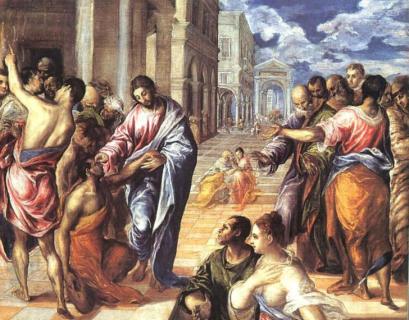
Jesus Healing Blind Bartimaeus El-Greco, 1578
Jesus Healing Blind Bartimaeus
El-Greco, 1578

We are rapidly approaching Holy Week and all of the exciting and heartbreaking moments the weeks brings.  In Mark the last story before the Triumphal Entry is of the Healing of Blind Bartimaeus that takes place as Jesus is traveling through Jericho to Jerusalem and his appointed fate.  I am offering the above painting by El-Greco for you to contemplate with the prayer practice of Visio Divina.  I have always found this story from the Gospel of Mark one of the most moving story of courage and faith in scripture.  Bartimaeus doesn’t know how close he is to Jesus; he simply calls out and has faith Jesus will answer him.  The questions Jesus asks of Bartimaeus also draw me into a deeper understanding of sight and I hope you will consider those questions and the responses as well.

May your sight be deepened in preparation for the coming week as your contemplate El‑Greco’s painting and the scripture lesson.

VISO DIVINA

  1. Study the picture slowly, taking a first glance and noting the colors, people, places and things.  Remain with the image for one to two minutes. If you would like, jot down a few words about the image.
  2. Read the Scripture lesson slowly and in meditation. Return to the painting does the scripture alter your perspective of the painting in anyway?  Do the questions and responses open new doors as you gaze at the painting?
  3. Take a second, deeper, look. Where is there movement? What relationships do you see? Engage your imagination. Where are you in the artwork? What do you see from that perspective? What deeper meaning emerges?
  4. Respond to the image with prayer. Did the image remind you of an experience, person or issue for which you’d like to offer thanksgiving or intercession? Place yourself in the place of Bartimaeus, and then in the place of a spectator, or one of the Disciples. Does your perspective Change?  What do you feel when you become Bartimaeus or a spectator?  Offer your thoughts as prayer to God.
  5. Find your quiet center. Breathe deeply. Relax your shoulders, arms and legs. Rest in this quiet. Let God pray in you. God prays beyond words.

May the Peace of God be with you as you travel the Holy Week Journey.

Ruth Jewell, ©March 24, 2015

Hope

Sermon Given at Lake Washington Christian Church
February 22, 2015


rainbow-landskape

Genesis 9:12-17  12God said, “This is the sign of the covenant that I make between me and you and every living creature that is with you, for all future generations:13I have set my bow in the clouds, and it shall be a sign of the covenant between me and the earth. 14When I bring clouds over the earth and the bow is seen in the clouds, 15I will remember my covenant that is between me and you and every living creature of all flesh; and the waters shall never again become a flood to destroy all flesh. 16When the bow is in the clouds, I will see it and remember the everlasting covenant between God and every living creature of all flesh that is on the earth.” 17God said to Noah, “This is the sign of the covenant that I have established between me and all flesh that is on the earth.”

Psalm 25:5-6 5Lead me in your truth, and teach me, for you are the God of my salvation; for you I wait all day long. 6Be mindful of your mercy, O Lord, and of your steadfast love, for they have been from of old.

1 Peter 3:21  21And baptism, which this prefigured, now saves you—not as a removal of dirt from the body, but as an appeal to God for a good conscience, through the resurrection of Jesus Christ,

Mathew 1:15-15 14Now after John was arrested, Jesus came to Galilee, proclaiming the good news of God, 15and saying, “The time is fulfilled, and the kingdom of God has come near; repent, and believe in the good news.”

Awhile back a friend asked me what was my favorite scripture and without hesitation I said Micah 6:8 “He has told you, O mortal, what is good; and what does the Lord require of you but to do justice, and to love kindness, and to walk humbly with your God?”  Then she asked the question … Why? I had to think about that for awhile.  I could have said that it was how my Father ended all of our dinner prayers and hearing it always brings back wonderful memories.  Or, I might have told her my Disciples tradition has based its mission and vision statement on it and those statements have opened the door to a witness in social justice and peace in the greater world.  But while each of those reasons are truth the real reason is this one verse from Hebrew scripture gives me Hope.

It is the hope of the rainbow that symbolizes the covenant between God, one-another and all creation.  It is the cry of the Psalmist who says “O, Lord, Teach me your paths, Lead me in your truth and teach me,” and the voice of the Gospel writer of Mark who writes “Jesus came to Galilee, proclaiming the good news of God.”

In our world today hope seems to be too little and too late.  We watch the news and it’s filled with killing, greed, anger, hate, and very little that would give us hope for a better world.  Killing, whether of the body or spirit, disrupts God’s purpose for our lives. To kill a human being  made in the divine image is to subvert our lives which were purposely created to be lived in mutuality, support and respect, to live in right relationship with each other, God, and creation.  Killing for greed, hate, and anger is to kill a little of ourselves and build a wall, brick by terrible brick, between us and God.

So what does the word “Hope” mean for us then? Those who define words say it is to expect with confidence.  For others it means to expect things will get better, not only to get us through the difficult times in our lives, but also for our world, we will have a place of peace and justice for all creation, not tomorrow, or sometime in the far future but NOW, today.  We in all of our faith communities across the globe are called to seek justice, offer kindness, and be examples of living in peace to the world, to be a living hope.

God promised the descendants of Noah, and all creation that God would no longer destroy the world.  As a covenantal symbol of God’s own self-limiting, God’s disarmament, God placed a rainbow in the sky. In Noah’s time bows were symbols of violence just as guns are for us today.  So God laid down his weapon of mass destruction and placed it in the sky and said ‘I will no longer destroy what I have created.’  I wonder what God would place in the sky today, a nuclear bomb maybe?

Don’t get me wrong, I haven’t forgotten all of the killing done in the name of God in Scripture.  And, I must admit I have difficulty with the genocidal practices of Joshua when the Israelites crossed the Jordan River into the Promised Land.  But I also know that just because a practice is in the Bible doesn’t make it an acceptable practice for today.  And, that is the reason I so firmly believe in God’s promises of hope.

You see God’s covenant of the rainbow means that we, you and I, all humans, are in a covenantal relationship with God, each other, and creation and that means that all life matters, my life, your life, white, black, yellow and brown life, furred and feathered life and (much to my discomfort) insect and spider life.  The Psalmist makes a claim of hope and trust in God and tells us that God’s protection flows from the mouths of those who have no hope or trust in systems of violence, injustice, and oppression. Not just overt physical acts of injustice but injustice and violence and oppression brought about by attitudes, social structures, and any other “isms” that threatens the peace and justice of God’s Kingdom.

God’s rainbow of hope spoken in the Good News of the Gospels goes beyond a “me-centered” interpretation of the world. God’s hope reaches out across our selfish desires to those who need hope, justice, and mercy. Where do you find God’s hope? It is placed where there is justice and peace and there you will find Kingdom of God. Jesus preached the Good News of hope. Hopeful news that leads not only to the salvation of those who accept the gift freely given, but is also the promise of something more, a new and different life for those who are the most victimized.  All faith communities are called to be participants in our own salvation by working for justice, now, in the context of our present world, thereby helping to bring the good news to those who need it, where ever and whenever it is needed.

We as believing members of our faith communities are to point the way to the kingdom breaking into our world right now. The kingdom of God isn’t a future event it is happening right now. Every time we offer a helping hand to someone who is hungry, or cold, or afraid the door to God’s Kingdom opens just a bit more.  Every time we stand up to those who would harm one of God’s children, the kingdom shines a bit brighter.  Every time we stand between victims of injustice and the perpetrators God let’s a little more light out of the door.   Every time we speak out when we see an injustice God smiles and sends another rainbow.

You know the Irish tell us that there is gold at the end of the rainbow, and I believe that is true.  Because I believe that God’s kingdom is that golden treasure and we are to seek it just as the man who sought out the pearl of great price.  What could be more beautiful than walking across the rainbow into the Golden Kingdom?

Yes, on the first Sunday in Lent, all of the Lectionary scriptures are about hope.  Whether you read Genesis, Psalm 25, 1 Peter, or Mark each of them has an element of hope for dark times, in a dark world.  Each one offers a ray of light to bring us out of darkness. The light calls us, bright and shinning, multicolored, and golden with hope and promise.  God first gave the rainbow as a promise that She would never forget any of her children.  The Psalmist tells us that God will always be there to sustain us.  And, Jesus, rekindled the hope in the hopeless that a better life was there for them.  Jesus reminds all of us that God will sustain us as we work to be the witness’ against injustice, violence and oppression.

God said, “When the bow is in the clouds, I will see it and remember the everlasting covenant between God and every living creature of all flesh that is on the earth.”  How does Micah fit into this, well Micah reminds us which path we are to take, “what does the Lord require of you but to do justice, and to love kindness, and to walk humbly with your God?”  We are called to be living communities of hope, of God’s promise in every moment of our individual and communal lives.

AMEN

Ruth Jewell, ©February 23, 2015

“What If” – Prayerful Tuesday

Matthew 13:2b-9 “Listen! A sower went out to sow.4And as he sowed, some seeds fell on the path, and the birds came and ate them up. 5Other seeds fell on rocky ground, where they did not have much soil, and they sprang up quickly, since they had no depth of soil.6But when the sun rose, they were scorched; and since they had no root, they withered away. 7Other seeds fell among thorns, and the thorns grew up and choked them. 8Other seeds fell on good soil and brought forth grain, some a hundredfold, some sixty, some thirty. 9Let anyone with ears listen!”

Golden-Grain-Field-600x375

Every interpreter I have ever read tells us this scripture is about the ground. It’s about us being good or bad ground for the word of God.  So what if, just what if, we have it upside down.  I’m not saying we do, this is a “what if,” looking at the parable from the other side, from the Sower’s perspective.

Barbara Brown Taylor in her book The Seeds of Heaven, Sermons on the Gospel of Matthew (2004) asks what if this parable isn’t about us, not about our failures or success’.  But rather about an extravagant sower who flings his seeds everywhere and “wastes it with holy abandon?” If this isn’t about us as ground for the word of God then this parable has a completely new meaning.  Taylor says what if “the focus is not on us and our shortfalls but on the generosity of our maker, the prolific sower, who does not obsess about the conditions of fields, who is not stingy . . . but casts his seed everywhere, on good soil and bad.”  What if God, the prolific Sower, says I have a lot of seed and some will take hold right away, but who knows maybe, just maybe, some sown in not the best of places may still feed a soul. Suppose Jesus was saying we are to sow God’s word everywhere, don’t expect a harvest, or at least a big one, just speak the word, live the word, be the word, and see what happens.

So this week I challenge you to go and live the life of a prolific sower. Imitate the Great Sower, and be one of those who has ears and hears.

Ruth Jewell, ©February 3, 2015

Marcus Borg & Gratitude for our Mentors—Prayerful Tuesday

Marcus Borg 1931-2015
Marcus Borg
1931-2015

This last week I heard of the passing of Marcus Borg. I was sadden not just at his passing but because I have learned so much from his writings. I will miss reading his words and having them open up my understanding of Jesus as both human and Divine.  Marcus Borg’s writings were instrumental in changing how I came to look at Jesus, the apostles, and the first century Christians.  He made me think and doubt what I have always believed to be true and to take that doubt and turn it on its head by searching for answers and being comfortable with finding only more questions.

Because of Marcus Borg I began to read scripture, questioning the standard interpretations, searching for what the words printed in the Bible meant to those they were written to, the first century believers in Jesus.  Borg’s books were my first window into the church of the 21st century and why, and how, it is so different from the community of believers in the 1st century.  Reading Borg’s books were instrumental in giving me an interest in pursuing a Masters of Divinity degree and looking at the carefully at the path leading to ordination.  Yes I will miss this Master of Theology who opened doors and, through his writings, fostered a love of scripture, sacred texts, theology, and history.  Whose writing led me on a search for the divine and human Jesus that I wanted in my life.

We do not go through this life alone. There are many people, our mentors, who have walked and are walking with us.  Some mentors we know, some mentors we request or go looking for, some we have not known they were mentors but were our companions for a while, showing us us how to live by living their own quiet, faithful lives.  Some mentors never know they mentored us at all. Marcus Borg was one of my mentors who never knew he walked with me. I am grateful for his life and his words.  I never met him, only read his books, but I felt ‘close’ to this incredible theologian who made Jesus and God accessible to me.

I will never be able to thank him, so, instead I will thank all of my other mentors while I still have time.  My parents, my first grade teacher Miss Wooster, they taught me courage and determination. I am grateful for Pastors from childhood to adulthood that listened to my ravings and didn’t belittle me.  I am grateful for my current pastor, and friend, Laurie, who has been the most gracious and gentle of mentors as I have grown in my faith. I am grateful for friends who let me be me, inspiring me to be the best friend I could be.  I am grateful for my beloved John who has supported me through thick and thin as we have traveled this crazy new journey God has led us both on in the last 15 years.

I am grateful for the love, comfort, and companionship of dogs, cats and birds who have taught me the value of unconditional love. I am grateful for being able to live and work, and play in a world of great beauty, and sorrow.  I am grateful for my life as it is and as it will be and I know that whatever life hands me I know I am not alone, there is always someone standing beside me to offer encouragement.

On this Prayerful Tuesday who are you grateful for?  Who has walked with you on a difficult path or a path of exploration and great joy?  Who walked with you, gave you insights, taught you a lesson of life that you didn’t recognize at the time?  We all have people who have brought meaning to our lives, today offer your gratitude, your thanks for your life’s mentors.

Gracious Presence, I am grateful for all who walk, and have walked, with me on my very bumpy life’s journey. I am grateful for your presence as you have been with me always, even though I don’t recognize you. My spirit is grateful for all I have been given, and thankful for all that is yet to come.  Amen.

Ruth Jewell, ©January 27, 2015

The Angel’s Voices

Mt. Baker, WA, from Artist Point, Photo by Ruth Jewell, 14.09.15
Mt. Baker, WA, from Artist Point,
Photo by Ruth Jewell, 14.09.15

Prepared for a Sermon at Queen Anne Christian Church, Seattle WA
January 18th, 2015

Scripture: Psalm 139:1-6, 13-18

Have you ever had that feeling you are being watched and you turn around and around to see who is there?   I have and I must admit it often feels creepy!  Someone is watching me, why, who are they, what do they want, will they hurt me?  Some might say these are the questions of a paranoid mind, but, given the status of our world today, not uncommon in these days of uncertainty, fear, and, let’s be honest, at least a little hate, ok a lot of hate.

So when I read the Psalm for this week I had to really think what it means to be “watched,” “known,” by God.  This Psalm is telling me that I am being watched, by God no less.  Is that a good thing or should I be afraid, really afraid.  As I was contemplating these verses I remembered an incident out of my childhood.  It was a memory of being known by God and knowing it was keeping me safe.

Nearly 62 years ago I was severely burnt and spent 6 months in hospital healing and having reconstructive surgery.   In reality I am blessed to be here, because I should have died that summer, but didn’t.  However, I did spend a great deal of time on a children’s ward of a Cleveland Hospital.  There were number of other children there as well, just as injured and ill as me and one little boy and I became good friends.  I do not remember his name; I do remember he was dying.   He was a little older than I was but could not walk; I could get up and walk a little but couldn’t read as well as he could.  I would get books and games to play with and he would read the harder books.

Children will often tell another child something important when they aren’t sure their parents would understand or listen.  So one day he told me that he knew he didn’t have long to live and he wanted me to tell his parents he was ok with it.  You see he had a guardian angel who stayed by his side and the angel had told him he would be going soon and no longer in pain, his parents would be sad for awhile but they would remember him forever.

One night I awoke to a great deal of crying and saw the mother holding the little boy.  I remembered what he had asked me to do so I crawled out of my bed and tried to tell them that the boy was OK, and that he was with his angel now.  However, before I got very far with that a nurse scooped me up and put me back in my bed saying something patronizing.  I never really talked about that incident again; I understood what I had to say was pretty unimportant to adults and not worth listening to. It was the thought of the time that children didn’t understand death or God and it was, and is, a wrong thought.

Being known by God, being watched by God, children understand that, after all they are always being watched.  By parents, teachers, friends, family members who want to keep them safe.  So knowing God is watching them is no big deal, just one more person on the list to keep them safe.  Besides isn’t there something comforting knowing you have a guardian angel nearby, how cool is that.

From the time they are formed in the dark, cavern of their mother’s womb they are cradled and whispered to by angels.  By 18 weeks of pregnancy the embryo begins to hear his first sounds, Mom’s heart beat, the movement of her blood, and bowel sounds.  He also hears His Mom’s and Dad’s voice, music, laughter, and tears.  To him it’s, Angels voices coming from, everywhere.  Children know they are being watched, searched out as they are being formed in the dark.

After birth we are still connected to those angels, only now they have blurry faces, but they can see the angels smile at them and hear their whispers and while breast feeding they still hear the comforting sound of Mom’s heartbeat.

It is a sad fact that as we grow we forget those connections to the mystery of our beginnings.  We let other sounds carry us away from the angel’s voices, the whispers that we are beloved and we are watched over. We, who were made so carefully, struggle to be free of the binders, free of being hemmed in from behind and before. We, who in secret were made so wonderfully and woven of star dust and love, want to run free of the restrictions of God, angels, or anyone else.

Yet there is a part of us that yearns to be known.  Oh we may fight it, rebel and run away because we want to “do it our way.”  But really, at some level, isn’t it comforting to know just how beloved we are?  The Psalmist said “My days are all inscribed in Your Ledger; Days not yet shaped—each one of them is counted.”[1] Those counted days are from the moment we are conceived in flesh to the moment we let go of this body and return to God.  Yes we still have days that God has counted that we know nothing about, yet.  But God is still watching and still planning, or more likely, revising our life plan based on our latest actions.

You see I’ve never been a big proponent of predestination, were God has planned our lives out before we are born.  No I am a firm believer in free will and our obligation to choose life over death.  We, you and I, must choose to follow one path over another and depending on our choices our life is rewritten again and again.  I know that because I have had my life rewritten all because I’ve made some rather dumb choices in my life.  My guess is we all have, because we are human, we are embodied; we are separated from that light of God and God deliberately put us on our own resources for a purpose we do not know.  (My first question for God when I return is “what were you thinking.”)

What the Psalmist tells us is even in our bad choices we are watched, cared for, beloved, held safe, and not alone.  God keeps us in God’s thoughts; we are never far from the Divine mind.  “How weighty to me are your thoughts, O God! How vast is the sum of them! I try to count them—they are more than the sand; I come to the end—I am still with you.”  “I am still with You,” God is with me.  Matthew writes that Jesus’ last words to his disciples were, “And remember, I am with you always, to the end of the age.”  We have that promise.  God has not left us alone, Jesus has not left us alone, the angels are still whispering, if, only we listen.

Rabbi Schachter-Shalomi translated verse 14 as follows, “I am overcome with thanks at Your awesome wonders, Your astonishing works, of which my soul is aware.”  Our souls know what God does, what Jesus does, even when we are unconscious to those actions.  Our souls know even when we reject God’s call that we are not alone.  That we are watched over and having our lives rewritten again and again based on whether we chose life or death.

Those angel whispers, messages of comfort from the Holy, still hold for each and every one of us.   That first sound we heard in our mothers’ wombs, the first whisper of life from the sacred, was a heartbeat.  It still is the whisper of life for all of us.  Without our hearts beating strong and level life will fade.  But it is not just the heart of our flesh that we need.  We also need the voice of the heart of our souls, our spirit, to truly live life as God intended.  Remember Moses’ last words “choose life.”  The messengers of God, the angels voices all whisper, “choose life.”

Ruth Jewell, ©January 17, 2015

[1] Schachter-Shalomi, Rabbi Zalman, Psalms in a translation for praying, Alliance for Jewish Renewal, Philadelphia, PA, 2014.

My 2015 New Years Resolution – Prayerful Tuesday

Cape Cod, Ruth Jewell 2008
Cape Cod, Ruth Jewell
2008

I have been contemplating making a resolution this year.  My track record for keeping resolutions is poorer at best as I rarely make it past Jan 2nd but, maybe this year will be different. You see I am actually thinking about a resolution that fits my life style rather than dramatically changing it. Keeping expectations low can’t hurt this process.

My 2015 resolution is to deepen my prayer life.

I am going to accomplish in two steps.  First I am going to carry a small blank book with me at all times where I can record names of people I am asked to hold in prayer.  That way I won’t forget the name of the person needing prayer even if I don’t know them well or not at all.  I already set aside a portion of my meditation time for intercessory prayers but I often forget the names of those who have asked for prayer.  When that happens the best I can do is a general prayer that holds up everyone who is ill and suffering, while this is lovely and includes the individual it has lost the personal feeling for my prayer.

The second act is to begin practicing a new spiritual practice called “Dedicated Suffering”[1] presented by Jane Marie Thibault in her book Pilgrimage into the Last Third of Life, co-authored by Richard L. Morgan.  The purpose is to take the energy surrounding my suffering and asking Christ to ‘transform it into loving-kindness for the chosen person or group being held in prayer.

In the last few years I have had an increasing amount of physical pain in my life and a lot of my life energy is involved with minimizing that pain.  Ms Thibault developed a way to dedicate that energy to Jesus as a gift, then asking Jesus to change that gift into love for a person being held in prayer.

Since I have been doing this only a few days I can’t say I notice major any changes in my life but like all spiritual practices you have to do for a while before you see anything new.  That is why it is called ‘practice.’

As we grow older chronic pain and suffering increases and often limits what we can accomplish each day.  The practice of Dedicated Suffering offers a way to extend our prayers to others and puts the energy of our pain and suffering to good purpose. I offer the following instructions so you may try it for yourselves.  Maybe at the end of 2015 we can compare notes and see how gifting our energy to Christ to provide loving-kindness to those in need has changed our lives.

Dedicating Your Pain and Suffering to Help Others

  1. Find yourself a quiet corner where you may sit silence for a few minutes. Focus on your pain and the energy you are expending to minimize it.
  2. Offer your suffering energy to Jesus as a gift.
  3. Select a person or group in need of your prayers then ask Jesus to accept the energy of you suffering and change it into love for that person or group.
  4. Spend a minute or two imagining Jesus sending love and help to the person or group.
  5. End by offering Jesus a word of gratitude.[2]

While I haven’t been doing this practice for a long time yet I do find that I feel less encumbered by my chronic pain and have just a bit more energy to be the person I am meant to be.

Ruth Jewell, ©January 6, 2015


[1] Thibault, Jane Marie and Richard L. Morgan: Pilgrimage into the Last Third of Life, Upper Room Books Nashville TN, 2012, Pgs 112-115.

[2] Ibid. pg. 113