Laughter – Prayerful Tuesday

Psalm 126:2a our mouths shall be filled with laughter,
our tongues, with songs of joy

happy mouse

Photographer Unknown

Last Christmas Day my gift from Santa was a pinched nerve in my back. Apparently our dear Santa thought that was either funny or I was really bad last year.  Actually the problem is due to the fact that we humans stand upright. If we still walked on our knuckles like other apes we would have fewer problems. But then we wouldn’t be able to see over the tall person, in the tacky Uncle Sam hat, during the 4th of July parade would we.

Any way I digress.  What I am trying to say is in order to deal with the pain I have rediscovered the value of laughter as a spiritual practice.  Like the little mouse above I have learned the grace of sharing my joy at being alive instead of being the grouch my beloved John says I can be.  After all what does he know he only lives with me?

Spending time finding joy in all that is around me, offering that joy as prayer, and letting the response of joyful light to enter deep within does much for my own spiritual well being and for the life of those around me.

I am not the first to promote laughter as a spiritual practice, remember I said I rediscovered this practice.  But it is one we forget when life overwhelms us.  Taking ourselves seriously is important but it is also important to not go to the extreme.  No matter what we do, how we feel, or how badly things have gone there is always something to laugh at, even if it is just ourselves.

Before you all get your knickers in a knot I want you to know I am not making light of those who fight depression every day of their lives. Because depression isn’t a choice it’s an illness that needs to be addressed.  Caring for and helping those who fight mental illness is also a spiritual practice and an important one and something we all need to do.

However, for those of us who are fortunate not to experience depression learning to laugh, to find joy in life, and to bring joy to others is a spiritual practice, a spiritual practice that helps us all to not take ourselves too seriously.  For me laughing at life in general and discovering the joy in simply living each day brings me closer to God, who, I am sure, is laughing along with me.

Today I challenge each and every one of you to find something that brings you joy.  May your joy be your gift others and may it be a door to a deeper inner joy where you and the Holy Spirit have a good laugh.

Ruth Jewell, ©June 9, 2015

What will be, will be – Prayerful Tuesday

Psalm 131:1-2 God, I’m not trying to rule the roost,
I don’t want to be king of the mountain.
I haven’t meddled where I have no business
or fantasized grandiose plans.

I’ve kept my feet on the ground,
I’ve cultivated a quiet heart.
Like a baby content in its mother’s arms,
my soul is a baby content. (MSG)

Akaroa, New Zealand, April 9, 2015 taken by Ruth Jewell©
Akaroa, New Zealand, April 9, 2015
taken by Ruth Jewell©

One of the benefits of a sabbatical is having the time to stop and let the world go by. In fact I have begun to practice an extension of stopping that I call “what will be, will be.” On my trip I would wake in the morning and intentionally decided to let the day unfold as God intended for it to happen, making few plans, being open to opportunities to meet people or visit a place I hadn’t been before, taking the time to really listen to the person I just met, stopping and really seeing the world around me and the hardest of all, trying not to control my days events.  What I discovered was I was more relaxed and rested at the end of the day than this normally anxious introvert is.

This is more than mindfulness or being in the moment.  It is letting the Divine control the day, opening my eyes to the Good in each person I meet and greeting them with the Good within me.  This is an intense letting go of my expectations of how things ‘should’ be and seeing how they are/can be beautiful and insightful.

Of course I couldn’t do this every day.  Sometimes we had already made plans in advance so those intentional days weren’t every day, even on a vacation.  But I did make them happen often, and probably more often than I will be able to do now that I am home. However, I do wish to maintain this spiritual practice and hope my ability to let go and let God control my days increase. Here are a few suggestions to help you, and me, get started.  As I get better at this, or you, we might add suggestions or take some away, we will just have to wait and see how God unfolds this practice.

  1. Begin the day with silent prayer ending with a prayer for patience and openness
  2. As you start your day and continue through your tasks really notice what you are doing, see the people you are with, taste the food you eat, notice your surroundings, even the ugliest of areas has beauty if you look.
  3. As time allows stop for a moment and breathe deeply, if possible sit and let God into your day, your heart
  4. Let God into the moments of confusion and frustration, breathe deeply, say a prayer, let others express themselves and be aware of their hurt and pain, or joy and celebration. Recognize they too have the Divine within and welcome them.  (This is the hardest part, so do not be surprised if you fail, just keep trying)
  5. At the end of your day, sit again in silence; let your heart and mind reflect on your day, the good and the bad hold those you meet that are hurting in prayer, and offer gratitude for those who are celebrating.
  6. End by offering your own prayer of gratitude.

We all can’t take 6 weeks or even a day of sabbatical, but we all can let the Divine into our daily lives. We can offer one of our ‘normal’ busy days to God, and changing how we see our tasks and the people we interact with helps us change how we see the world.  It costs nothing to offer praise or condolences, or to sit and listen to someone’s story but the gift is priceless.

Blessings on your Journey

Ruth Jewell, ©June 2, 2015

Praying With Gratitude – Prayerful Tuesday

Sunset in the South Pacific April 23, 2015 (Ruth Jewell)
Sunset in the South Pacific
April 23, 2015 (Ruth Jewell)

While I was traveling in April I carried a small book with me by Mark E. Thibodeaux, SJ titled Reimagining the Ignatian Examen.[1] On our sea days when I would sit on the deck of our cruise ship and watch the ocean go by I various meditations for my daily prayer time.

Thibodeaux’s book takes the traditional Examen and includeds a specific focus to use within the prayer practice.  There are 34 different themes and I discovered a number of them to be very helpful for me as I sat in stillness. Over the next several months I will occasionally offer one of the meditations from the book for our Prayerful Tuesday. As today follows Memorial Day when we honor those who have died in service I would like to offer the meditation for Gratitude.

First let me offer a few hints from the book to get you started.

  1. Keep it short. Keeping your Examen under 15 minutes will keep your prayer in the moment and a reminder that this is a check-in with God that reorients your toward the Divine.
  2. Skip to the good parts and don’t get hung up on sin. You only want to dwell on the steps and you want to get to the point rather than linger for an extended period of time. Nor do you want to dwell on all the things that have gone bad or at least you think have gone bad.  God has the facts you don’t have to bore him with a lot of details.
  3. Sometimes, break all the rules. If you feel like it, skip over parts of the Examen you don’t feel you need to do or change them around.
  4. Experiment with different ways of journaling. Tweet-sized, or drawing, or video yourself dancing.  Do whatever moves you in prayer.
  5. Keep it prayerful. Keep the prayer God centered and don’t let your meditation drift into your shopping list or your latest aggravation.  Extra hints: A. ask God to take the lead, ask God to do your Examen for the day; B. Talk to God instead of yourself; C. listen for God’s voice, sit in silence for a moment and let God enter you

Here is how I began and closed my ritual, you may choose something totally different that fits you and the place you’re in spiritually right now:

  1. I stand still for a moment and let my mind quiet.
  2. I repeat Micah 6:8 as I sit down
  3. I place my hands in my lap, palms up, in a gesture of being open to God’s love and grace
  4. I slow my breathing and clear my mind, sitting very still for a moment
  5. I welcome God in to my heart and spirit
  6. Then I begin my Examen

Closure:

  1. I take several very deep breaths as a way to bring myself back to moment
  2. I place my hand on heart and repeat Matthew 28:20b
  3. I journal for a short while before rising from my chair.

Note: I change scriptures from time to time, substituting poetry and prayers.  Remember nothing is written in concrete.

Examen theme of GRATITUDE

  1. Begin in your usual way
  2. Ask God to reveal special blessing in your life this day. As yesterday was Memorial Day, ask God to also reveal the special blessing you’ve received from someone you loved who has passed on.
  3. Ask yourself ‘what am I grateful for today? “Who am I grateful for?’ Name the person(s) gift and offer the following “Lord, I am so grateful for your gift to me of _____.” Repeat this as many times as you need to
  4. Relish each gift in turn, letting them warm your heart. Using prayerful imagination see, feel, hear, touch, sense the gift again
  5. Let the gifts you have received dance in your memory offering your gratitude to God for each one. Offer the following; “Thank you Lord for (neighbor, family, laughter, shared meal, etc.)
  6. End in your usual way.

I truly enjoyed Thibodeaux’s focuses on my trip, they helped me retain a pilgrim attitude to the whole trip and I hope you find today’s focus helpful as much as I did.

Peace and Blessing on your journey

Ruth Jewell, ©May 26, 2015

[1] Thibodeaux SJ, Mark E; Reimagining the Ignatian Examen, Loyola Press, Chicago, IL, 2015

Sabbatical

Artist Point, Mount Baker, Washington,  Photo taken by Ruth Jewell September 5, 2014
Artist Point, Mount Baker, Washington,
Photo taken by Ruth Jewell
September 5, 2014

To all of my wonderful readers and followers of my Blogs on A Quiet Walk, and Beguine Again, this will be my last post for awhile as I am taking a sabbatical from electronic media until Mid-May.  I will be traveling to new and exciting places, taking time for quiet reflection and renewal.  I will return to the Blogosphere May 19th with new stories, maybe new prayer practice or and new insights. As I travel please keep me and my husband, John, in your prayers.

I wish each and every one of you a meaningful Holy Week and a celebratory Easter.  Peace be with you all.

Ruth Jewell, ©March 24, 2015

Blind Bartimaeus, Questions. Answers? – Prayerful Tuesday

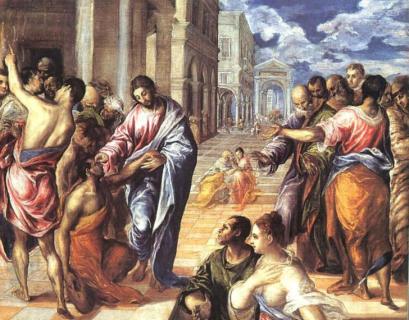
Mark 10:46-52 46They came to Jericho. As he and his disciples and a large crowd were leaving Jericho, Bartimaeus son of Timaeus, a blind beggar, was sitting by the roadside. 47When he heard that it was Jesus of Nazareth, he began to shout out and say, “Jesus, Son of David, have mercy on me!” 48Many sternly ordered him to be quiet, but he cried out even more loudly, “Son of David, have mercy on me!” 49Jesus stood still and said, “Call him here.” And they called the blind man, saying to him, “Take heart; get up, he is calling you.” 50So throwing off his cloak, he sprang up and came to Jesus. 51Then Jesus said to him, “What do you want me to do for you?” The blind man said to him, “My teacher, let me see again.” 52Jesus said to him, “Go; your faith has made you well.” Immediately he regained his sight and followed him on the way.

Jesus Healing Blind Bartimaeus El-Greco, 1578
Jesus Healing Blind Bartimaeus
El-Greco, 1578

We are rapidly approaching Holy Week and all of the exciting and heartbreaking moments the weeks brings.  In Mark the last story before the Triumphal Entry is of the Healing of Blind Bartimaeus that takes place as Jesus is traveling through Jericho to Jerusalem and his appointed fate.  I am offering the above painting by El-Greco for you to contemplate with the prayer practice of Visio Divina.  I have always found this story from the Gospel of Mark one of the most moving story of courage and faith in scripture.  Bartimaeus doesn’t know how close he is to Jesus; he simply calls out and has faith Jesus will answer him.  The questions Jesus asks of Bartimaeus also draw me into a deeper understanding of sight and I hope you will consider those questions and the responses as well.

May your sight be deepened in preparation for the coming week as your contemplate El‑Greco’s painting and the scripture lesson.

VISO DIVINA

  1. Study the picture slowly, taking a first glance and noting the colors, people, places and things.  Remain with the image for one to two minutes. If you would like, jot down a few words about the image.
  2. Read the Scripture lesson slowly and in meditation. Return to the painting does the scripture alter your perspective of the painting in anyway?  Do the questions and responses open new doors as you gaze at the painting?
  3. Take a second, deeper, look. Where is there movement? What relationships do you see? Engage your imagination. Where are you in the artwork? What do you see from that perspective? What deeper meaning emerges?
  4. Respond to the image with prayer. Did the image remind you of an experience, person or issue for which you’d like to offer thanksgiving or intercession? Place yourself in the place of Bartimaeus, and then in the place of a spectator, or one of the Disciples. Does your perspective Change?  What do you feel when you become Bartimaeus or a spectator?  Offer your thoughts as prayer to God.
  5. Find your quiet center. Breathe deeply. Relax your shoulders, arms and legs. Rest in this quiet. Let God pray in you. God prays beyond words.

May the Peace of God be with you as you travel the Holy Week Journey.

Ruth Jewell, ©March 24, 2015

Encircled in the Arms of Prayer – Prayerful Tuesday

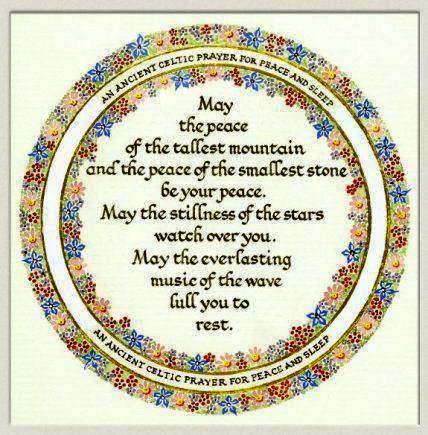
A Celtic Prayer,  from The Celtic Christian Tradition September 25, 2013
A Celtic Prayer,
from The Celtic Christian Tradition
September 25, 2013

We are coming to the end of Lent, a time of quiet reflection.  One aspect of reflection is prayer; prayer for ourselves, the world, those who are suffering, and those who cause suffering.  Today I am offering an ancient form of prayer for this week’s prayer practice called the “encircling prayer.” This particular prayer is based on a prayer I discovered at the Wells Cathedral in Wells England.  It is a lovely prayer in which to hold in our hearts those in need of comfort and support, and for those who lay upon on hearts.  As the above Celtic Prayer offers: ‘May the peace of the tallest mountain and the peace of the smallest stone be your peace.  May the stillness of the stars watch over you.  May the everlasting music of the wave lull you to rest.”

Circle Prayer Based on a Prayer found in the Gethsemane Chapel,
Wells Cathedral, Wells, England
This is a form of prayer used by early Celtic Christians.
It is called the Caim, the encircling prayer.

Putting Ourselves in God’s presence 

Circle me, O God, encircle me with your presence.

Keep joy within, keep bitterness out;
Keep generosity within, keep greed out;
Keep love within, keep self-seeking out;
Keep light within, keep darkness out.

In the name of the Sacred Three, the Father, Son and Holy Spirit, Amen

Prayer for Peacemakers

Circle, O God, those who work for peace and Justice in your world, encircle them with your presence.

Keep wisdom within, keep folly out;
Keep strength within, keep weariness out;
Keep hope within, keep despair out;
Keep light within, keep darkness out.

In the name of the Sacred Three, the Father, Son and Holy Spirit, Amen

For victims of violence and injustice

Circle, O God, those who are victims of violence and injustice, encircle them with your presence.

Keep truth within, keep falsehood out;
Keep compassion within, keep hard-heartedness out;
Keep love within, keep hatred out;
Keep light within, keep darkness out.

In the name of the Sacred Three, the Father, Son and Holy Spirit, Amen

 For those who commit acts of violence and injustice

Circle, O God, those who have committed acts of violence and justice, encircle them with your presence.

Help them to see the truth and to turn away from falsehood;
Help them to learn compassion and leave hard-heartedness behind;
Help them find the courage to turn away from evil;
May they feel your love in a world filled with hate;
Help them to see your light in the darkness.

In the name of the Sacred Three, the Father, Son, and Holy Spirit, Amen.

Prayer for those on our heart

Circle, O God, (name the person(s) for whom you are praying), encircle them with your presence.

Keep wholeness within, keep sickness out;
Keep hope within, keep despair out;
Keep peace within, keep turmoil out;
Keep light within, keep darkness out.

In the name of the Sacred Three, the Father Son, and Holy Spirit, Amen.

A Gethsemane Prayer – Closing

Christ of wounds, Christ of tears,
Christ of the wounds of the piercing,
Hold us in your hands, scarred with love,
Through all our trials and sufferings,
And by your wounds, may we find healing.  Amen.

Ruth Jewell, ©March 17, 2015


Letting Go – Prayerful Tuesday

A Walk In Yost Park Canyon

This week’s prayer practice is one a friend of mine taught me in the last couple of weeks.  It is one of Thich Nhat Hanh’s practices called “Letgo.”   After I began the practice I realized ‘Letgo’ has many similarities with the Examen and found that I was experiencing some of the same benefits.  As I have begun to settle into this practice I have discovered my days to be calmer and more centered even when the world gets busy.  I am able to separate what is important from what it is not.  The most amazing thing is of the many of events and things I thought were important they just are not priorities any longer.  Instead I am able to focus on what makes my life more enjoyable, beautiful and to just BE.  So I offer this practice as my gift to your well Being.

Letgo Practice

I usually pick a time of day when things are quiet, either early in the morning or just before I go to bed.  I like both times.  The morning time energizes me and the evening time centers me and quiets my mind so that I sleep much better.  But select a time that works best for you.  I do set aside 20 to 25 minutes for each session.

  1. Begin by sitting quietly, concentrating on your breath. Reflect on those things you have let go of in the past.  You many begin your ‘list’ as early in your life as you wish.
  2. Be aware that our conscious attention only catches a small portion of what goes on in lives.
  3. Start with small steps first. Accept that events such as rush hour traffic, broken washers, and burnt dinners will always be there to annoy and frustrate you.  Use these events to practice an acceptance of those things that just happen because it’s life.
  4. Be mindful of those times when you pick up old burden or worry’s and begin to carry them around again. Learn to recognize the old resentments and anger that emerges and ask yourself if you want to continue to hold space in head and heart for them.
  5. Take deep breaths and let the burdens, anger, and resentment flow out with each exhale.
  6. Repeat step 5 as often as necessary until you are able to bring your mindfulness back to the now.

May the peace of God be with you all.

Ruth Jewell, ©March 10, 2015

Covenant – Prayerful Tuesday

Genesis 9:12-13  12God said, “This is the sign of the covenant that I make between me and you and every living creature that is with you, for all future generations: 13I have set my bow in the clouds, and it shall be a sign of the covenant between me and the earth. 

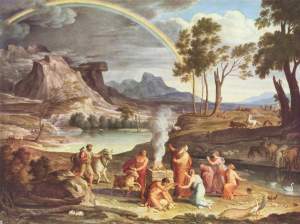
Joseph Anton Koch, 1803

The Hebrew Scripture for Sunday was from Genesis 9, the covenant between God and the earth.  Following the Flood, God voluntarily disarms, self-limits, herself by making a promise between Noah’s descendents and all creation never to destroy the earth again.  It is promise made to all of creation not just humans. God’s promise means we are to be in relation with each other and all of creation. (If you are not familiar with God’s promise please read Genesis 9:8-17.) Above is the painting by Joseph Anton Koch of Noah’s Thanksgiving Offering, which we will be using for today’s Visio Divina.

  1. Study the picture slowly, taking a first glance noting the colors, people, places and things.  Remain with the image for one to two minutes. If you would like, jot down a few words about the image.
  2. Take a second, deeper, look. Where is there movement? What relationships do you see? Engage your imagination. Where are you in the artwork? What do you see from that perspective? What deeper meaning emerges?
  3.  Respond to the image with prayer. Did the image remind you of an experience, person or issue for which you’d like to offer thanksgiving or intercession? In what way does God’s promise change, or not change how you visualize your relationship with the earth, each other, and God? Offer your thoughts as prayer to God.
  4. Find your quiet center. Breathe deeply. Relax your shoulders, arms and legs. Rest in this quiet. Let God pray in you. God prays beyond words.

Rainbows are symbols of hope, and renewal following a crisis.  May this day bring you your own personal rainbow.

Ruth Jewell, ©February 24, 2015

Hope

Sermon Given at Lake Washington Christian Church
February 22, 2015


rainbow-landskape

Genesis 9:12-17  12God said, “This is the sign of the covenant that I make between me and you and every living creature that is with you, for all future generations:13I have set my bow in the clouds, and it shall be a sign of the covenant between me and the earth. 14When I bring clouds over the earth and the bow is seen in the clouds, 15I will remember my covenant that is between me and you and every living creature of all flesh; and the waters shall never again become a flood to destroy all flesh. 16When the bow is in the clouds, I will see it and remember the everlasting covenant between God and every living creature of all flesh that is on the earth.” 17God said to Noah, “This is the sign of the covenant that I have established between me and all flesh that is on the earth.”

Psalm 25:5-6 5Lead me in your truth, and teach me, for you are the God of my salvation; for you I wait all day long. 6Be mindful of your mercy, O Lord, and of your steadfast love, for they have been from of old.

1 Peter 3:21  21And baptism, which this prefigured, now saves you—not as a removal of dirt from the body, but as an appeal to God for a good conscience, through the resurrection of Jesus Christ,

Mathew 1:15-15 14Now after John was arrested, Jesus came to Galilee, proclaiming the good news of God, 15and saying, “The time is fulfilled, and the kingdom of God has come near; repent, and believe in the good news.”

Awhile back a friend asked me what was my favorite scripture and without hesitation I said Micah 6:8 “He has told you, O mortal, what is good; and what does the Lord require of you but to do justice, and to love kindness, and to walk humbly with your God?”  Then she asked the question … Why? I had to think about that for awhile.  I could have said that it was how my Father ended all of our dinner prayers and hearing it always brings back wonderful memories.  Or, I might have told her my Disciples tradition has based its mission and vision statement on it and those statements have opened the door to a witness in social justice and peace in the greater world.  But while each of those reasons are truth the real reason is this one verse from Hebrew scripture gives me Hope.

It is the hope of the rainbow that symbolizes the covenant between God, one-another and all creation.  It is the cry of the Psalmist who says “O, Lord, Teach me your paths, Lead me in your truth and teach me,” and the voice of the Gospel writer of Mark who writes “Jesus came to Galilee, proclaiming the good news of God.”

In our world today hope seems to be too little and too late.  We watch the news and it’s filled with killing, greed, anger, hate, and very little that would give us hope for a better world.  Killing, whether of the body or spirit, disrupts God’s purpose for our lives. To kill a human being  made in the divine image is to subvert our lives which were purposely created to be lived in mutuality, support and respect, to live in right relationship with each other, God, and creation.  Killing for greed, hate, and anger is to kill a little of ourselves and build a wall, brick by terrible brick, between us and God.

So what does the word “Hope” mean for us then? Those who define words say it is to expect with confidence.  For others it means to expect things will get better, not only to get us through the difficult times in our lives, but also for our world, we will have a place of peace and justice for all creation, not tomorrow, or sometime in the far future but NOW, today.  We in all of our faith communities across the globe are called to seek justice, offer kindness, and be examples of living in peace to the world, to be a living hope.

God promised the descendants of Noah, and all creation that God would no longer destroy the world.  As a covenantal symbol of God’s own self-limiting, God’s disarmament, God placed a rainbow in the sky. In Noah’s time bows were symbols of violence just as guns are for us today.  So God laid down his weapon of mass destruction and placed it in the sky and said ‘I will no longer destroy what I have created.’  I wonder what God would place in the sky today, a nuclear bomb maybe?

Don’t get me wrong, I haven’t forgotten all of the killing done in the name of God in Scripture.  And, I must admit I have difficulty with the genocidal practices of Joshua when the Israelites crossed the Jordan River into the Promised Land.  But I also know that just because a practice is in the Bible doesn’t make it an acceptable practice for today.  And, that is the reason I so firmly believe in God’s promises of hope.

You see God’s covenant of the rainbow means that we, you and I, all humans, are in a covenantal relationship with God, each other, and creation and that means that all life matters, my life, your life, white, black, yellow and brown life, furred and feathered life and (much to my discomfort) insect and spider life.  The Psalmist makes a claim of hope and trust in God and tells us that God’s protection flows from the mouths of those who have no hope or trust in systems of violence, injustice, and oppression. Not just overt physical acts of injustice but injustice and violence and oppression brought about by attitudes, social structures, and any other “isms” that threatens the peace and justice of God’s Kingdom.

God’s rainbow of hope spoken in the Good News of the Gospels goes beyond a “me-centered” interpretation of the world. God’s hope reaches out across our selfish desires to those who need hope, justice, and mercy. Where do you find God’s hope? It is placed where there is justice and peace and there you will find Kingdom of God. Jesus preached the Good News of hope. Hopeful news that leads not only to the salvation of those who accept the gift freely given, but is also the promise of something more, a new and different life for those who are the most victimized.  All faith communities are called to be participants in our own salvation by working for justice, now, in the context of our present world, thereby helping to bring the good news to those who need it, where ever and whenever it is needed.

We as believing members of our faith communities are to point the way to the kingdom breaking into our world right now. The kingdom of God isn’t a future event it is happening right now. Every time we offer a helping hand to someone who is hungry, or cold, or afraid the door to God’s Kingdom opens just a bit more.  Every time we stand up to those who would harm one of God’s children, the kingdom shines a bit brighter.  Every time we stand between victims of injustice and the perpetrators God let’s a little more light out of the door.   Every time we speak out when we see an injustice God smiles and sends another rainbow.

You know the Irish tell us that there is gold at the end of the rainbow, and I believe that is true.  Because I believe that God’s kingdom is that golden treasure and we are to seek it just as the man who sought out the pearl of great price.  What could be more beautiful than walking across the rainbow into the Golden Kingdom?

Yes, on the first Sunday in Lent, all of the Lectionary scriptures are about hope.  Whether you read Genesis, Psalm 25, 1 Peter, or Mark each of them has an element of hope for dark times, in a dark world.  Each one offers a ray of light to bring us out of darkness. The light calls us, bright and shinning, multicolored, and golden with hope and promise.  God first gave the rainbow as a promise that She would never forget any of her children.  The Psalmist tells us that God will always be there to sustain us.  And, Jesus, rekindled the hope in the hopeless that a better life was there for them.  Jesus reminds all of us that God will sustain us as we work to be the witness’ against injustice, violence and oppression.

God said, “When the bow is in the clouds, I will see it and remember the everlasting covenant between God and every living creature of all flesh that is on the earth.”  How does Micah fit into this, well Micah reminds us which path we are to take, “what does the Lord require of you but to do justice, and to love kindness, and to walk humbly with your God?”  We are called to be living communities of hope, of God’s promise in every moment of our individual and communal lives.

AMEN

Ruth Jewell, ©February 23, 2015
Breath of Life—Prayerful Tuesday

Genesis 1:1-2, 2:7  1:1 In the beginning when God created the heavens and the earth, 2the earth was a formless void and darkness covered the face of the deep, while a wind from God swept over the face of the waters.

2:7 then the Lord God formed man from the dust of the ground, and breathed into his nostrils the breath of life; and the man became a living being.

Amos 8:11 The time is surely coming, says the Lord God, when I will send a famine on the land; not a famine of bread, or a thirst for water, but of hearing the words of the Lord.

Have you ever been unable to breath?  I mean you just couldn’t get air into your lungs.  I have several friends who suffer from Asthma and they tell me it is the most frightening thing to happen to them.  Without air we can’t live.  It is the first requirement of life, the first thing we do upon birth is to take that first breath and the last thing we do at our passing is to let the last breath go.

Genesis tells us that air is the first gift God gave to the earth. I mean it says so right there in the second verse, “a wind from God swept over the face of the waters” and then in chapter 2 God brings man to life by breathing into his nostrils, breath is life.  Without air we don’t live.  Breath, ruach, spirit, is the palpable presence of God in our lives.

I guess that is what makes Amos’ words so scary to me. If the God I trust to be there when I am frightened tells me that She will no longer come to me, that she is separating himself from me that means no air, no breath, no spirit  to enliven my life.  I mean you can’t have words without breath and no words means no breath of God, no life.

With every inhalation we partake of God’s gift of life and with every exhalation we give back life.  We have been doing it since our first breath at birth and will continue until we release our last breath at our dying.  Breathing is a sacred act of life giving; it is the ultimate communion with God and each other.  Turn to the person next to you and watch them breathe, the air they release is the air you take in and the air you release is the air they take in.  Breathing is the most intimate act of our lives.  Breathing connects us to all life, past, present, and future life.

Every breath we take has been blowing across this earth since God blew the wind across the waters.  With ever inhalation we breathe there is a molecule of air breathed, and passed on to us, by Jesus on the cross, Moses as he spoke to the burning bush, Sarah as  she delivered Isaac, Dinosaurs, Amos, even Hitler.  We breathe air given to us as a life gift and how we use it depends on us.

This week I ask that you think about breathing and contemplate who is sharing your breath.  Breathe deeply, take each breath into your lungs and feel the life fill you as your lungs inflate.  Treat each breath as the gift from God that it is, and grace each exhalation with a gift of your own gratitude.  Offer a prayer for those who struggle to breathe and remember how much their life, and yours, depends on the breath of God.  Treat the air as sacred and refrain from fouling it with contaminants.  With every breath you take this week let it be a prayer of thanks to God for the breath of life given at the beginning of time.

Ruth Jewell, ©February 10, 2015