“I have come to believe that God, Truth, Beauty, Love—all those concepts I associate with the Divine—are not things that are “found” at the end of the path, like the post of gold at the end of the rainbow, but rather are what I experience on the journey as I travel through life—or perhaps, more explicitly, they are the journey itself.” Jan Phillips, No Ordinary Time[1]
The above quote by Jan Phillips states beautifully one of the revelations of my own life. Searching and hoping to ‘find’ love and truth is an exercise in futility. Beauty, truth, love, and G-d come to me in those moments when I least expect them to arrive on my doorstep. They often ‘find’ me when I am in the darkest and most terrifying moments of my life and they pull me from the depths back into the light. Or they show up unexpectedly, like a un-birthday present, while I am in the midst of something totally unrelated.
In your time of prayer this week reflect on when and where the Divine has surprised you with love, a new truth, and beauty. Give thanks for those moments of joy and vow to be more open to the un‑birthday moments in your life.
This past week I have been meditating with a book by Jan Phillips[1] and one of the daily readings was on creativity and the Cosmos a chapter that touched me deeply as I read it. Someone once asked her “what is dying to be born?” and I realized that I have been asking that question of myself and the universe for many years. If I think about birth and death in the Cosmos then I have to remember that every time a star dies many more are born in its place. Our Sun came from the death of one such star and we are the children of that star. Every element in our body once resided inside the burning birth chamber of a star. When our sun dies it will spread all of the elements we now carry out into the universe to be born again in another star and planet and maybe another life. How’s that for immortality.
I have been pondering various forms of the question ‘what is dying to be born’ for a long time now. It is a good question no matter how it is framed. It is important to recognize that we are dying and being reborn each day, in every moment of each day. Who I am now is the product of what died to give me life in this moment. In recent years I have given a great deal of my meditation time to what wants to be born in me and what has to be ejected before that happens. I am slowly coming to understand some of what and who I am. For the first time in 67 years I feel a sense of purpose that has come from my own efforts instead of letting outside forces change me. Taking the time to be in prayer has helped form new paths that I would never have explored otherwise. So today I present a quest for each of you, and if you choose to accept it you might, just might, discover your own new paths.
The quest I am presenting to you this day is to focus for 15 minutes each day on what within you is dying to be born. To open your heart and mind to the universe and let the sounds of new born stars and newborn babies inspire you to new paths of exploration. To bless you on your journey I offer the following prayer written by Jan Phillips calls on the connection we have with all creation:
Our Father, Holy Mother
Creator of the Cosmos, Source of Life
You are in my mind, in my garden,
in my cup of wine and loaf of bread.
Blessed be your names:
Mother, Allah, Goddess, Beloved, Father,
Radiant One, Yahweh, HaShem, Sophia
Your presence has come, your will is done
on earth as it is in the cosmos.
May we give each other strength, mercy,
tenderness, and joy
and forgive each other’s failures,
silence, pettiness, and forgetfulness
as we ask to be forgiven
by those we’ve hurt.
Lead us home
to ourselves, to You,
to clarity, to oneness
and deliver us from the darkness
of our ignorance and fear.
Saturday, June 21st, was the summer solstice and I spent the day in a solstice retreat. It was a time of quiet meditation, laughter, the beginning of new relationships and the renewal of others. One of our discussions covered how all of us have a ‘longing’ for the companionship of others. I, like most people, was born into a family that served as my primary home of ‘be-longing’ for many years but now the events of normal life has separated me from most of my birth family. As a result I created my own ‘family’ through relationships with good friends, companion animals, and my husband and his family.
I had never thought of either a birth-family or a self created-family as a holy thing until I read a book by the late John O’Donohue, Eternal Echoes: Celtic Reflections on our Yearning to Belong.[1] In the very beginning of the book O’Donohue says “When you suppress your wild longing and opt for the predictable and safe forms of belonging, you sin against the rest of Nature that longs to live deeply through you” (pg 5). When we deny our need to belong in relationship with others we deny our true selves and we deny God’s gift of grace of the warm embrace of those who care for us. Yes being in relationship with any other being entails risk; the risk of loss and grief, and the risk of being betrayed. Yet while all of those risk may/do/will happen the benefit joy of knowing there is someone who understands you and is willing to be there for you totally outweighs any sorrow that may occur in the future.
Yes I have lost people I had been in relationship with for many years to death, relocation, and arguments. And losing a friend because of anger or betrayal is the hardest lost for it means a break in the sacred bond God had gifted us with. Today I am more aware of my relationships, looking for ways to nurture them instead of poisoning them. Belonging requires hard work, but like a garden the fruits of the harvest are bountiful and delightful.
Today I ask you to hold in prayer your relationships with your family, friends, companion animals, God and draw strength from knowing you are not alone even when the night is the darkest.
Roman 6:1-11 What then are we to say? Should we continue in sin in order that grace may abound? 2By no means! How can we who died to sin go on living in it? 3Do you not know that all of us who have been baptized into Christ Jesus were baptized into his death? 4Therefore we have been buried with him by baptism into death, so that, just as Christ was raised from the dead by the glory of the Father, so we too might walk in newness of life. 5For if we have been united with him in a death like his, we will certainly be united with him in a resurrection like his. 6We know that our old self was crucified with him so that the body of sin might be destroyed, and we might no longer be enslaved to sin. 7For whoever has died is freed from sin. 8But if we have died with Christ, we believe that we will also live with him. 9We know that Christ, being raised from the dead, will never die again; death no longer has dominion over him. 10The death he died, he died to sin, once for all; but the life he lives, he lives to God. 11So you also must consider yourselves dead to sin and alive to God in Christ Jesus.
Matthew 10:24-39 ‘A disciple is not above the teacher, nor a slave above the master;25it is enough for the disciple to be like the teacher, and the slave like the master. If they have called the master of the house Beelzebul, how much more will they malign those of his household! 26 ‘So have no fear of them; for nothing is covered up that will not be uncovered, and nothing secret that will not become known. 27What I say to you in the dark, tell in the light; and what you hear whispered, proclaim from the housetops. 28Do not fear those who kill the body but cannot kill the soul; rather fear him who can destroy both soul and body in hell.* 29Are not two sparrows sold for a penny? Yet not one of them will fall to the ground unperceived by your Father. 30And even the hairs of your head are all counted. 31So do not be afraid; you are of more value than many sparrows. 32 ‘Everyone therefore who acknowledges me before others, I also will acknowledge before my Father in heaven; 33but whoever denies me before others, I also will deny before my Father in heaven.34 ‘Do not think that I have come to bring peace to the earth; I have not come to bring peace, but a sword. 35 For I have come to set a man against his father,and a daughter against her mother, and a daughter-in-law against her mother-in-law; 36 and one’s foes will be members of one’s own household. 37Whoever loves father or mother more than me is not worthy of me; and whoever loves son or daughter more than me is not worthy of me; 38and whoever does not take up the cross and follow me is not worthy of me. 39Those who find their life will lose it, and those who lose their life for my sake will find it.
For 10 years I was an environmental consultant performing Human Health and Ecological risk assessments for the military and private concerns. One of the uses of my reports was to define what would be the cost of a cleanup of a contaminated site both as risk of exposure and monetary cost of cleanup. The EPA has a basic cleanup target of 1 in 10000 chances of illness or death from exposure to contaminated soil, water, or air. Of course all is negotiable but that is what is desired. The EPA doesn’t really care about cost but companies do and so does the military. Cleanup is not popular with those who own the property. There is a balancing act that goes on at the negotiation table between the EPA and the owners of the property. The property owners want to remove as little as possible to keep cost down and the EPA wants as much removed as possible to keep risk down. When you add in resident and ecological groups to the mix you probably get some idea of how complicated such negotiations can be. But the key word is negotiable.
Matthew writes in this passage what the cost of discipleship will be for those who follow in the path of Jesus. He tells his community what the risks are when you commit to following Jesus’ teaching and he doesn’t mince any words and the cost is not negotiable. For those who are faithful to God and Christ will face criticism, be misunderstood, run out town, and face death at the hands of the Romans just as Jesus did. How is that for a recruiting statement? I can hear the thought of a potential follower now. “Ok, my family will disown me, I will most likely be run out of town on rail, I will have my words twisted around to mean something other than what I said, and the Romans are going to kill me, tell me again why I should sign up for this.” If a follower of the WAY ever thought about the risks they wouldn’t sign up. I mean would you give up everything to go out and teach others about the WAY of Jesus. Would you give up the king-size bed, the running water, the clean clothes, or 3 meals a day? What is amazing to me is that anyone actually did and I am grateful to those who had, and have, the courage to walk that difficult path.
Matthew wanted his community to understand those risks while having the courage to choose a way of life that would be difficult but result in a life lived within God as found in the life of Jesus. Matthew’s words challenge us to stand up for injustice just as Jesus did. To use our voice to speak for those who are silenced. To live a life of compassion and peace towards everyone no matter how different they may be from us; from a different culture or socio-economic class, differently abled, or differently gendered, or (and this is the hard part) even if they have done harm to us or someone we love. Matthew says we are called to right injustice even at the expense of our own comfort, reputation, relationships, financial security, or even our lives. That is a hard decision to make and I know I (as a risk assessor and a seminary student) that discernment before that decision to be baptized and commit to that life is often very difficult. And let’s face it the reasons to proceed are not all that well laid out. So where do we find some answers.
Well before Matthew wrote his Gospel Paul wrote a letter of introduction to the Roman community and in that letter we have this short passage that summarizes reasons for following the WAY and those reasons are just as valid today as they were in the 1st century. Following the WAY was dangerous and even Paul doesn’t deny that but the benefit is a life lived into love.
Paul tells the Romans, and us, that when we commit ourselves to being baptized we are baptized into the death and resurrection of Christ. Just as Christ died to sin and lives to God we are to recognize our baptism as dying to sin and living into God. Notice I didn’t say Christ died FOR our sins, Paul did not believe Jesus died because God wanted a sacrifice for our sins. No, Jesus death on the cross saves us because God overcame and said No to sin through his resurrection of Christ. God’s message of Jesus’ life, death, and resurrection was to reconcile those who are separated from God back into those loving arms. Called Atonement, or better still “at-one-ment,” reconciliation is the means of re-membering those who have spent their lives lost in a wilderness far from God back into the body of God through Christ.
When Paul writes “So you also must consider yourselves dead to sin and alive to God in Christ Jesus” he is talking about saying no to sin and moving toward God as experienced in the life, death, and resurrection of Jesus. Marcus Borg and John Dominic Crossan in their book Meeting Paul open the verse 6:3-4 to a new insight
“all of us who have been baptized into Christ Jesus were baptized into his death? 4Therefore we have been buried with him by baptism into death, so that, just as Christ was raised from the dead by the glory of the Father, so we too might walk in newness of life.”
We are graced with newness of life that includes a transformed way we see our world. A commitment leading to the ritual sacrament of Baptism results in a “renewing of [our] minds.” We being to see the world differently, living our lives into a richer and fuller life in love. We no longer see the world as other and different from ourselves but rather we see ourselves and the world as part of the body of God and Christ.
For Matthew, for Paul and for us these changes and commitments have political implications. It means we as followers of the WAY are to stand against the “wisdom of this world” as it is known today. We are to refuse to follow a path that results in harm, injustice, or death for anyone, whether we agree with them or not.
That is hard to do, I know it is hard for me. I too have watched the news and read the papers about mass shootings, people who demonize the poor and needy and I get angry. Sometimes I say things I might regret because I want them punished; you see I also forget they are part of God’s body. As a consultant I tried to tell the truth as I calculated it and saw it but I dealt with people who had very different agendas from mine. I grew frustrated and angry at people who only looked at the “bottom line” or a single unachievable number instead of considering how what they had done, and will do, affects those who live in the area, human and ecological. I wanted things to change and it wasn’t until I realized that the change must begin with me that I knew what I would do. I had to stop seeing the world with a “bottom line” perspective because all of creation, human and non-human are simply too important..
In Matthew Jesus says “Those who find their life will lose it and those who lose their life for my sake will find it.” The life I lost is the one that holds tight to the world I see in the news reports while the life I gain is a life lived in relationship with God. While I often forget that I try to remember, what all of us need to remember are these words of Jesus’ “Do not be afraid … I am with you always, to the end of the age.”
Words are many things:
hurtful, uplifting, loving, hateful,
words are either —
fertilizer for the growth of new life, … or
poison for the soul.
Actions do many things:
open or close door, feed or starve the hungry,
actions can —
lift up the soul into the sun, … or
drive the soul into the ground.
Life versus existence
which will it be.
To live life means;
speaking for the voiceless,
encouraging the timid, guiding the young,
sharing from your abundance, and
laughing until the dawn.
To exist means:
storing your treasures in leaking vessels,
hiding fearfully behind walls of your own making,
distrusting those closest to you, and
being alone even in a crowd.
Life is to be lived
to share good fortune and bad,
to share laughter and tears,
to offer a helping hand,
to dance and sing together
Giving is better than hording
light of life is better than the darkness of existence.
Life for all is at its best when
all have what they need, enough
encouragement, love, compassion, justice, mercy.
I have been reading a book titled Never Pray Again[1] that explores prayer leading into action. I have always been an advocate of prayer that gets me moving in the right direction. I want prayers that get me up out of my chair, out of my house, out into my neighborhood and community to do my small part in fighting injustice, cleaning up creation, or sitting with someone in need of a friend. Like the authors I believe that when we say those magic words “I will pray for you” all to often we think that is all we have to do, and that isn’t quite right. God does answer prayers, but God cannot do it alone. God needs our arms and legs, and yes even our imagination, to get the job done. We are to not just offer prayers of intercession but also intercede on behalf of those who cannot act by themselves. We are not to just offer prayers of healing but also enable and encourage those who are wounded so that they may become whole members of the community. We are not to just to offer prayers of support but also get out on the street and offer ourselves in support of those in need. We are to shower the love God has gifted us with onto everyone we meet, whether they are friend or enemy.
Just imagine what the world would look like if this became the radical new trend. I can hardly contain myself because it is such an exciting thought. But reality will and does set in to temper my enthusiasm. Because I know, and you know, that isn’t happening anytime soon, but we have to start somewhere. Here are 2 possible things to do that are suggested by the authors:
The next time you someone begging go and grab a couple of meals and sit down with that person and listen to them talk about their problems. When you both have finished your meal thank them and the next time you see them acknowledge them instead of passing them by. If you can’t sit down with them then, at the very least, give them the meal and ask for their name so you might respond to them as a fellow traveler.
Invite and outsider in. Find a new person, in your apartment building, neighborhood, workplace or school and invite them to lunch or tea and coffee. Even if they may not “fit-in” with your normal social group listen to them and get to know them as a person, someone with their own dreams and aspirations. You might invite them to something you do regularly with others, not as a token, but as a real invitation.
Both of these activities are prayer in action, reaching out to those who we might never have met, sharing ourselves, offering respect, leading to a new wholeness in all. This is what Jesus did. If we are to call ourselves followers of Jesus aren’t we obligated to do what he taught us?
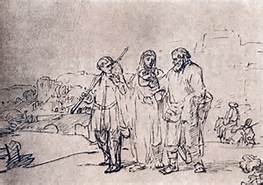
The story of the two disciples on their way to Emmaus who meet the resurrected Jesus is a familiar story to us all, maybe to familiar. I found this drawing of Rembrandts and it touched me in a way some finished painting cannot. If you look closely you will see it is not a complete drawing, you have the basic outlines some detail is included but most of the fine detail is missing. In a way that is what the scriptural story is for me, the fine details are left out. For instance Rembrandt portrays a young and an older disciple with Jesus but I don’t remember ages being given. For some reason I always pictured the road they were walking on as being isolated but in the background here you see other travelers, is that possible. Jesus is in deep conversation with the two and I often wondered why these two were they the only ones of his disciples not afraid to go out? I could go on forever but then you wouldn’t have a chance to meditate on this drawing.
So today, I offer this drawing for Visio Divina practice. Gaze at the picture and as you focus on the images place yourself in the role of one of the disciples. Ask yourself the following questions:
The other disciples are afraid of leaving the upper room but you have chosen to travel. If you had been one of these disciples what would you have thought of this stranger interposing himself on you and your companion? Would you have been afraid?
In what ways does this the teaching of the stranger peak your curiosity.
What is it about the stranger that draws you to him? Does he somehow feel familiar?
Given that some of the women in your group have come back from the tomb telling everyone that Jesus was alive, can you entertain the possibility that you are talking to your risen Lord even if you are afraid to say so out loud.
May Christ meet you on the road and offer you comfort.
“. . . too often we resist the urge to turn our hearts to God, for this might entail some serious and inconvenient changes in our lives.” Jamal Rahman, Out of Darkness into Light
This past week has been interesting. You see I am coming to a place where I have to let go of some goals and turn my resulting life, that will be, over to God. Now I am a stubborn person, and I LIKE being in control of my journey, but, I am discovering I control nothing. Nothing in my life is predictable, except when I surrender my will to God.
The above words of Jamal Rahman really hit home for me, because surrendering to God does mean my life changes dramatically. The number one in my life can no longer be me, but God. It means everything I do take’s on a sacred attribute because I’m not doing it for myself; I am doing nothing, because you see everything is for and through God.
When I give up and let go of the reins I am clutching in my white knuckled hand my life focus changes from “it’s all about me” to it is all about what God wants of me; doing justice, loving kindness, and walking humbly with God (Micah 6:8). While Micah’s words sound simple they are not easy and I am consciously, continually, moving into them bit by painful bit.
One of my first steps in surrendering to God began with (or I should say begins with) a practice of examining the unease I have with my life and then holding it to as I find the root cause. I allow myself to kind to me as I acknowledge and hold the energy the cause has over me, offering it up in prayer for God’s mercy and forgiveness.
So I offer Surrender as our spiritual practice of the week. When you feel something is wrong in your life do not ignore or deny it. Instead sit quietly and hold the feeling in your heart, listen to it and search from where it comes. Then as you hold the feelings in your heart pray to God for strength and mercy, asking for God to walk with you as you go deeper into the feeling and surrender the cause to God in prayer. Over time as you repeat this practice you may discover your connection and relationship with God growing ever stronger.
Surrender may be difficult but not impossible when you remember the words of Jesus who said “do not be afraid, for I am with you always.” (Matthew 28:10).
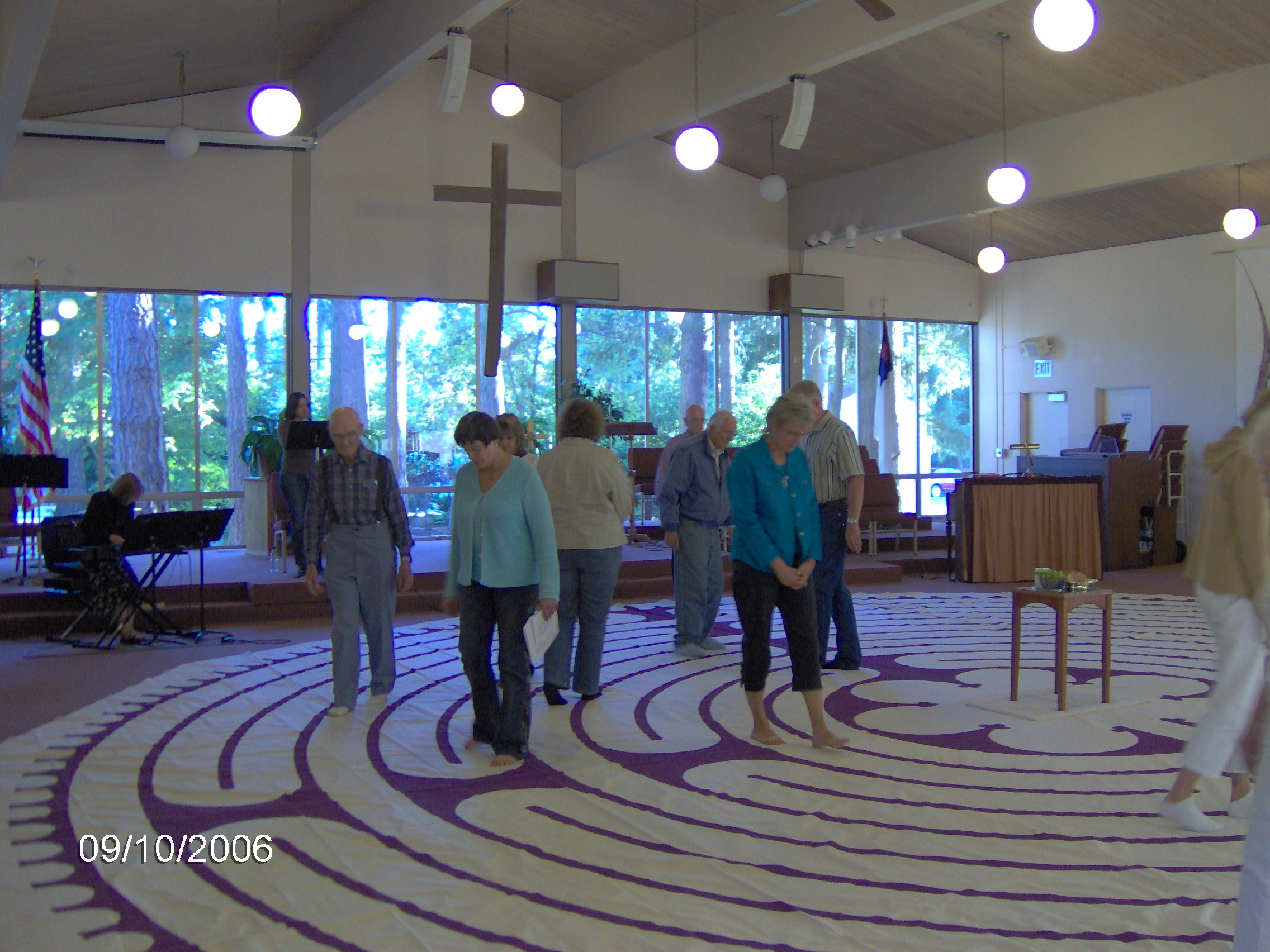
Several years ago I led a labyrinth walk on September 11, in memory of the World Trade Center Disaster. It was held in the churches outdoor labyrinth and the day was perfect for walking. I placed two baskets at the entrance of the labyrinth, one held fallen leaves to represent those who had died that day and the second held small river stones to represent the courage of all of the emergency people who responded to the attack. Each walker was to carry leaf and stone into the center. They were asked to leave the leaf either in the center or place it along the path of the labyrinth. The stone was theirs to keep in remembrance of the walk. The walk was open to the public and was well attended.
One young woman came near the end of the walk and I remember her because she was unsure as to whether she would walk or not. Finally she picked up a leaf and stone and entered the labyrinth. As soon as she entered tears started to roll down cheeks, she walk very slowly stopping at each of the stone benches to sit for few minutes. When she reached the center she sat down on the bench and bent over appearing to be either in pain or great distress. I thought about going to see if she needed help but changed my mind and waited. She must have sat there for 15 to 20 minutes before she stood up, carefully placed her leaf on bench and walked out of the labyrinth.
When she exited she came over to me to apologize for taking so long and I told her that it was quite alright. She said she had read of the walk in the newspaper and that she really wanted to be here today. You see, her sister worked in the World Trade Center and died that day. At the time she was also living and working in New York and when she heard that plane had crashed to the towers she had run out and saw the towers collapse. They never found any remains of her sister.
She told me she hadn’t realized how much grieving she still had to do and that the walk had been more painful than she thought it would be, but she was glad she walked. I told her the labyrinth was always open to the public and she was free to walk it at anytime. I also gave her the names of a couple of Pastoral Counselors she could call if she needed to talk to someone. She left clutching her small stone.
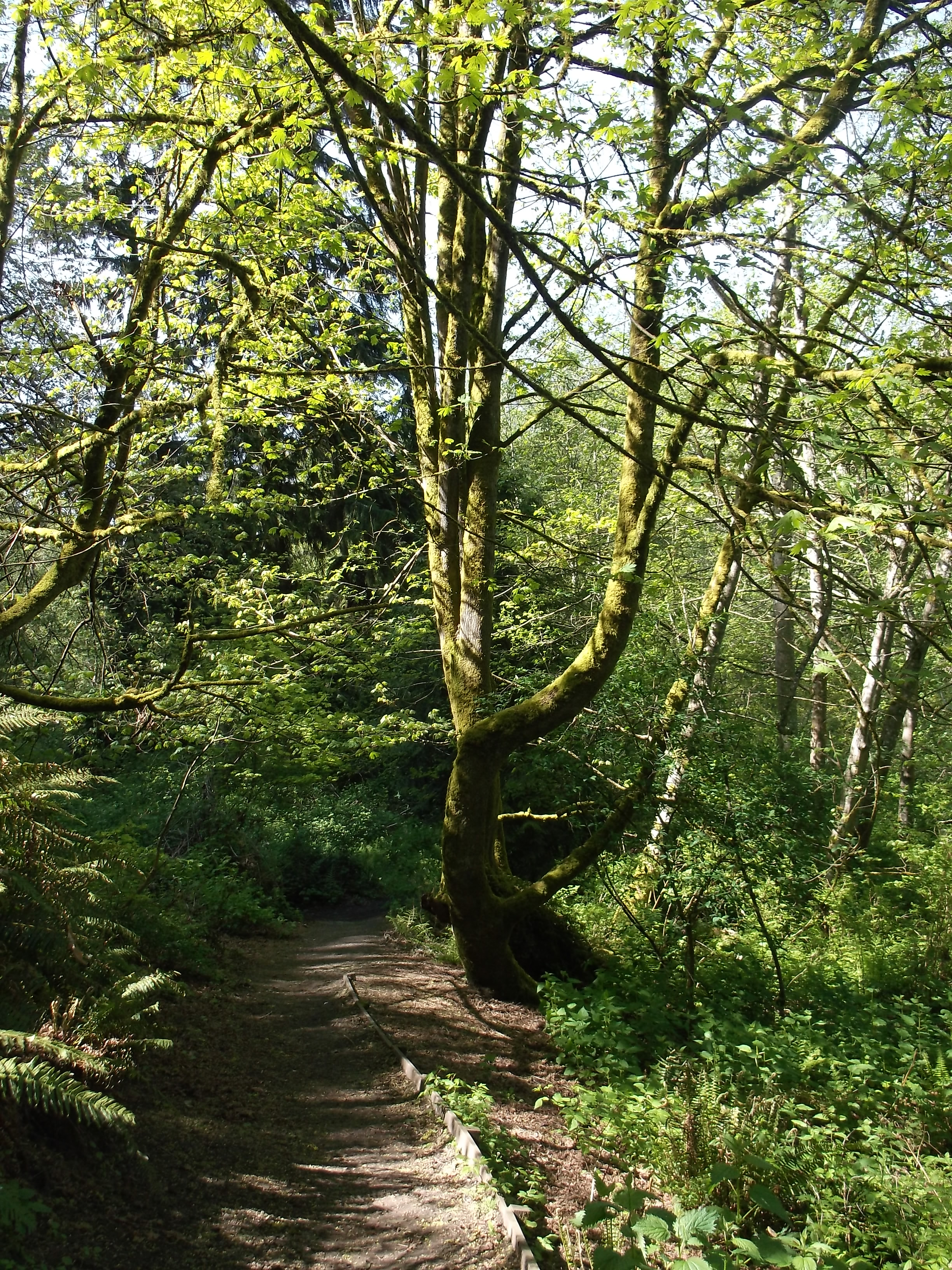
Fortunately all labyrinth walks are as dramatic as this young woman’s. Most, if not all, are walks that draw us into a quiet place and provide space for conversation with God. Yes revelations can occur but they are very rare. It is a blessing just to have a quiet walk that brings some peace and serenity to your life. That’s plenty I think.
If you’ve never walked a labyrinth here is some historical information. Labyrinths are an ancient meditation tool that predates Christianity. Up until the end of the middle ages they were use in place of a pilgrimage to Jerusalem. People walked the labyrinths sometimes on hand and knees to simulate the difficulties of a long journey. Around the middle of the 1400’s labyrinths fell out of favor and it wasn’t until the middle of the 20th century that they were “rediscovered” as a meditation tool. They are now very popular and used by those striving for deeper spirituality and also in the health professions where the health benefits of walking the labyrinth have proven to be quite diverse.
The spiritual practice I am recommending this week to walk a labyrinth. You may locate labyrinth in area that you may walk, or you may “walk” a labyrinth with your finger using a printed labyrinth figure or finger labyrinth made of wood, stone, or metal.
Below are guidelines for walking a labyrinth either with your feet or your finger provided by the Disciples Home Missions and here is a link to a virtual labyrinth provided by The Labyrinth Society http://labyrinthsociety.org/flash/labyrinth.htm and a link to several labyrinth designs you can print out and use on your desk top provided by the Relax 4 Life website http://www.relax4life.com/paperintuipaths.htm
The labyrinth has only one path. It differs from a maze in that there are no tricks to it. From early on within the Christian tradition to now, countless people have walked labyrinths as devoted acts of pilgrimage, prayer and spiritual formation. There is no right way or wrong way to walk the labyrinth. As you follow the winding pathway to the center and back out again, surrender to the journey with an open heart and an open mind.
Four Fold path of the labyrinth
REMEMBERING you are invited to gather your thoughts as you prepare to begin your walk; remember you are blessed. All that we have, all that we are is a blessing from God. If you are waiting in a line of others for your turn to enter the labyrinth, this is a time for literally counting your blessings.
RELEASING begins when you enter the labyrinth and ends upon arriving at the labyrinth’s center. This is an opportunity for “letting-go” of whatever distracts you. This is a time for quieting, opening, emptying, and shedding. For some, this happens through a mindful slowing and deepening of their breathing, or the silent repeated reciting of a simple prayer.
RECEIVING is a gift at the center of the labyrinth. Having emptied oneself, there is now spaciousness within to receive creative Spirit. Receiving guidance, interior silence, new insight, deeper wisdom, a sense of peace are only a few experiences that can occur on a labyrinth walk. It is different for everyone. You may sit or stand in the center as long as you like. Receive what is there for you to receive and accept such as a divine gift.
RESOLVE, begins when you leave the center and return on the same path back out of the labyrinth. There are many aspects of this: you can resolve to take a next step in your life, or come to a resolution about something bothering you. Rejuvenation often occurs, or a feeling of rebirth begins. Or, on your way out, you reclaim those responsibilities you set down on the way in, but for which you have new strength to carry them. Often, feelings of strengthening and integration occur. Symbolically, you take back out into the world what you’ve received.
Some wisdom for these Four R’s of the labyrinth
This way of using a labyrinth is only a map; it is not the territory. You can allow blessing anywhere on the labyrinth. You can release anywhere on the labyrinth, you can receive anywhere; you can come to resolution anywhere on the labyrinth. The Fours R’s is one way of understanding what can happen while you are walking the labyrinth. Do not hold these too tightly; during your walk you will understand the flow.
This Labyrinth ministry resource is Provided Courtesy of Disciples Home Missions (DHM), Office of Search and Call, of the Christian Church (Disciples of Christ) Indianapolis, IN, Rev. Warren Lynn, This document is created with permission from, and based on a source by, Veriditas, Inc., San Francisco, CA; The Rev. Dr. Lauren Artress
1 Thessalonians 5:12-18 (NRSV) 12But we appeal to you, brothers and sisters, to respect those who labor among you, and have charge of you in the Lord and admonish you; 13esteem them very highly in love because of their work. Be at peace among yourselves. 14 . . ., encourage the faint hearted, help the weak, be patient with all of them. 15See that none of you repays evil for evil, but always seek to do good to one another and to all. 16Rejoice always, 17pray without ceasing, 18give thanks in all circumstances; for this is the will of God in Christ Jesus for you.
There is an ancient story in the Orthodox Christian Tradition concerning a Pilgrim who searches for a deep communion with God, for an understanding of prayer and the spiritual practice of “prayer without ceasing.” In his travels and conversations with people of the church he discovers the writings of the Christian writers where he learns how to let his life be a witness to the teachings of Christ through unceasing prayer. Using the words of the blind beggar Bartimaeus who calls out to Jesus “Jesus, Son of God, have mercy on me, a sinner,” and timing his breath and steps to the rhythm of the prayer the Pilgrim repeated the prayer without stop as he journeyed from place to place. He found that even when he wasn’t literally speaking the prayer it was playing in the back of his mind and guided him in his actions towards all he me.
The prayer the Pilgrim used is called the “Jesus Prayer” and often used in a form of contemplative prayer called the Breath Prayer. By repeating the Jesus Prayer in a daily prayer practice the mind learns to become still and your being centered in order for the still small word of G-d to be heard and the presence of G-d to be felt. But the pilgrim wasn’t just praying a breath prayer; he was using an ancient form of prayer called chanting.
A chant is defined as a “short, simple series of syllables or words that are sung on/or intoned to the same note or a limited range of notes; A canticle or prayer is sung or intoned in this manner, or to sing or intone to a chant such as chant a prayer. It is the repetitive speaking or singing a single tone, word, or phrase that the one praying uses to open the door into G-ds presence. And, chanting has an eclectic past. It is used by almost every religion in some form or other. The far Eastern Tradition often uses a single tone, pronounced “ohm,” to draw their minds into stillness and into oneness with the universe. Those in the Judaic faith repeat the Shema, “Hear, O Israel, the Lord is our God, the Lord is One. Blessed be the Name of His glorious kingdom forever and ever. And you shall love the Lord your God with all your heart and with all your soul and with all your might,” traditionally as they rise in the morning and as they go to bed at night. But it is also used as a prayer chant. Those in the Roman Catholic Faith have many chants which they use to draw their minds into stillness and their hearts into G-ds presence. One type, Gregorian chants, were psalms set to music in which medieval Monks used for the same purpose, creating stillness. I became interested in chanting many years ago when I heard my first Gregorian chant and found the cadence and sound of the notes lifted my heart into a new place that it had never been before. I have been chanting ever since.
In the scripture quoted above from 1 Thessalonians Paul calls us to pray without ceasing. When I was a teenager and heard those words my first thought was that is impossible. After all, I have class work to do, problems to figure out, chores to do, people to talk to, games to play, work to do, you name it and I could find a reason why such a task would be difficult. I’m betting you could add to this list, after all our lives are busy with living. So how on earth can we pray constantly? Well it has taken me a little while, Ok, OK, a long while, to figure that conundrum out. I realized that Paul wasn’t asking us to give up our lives. Rather he was calling us to center our lives in prayer. For me chanting has been the way to accomplish that task.
Now you might be asking how chanting helps me pray unceasingly? A while back I was laid off from my job and I was truly afraid of what could happen if I didn’t find another one. Every evening, following a day of unsuccessful job searching, I took long walks with my dog and tried to come to grips with what was happening to me. The problem was I was the only one talking. In fact I realized I was talking so much that if G-d was there she was never going to get a word in edgewise. One evening a friend invited me to a Taizé service and I rediscovered the peacefulness of singing chants in order to quiet my mind and offer the simple prayer of myself.
My Spiritual Practice of Chanting
So how does chanting help G-d enter, well the steps are pretty easy really. First of all there are really no hard and fast rules. You begin by identifying a word or phrase that draws your attention and has significance for you. This is a trial and error processes so don’t worry if it doesn’t quite fit and you have to change it. You will discover your chants will change over time as your needs change.
To begin a spiritual practice of prayer chanting set aside 15 to 20 minutes in your day and repeat your chant, rhythmically, timing it to your breath or your step as you walk. You may chant out loud or you may do it silently it all depends on where you are and what is happening around you at any given moment. The major thing is to practice it every day. Learning a Spiritual practice means you must do it every day just as if you were learning to play an instrument or play a game, it takes commitment.
You have a wide choice of times to choose when to practice your chants. You may set aside a quiet time as you would for any meditation or you may chant while preparing for you day in the morning or rest at night; waiting and riding public transit; doing dishes, laundry, or other housework. The key is to do it every day. Gradually, just like the ancient Pilgrim, the prayer will begin to “play” in the background of you mind all the time, providing comfort and guidance in all your daily activities.
You may chant using whatever method you are most comfortable with such as a single tone, as those in the Far Eastern traditions do; a single spoken word or phrases, such as the Jesus Prayer; or, and this is my preferred way, a musical chant. Whatever you choose the process is pretty much the same. Musical chants are often short scriptures or spiritual phrases set to a simple tune that is easily remembered and sung. Because I love music, even though I no longer am able to sing well, and I find musical chants the easiest for me to remember and repeat when I am praying. I find that music triggers a sense of stillness the spoken word alone cannot do.
I mentioned my chants change from to time to time and it is because my relationship with G-d changes over time. As my relationship deepens I become more comfortable with certain chants because they draw me deeper into the mystery that is G-d. You will know when that happens and you will also simply know what chants deepen your experience with G-d and other don’t. I have a number of different chants that I am particularly fond of that I use depending on where I am emotionally and spiritually that day. Most often I use scripture passages that have been set to music but occasionally I will use a phrase that means something to me at that time in my chants. Currently one of my favorites is based on Matthew 28:10, 20 “Do not be afraid, I am with you always.” The music is written by Harpist Linda Larkin and the arraignment is by John P. Newell. This chant reminds me I am not alone and I find comfort in it when I am confused and frustrated. I also often use the Taizé chant Ubi Caritas (Live in Charity) written by Jacques Berthier of the founder of the Taizé community. Currently these are very meaningful for me but you may use whatever chant fits your current spiritual journey.
My prayer for you journey is you will find comfort in G-ds presence as you sing words of peace, prayer, love.















 A Quiet Walk