Like good stewards of the manifold grace of God,
serve one another with whatever gift each of you has received.
–1 Peter 4:10
Jesus Washing Peters Feet
Ford Madox Brown, 1821-1893
My morning’s meditation topic was “service” and it started a train of thought (ok it was actually a brain worm but let’s not quibble) about how I “serve” others. I must admit there are times when I am not very nice and I do it only because I have too or to prevent an argument. I am quite good at rolling the old eyeballs in those instances.
But that is not what Jesus taught; the Gospel of Mark records Jesus saying “Whoever wants to be first must be last of all and servant of all.” (Mark 9:35b) In fact all through scripture we are called to be God’s servants and, from my perspective, if we are all, humanity and creation, images, the manifestation of God in the world then it makes perfect sense that we are also servants of all we encounter, human or otherwise. To be a true witness of the resurrection is to serve, with joy, our fellow travelers on this planet. That means caring for the earth and all that lives on it. It means caring for those who cannot care for themselves, speaking up for those who have no voice and doing all with grace and with every ounce of our God given gifts. One of my favorite rituals is foot or hand washing. To personally hold someone’s hand or foot in your hands, pouring the water over them, wrapping them in a towel and then look them in their eyes and tell them they are beloved by God gives me chills.
But rituals aside service means anything that places you in the position of servant. Cleaning the home of an elderly friend or family member, mowing the lawn and weeding the garden when you know the owner can’t bend over anymore, creating a garden and sharing the harvest with neighbors or a shelter all are ways we may offer our service. But there are even simpler ones that often get overlooked; such as picking someone up for an event, calling on the ill, taking out the garbage or keeping a room clean. These are services that make life easier for others and, when done with joy, happiness in our own lives.
So this week I am challenging you to 1) notice when you do a simple act of service, and 2) if the opportunity comes up to offer your special gifts to others to give it a try. When you do you are witnessing the resurrection in action and love blossoms.
“And of His Signs is that He created mates for you from yourselves that you might find peace of mind in them, and He put between you love and compassion al-Qur’an 30.21
Public Domain Photo
With one silent laugh
You tilted the night
And the garden ran with stars. – Jalal-ud-Din Rumi
To love someone, especially someone who doesn’t expect you to love them, may be the most important of the spiritual practices. Love is a grace of God given freely to all and as Oscar Hammerstein wrote “Love in your heart isn’t put there to stay. Love isn’t love till you give it away.” God put love in our hearts to be shared with all creation, not just humanity but animals, flowers, and yes, even rocks. To truly love is as close as we get to being the image of God.
This week share your love with a family member, a friend, an adversary, an enemy. Let the love in your heart out and be God’s image in the world.
For where two or three are gathered in my name, I am there among them.” Matthew 18:20
Welcoming the Other Microsoft Free Clip Art
On Monday this week I volunteered at Common Ground, a Hospitality Space in Everett, WA. From Monday through Thursday, from 8 AM to 12 Noon, the homeless or those who live on the edge of homelessness come in for coffee, tea, and whatever snacks the Space receives by donation. While the makeup of the guests varies from day to day many come every morning and have discovered they will be received with a cheerful smile and an invitation to eat and talk. This is true communion for four mornings a week. The Pastors Rebecca and Luke Sumner have created a space where everyone feels safe and welcome. This is a place where food, warm drink, and an available ear for listening are always present. This is also hospitality at its finest.
For this Easter Season I am offering spiritual practices that reflect how we are witnesses of and express the light of the resurrection. When I volunteer at Common Ground I am witnessing firsthand the light of Christ’s resurrection in two young pastors and with their volunteers. When a person comes in to Common Ground they are not turned away, rather, Luke and his volunteers make sure each one is fed and offered a warm drink. When they have socks, hats, gloves or scarves they hand those out, making sure those who need them the most are the first ones to receive them. Volunteers sit down with the guests and get to know them as people not just as that unkempt person on the corner. As a volunteer I have found that the most important thing I can do is begin a conversation and then simply listen to often amazing stories of life that I normally only read about. I discover just how much alike we all are.
Yes there are those who drink too much, who abuse drugs, those whose mental illness has dropped them through the cracks of society and those who are just down on their luck. But at Common Ground none of that matters, all are fellow humans trying to make it in this life, all are beloved Children of God who only want to be seen and accepted for who they are. I am always tired when I leave Common Ground but I am also filled with an different kind of energy that keeps me coming back to visit with those I have met before and those I have yet to meet.
Common Ground may not look like a sacred space but it is. Here are the people Jesus of Nazareth spoke to first, ate with, joked with, and made the ultimate sacrifice for. Here I see the resurrection light shining in the Pastors, the volunteers, and the community that is forming out of street people and the discarded people of society. This is a spiritual practice that offers the concrete results of love in the form of food, drink and conversation and hands on spiritual practice where progress is heard in the proffered “thank you, I really appreciate what you do here.”
This week I offer the spiritual practice of hospitality. Sometime this week go out of your way to welcome someone or make someone comfortable. For example when I used to ride the bus to and from work or class I often would sit down next to a young mother; young mothers nearly always seem a bit frazzled. I would start up a conversation and then let them talk about their children and how their day is going. They mothers and the children often left the bus with a smile on their faces and I had just made a new friend. Hospitality isn’t just feeding or clothing the stranger, it’s really about being a real person to each and everyone you meet and being compassionate and honest in your speech and actions. To accept someone different from you is a magical beginning to new ways of seeing the world no matter who you are.
During this week may you discover that a full heart comes from emptying yourself by giving kindness and hospitality to others.
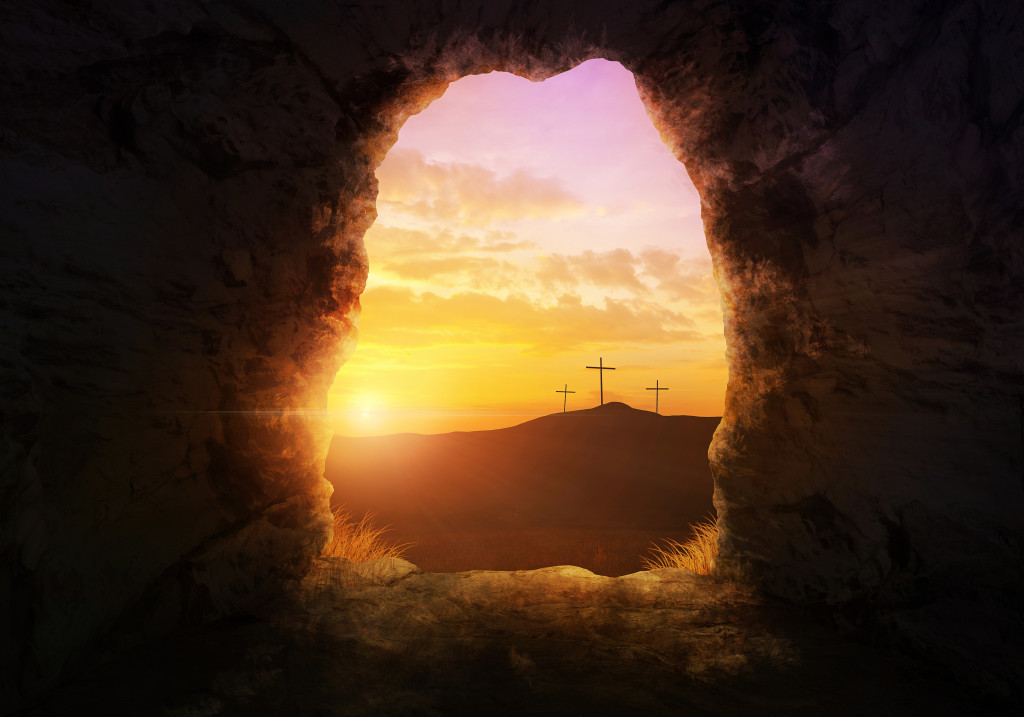
1After the Sabbath, as the first day of the week was dawning, Mary Magdalene and the other Mary went to see the tomb. 2And suddenly there was a great earthquake; for an angel of the Lord, descending from heaven, came and rolled back the stone and sat on it. 3His appearance was like lightning and his clothing white as snow. 4For fear of him the guards shook and became like dead men. 5But the angel said to the women “Do not be afraid; I know that you are looking for Jesus who was crucified. 6He is not here; for he has been raised, as he said. Come, see the place where he lay. 7Then go quickly and tell his disciples, ‘He has been raised from the dead, and indeed he is going ahead of you to Galilee; there you will see him.’ This is my message for you.” 8So they left the tomb quickly with fear and great joy, and ran to tell his disciples. 9Suddenly Jesus met them and said, “Greetings!” And they came to him, took hold of his feet, and worshiped him. 10Then Jesus said to them, “Do not be afraid; go and tell my brothers to go to Galilee; there they will see me.” –Matthew 28:1-10
We are now in the season of Easter, yes I said “season,” which is comprised of the weeks from Easter Sunday to Pentecost. This is a time of reflection on what it means to be a Christian and the significance of living a life of God’s people out in the world. Easter season is a time for all of us who are the church to focus on how we are witnesses of the resurrection in our daily lives. In the light of the Easter Season the weekly spiritual practices will focus on how we express the light of the resurrection to those we live and work with and those we meet in our goings and comings.
To begin this series of Spiritual Practices I would like to start with the Spiritual Practice of Intention. The practice of intention focuses on how you are “being” in the now, this very moment. Your intentions come from your own understanding of what is important to you in our ever changing world. When you reflect and meditate on what matters to you, what is most important to your inner self you learn to act out of that intention. Your commitment to, and actions in, the world around you will begin to reflect what you value most, and what lies within your heart. I am not talking about setting goals rather I am suggesting that you search your heart for what you value most. What is important about the spiritual practice of intention is you do not want to search for peace, stop thinking, or discover some enlightened thought. Rather you are looking to set an intention, discover what it is that you value most and then do you best to live into that intention as you go about your daily life.
For the practice I would like to suggest you take some time this week and contemplate what matters most to you. Two or Three times this week set aside 15 to 20 minutes to sit in silence, and explore your inner dreams, wishes, and desires. What is most important to you? Do you value peace, justice, or mercy, or something else? Contemplate how you might express that value in the coming weeks of living your daily life. Let yourself rest in the silence and in the voice of your heart offer up a prayer to the Divine asking for guidance and giving gratitude for the grace God has given you.
May the Eternal give you guidance and show you how to live as a child of the Everlasting. Amen
“for I was hungry and you gave me food,
I was thirsty and you gave me something to drink,
I was a stranger and you welcomed me”. – Matthew 25:35
Louis Guido Maximilian Jewell (aka Louie) Adopted March 19, 2016
I apologize for being late today, but, just returned from the Westar Institute Spring Meeting held in Santa Rosa CA. I returned a day late because I adopted the cute little fellow above. I ended up staying an extra day to bond with my new little friend before we made the long drive home.
You may be wondering how adopting a dog from shelter is related to a theological meeting but it does fit in quite well actually. A major theme of the meeting was hospitality, the welcoming of the other into our midst. That other may be someone from a different culture, race, faith tradition, age, or gender. It also means welcoming the non-human other. God intends us to express our welcome to all creatures, mammal, bird, fish, reptile, and (here’s the hard part for me) insects. God intended us to care for all nature, human, non-human, plant, and stone for all are children of God.
As I listened to the lectures and discussions I wondered when we lost the ability to care for others, human or non-human. When did we forget to practice loving the other and caring for the sick, the homeless, and the incarcerated? It doesn’t matter if the other in need is a man, woman, child, dog, cat, horse, or any other child of God, all deserve to live a good life and to be welcomed into our arms.
Ever since my beloved Suzie died in January from a stroke I have been considering adopting another Chihuahua and while I was in Santa Rosa I visited a Sonoma County Animal Shelter and was introduced to Louie. I thought about what it means to care for someone other than myself and while a small dog wouldn’t be everyone’s choice it is mine. So we are welcoming into our small home and family a new member. Louie was abandoned on the streets of Santa Rosa; he is between 3 and 5 years and was discarded like trash. A shy little fellow who is way smarter than you’d think. After all he has lived for some time on the streets, and survived. He is loving, gentle and wants only to be loved. Just like anyone who has been discarded and forgotten.
So this week, for our spiritual practice, I am asking you to practice hospitality. I’m not suggesting you go out and adopt a dog or any other animal, although I wouldn’t stop you. Rather I am suggesting that you see the homeless on the street for the people of God that they are. You might volunteer to spend a couple of hours helping out at a homeless shelter, food bank, or animal shelter. If you see a homeless person on the street, offer them a sandwich or granola bar. When you offer your gift, shake their hand look them in the face and see the Holy Spirit looking back. Talk to Terri Stewart about volunteering at the King County Juvenile Center and learn to see children of the streets as angels in disguise. If you are interested attend a service of a different faith tradition and listen with open heart and mind. At the end of the week reflect on what you have experienced and learned of the other. Offer a prayer for all who are forgotten and pushed aside.
Loving, welcoming Spirit may we see your face in the eyes all we meet, human and non-human. Help us to open our hearts to the stranger in our midst, and welcome them with open arms.
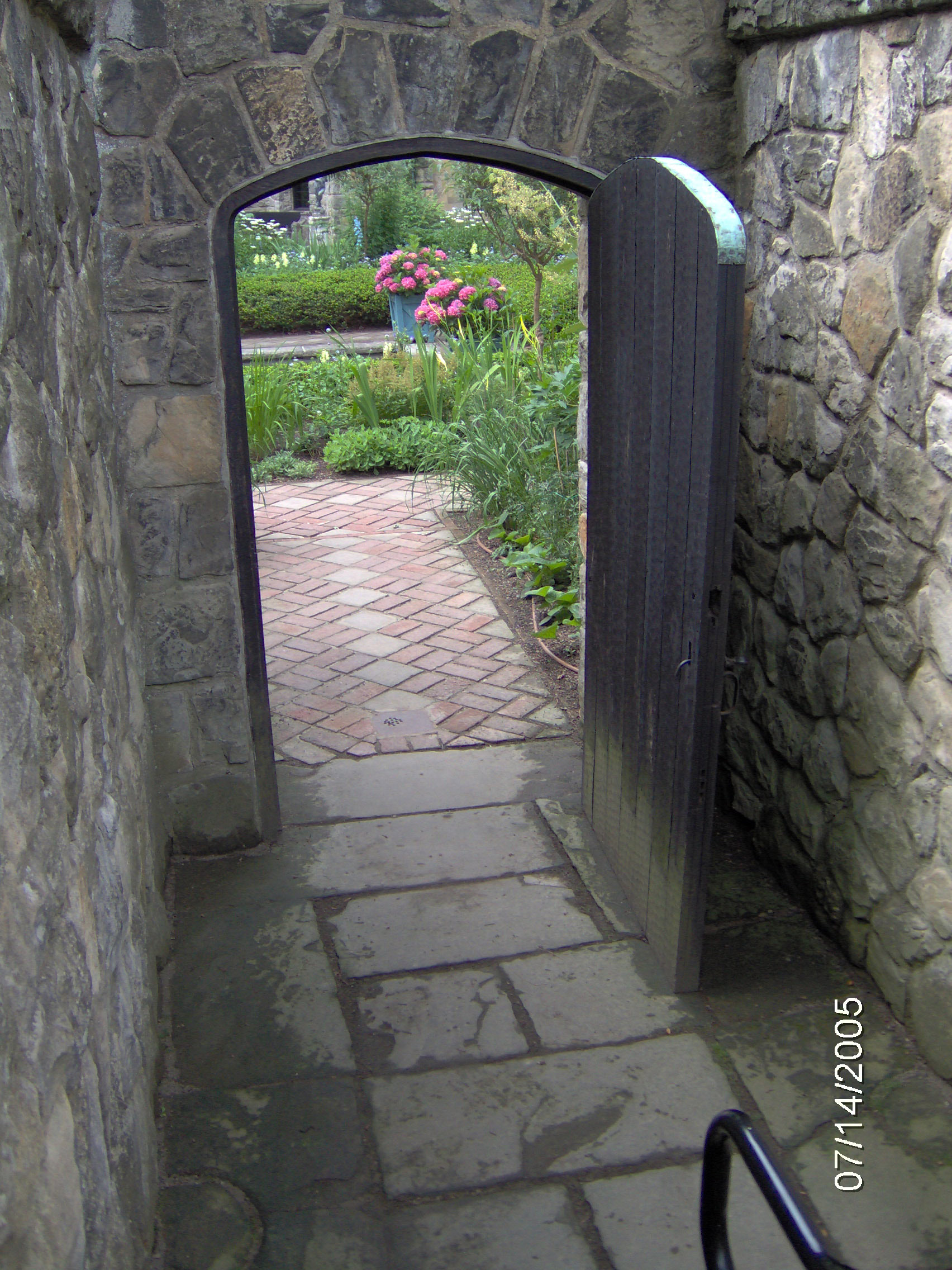
Open doors offer promise and fear, joy and sadness. Behind an open door there could be grandchildren waiting for fresh baked cookies, or maybe something else, something fearful waits for us. The above photo of an open door could be deceptive, there might be a garden beyond or there could be a path to a destination we didn’t want to travel. We will never know until we cross that threshold. Crossing into the unknown is one of the most frightening things we do as humans. The unknown is what we make of it and we can’t confront our fears or live our lives until we are willing to move through the door and confront what lies on the other side.
Today I am offering the spiritual practice of Visio Divina using the photograph above. Before you begin, sit for a moment with your feet on the floor, close your eyes and breathe deeply, letting your body relax and open your soul’s heart. Now open your eyes and let your imagination and God’s love lead you through the following steps.
Study the photo slowly, taking a first glance noting the colors, places and things. Remain with the image for one to two minutes. If you would like, jot down a few words about the image.
Take a second, deeper, look. What do you see? What draws you in? Engage your imagination and describe what lies beyond the door? What are you leaving? Where do you see yourself in the photo? What do you see from that perspective? What deeper meaning emerges?
What feelings arise within you as you gaze at the photograph? Do you feel fear; are you uncomfortable; are your excited or do you anticipate what you might find?
Respond to the image with prayer. Did the image remind you of an experience, person or issue for which you’d like to offer thanksgiving or intercession? Does the photo bring to mind an instance when you have stood at a door, either opened or closed? Offer your thoughts as prayer to God.
Find your quiet center. Breathe deeply. Relax your shoulders, arms and legs. Rest in this quiet. Let God pray in you. God prays beyond words.
Gracious Holy Spirit each day we stand at a new door, where our next challenge lies beyond. Give us strength to face whatever we find across the threshold. We are grateful for the courage you give us as you accompany us through each door. Amen
If I speak in the tongues of men and of angels, but have not love, I am a noisy gong or a clanging cymbal. – 1 Corinthians 13:1
Photo by Joe Beck, Unsplash
Today is Super-Tuesday, a day when political parties in mostly southern states choose who they want to run as their Presidential Candidate. So far in this election we have heard the traditional political rhetoric and a great deal of speech filled with anger, hate, bigotry, greed and plan nonsense. My choice of candidate is not important, no, rather what is important is that each of us look carefully at who is running and who has the American peoples best interest. Not just white, male, and wealthy, but all Americans regardless of socioeconomic status, choice of faith, where they come from, color of their skin, age, or gender identification. All Americans regardless of whether or not they have U.S. citizenship or hopes to attain American citizenship all must be considered equal participants in our society.
In the Gospel of Matthew Jesus says “No one can serve two masters; for either he will hate the one and love the, or he will be devoted to the one and despise the other. You cannot serve God and mammon.” We cannot serve the people, the Divines own people, if we serve our own self interests. When we love power, money, and status more than we love the people of God, whoever they may be, pain and suffering will be, has been, the result. We who call ourselves followers of the Divine, with whatever faith tradition we choose, must not let those whose primary interest is greed, hate, and power, and not the American people, or the people of the world be elected into a position where they could destroy the fabric of our nation and world.
So today, offer prayers for those voting, that they think carefully of their choices. To refuse to let false, hateful and self-serving rhetoric sway them. Rather pray that all people will stand together to push back the evil we are seeing displayed during this election year.
My prayer: May the hand of every voter be guided by the desire for a country that holds sacred the lives and well being of all who live in American and beyond.
15 One of the dinner guests, on hearing this, said to him, ‘Blessed is anyone who will eat bread in the kingdom of God!’ 16Then Jesus* said to him, ‘Someone gave a great dinner and invited many. 17At the time for the dinner he sent his slave to say to those who had been invited, “Come; for everything is ready now.” 18But they all alike began to make excuses. The first said to him, “I have bought a piece of land, and I must go out and see it; please accept my apologies.” 19Another said, “I have bought five yoke of oxen, and I am going to try them out; please accept my apologies.” 20Another said, “I have just been married, and therefore I cannot come.” 21So the slave returned and reported this to his master. Then the owner of the house became angry and said to his slave, “Go out at once into the streets and lanes of the town and bring in the poor, the crippled, the blind, and the lame.” 22 And the slave said, “Sir, what you ordered has been done, and there is still room.” 23 Then the master said to the slave, “Go out into the roads and lanes, and compel people to come in, so that my house may be filled. 24 For I tell you,* none of those who were invited will taste my dinner.” ’
On a warm June afternoon in 2000 I was sitting at the entrance to the primary hotel in Vallejo CA. I was waiting for a bus to come and deliver John to me who was coming from the Oakland airport. I could hardly contain myself, you see in just a few short weeks I would be retiring from my consulting job and moving back to Edmonds. John was coming to help me pack-up the apartment and drive with me back to WA. We would be married in September. This was the beginning of 6 months of celebration that has extended into nearly 16 years.
I had accepted an invitation, I said yes. I knew that in that acceptance I would now be living a new life and one that would require me to make the choice to change from a life of taking care of only me to taking care of someone else. Now that’s a huge change for someone who was 53 and never married. But it was a choice that I have been grateful for ever since. You see by accepting the invitation I was transformed from a stranger into a member of a community. And, as a result I was blessed with a new life that has had its challenges and its joys. That’s what happens when you chose to transform your life. Life can be a bed of roses, but what you must remember is roses have thorns and you can be sure you will sometimes get stuck with one, or more, of those thorns.
Today’s scripture is not only about choosing between accepting and refusing an invitation to a banquet given by an upper class gentleman, it is about choosing between accepting or refusing to live a transformed life of free grace in the way we were meant to live. It is choosing to live as a member of a community rather than being a stranger, and, to decide living a transformed life means accepting all of that life of grace. It means we are to commit to live that life no matter what gets thrown at us or how many thorns we run into. Living a transformed life of grace doesn’t mean there won’t be thorns, or potholes, or great sorrows on your path. It means we are given the strength to walk through them because we aren’t traveling the road alone.
Our story this morning is about a man who has invited his friends and, probably, business associates to a banquet. In the first century preparing a large dinner was not an easy process. Different items were served depending on how many people RSVP’d the invitation. If only a small number accepted then chicken fish or duck may be the main course and a larger number would result in the host preparing anything from a one lamb or oxen to preparing many.
You have to remember there was no refrigeration so all of the food had to be prepared and eaten before it spoiled. To help prevent food wastage two invitations were sent out. The first invitation invited the guests to the dinner and they responded yes or no but the time of the dinner was not given. When all is ready the host sends out a second invitation calling the people to the prepared dinner. It was extremely rude to accept the first and not come for the second invitation because that meant a huge waste of resources for the host.
The householder has invited the guests and now sends his servants to call them to the prepared dinner. But despite accepting the first invitation all of his guests find excuses for not attending. The first guest refuses because of business issues. The second guest let’s his possessions take precedents over his social obligations, and the third puts his home and family above attending to a promise already given. I suppose to us these don’t seem like unreasonable reasons for not attending but what if we look at the story from a different direction.
First of all this isn’t a story isn’t about an ordinary householder. No, our host happens to be Jesus who is inviting his guests into a relationship that will transform their lives. How does the story and the excuses change when we see that it is Jesus who is inviting us into a banquet that will transform us from strangers into the Children of God in order to live a new life? How will that perspective change the way we hear this parable?
So here is how the story might sound if we told it as if Jesus was throwing this shindig? The guests Jesus first invites to his amazing banquet are those he expects will accept the invitation because they already understand, or he thinks they do, what it means to live the transformed life He is offering them. Jesus wants them to come and celebrate with Him, to become part of the new life that only happens when we accept the Divine invitation. An invitation of free grace to live the life we are meant to live in the presence of God, Jesus and Holy Spirit. So he sends his disciples out to bring his guests to the party; the food is ready, wine is poured, the orchestra is tuning up for an all night event. But his disciples come back and tell him all have refused, all are too busy with the details of life, the minutia of daily living. So what does he do, after all he has a hall prepared, food on the table, wine chilling, and musicians waiting? Well, Jesus did just what he told his disciples to do when he sent them out to preach and the invitations they gave were refused. He “dusted the dirt from His sandals” and turns his back on those who refused him and sends his disciples out again into the streets to bring in whomever they find to the party, the good and the bad, the worthy and the unworthy. These guests are the disadvantaged of the Jewish people; tax collectors, prostitutes, the homeless, and the ostracized because they are different. But still he has room so he sends out his servants again this time to the people from the roads and byways around the city. These are the people normally not considered part of the ‘Jewish family,’ these are the gentiles, the ultimate outsiders for the Jewish people.
How would we identify these people with those from today, the 21st century? Well think of who are our people of the streets and you might first of all think of “Nicholsville,” or the man or woman standing on the corner with a sign that says “Homeless vet, needs food and job,” and think of the shop keepers in the poorest parts of Seattle, or any town for that matter. It was people like these who were the ones who were welcomed into Jesus’ party. They were the nobodies of the town and here they were going to a big shindig given by the most important person in town. Now think of those people outside the Christian circle of community, Muslims, Buddhists, Jewish, atheist, and agnostic. Those might be our version “gentile.”
Can you imagine how they all felt? Can’t you just hear them as they walk to the mansion, “Jesus invited me, me, to his party,” “You too, I can’t believe it,” “I was invited too, and get this, the woman said come as I am, and it didn’t matter if I’m not part of the Christian faith. He just wants me to celebrate the Divines presence in my life as you celebrate it in yours, how cool is that.”
Unlike Jesus’ first guests these guests weren’t concerned about who they would be sitting next to at the table or who might make a big splash in the news media. It didn’t matter to them that the person next to them was a drug addict, a thief, a prostitute, a shop keeper, a prosperous business person or followed a different faith, they were all children of the one God. They didn’t care if Jesus was failing or succeeding in life. They were excited about being invited. They understood the importance of being invited to this banquet, this table. They wanted to have new lives. Unlike those first invited they knew their old lives weren’t working for them and they were willing to change and live new lives, transformed lives of grace that had meaning and where all people are recognized as family and community despite who they were or how they walked their way to God.
What Jesus was offering wasn’t a new idea for his banquet. For centuries the Prophets of Israel were telling the people the same thing. Moses says in Deuteronomy (30:19b) “Choose life so that you and your descendants may live.” In Proverbs 9 Wisdom calls to the people:
4“You that are simple, turn in here!” To those without sense she says, 5 “Come, eat of my bread and drink of the wine I have mixed. 6 Lay aside immaturity, and live, and walk in the way of insight.”
And through Isaiah God tells the Jewish people:
6 “ theLordof hosts will make for all peoples a feast of rich food, a feast of well-aged wines, of rich food filled with marrow, of well-aged wines strained clear.”
In the New Testament James writes:
6 “God opposes the proud, but gives grace to the humble.”
God has been inviting us to the table of grace since the beginning. She spoke through the fathers of the Jewish people, through the prophets, sent her Son and spoke through the disciples. But we have let greed and self-centeredness takes precedence over the original message of grace.
But what does it mean to choose life? Well “When you say ‘Yes’ to life you say ‘Amen’ to all of life as a package deal. Thereafter the so-called problems you have with personal injustice do not arise. You renounce your concept of victimhood and the old impulse to complain about being unfairly treated.” A “commitment to life . . . refuses to make any distinction between your outer life and your inner life, or between secular and sacred spheres of life, or between loving God, loving all of life, or loving one’s neighbor, no matter who they are. Nor does it distinguish between your current life concerns or your eternal concerns. On the contrary, it simply calls for an unhesitating and unreserved ethical response to the call of life, the call of Jesus, God, and Holy Spirit – right where you are at this moment in time, at this point in your life,” to live a life where you defend justice for all and refuse to accept injustice for anyone as an expedient to living.[1] That is what Jesus taught, that’s grace. It’s not new information, its old stuff we haven’t listened to, at least not for long time.
No matter how you tell today’s story it’s about Divine invitations, the acceptance of grace, and how you live once you’ve accepted God’s grace. When John asked me to marry him, I had a number of options. Like the first invited guests I could have refused and that would have been that. I don’t know where I would have been 16 years later but I am quite certain it wouldn’t have been here. But I did say yes and again to that yes I had options as to how I was going to live within this new relationship. One way was I could continue to behave as I have always behaved, just as the first guests invited to the banquet. Taking care of me, making sure I had what I wanted and what I needed. Yes John would be there but our relationship would not have been very deep because I wouldn’t have let him into the deeper part of me, the part of me that would have built the relationship where both of us would have lived a transformed life. But I chose to say yes and I chose to attend my life banquet. I let John into my heart and said we are partners and what I do and what you do will affect and change who we both are. We looked at the covenant of our marriage and said we do this together as one, not as two people living their own lives in one house. When I accepted John’s invitation to marry, when I accepted that covenant, I had no clue as to what that might look like, but I knew I was going to have to change if I was going to make my life with John. And yes it hasn’t always been sunshine and flowers. Sometimes we have had our thorny moments. But it was because we chose to live a life together as one that we had the strength to overcome all thorns and rocks in our path. While my wedding story wasn’t about God’s grace specifically, by accepting my invitation I discovered grace in a way I did not expect, and that is how it sometimes work.
As many diverse faith community’s we are given a Divine invitation to free grace every time we choose to come invite to our tables all people no matter who they are. We have heard this invitation before and we accepted it with our desire to be who we, as individuals and as communities, were meant to live. We are invited to a banquet of grace, welcoming every single one of us to the head table, and No questions asked about our past or how many times we haven’t understood, if we believe a certain way, or look a certain way. No the Divine wants us to come and join Her. To laugh and sing and eat together, to tell jokes, and play games. To dance to the music that life brings us, and cry together when life brings us sorrows. We are asked to change who we are at our deepest level and live grace filled lives that do not see differences between us, whether they are gender, racial, religious beliefs, cultural, social, or political. He asks us to live a life where we see only brothers and sisters and not people of different abilities, colors, faiths, or cultures.
We can change the world we live in, we can change the world by being the people we are meant to be, a people of grace, by being a people who refuse to accept evil, greed, and self-centeredness as the status quo. We can change the world by refusing to accept war as the only solution, or that homelessness and hunger is just part of life. We can change the world by seeing each other as the Children of God, living the life God meant us to live.
The banquet meal is ready to be served: lamb roasted, wine poured out, table set with silver and flowers. . . . Jesus goes to town, stands on the street corner, and invites everyone within the sound of his voice: Come, rich and poor alike, come the worthy and the unworthy, come with me, oh come, and celebrate the joining of our spirits! I’ve prepared a wonderful spread—fresh-baked bread, carefully selected wines. Leave your lives of self-centeredness, loneliness, fear, poverty, greed, and come, celebrate with me! Come celebrate a life with meaning, a life of grace. Come change your lives, remember to live transformed, not only your inner selves, but also your outer selves. Put on your cloak of joy and celebration and come, walk up the street to a life with meaning.”[2]
Amen
[1] Cupitt, Don: Life, Life, Polebridge Press, Santa Rosa, CA, 2003, pg 6-7.
“Therefore I despise myself, and repent in dust and ashes.” Job: 42:6
“You desire truth in the inward being;
therefore teach me wisdom in my secret heart.”
Psalm 51:6
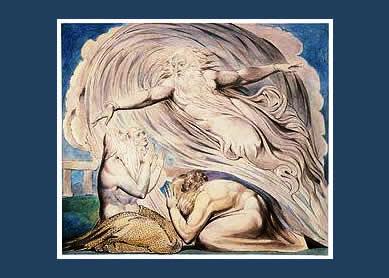
God Speaks to Job out of the whirlwind William Blake, 1757-1827
Tomorrow is Ash Wednesday and the beginning of Lent. Growing up in the Christian Church (Disciples of Christ) tradition I knew about Ash Wednesday but the community I worshiped in didn’t celebrate it. It wasn’t until I was an adult, and living in California, that I really understood that having a smudge of ashes on my forehead meant repentance. Repentance is not just saying sorry, it means examining my past behavior and then changing what I do in the world, turning my actions around to behave as the faithful follower of Jesus I wish to be. And unless I begin the process of change, or at least try to repent, I have not truthfully repented. Because repentance is a spiritual practice God knows I will stumble and have to start all over again. Failing isn’t seen as failure, but as one more step in changing from the old me to the new me.
In today’s world people blithely say they are giving something up for Lent. Often it is some type of food, drink, or action, such as weight loss or smoking none of which really affect our lives and like New Year’s resolution never keep. That is not what the repentance of Ash Wednesday or the time of Lent is. No, it means looking closely at what we do every day and then vowing to the Holy Spirit to change some aspect of our life to fit more closely with the teachings of Jesus. To do that is a truly meaningful act of fasting and repentance; also a very difficult one. But remember failing to keep your promise is only failure if you don’t start over right where you left your fasting path.
So the spiritual practice for this week is to prayerfully look at your life and what you do every day. Is there something in need of changing? Is there something you could do better, or begin to do, which would bring new meaning to your life? Then, for your Ash Wednesday statement of repentance, choose to promise God you will repent and change; then practice changing your actions for Lent. Don’t feel discouraged if it is difficult and you have trouble getting started, just keep trying and taking your discouragement to God in your prayer practice. After all there is a reason it’s called a “practice.”
May your Lenten meditations and fasting bring joyful changes into your life.
Matthew 28:20b “And remember, I am with you always, to the end of the age.”
God does not want
us to be burdened
because of sorrows and tempests
that happen in our lives,
because
it has always been so
before miracles happen.
–Julian of Norwich, 14th century Anchoress
Microsoft Clip Art
Sorrow, grief whether from unforeseen circumstances or our own doing always seems to lead us to questioning our beliefs and faith. We ask ourselves, the universe, or the Divine “why is this happening to me?” In our woundedness we nearly always believe we will never be able to recover, to fully live life again. I know what it feels like, I have been there way too many times and yes I felt totally adrift without friend or companion. Yet I was, we are, never really alone. There is always someone to lay at their feet your fears and pain. Sometimes we have to look for confidants, and sometimes we only have to open our hearts. When we open up and let the pain scream out the healing process begins.
So yes with time the wounds of our heart, mind and soul do heal and we move on. We learn from our pain and discover new strength deep within that provides the fuel to live a joyful and fulfilling life helping us move into a better place in our lives. We learn there are relationships that can’t be broken even in the darkest times. We also learn that from loss great things will grow. The two greatest miracles of sorrow are learning we do have the strength to walk through the dark places in our lives and learning to forgive ourselves.
But when we refuse to look at our sorrows, too afraid of the memories to bring them out into the open where the light is we never learn from our struggles. By keeping the memories of the painful times of life locked within we never allow ourselves to find the deeper meaning in our sorrows, or the strength that comes from squarely facing them. We never completely heal.
Healing doesn’t mean forgetting because if we forget than we cannot come to an understanding of who we are and are meant to be. Life isn’t easy; it is full of ups and downs. More than likely we spend more time in the valleys than we do on the mountain tops. But just as a young tree grows stronger when strong winds blow it around we too grow stronger; strong enough to face the next valley, and the next, and the next. With each one we gain a bit more strength. Yes, I know all too well that it doesn’t feel like that in the moment but it is true. Living your life without challenges, or risk of sorrows, isn’t living it is existing and there lies the difference.
Spiritual Practice:
Have your traveled a dark valley? Did fear keep you from moving forward or from sharing your pain with a friend, pastor, spiritual director, or directly with the Spirit? If you could not let your sorrows out what would help you to find what you need? Prayer and silence are strong tools for rebuilding our relationship with the Divine. Offer your fears to the Spirit in your own way of prayer. Confiding in a spiritual director, a close friend, or your pastor may help guide you in your own search for answers. Each journey is different and requires different tools. Asking for help is not a weakness but strength and a spiritual practice in itself. Let your heart be healed by finding the best tool for you.
Blessings on your journey wherever the road takes you.

 Jesus Washing Peters Feet















 A Quiet Walk