Note: the artist is making a right hand labyrinth, instruction are for a left hand labyrinth. The method is the same; the difference is the starting point, which is from the top left hand short angle line to the top long center line.
I love walking a labyrinth, whether in an indoor or outdoor setting. It is one of the best ways to find the stillness within I need to hear the voice of the Divine. But sometimes I am nowhere near a labyrinth, so in that case I will use a finger labyrinth. But I don’t always carry one with you, so, what I do is draw my own labyrinth. Drawing a labyrinth can also be a meditative act, which can be done anywhere or anytime I have a few moments to spare.
I have provided the following instruction for drawing the Classical (or Cretan) Labyrinth, which is the simplest to draw. As you sit down with your paper, take a deep breath to center yourself. Offer a prayer of intention and begin to draw. As you make your seed pattern and connect each of the lines and dots give yourself to the process, letting the growing Labyrinth enter into your prayers and meditation. When you are finished use your finger or pencil too “walk” your labyrinth just as you would with any finger labyrinth. When you have “exited” offer a prayer of thanksgiving and gratitude for these moments of stillness.
Instructions for Drawing Classical (Cretan) Labyrinth
The best way to draw a labyrinth is to begin with a pencil and paper (you might want to include eraser?) We do not know who found it out or invented it, but this method is ingeniously simple and with practice easy to repeat.
It is very important to place your pattern such that you have sufficient space paper for the following steps. Draw the pattern into the lower half of your sheet of paper just slightly left of the center line, making sure you leave enough space on the right and left side and above.
First you draw the basic seed pattern that consists of 4 dots in a square. Inside draw an equal-leg cross. And into each of the 4 small squares resulting I draw a small angle.
Fig. 1
Fig. 2. Seed Pattern
Next you will begin to connect the dots and lines, in sequence, from the left to the right, clockwise all in arc-shaped lines as shown in Fig 3 and Fig. 4
Fig. 3 The First Arc
Fig. 4 Three of the Equally Spaced Arcs
Begin with the middle line (see Fig. 3 above) this is the center.
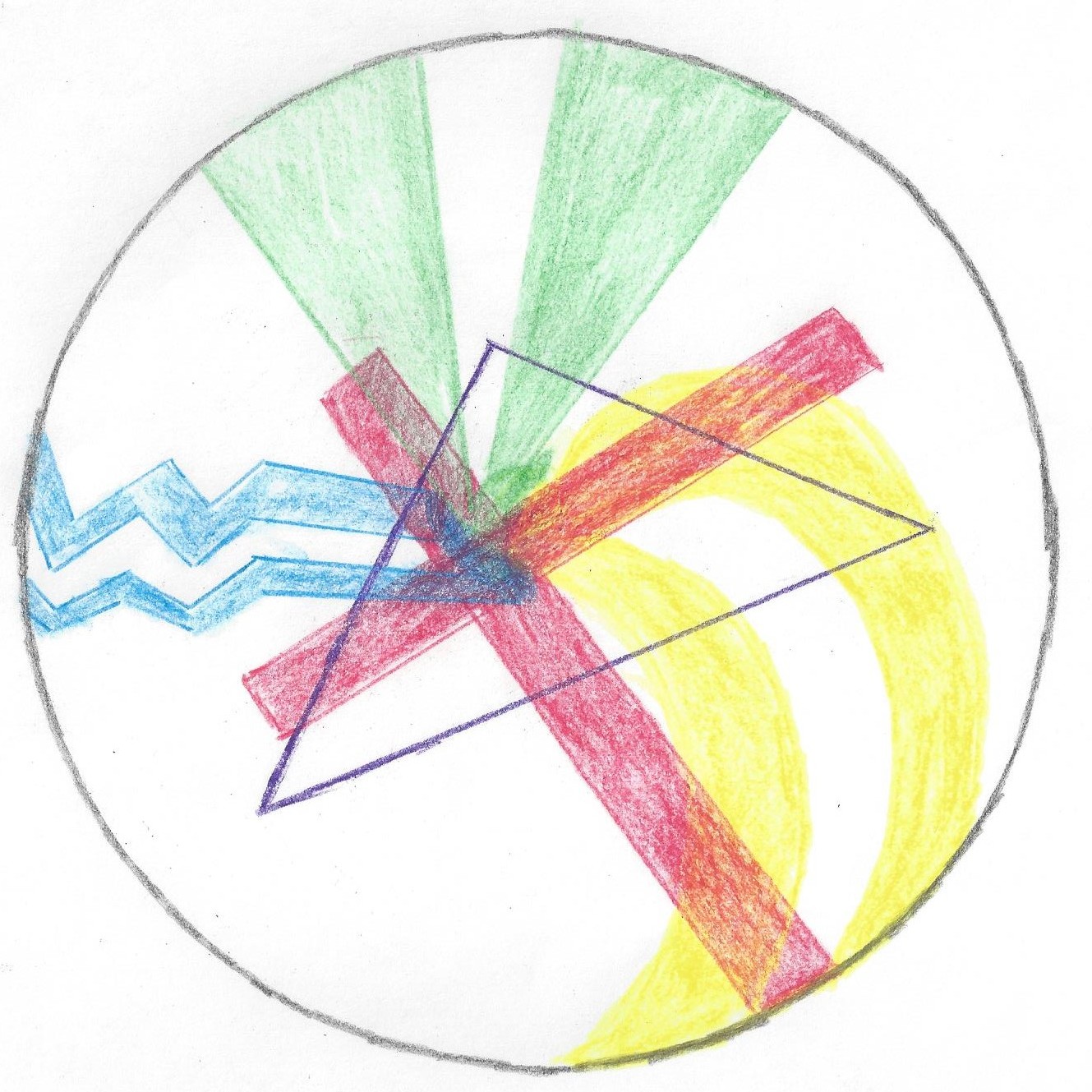
Now connect the next free end of the line on the left side to the free dot on the right side with an arc equal distant from the first arch (Fig. 4). Continue drawing arcs from left to right. After all of the left side lines and dots have been connected there should be a gap between the bottom left short angle line and the bottom long center line, that is the entrance. Your Labyrinth should look like Fig. 5, if it doesn’t simply start over. Using your finger or a pencil to “walk” your completed Labyrinth.
Last night was the Autumnal Equinox. The Sun crossed that imaginary line in the sky called the celestial equator from north to south. Spring begins in the southern hemisphere and fall officially begins here in the north. I don’t know about you but I’ve been feeling ‘fall’ for some time now. The nights are cooler, the air has that dried leaf smell to it and the light, well, just looks different, fallish you might say. But with all things human we have to have a point in space and time that defines what we already know to be. We humans can be silly.
While summer is my favorite time I have to admit fall has its good points. There is nothing like taking a walk in the park, leaves crunching beneath my feet, red gold above my head and a blue sky the color of which you only see in fall. This is the time of year I make a pilgrimage into our neighborhood park, Yost Park, and find a quiet corner to sit and pray with nature. A thank you prayer for a lovely summer, a pray of gratitude that I am able to experience the joys, and beauty of all the seasons. I reflect on the past summer and all of the joy and sorrow it brought. As I gaze at the now flaming trees amongst the dark evergreens I allow memory’s to surface of past falls, and allow myself to sink into that deep connection to nature that comes only from giving me permission to feel the creative life of the surrounding world now slowing into slumber. I often remember past fall walks with my father. We used to walk through our fields that were once green and bursting with life but now covered in a sleepy haze the ground began to enter its winter sleep.
Fall is a good time for reflection, a time to take stock, a time to remember, and a time for rest. So for this week’s prayer practice I would like to offer you a Prayer of Examen with nature. Being outside and experiencing the smells and sights of the natural world often triggers memories of past walks by yourself or with others. It gives the experience of the Examen a very immediate and fresh sense, allowing the old memories to open a deeper connection to the creator in today’s moment.
Prayer of Examen with Nature:
Take 30 minutes, or more if you like, and go for a walk outside. Find a quiet place where you may sit without interruption. Note: leave your cell phone at home.
Let this time be just between you and God. In whatever way is most comfortable for you ask the Holy Spirit to guide your memories through your imagination.
As you sit allow a memory to surface of an experience from the past summer or from a previous year where you felt deeply connected with nature and creation.
In your imagination, visit your memory, recall details such as colors, smells, and sounds, even tasted. Take your time in remembering the details. If you have your journal with you may want to write them down.
Walk through your memory, turning it around and viewing it from different angles. Are you with someone, or alone? Where was it? Was it a joyful memory or one that tugs at the heart with sadness? Not all fall memories are happy ones and those that cause us grief can be just as meaningful as the joyful one. Linger with your memory; let it soak in.
When you feel you have spent sufficient time with your meditation notice how you feel at this moment and offer any gratitude that arises. Express thankfulness to God in the way that is most natural for you. You may want to express your gratitude for the part of nature you have spent this time, recognizing the part it played in your imagination.
You may wish to write your insights in your journal or just what you did or did not notice in your memory for later reflection.
May your time of reflection and rest in your quiet corner of creation help shape how you see and experience nature in the coming days and years. May all creation bless you with rest and healing.
What does it mean to eat locally grown foods? Well it doesn’t mean you eat only food grown in your area. Rather it means you understand the importance of food or, as my friend David Bell says (Eating Locally, Artistically, justbetweentheridges.wordpress.com), the sacredness of food. Eating food from a neighbor or a local farmer has less impact on the environment than food grown at great distance from us. There are few transportation costs, less gas and oil means a smaller carbon footprint. Most local farmers use fewer pesticides or none at all that leads to less contamination of the environment and fewer chemicals to which we are exposed. The food is fresher because we are buying directly from the farmer we they can pick the fruit and produce at its peak instead of early because they don’t have to transport it as far. That leads to better nutrition for us and our families. The relationships built with farmers means you know where your food comes from and how it is produced. Those are some of the benefits but what about the sacredness of food?
Well, food is sacred. It is a gift from the Holy Presence to feed our bodies and when we separate ourselves from where it originates we lose a connection with the Holy that is basic to life itself. Throughout scripture food plays an important role in the relationship with God, and with the people of the bible. In Genesis God provided food for Adam and Eve, when they were banned from the Garden God still provided for them. The Israelites are fed by God with food from heaven; Elijah is cared for by angels; and at the end of his 40 days of temptation, the angels provided for Jesus. Ultimately we celebrate the sacredness of food every Sunday when we bless bread and cup and offer the feast of Jesus at the communion table. Food is important not just to our physical well being but to our spiritual well being as well. The work a farmer does is not only necessary to our existence it is a holy occupation, a sacred act, a connection between God, earth and us.
This week spiritual practice is to offer thanks at each meal for the food you eat. Here is the table prayer I use, you may use it or one of your own:
Holy Giver of Life, I thank you for this food before me, thank you for the earth in which it was grown, thank you for sun and rain that nurtured, thank you for the farmer who harvested it, and thank for the hands that prepared it. May this food feed our bodies as you feed our souls. Amen.
May your week be filled with wonderful food and abundant grace.
Matthew 18:21-22: 21 Then Peter came and said to him, ‘Lord, if another member of the church sins against me, how often should I forgive? As many as seven times?’ 22Jesus said to him, ‘Not seven times, but, I tell you, seventy-seven times.
This week’s prayer practice comes from the lectionary readings. In Matthew, Peter asks Jesus how many times he should forgive someone and Jesus’ response is an astronomical number. So how many times should we forgive? An infinite number of times.
I have often wondered what brought up that topic for Peter. Did he have someone he needed to forgive, did one of the other disciples do something that irritated him, or might one of his family been causing him trouble? I know those are some of the reasons I often need to offer forgiveness and to receive forgiveness.
Hurting someone’s feelings is simply part of being human and living in relationships. We are not always pleasant to be around anymore than anyone else is and so unless we forgive each other of those hurt feelings we would be carrying a terrible burden that would eventually eat away at our souls.
Several years ago a man entered an Amish school house and killed all of the children before he shot himself. It would have been understandable for the families of those children to be angry and want revenge on the shooters family, but that is not what happened. Instead they surrounded the widow and her children in love and cared for her and her children in her grief the way they cared for their own grief. A spokesperson for the Amish community said the best way to remember the lives of the children lost was to offer forgiveness and compassion to the shooters wife and child and if the shooter had survived they would have told him they forgave him. I have known Amish families and I wasn’t surprised by their actions but still it must have been very hard to offer that kind of loving forgiveness. You see I have carried around some anger for a long time for something someone did to my mother and I need to let forgive the person. It is time to simply release that anger and offer my forgiveness. In his book Spiritual Gems of Islam[1] Imam Jamal Rahman offers a meditation practice that guides us in releasing our anger and offering forgiveness even when the person is no longer with us by reaching out to the soul of the person to be forgiven. Briefly here are the steps to follow:
Begin in a state of meditation or stillness, let yourself feel safe and loved When you are ready call to the soul the person you wish to address
Give yourself permission to experience your feelings this person evokes in you. Notice in your body where those feelings are located. Feel compassion and mercy for yourself and slowly embrace those feelings
When you are ready allow the feelings of mercy and compassion as a bridge to the persons soul and tell why you are forgiving them.
Offer a prayer in the presence of the person’s soul that expresses your needs in relation to the person. State your heartfelt desire in prayer. End the prayer with whatever is in your highest interest, is manifesting for you now.
As you continue to meditate tell the person’s soul that they have been part of your life but that it is now time to let them go, with love and forgiveness. Jamal recommends a ritual of cutting cords to release your attachment to the person.
Listen for the soul of the other person expressing gratitude for this work of healing. Offer to release the person’s soul and envision his/her soul being embraced by the Holy Spirit.
As you end of your meditation, give yourself permission to be loved by the Spirit and slowly return to awareness.
The above is a brief introduction to the prayer practice but it follows all of the steps. However, if you are interested in furthering your understanding of this beautiful Sufi meditation I strongly recommend reading Imam Rahman’s book.
Peace to you all, and May your heart open like a flower in forgiving love for the unlovable and the lovable alike.
For the last couple of days I have been using a prayer book of a collection of Julian of Norwich’s writings as my meditation focus and I would like to share this morning’s prayer with you.
Now our Lord reminded me
of the desire for him I had earlier.
I saw that nothing stood in my way but sin,
and I realized that this is the same for all of us.
And I thought that if there were no sin,
we would all be pure and akin to our Lord
Just as we had been created sinless.
But in my vision, Jesus informed me
of everything necessary for me to know.
And he told me: Sin is necessary,
but everything will turn out for the good,
and all will be well,
and everything will be well.
by the simple word, ”sin”
God reminded me of all that is not good
and of the suffering and grief of all creation,
and above all of the utter shame and sacrifice
he endured for our salvation.
We have all suffered woe and sorrow
as we follow our master Jesus,
and we shall do so until we are utterly purified,
I did not see sin itself,
for it has no real substance,
it is not real:
it can be known only by the suffering it causes,
and even that pain lasts but a while.
And during the woe
we might take consolation in our Lord’s suffering.
And out of his tender love, he consoles us, saying:
True, sin caused this pain, but all will be well.
In his voice I never hear a hint of blame,
and since we who are guilty are not blamed,
why should we in turn blame God?
Julian of Norwich
All will be well, that is a powerful statement of faith, of trust in G-d to always be there. Sometimes it is hard for me to hold onto those words. Sometimes they don’t seem true especially in these days when violence and disasters dominate our world. But Julian of Norwich says “but everything will turn out for the good, and all will be well, and everything will be well” and somehow in this morning’s meditation I find the space to believe that and to trust G-d knows what she is doing.
For this week’s spiritual practice to consider the sins of the world war, pollution, global warming and to hold the victims in your heart and offer prayers for their well being. As you sit with your prayers listen for a call to work in some way to right an injustice you see this week.
The month of August is one of my favorite times of the year a time of reflection and gratitude. This has always been a slow time of year for me. A time to sit on the porch with a cold glass of iced tea and just sit, letting the warm air surround me, and the end of summer sounds lull me into a lazy half-sleep. There are fresh vegetables from the garden, or farmers market, that make even the simplest meals a feast. Ice cream tastes better with ripe fat blackberries, or sweet peaches on top. The trees are making a tired sound as the August breezes blow through leaves that are drying out and getting ready to turn into autumns crowning glory of red and gold.
In May there is excitement, joyousness and expectations in the air, but in August the air begins to get sleepy, tired and a little sad. In just a few short weeks our children will be back in school, the air will turn cold and instead of juicy watermelon on the back porch it will be hot chocolate with cookies at the kitchen table.
As you can see, for me, August is a time of reflection and remembrance but it is also a time to take stock and explore what I am grateful for. And, today gratitude fills my thoughts. I am grateful for the warm sun and gentle rains that have fed my vegetable garden this year. I have feasted on fresh lettuce, green beans, garlic, onions, tomatoes and cucumbers. I have been able to put some in our freezer to pull out and remember the warm summer sun in the darkness of winter. I am grateful for the time spent lying in the shade and letting our dogs use me as a chew toy. Together John and I have watched the sun set over the Olympic Mountains, turning the gold and purple and the waters of Puget Sound into silver. I am grateful for walks in Yost Park and along the Edmonds beach, watching children play in forest and sand. I am grateful for the feeling of life that thrums through me when I watch the sunrise over the trees of Yost Park, turning the sky from dark to bright and the Olympic Mountains pink with the first rays of light. I am grateful for the silence of the morning as I sit and meditate on our deck before sunrise. And, I am grateful for the opportunity to write in my blog, to have the time to read or simply sit and just be.
Gratitude is what warms my heart and gratitude is the spiritual practice I am asking you to join me in this week. You have read some of what I am grateful for now it is your turn. As this summer winds down what are you grateful for? Has something, no matter how small, given you pleasure or challenged you this summer? Have you done something that warms your heart and causes’ it to “swell with thanksgiving?” Did you travel, or read a book, or did you just stop and let the summer wash over you? All of these, and more, are reasons to be grateful.
May G-d bless these your last days of summer with juicy berries and sweet peaches, gentle breezes and warm sunshine. And, may you heart swell with gratitude for the gifts G-d graces you with.
Luke 6:12 During that time, Jesus went out to the mountain to pray, and he prayed to God all night long.
Deception Pass, August 15, 2014
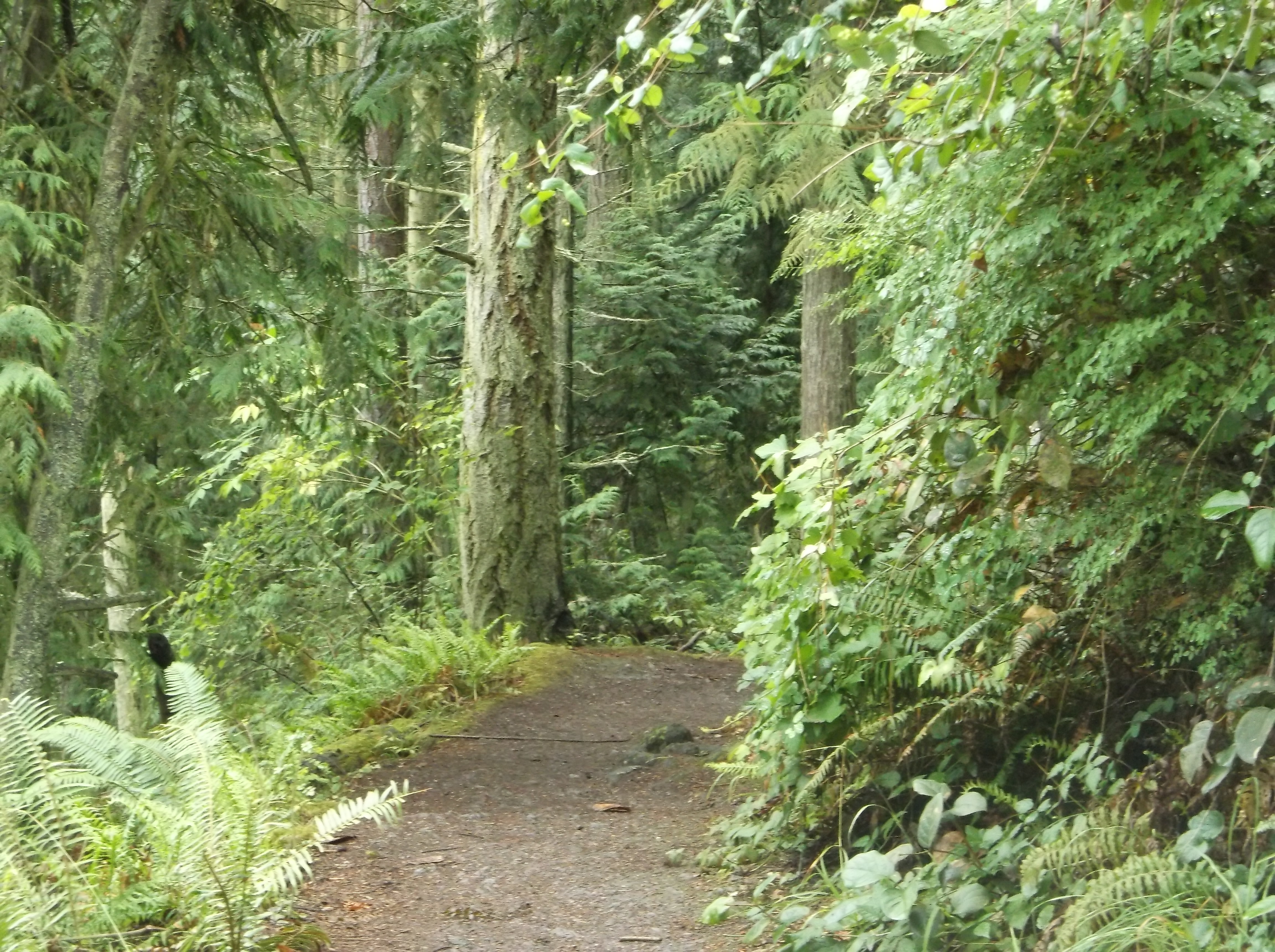
God speaks to us in many ways–through relationships, our experiences, sacred texts such as the Bible and many more. Today I am asking you to “read” a photograph using the practice of Visio Divina, Latin for divine seeing, which is praying with images to listen to God’s words. Todays focus of our pray is a picture of a woodland path. Using the following four steps explore the images and emotions that the picture brings up for you. Let the God speak to you through those images and remembered experiences.
Slowly gaze at the picture, taking a first glance noting the colors, places and things. Remain with the image for one to two minutes.If you would like, jot down a few words about the image.
Take a second, deeper, look. Where is there movement? What relationships do you see? Engage your imagination.Where are you in the in the picture? What do you see from that perspective? What do you think lies around the corner? Do you want to continue on the path? Would you walk this path alone or would you rather have a friend along? Why? What deeper meaning emerges?
Respond to the image with prayer. Did the image remind you of an experience, person or issue for which you’d like to offer thanksgiving or intercession? Offer that prayer to God.
Find your quiet center. Breathe deeply. Relax your shoulders, arms and legs. Rest in this quiet. Let God pray in you. God prays beyond words.
Divine Mother surround us in the love of your embrace
Divine Father guide us through the trials of life
Divine Brother walk with us in light and shadow
Divine Sister Spirit breathe your strength into our hearts
In the midst of the Divine Grace we spend our days
“I have come to believe that God, Truth, Beauty, Love—all those concepts I associate with the Divine—are not things that are “found” at the end of the path, like the post of gold at the end of the rainbow, but rather are what I experience on the journey as I travel through life—or perhaps, more explicitly, they are the journey itself.” Jan Phillips, No Ordinary Time[1]
The above quote by Jan Phillips states beautifully one of the revelations of my own life. Searching and hoping to ‘find’ love and truth is an exercise in futility. Beauty, truth, love, and G-d come to me in those moments when I least expect them to arrive on my doorstep. They often ‘find’ me when I am in the darkest and most terrifying moments of my life and they pull me from the depths back into the light. Or they show up unexpectedly, like a un-birthday present, while I am in the midst of something totally unrelated.
In your time of prayer this week reflect on when and where the Divine has surprised you with love, a new truth, and beauty. Give thanks for those moments of joy and vow to be more open to the un‑birthday moments in your life.
Roman 6:1-11 What then are we to say? Should we continue in sin in order that grace may abound? 2By no means! How can we who died to sin go on living in it? 3Do you not know that all of us who have been baptized into Christ Jesus were baptized into his death? 4Therefore we have been buried with him by baptism into death, so that, just as Christ was raised from the dead by the glory of the Father, so we too might walk in newness of life. 5For if we have been united with him in a death like his, we will certainly be united with him in a resurrection like his. 6We know that our old self was crucified with him so that the body of sin might be destroyed, and we might no longer be enslaved to sin. 7For whoever has died is freed from sin. 8But if we have died with Christ, we believe that we will also live with him. 9We know that Christ, being raised from the dead, will never die again; death no longer has dominion over him. 10The death he died, he died to sin, once for all; but the life he lives, he lives to God. 11So you also must consider yourselves dead to sin and alive to God in Christ Jesus.
Matthew 10:24-39 ‘A disciple is not above the teacher, nor a slave above the master;25it is enough for the disciple to be like the teacher, and the slave like the master. If they have called the master of the house Beelzebul, how much more will they malign those of his household! 26 ‘So have no fear of them; for nothing is covered up that will not be uncovered, and nothing secret that will not become known. 27What I say to you in the dark, tell in the light; and what you hear whispered, proclaim from the housetops. 28Do not fear those who kill the body but cannot kill the soul; rather fear him who can destroy both soul and body in hell.* 29Are not two sparrows sold for a penny? Yet not one of them will fall to the ground unperceived by your Father. 30And even the hairs of your head are all counted. 31So do not be afraid; you are of more value than many sparrows. 32 ‘Everyone therefore who acknowledges me before others, I also will acknowledge before my Father in heaven; 33but whoever denies me before others, I also will deny before my Father in heaven.34 ‘Do not think that I have come to bring peace to the earth; I have not come to bring peace, but a sword. 35 For I have come to set a man against his father,and a daughter against her mother, and a daughter-in-law against her mother-in-law; 36 and one’s foes will be members of one’s own household. 37Whoever loves father or mother more than me is not worthy of me; and whoever loves son or daughter more than me is not worthy of me; 38and whoever does not take up the cross and follow me is not worthy of me. 39Those who find their life will lose it, and those who lose their life for my sake will find it.
For 10 years I was an environmental consultant performing Human Health and Ecological risk assessments for the military and private concerns. One of the uses of my reports was to define what would be the cost of a cleanup of a contaminated site both as risk of exposure and monetary cost of cleanup. The EPA has a basic cleanup target of 1 in 10000 chances of illness or death from exposure to contaminated soil, water, or air. Of course all is negotiable but that is what is desired. The EPA doesn’t really care about cost but companies do and so does the military. Cleanup is not popular with those who own the property. There is a balancing act that goes on at the negotiation table between the EPA and the owners of the property. The property owners want to remove as little as possible to keep cost down and the EPA wants as much removed as possible to keep risk down. When you add in resident and ecological groups to the mix you probably get some idea of how complicated such negotiations can be. But the key word is negotiable.
Matthew writes in this passage what the cost of discipleship will be for those who follow in the path of Jesus. He tells his community what the risks are when you commit to following Jesus’ teaching and he doesn’t mince any words and the cost is not negotiable. For those who are faithful to God and Christ will face criticism, be misunderstood, run out town, and face death at the hands of the Romans just as Jesus did. How is that for a recruiting statement? I can hear the thought of a potential follower now. “Ok, my family will disown me, I will most likely be run out of town on rail, I will have my words twisted around to mean something other than what I said, and the Romans are going to kill me, tell me again why I should sign up for this.” If a follower of the WAY ever thought about the risks they wouldn’t sign up. I mean would you give up everything to go out and teach others about the WAY of Jesus. Would you give up the king-size bed, the running water, the clean clothes, or 3 meals a day? What is amazing to me is that anyone actually did and I am grateful to those who had, and have, the courage to walk that difficult path.
Matthew wanted his community to understand those risks while having the courage to choose a way of life that would be difficult but result in a life lived within God as found in the life of Jesus. Matthew’s words challenge us to stand up for injustice just as Jesus did. To use our voice to speak for those who are silenced. To live a life of compassion and peace towards everyone no matter how different they may be from us; from a different culture or socio-economic class, differently abled, or differently gendered, or (and this is the hard part) even if they have done harm to us or someone we love. Matthew says we are called to right injustice even at the expense of our own comfort, reputation, relationships, financial security, or even our lives. That is a hard decision to make and I know I (as a risk assessor and a seminary student) that discernment before that decision to be baptized and commit to that life is often very difficult. And let’s face it the reasons to proceed are not all that well laid out. So where do we find some answers.
Well before Matthew wrote his Gospel Paul wrote a letter of introduction to the Roman community and in that letter we have this short passage that summarizes reasons for following the WAY and those reasons are just as valid today as they were in the 1st century. Following the WAY was dangerous and even Paul doesn’t deny that but the benefit is a life lived into love.
Paul tells the Romans, and us, that when we commit ourselves to being baptized we are baptized into the death and resurrection of Christ. Just as Christ died to sin and lives to God we are to recognize our baptism as dying to sin and living into God. Notice I didn’t say Christ died FOR our sins, Paul did not believe Jesus died because God wanted a sacrifice for our sins. No, Jesus death on the cross saves us because God overcame and said No to sin through his resurrection of Christ. God’s message of Jesus’ life, death, and resurrection was to reconcile those who are separated from God back into those loving arms. Called Atonement, or better still “at-one-ment,” reconciliation is the means of re-membering those who have spent their lives lost in a wilderness far from God back into the body of God through Christ.
When Paul writes “So you also must consider yourselves dead to sin and alive to God in Christ Jesus” he is talking about saying no to sin and moving toward God as experienced in the life, death, and resurrection of Jesus. Marcus Borg and John Dominic Crossan in their book Meeting Paul open the verse 6:3-4 to a new insight
“all of us who have been baptized into Christ Jesus were baptized into his death? 4Therefore we have been buried with him by baptism into death, so that, just as Christ was raised from the dead by the glory of the Father, so we too might walk in newness of life.”
We are graced with newness of life that includes a transformed way we see our world. A commitment leading to the ritual sacrament of Baptism results in a “renewing of [our] minds.” We being to see the world differently, living our lives into a richer and fuller life in love. We no longer see the world as other and different from ourselves but rather we see ourselves and the world as part of the body of God and Christ.
For Matthew, for Paul and for us these changes and commitments have political implications. It means we as followers of the WAY are to stand against the “wisdom of this world” as it is known today. We are to refuse to follow a path that results in harm, injustice, or death for anyone, whether we agree with them or not.
That is hard to do, I know it is hard for me. I too have watched the news and read the papers about mass shootings, people who demonize the poor and needy and I get angry. Sometimes I say things I might regret because I want them punished; you see I also forget they are part of God’s body. As a consultant I tried to tell the truth as I calculated it and saw it but I dealt with people who had very different agendas from mine. I grew frustrated and angry at people who only looked at the “bottom line” or a single unachievable number instead of considering how what they had done, and will do, affects those who live in the area, human and ecological. I wanted things to change and it wasn’t until I realized that the change must begin with me that I knew what I would do. I had to stop seeing the world with a “bottom line” perspective because all of creation, human and non-human are simply too important..
In Matthew Jesus says “Those who find their life will lose it and those who lose their life for my sake will find it.” The life I lost is the one that holds tight to the world I see in the news reports while the life I gain is a life lived in relationship with God. While I often forget that I try to remember, what all of us need to remember are these words of Jesus’ “Do not be afraid … I am with you always, to the end of the age.”
Amelia with her brother Liam and Suzie, the Chihuahua
Amelia is a 5 year old, little girl who is a mixture of tomboy, imp, princess and budding scientist but most of all a Grammy’s delight. Walking home from school with Amelia is always an adventure. Today we hadn’t gotten even 100 feet from her school when she bent over and said, “Look Grammy, I found a purple maple seed.” Amelia hands me the seed and says “now you carry this for me I want to show dad.” Off she runs to her next exciting stop, which is about 50 feet ahead. “Look what I can do Grammy,” she said as she runs up a yard to the brick wall and with one heart stopping leap lands safely on the ground in front of me. “My, my you are so good at jumping,” I said as I pushed my heart back into my chest.
Running ahead of me again she suddenly stops and gets down on her knees, as I walk up to her she is talking to a small ant hill. “Look how busy they are, Grammy, where are they going so fast?” “Well,” I tell her, “this is a new ant hill so they are just building it up right now and gathering in some of the leaves for food. Don’t disturb the nest or they will bite.” “Really,” she says as she prepares to test my theory. “Yes really, and those bites hurt so let’s leave them to their work, OK.” “Ok,” and she is off again.
“Help me look for snails, Grammy.” Amelia has a love affair going with snails of every shape and size. She picks them up and carries them carefully along with her, until, that is, she forgets she has them in the heat of a new discovery and then the snails are old news. Sometimes she carries them all the way home and we release them into the backyard and into the wild.
Every moment with Amelia is a discovery in a half, every rock a treasure trove, every leaf a rare jewel to be enjoyed. Worms and snails are potential friends or pets to be trained. We sing songs to stop traffic on our progression across a busy street and she dances down the street to a tune in her head.
Oh the life of a 5 year old, a world of discovery ahead and an imagination that has no boundaries. Where does all of the enthusiasm go to as we grow older? Is life so trying and stressful that we forget just what it means to be in the moment? As I watch my little adventurer skip down the sidewalk I am trying to remember what it was like to be that carefree, and find delight in a snail slowly making its way up a wall.
Maybe that is what grandchildren are for, to awaken in each of us that little boy or girl lost in the mists of time. To remind us of the important things like snails, red leaves, purple maple seeds and sunshine and shadow. Amelia has reopened a door I thought was shut and locked. A part of me remembers and dances with my little genius, princess, geologist, archaeologist, biologist, and junk collector as we walk home from school.

















 A Quiet Walk