On Face Book I follow the Anam Cara Ministries page, which posts daily meditations. I often find one that makes me stop and think and last week the following post drew my attention:
Artistic Afternoons: Look up. (Right now.) What do you see? Write about it. Anam Cara Ministries, November 4, 2015.
I stopped and just looked around me. Looking up I saw the wind chime I made from small bells given to me by a friend and origami peace doves made by another friend, when the window is open and a breeze comes through it rings as I work at my desk. There are books, all of which I’ve read, on a shelf above the window. There is a decorative bird cage which I occasionally use to put in small special items, often my grandchildren. And, hanging on the side of the cage are 2 scarves I was given at an InterPlay session. As I looked at these I realized all of them are part of me, and they connect me to family and friends, present and past, which are part of my life. In each there is the memory of love shared. I am grateful to Anam Cara for giving me a priceless gift of memories.
I was grateful for the being reminded of loving memories I had been too busy to notice. From time to time we all need to be reminded to remember events and people in our past; to remember old hurt and forgive them, or linger on the memories of old friends. Today I offer Anam Cara’s gift to remember, to forgive, and linger over fond memories of gifts past. It is a simple practice of observation and being in the moment. So today “Look up. Maybe look around you. What do you see? Write about it.”
Photo by By Sebastian Unrau, Unsplash, November 2, 1015
Fall has finally arrived in the Northwest. The trees are shedding their leaves, my garden is clean all ready for winter, and the air has turned cold. The land is preparing to sleep until the earth shifts again and the warm sun returns. I took a walk through Yost Park with the dogs the other day and the air was rich with the scent of wet and rotting leaves. This is a time for animals to prepare for the coming winter when food is scarce and the land is cold and wet.
Fall is also a time for us to slow down, to sit with a cup of warm tea, coffee, or coco and let the seasons turn. A time to pull out the afghans and a good book. It is also a time of reflection. It is a time to remember the joys of spring and summer and the many joyful moments. A time to ask ourselves questions: what have I done this year that will leave it a better place? Have I spent time caring for others, standing up when injustice rears its ugly head? Have I taken care of my own spiritual needs? Have I remembered to stop, recharge and renew myself so that I will have the energy to be present to those in need? This is the time to look back at what I could have done better, and to look forward to how I will improve. It is also a time to reflect on how I have done my best with all I have even if I didn’t achieve all I wanted to; remembering that doing my best was enough.
This week I challenge you to sit down with a warm cup of something, or maybe a glass of wine, and spend some time on your past year. Let the joys and celebrations provide the energy to improve what didn’t go so well. Laugh, cry, and dance your memories of spring and summer. Remember the sun and wind on your face. Look back at your achievements and at what didn’t get done. It is a time to forgive yourself and others. Were you the best you could be? As the summer ended did you leave the earth a better place, did you care for the disadvantage, or do something to respond to the many, way too many, disasters of the last year? Look toward the coming year and ask yourself how can I be someone who cares about mercy, justice, and peace? How can I care for my own spiritual well being? These aren’t easy questions, and they may take many days to reflect on. But it is dark early now, and it’s cold outside so curl up in your lap robe and reflect on who you are.
May the coming days of fall and winter be a time of rest for your spirit and a time to prepare for the next spring and summer.
Psalm 23:1-3 1 The Lord is my shepherd, I shall not want. 2 He makes me lie down in green pastures; he leads me beside still waters; 3 he restores my soul.*He leads me in right paths for his name’s sake.
In the last several months I have been struggling to find the calm midst the shootings in Umpqua, the deaths of those fighting wild fires, more shootings (at least one a week), floods, earthquakes, and all of the other disasters that seem to be all that is ever reported by news media. I know I will not find any meaning in any of these crises, so, I am looking for a way through the noise and pain I hear, read about, and feel within. Yesterday I found my still point when I happened upon the following poem written by grandfather:
Commentary on the 23rd Psalm
“In pastures green?” Not always: sometimes Thou
who knoweth best, in kindness leadeth me
in weary ways, where heavy shadows be.
And by “still waters?” No not always so;
oft times the heavy tempest round me blow
and o’er my soul the waves and billows go
But where the storm beats loudest,
and I cry aloud for help, The Master standeth by
and whispers to my soul “Lo, it is I.”
So where He leads me I can safely go,
and in the blest hereafter I shall know,
why, in His wisdom, He hath lead me so.
By Grandfather Rufus Miller, 1937
As I read the familiar lines I remembered I don’t have to understand the why of things. I don’t have to carry the burdens of the world on my shoulders. I don’t even have try to carry all of the world’s problems. I can’t change the way people treat others, I have no control over how one person treats another. However, I do have control over how I treat those around me. I do have control of how I respond to the many crises trumpeted in the news.
My grandfather’s poem reminds me that life is not a bed or roses where everything will always be “hot coco, and peanut butter toast by the evening fire.” No there are bad people in the world and even though I, or my loved ones, have done nothing wrong, or done anything to cause a tragedy, other people will affect my life in both good ways and bad. I can’t stop it from happening. I know I can’t stop the hate, but, I can stop the hate from residing in my heart. I can stop myself from acting out of anger and rage. I can stop and take a deep breath and let the real me come up from deep inside. That is all I can do.
For the prayer practice this week I am offering a chant that helps me when I am feeling lost. It is the refrain of a hymn written by Marty Haugen and below is the score for the chant. Above is a video of Haugen’s complete hymn. Watch the above video and when you are feeling a little lost this week sing the refrain. You don’t have to chant out loud, and you can chant anytime of the day, driving, riding public transit, cooking dinner or even working on that paper for class or the boss.
Christ be with me, Christ within me,
Christ behind me, Christ before me,
Christ beside me, Christ to win me,
Christ to comfort and restore me,
Christ beneath me, Christ above me,
Christ in quiet, Christ in danger,
Christ in hearts of all that love me,
Christ in the mouth of friend and stranger.
I have always loved this couplet of St Patrick’s Breast Plate Prayer. In times of distress it has centered me and given me comfort. But as I was reading it for the umpteenth time in light of the recent school shootings in Oregon, Arizona and Texas I felt if St. Patrick would mind if I added a couple of lines to his prayer. You see this prayer says nothing of the compassion, mercy, or Justus we are asked to extend beyond ourselves and into the world. So St. Patrick doesn’t mind, well even if he does, I think an addition is in order, perhaps something like this:
Christ in the heart of the wounded,
Christ in the hands of the comforter,
Christ in our forgiveness,
Christ in our love for the enemy
Christ in our carrying for those who harm us
Christ in how we live day to day.
This is what I would add, and maybe you would add something else. But whatever you add let your words open your heart to both the victim and the one who commits the crime. That is what we are asked to do; it is a small thing but Oh so hard to succeed at.
I have been trying to think about what to say about the Umpqua shootings but my heart is breaking and my mind won’t process this. So I am asking you for your prayer this week to write letters to your legislators about gun legislation, talk to your neighbors about keeping safe, and get involved in your community and/or church youth programs. Talk kids and get to know your own children and the children they play with. Keep the kids involved with family and community and help them find safe ways to release anger and frustration. If you need a gun for hunting then talk to every member of the family about gun safety and keep your guns in a secure gun safe when you aren’t using them. I know that isn’t much but if all of us become more aware and involved in the efforts to regulate guns in a responsible manner than maybe, just maybe we won’t be speechless anymore.
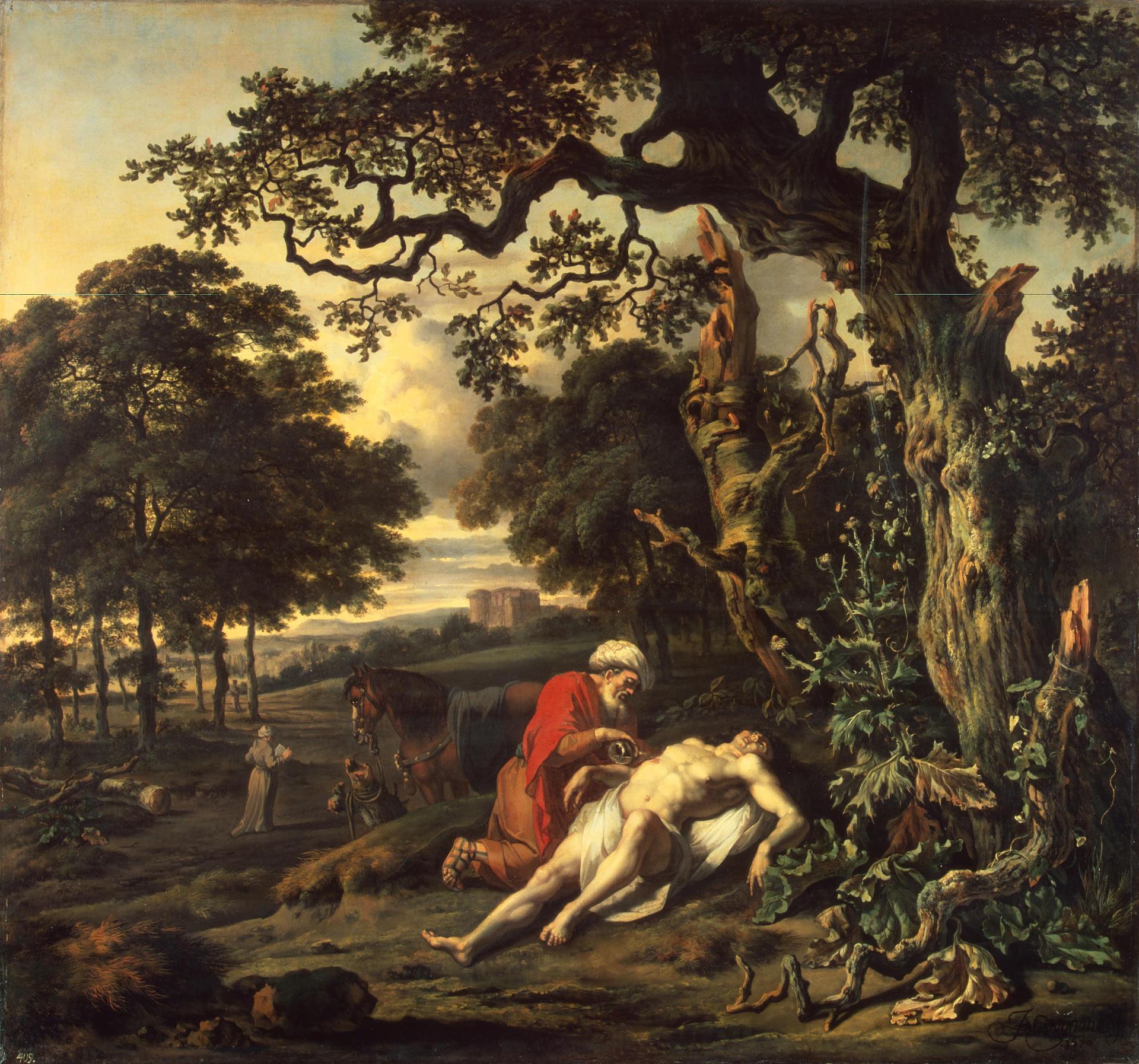
Luke 10:33-35 “A Samaritan traveling the road came on him. When he saw the man’s condition, his heart went out to him. He gave him first aid, disinfecting and bandaging his wounds. Then he lifted him onto his donkey, led him to an inn, and made him comfortable. In the morning he took out two silver coins and gave them to the innkeeper, saying, ‘Take good care of him. If it costs any more, put it on my bill—I’ll pay you on my way back.’ The Message)
I have watched the news media’s reports on desperate flights of Syrian’s and Iraqi’s to Europe with a breaking heart. I have donated funds to the Week of Compassion for their relief drive but it hasn’t helped the pain in my chest. This morning’s meditation scripture was the Good Samaritan and it seeded so appropriate for me right now as I am trying to discern what else I can do for people half the world away. So today my prayer practice for you is to sit down with this painting and this scripture and let God speak to you maybe together we can find our way on this difficult road.
Directions for Lectio Divina
Place yourself in a comfortable position and allow yourself to become silent. Focus for a few moments on their breathing; or use a “prayer word” or “prayer phrase” you gently recite to gradually center your thoughts. Use whatever method is best for you and allow yourself to enjoy silence for a few moments.
Turn to the text and read it slowly, gently. Savor each portion of the reading, constantly listening for the “still, small voice” of a word or phrase that somehow says, “I am for you today.” Do not expect lightning or ecstasies. In Lectio Divina, God is teaching us to listen to him, to seek him in silence. He does not reach out and grab us; rather, he gently invites us ever more deeply into his presence.
Take the word or phrase into you center. Hold it in your thoughts and slowly repeat it to yourself, allowing it to interact with your inner world of concerns, memories, and ideas. Do not be afraid of distractions. Memories or thoughts are simply parts of yourself that, Allow this inner pondering, this rumination, to invite you into dialogue with God.
Speak to God. Whether you use words, ideas, or images–or all three–is not important. Interact with God as you would with one who you know loves and accepts you. And give to him what you have discovered during your experience of meditation. Experience God by using the word or phrase he has given you as a means of blessing and of transforming the ideas and memories that your reflection on his word has awakened. Give to God what you have found within your heart.
Rest in God’s embrace. And when he invites you to return to your contemplation of his word or to your inner dialogue with him, do so. Learn to use words when words are helpful, and to let go of words when they no longer are necessary. Rejoice in the knowledge that God is with you in both words and silence, in spiritual activity and inner receptivity.
Sometimes in Lectio Divina, you may return several times to the printed text, either to savor the literary context of the word or phrase that God has given or to seek a new word or phrase to ponder. At other times, only a single word or phrase will fill the whole time set aside for Lectio Divina. It is not necessary to assess anxiously the quality of your Lectio Divina, as if you were “performing” or seeking some goal. Lectio Divina has no goal other than that of being in the presence of God by praying the Scriptures.
Directions for Visio Divina
Study the picture slowly, taking a first glance noting the colors, people, places and things. Remain with the image for one to two minutes. If you would like, jot down a few words about the image.
Take a second, deeper, look. Where is there movement? What relationships do you see? Engage your imagination. Where are you in the artwork? What do you see from that perspective? What deeper meaning emerges?
Respond to the image with prayer. Did the image remind you of an experience, person or issue for which you’d like to offer thanksgiving or intercession? Offer your thoughts as prayer to God.
Find your quiet center. Breathe deeply. Relax your shoulders, arms and legs. Rest in this quiet. Let God pray in you. God prays beyond words.
May compassion fill our hearts and like the Good Samaritan care for our fellow travelers in the world.
We are all Homo Sapiens sapiens but we will never be Human Beings until we stop just surviving and begin to live in harmony with each other and all creation.
NO MORE
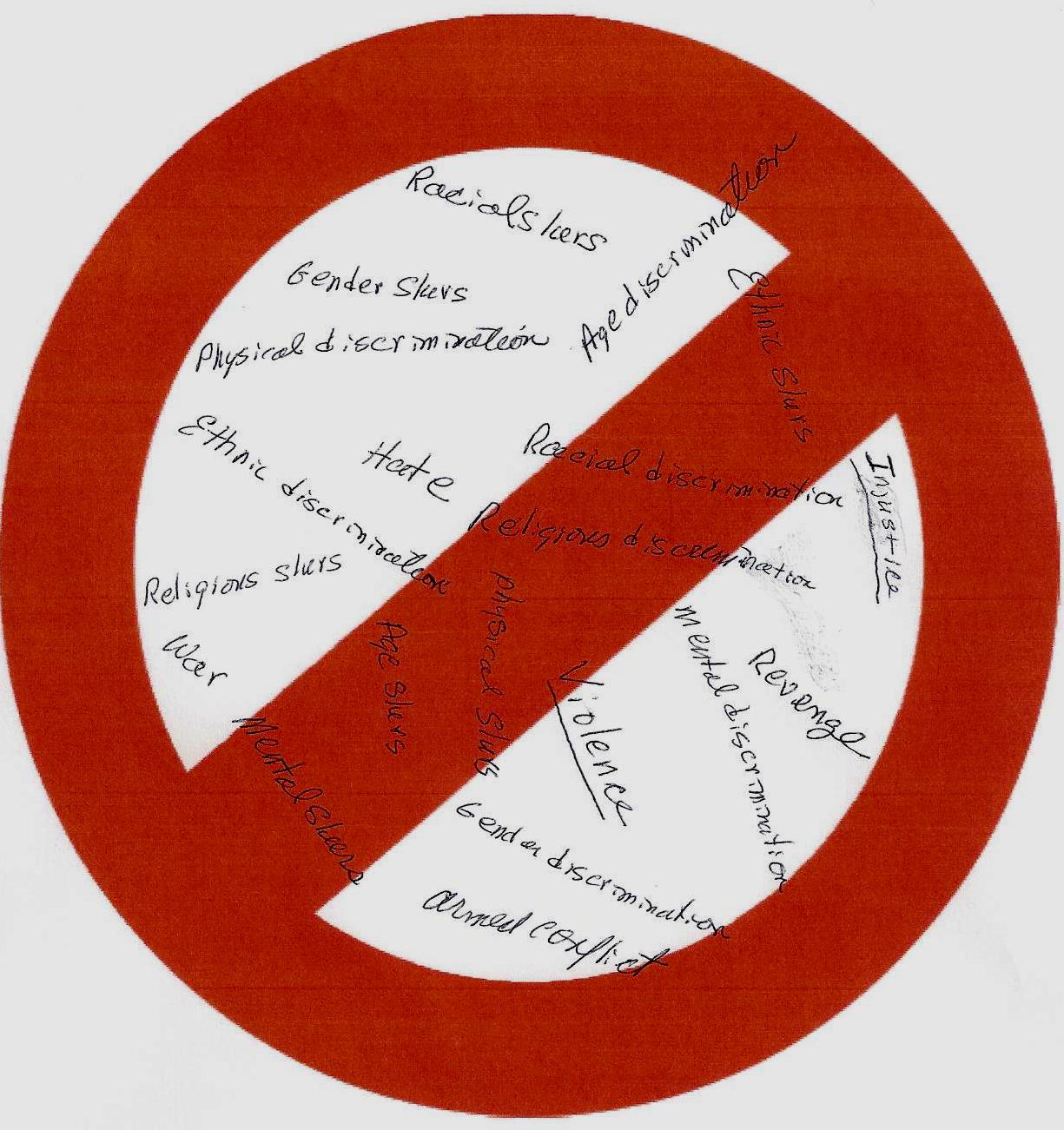
I have been trying to comprehend the shootings in South Carolina at the First Emanuel AME Church. Just as the acts in other mass shootings I simply can’t get my mind around a hatred that produces such evil. I have listened to the prayers for comfort and supplication. I have listened, unwillingly, to the NRA and other public speakers who blame the church pastor and members, or minimize the acts of the shooter. I can’t, or won’t, believe that 9 innocent people were the cause nor can I believe the shooter acted without encouragement.
You see, I believe we, you and I, are to blame for what happened in South Carolina. You and I, and everyone else regardless of skin color, privilege, ethnicity, or any other cultural classification are equally responsible for pulling the trigger and this is why I believe this.
We refuse to stand against acts of injustice, violence, discrimination, or the use of degrading speech. We listen politely and shake our heads and tell ourselves that offering a prayer that people will change is enough. We are afraid of what others might say about us if we stop someone in mid speech and tell them NO, I will not listen to this. We look the other way when someone abuses another. We tolerate public servants who degrade people of color, are poor, elderly, or have a religion they don’t follow. We have tolerated public servants who have spoken as if they are the only ones who matter, who have verbally abused our President and anyone else they disagree with or disagree with them.
We have created this atmosphere of hate and violence found in country today. Yes, I admit I am right there along with the rest of us. Have I stood up and defended someone being abused, sometimes yes but not always. I do it when it is convenient for me and that is not what we are called to do. We, you and I, are called by the Divine to be better than that.
This week I am recommending a spiritual practice of standing up and defending the voiceless. I am asking each of you to speak up when you hear someone abusing or degrading someone else. I am pleading with each of you to stand and be counted when you see injustice happening. As you go through this week remember this:
“8But he’s already made it plain how to live, what to do, what God is looking for in men and women.
It’s quite simple: Do what is fair and just to your neighbor, be compassionate and loyal in your love,
And don’t take yourself too seriously— take God seriously.” Micah 6:8 The Message (MSG)
Nursing an Ebola Victim Picture by Dr. Rudyard, Health Pictures
Matthew 25: 36 “I was naked and you gave me clothing, I was sick and you took care of me, I was in prison and you visited me.”
One of the books I read while I was on my sabbatical was Fields of Blood, Religion and the History of Violence by Karen Armstrong.[1] As always I was impressed with her writing and level of scholarship but more than that in this book Ms Armstrong lays out the reasons for our love of violence and power.
Right at the beginning she identifies one of the factors in our continuing struggle between living in a harmonious world or living in a power driven world, the construction of our brains. We have 3 brains, the old brain or reptilian brain is responsible for our fight or flight actions. It drives us to defend our territory for food and other resources, it is the self-centered part of the brain, most concerned with keep ourselves safe; the mammalian limbic system, which formed over the core of the reptilian brain is our second brain. It is responsible for new behaviors such as care of our young and the formation of allies with others; and the new brain, the third brain, the neocortex, is responsible for our “reasoning and self awareness that enables us to stand back from the instinctive, primitive passions.” (pg 4-5)
Ms. Armstrong proposes that the reptilian brain and limbic system are dominant within power systems that manipulate and control others. The limbic system extended the actions of the reptilian brain to include family or a community unity but, still, this drive for power and control of others for territory and resources requires violence. It wasn’t until about 20,000 years ago when the neocortex evolved did the idea of standing back and evaluating actions was there any question about the use of violence. Humanity really didn’t have a chance of becoming a reality until after the evolution of the neocortex and we have yet to learn how to use the “new brain” to begin to evolve into who we are meant to be. By this I mean most of us haven’t learned to overcome the impulses of the reptilian brain and limbic system and use our neocortex to evaluate our surroundings or our actions. In general we humans are “subject to conflicting impulses of [our] three distinct brains.” (pg. 5)
Fortunately there is hope for us all. A few of us are developing our neocortex’s and discovering what it means to be truly human. I was listening to NPR this past Sunday morning when a story about Dr. Kent Brantly was broadcast. Dr. Brantly was one of the American Doctors who contracted Ebola last year and survived. He was asked to deliver the graduating speech to the 2015 graduating class of the Indiana University School of Medicine. What he says about compassion is important for all of us to hear (italics are mine):
“In the first seven weeks of treating patients with Ebola, we had only one survivor; one survivor and nearly 20 deaths. Losing so many patients certainly was difficult. But it didn’t make me feel like a failure as a physician because I had learned that there’s a lot more to being a physician than curing illness. In fact, that isn’t even the most important thing we do. The most important thing we do is to enter into the suffering of others. And in the midst of what was becoming the worst Ebola epidemic in history, we were showing compassion to people during the most desperate and trying times of their lives. Through the protection of Tyvek suits and two pairs of gloves, we were able to hold the hands of people as they died to offer dignity in the face of humiliating circumstances, to treat with respect the dying and the dead. And in my opinion, that made those weeks, those difficult weeks of my career a success.”[2]
Compassion isn’t offering help, it is being with the suffering of others, it is living the suffering, walking together down a road you may or may not know where it leads. That is what Jesus did. He entered into the suffering of others, he walk the road to where ever they were headed, that is one, maybe the first, step to becoming human. Dr. Brantly has taken a step on a road most of us are afraid to even look at let along step onto. The Prophet Micah tells us “He has told you, O mortal, what is good and what does the Lord require of you but to do justice and to love mercy and to walk humbly with your God?” (Micah 6:8). To do justice, to love mercy, to walk humbly with God, sounds easy does it not? Ask Dr. Brantly how easy it was for him and he will tell you it is the hardest road you will ever walk, but if we wish to be the humans God has always wanted us to be it is a road we must walk.
This week my spiritual practice is more of a spiritual way of life. I would like to invite you on a journey with me to become the “human” God wants us all to be. To look at our actions by taking a step back and asking ourselves the following questions (I am sure there are more than these and please let me know what you would ask):
Does this action support justice or impede justice?
Is this action a loving act?
Does that action move me closer to God or does it separate me from God?
Simple questions, but, sometimes hard to answer. Our lives are filled with gray areas and we will need to determine how those gray, in between, spaces fit into our lives and either nurture or kill the life we want with God. This is not an easy practice or an easy way to live but I believe, at least for myself, a profitable one. I know I will stumble and so will you. That’s OK, just pick yourself up and start over again. Failure is a lesson in how not to do something. Loving life as God meant it to be was and is never easy. Just remember you are not alone.
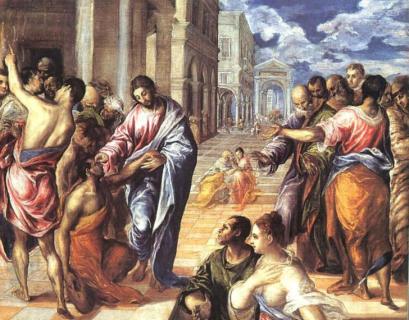
Mark 10:46-52 46They came to Jericho. As he and his disciples and a large crowd were leaving Jericho, Bartimaeus son of Timaeus, a blind beggar, was sitting by the roadside. 47When he heard that it was Jesus of Nazareth, he began to shout out and say, “Jesus, Son of David, have mercy on me!” 48Many sternly ordered him to be quiet, but he cried out even more loudly, “Son of David, have mercy on me!” 49Jesus stood still and said, “Call him here.” And they called the blind man, saying to him, “Take heart; get up, he is calling you.” 50So throwing off his cloak, he sprang up and came to Jesus. 51Then Jesus said to him, “What do you want me to do for you?” The blind man said to him, “My teacher, let me see again.” 52Jesus said to him, “Go; your faith has made you well.” Immediately he regained his sight and followed him on the way.
Jesus Healing Blind Bartimaeus El-Greco, 1578
We are rapidly approaching Holy Week and all of the exciting and heartbreaking moments the weeks brings. In Mark the last story before the Triumphal Entry is of the Healing of Blind Bartimaeus that takes place as Jesus is traveling through Jericho to Jerusalem and his appointed fate. I am offering the above painting by El-Greco for you to contemplate with the prayer practice of Visio Divina. I have always found this story from the Gospel of Mark one of the most moving story of courage and faith in scripture. Bartimaeus doesn’t know how close he is to Jesus; he simply calls out and has faith Jesus will answer him. The questions Jesus asks of Bartimaeus also draw me into a deeper understanding of sight and I hope you will consider those questions and the responses as well.
May your sight be deepened in preparation for the coming week as your contemplate El‑Greco’s painting and the scripture lesson.
VISO DIVINA
Study the picture slowly, taking a first glance and noting the colors, people, places and things. Remain with the image for one to two minutes. If you would like, jot down a few words about the image.
Read the Scripture lesson slowly and in meditation. Return to the painting does the scripture alter your perspective of the painting in anyway? Do the questions and responses open new doors as you gaze at the painting?
Take a second, deeper, look. Where is there movement? What relationships do you see? Engage your imagination. Where are you in the artwork? What do you see from that perspective? What deeper meaning emerges?
Respond to the image with prayer. Did the image remind you of an experience, person or issue for which you’d like to offer thanksgiving or intercession? Place yourself in the place of Bartimaeus, and then in the place of a spectator, or one of the Disciples. Does your perspective Change? What do you feel when you become Bartimaeus or a spectator? Offer your thoughts as prayer to God.
Find your quiet center. Breathe deeply. Relax your shoulders, arms and legs. Rest in this quiet. Let God pray in you. God prays beyond words.
May the Peace of God be with you as you travel the Holy Week Journey.












 A Quiet Walk