Choosing a Path – Prayerful Tuesday

Psalm 23: 1-3  The Lord is my shepherd: I lack nothing. He makes me lie down in green pastures; He leads me to water in places of repose; He renews my life; He guides me in right paths as befits his name. (The Jewish Study Bible, Tanakh Translation)

Boyce Thompson Arboretum Arizona, 2006

I subscribe to a Native American spirituality site, White Bison (www.whitebison.org), and recently I received the following daily meditation:

Elder’s Meditation of the Day – September 21

“everything is laid out for you. Your path is straight ahead of you. Sometimes it’s invisible but it’s there. You may not know where it’s going, but still you have to follow that path. It’s the path to the Creator. That’s the only path there is.”  — Leon Shenadoah, ONANDAGA

When I read this and held in my heart for awhile I recognized the truth in the statement.  However, I also saw that we are not given just one path, and many paths lead to the Creator.  Every day, every second of every day, we are asked to choose the path we will follow.  The choice is not always clear, nor is always easy.  Most often we are asked to make our choices quickly without thought and while these choices may seem insignificant it won’t be until much later do we realize how important they were.

I don’t have the answers to choosing the “right” path, as if any path could really be wrong. For me when I let go of my ego control and let The Great Spirit take the reins of my life the choices become easier, not easy, but easier.  I know I will still end up walking some dark and dangerous road instead of the one in sunshine, but I will also not feel I am alone on that scary path.

Letting go of our ego and releasing our control is hard spiritual practice to follow and one that I start over with every single day.  But there are rewards.  When I do let go I find that I am at peace with my choice of path and that I can smile and bear the difficulties much better.  Right now I am struggling with letting go and am on a path I am not sure of.  I keep saying ‘I can do this, I don’t need anyone else,’ but I know that is false.  I can’t do my life by myself!  I need the comfort of The Great Spirit and so I practice letting go.   Even though I slip back every day, and there will be doubt,  I grab onto the hand of the Spirit and haul myself up to the next step, the next place.

Do you have difficulty letting go of your control as you choose your paths?  What do you do to help you choose the next path, do you release your control of your life, or do you, just as I do, often say ‘I can do this by myself?’

Ruth Jewell, ©September 29, 2015


The Good Samaritan – Prayerful Tuesday


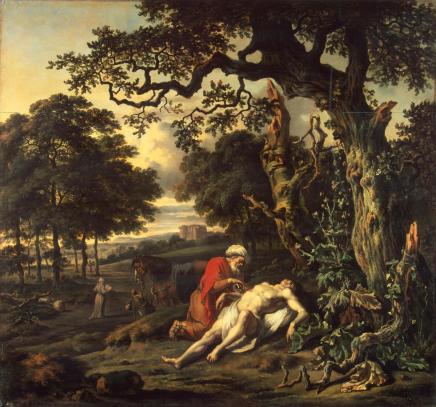
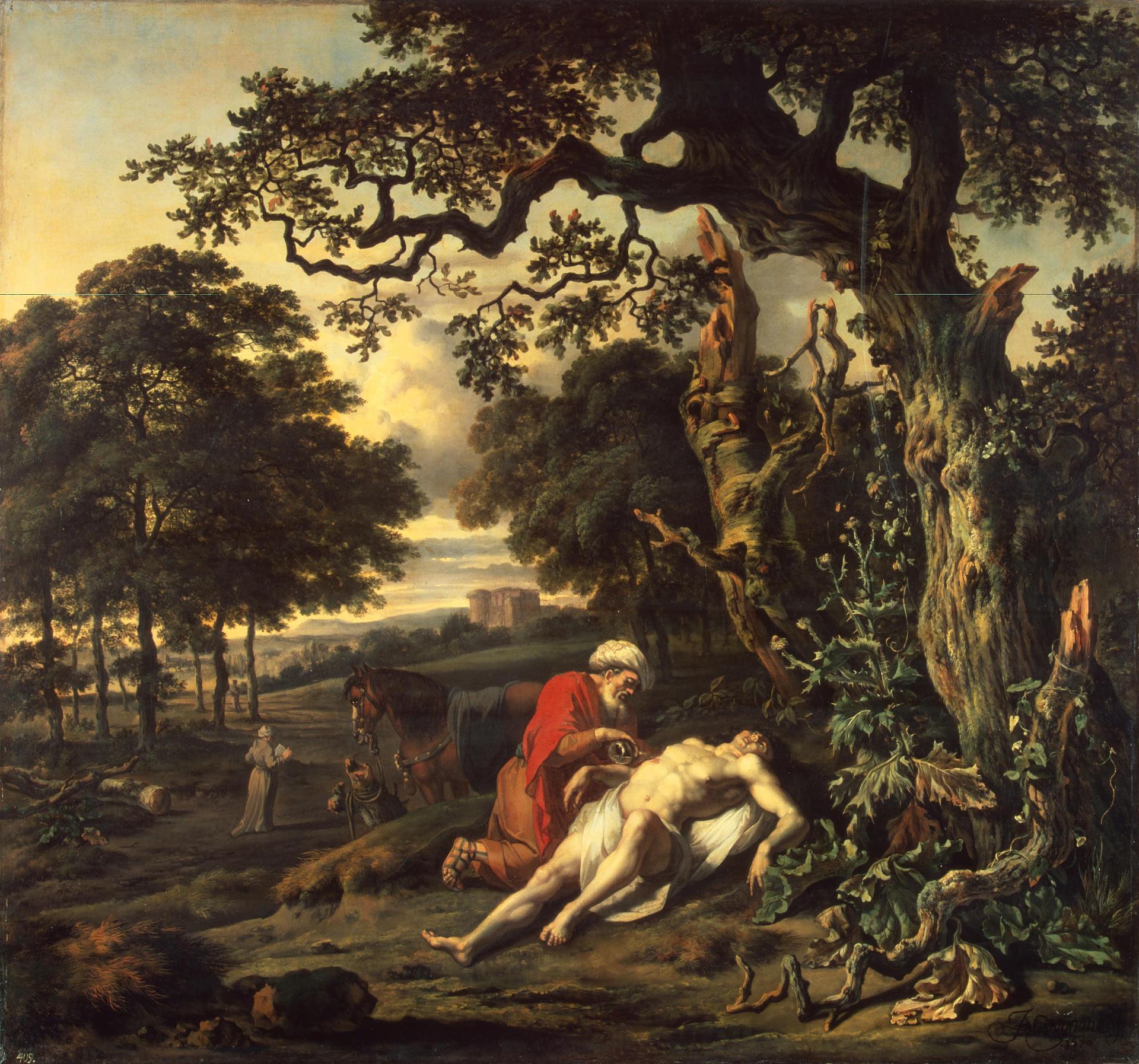
Jan Wijnants, Parable of the Good Samaritan, 1670
              Jan Wijnants, Parable of the Good Samaritan, 1670

Luke 10:33-35 “A Samaritan traveling the road came on him. When he saw the man’s condition, his heart went out to him. He gave him first aid, disinfecting and bandaging his wounds. Then he lifted him onto his donkey, led him to an inn, and made him comfortable. In the morning he took out two silver coins and gave them to the innkeeper, saying, ‘Take good care of him. If it costs any more, put it on my bill—I’ll pay you on my way back.’ The Message)

I have watched the news media’s reports on desperate flights of Syrian’s and Iraqi’s to Europe with a breaking heart.  I have donated funds to the Week of Compassion for their relief drive but it hasn’t helped the pain in my chest.  This morning’s meditation scripture was the Good Samaritan and it seeded so appropriate for me right now as I am trying to discern what else I can do for people half the world away.  So today my prayer practice for you is to sit down with this painting and this scripture and let God speak to you maybe together we can find our way on this difficult road.

Directions for Lectio Divina

  • Place yourself in a comfortable position and allow yourself to become silent. Focus for a few moments on their breathing; or use a “prayer word” or “prayer phrase” you gently recite to gradually center your thoughts. Use whatever method is best for you and allow yourself to enjoy silence for a few moments.
  • Turn to the text and read it slowly, gently. Savor each portion of the reading, constantly listening for the “still, small voice” of a word or phrase that somehow says, “I am for you today.” Do not expect lightning or ecstasies. In Lectio Divina, God is teaching us to listen to him, to seek him in silence. He does not reach out and grab us; rather, he gently invites us ever more deeply into his presence.
  • Take the word or phrase into you center. Hold it in your thoughts and slowly repeat it to yourself, allowing it to interact with your inner world of concerns, memories, and ideas. Do not be afraid of distractions. Memories or thoughts are simply parts of yourself that, Allow this inner pondering, this rumination, to invite you into dialogue with God.
  • Speak to God. Whether you use words, ideas, or images–or all three–is not important. Interact with God as you would with one who you know loves and accepts you. And give to him what you have discovered during your experience of meditation. Experience God by using the word or phrase he has given you as a means of blessing and of transforming the ideas and memories that your reflection on his word has awakened. Give to God what you have found within your heart.
  • Rest in God’s embrace. And when he invites you to return to your contemplation of his word or to your inner dialogue with him, do so. Learn to use words when words are helpful, and to let go of words when they no longer are necessary. Rejoice in the knowledge that God is with you in both words and silence, in spiritual activity and inner receptivity.

Sometimes in Lectio Divina, you may return several times to the printed text, either to savor the literary context of the word or phrase that God has given or to seek a new word or phrase to ponder. At other times, only a single word or phrase will fill the whole time set aside for Lectio Divina. It is not necessary to assess anxiously the quality of your Lectio Divina, as if you were “performing” or seeking some goal. Lectio Divina has no goal other than that of being in the presence of God by praying the Scriptures.

Directions for Visio Divina

  • Study the picture slowly, taking a first glance noting the colors, people, places and things.  Remain with the image for one to two minutes. If you would like, jot down a few words about the image.
  • Take a second, deeper, look. Where is there movement? What relationships do you see? Engage your imagination. Where are you in the artwork? What do you see from that perspective? What deeper meaning emerges?
  • Respond to the image with prayer. Did the image remind you of an experience, person or issue for which you’d like to offer thanksgiving or intercession? Offer your thoughts as prayer to God.
  • Find your quiet center. Breathe deeply. Relax your shoulders, arms and legs. Rest in this quiet. Let God pray in you. God prays beyond words.

May compassion fill our hearts and like the Good Samaritan care for our fellow travelers in the world.

Ruth Jewell, ©September 15, 2015


You Are Invited . . .

Matthew 22:1-14 Once more Jesus spoke to them in parables, saying: 2“The kingdom of heaven may be compared to a king who gave a wedding banquet for his son. 3He sent his slaves to call those who had been invited to the wedding banquet, but they would not come. 4Again he sent other slaves, saying, ‘Tell those who have been invited: Look, I have prepared my dinner, my oxen and my fat calves have been slaughtered, and everything is ready; come to the wedding banquet.’ 5But they made light of it and went away, one to his farm, another to his business, 6while the rest seized his slaves, mistreated them, and killed them. 7The king was enraged. He sent his troops, destroyed those murderers, and burned their city. 8Then he said to his slaves, ‘The wedding is ready, but those invited were not worthy. 9Go therefore into the main streets, and invite everyone you find to the wedding banquet.’ 10Those slaves went out into the streets and gathered all whom they found, both good and bad; so the wedding hall was filled with guests. 11“But when the king came in to see the guests, he noticed a man there who was not wearing a wedding robe, 12and he said to him, ‘Friend, how did you get in here without a wedding robe?’ And he was speechless. 13Then the king said to the attendants, ‘Bind him hand and foot, and throw him into the outer darkness, where there will be weeping and gnashing of teeth.’ 14For many are called, but few are chosen.”

The above text is about how we are invited into God’s grace. However, what we do with that grace is entirely up to us.  We can ignore it, accept it but only on our terms, or completely live into the gift of grace.  What we do will be our choice and that choice will determine how we live our lives.  The following is the text of the sermon I preached on August 23, 2015, at my home church, Queen Anne Christian Church, Seattle, WA.

On a warm June afternoon in 2000 I was sitting at the entrance to the primary hotel in Vallejo CA.  I was waiting for a bus to come and deliver John to me who was taking the bus from the Oakland airport. I could hardly contain myself, you see in just a few short weeks I would be retiring from my consulting job and moving back to Edmonds. John was coming to help me pack-up the apartment and drive with me back to WA.  We would be married in September.  This was the beginning of 6 months of celebration that has extended into nearly 15 years. I had accepted an invitation, I said yes. I knew that in that acceptance I would now be living a new life and one that would require me to make the choice to change from a life of taking care of only me to taking care of someone else. Now that’s a huge change for someone who was 53 and never married.  But it was a choice that I have been grateful for ever since.  As a result I was blessed with a new life that has had its challenges and its joys. That’s what happens when you chose to transform your life.  Life can be a bed of roses, but what you must remember is roses have thorns and you can be sure you will sometimes get stuck with one, or more, of those thorns.

The scripture from Matthew is not only about choosing between accepting and refusing an invitation to a wedding banquet given by a King, it is about choosing between accepting or refusing to live a transformed life of free grace in the way we were meant to live. And, to deciding to live a transformed life means accepting all of that life of grace.  It means we are to commit to live that life no matter what gets thrown at us or how many thorns we run into.  Living a transformed life of grace doesn’t mean there won’t be thorns, or potholes, or great sorrows on your path. It means we have the strength to walk through them.

Matthew’s version of this story, which is also found in the Gospel of Luke, is actually two parables about invitations. It’s a story about a king, who wants to invite people to celebrate the wedding of his son with a banquet.  Matthew adds two additional details to the story; the first is when some of the king’s friends’ killed his slaves and he attacks and wipes out the kingdoms of those who committed those atrocities.[1] It is accepted by most interpreters that this part of the parable, Verses 6 and 7, are an interpretation of Matthew’s who is reading back into this parable the destruction of Jerusalem and the Temple. Matthew adds it because within his community he has people who are struggling with the loss of their ancestral home.  It is not believed to be part of the original parable from the time of Jesus, the oldest version of which is found in the Sayings of Q. Actually these verses are much more characteristic of an interpretation of God from the Hebrew Text rather than the life and teachings of Jesus.[2],[3] Matthew’s second addition are the last 4 verses, verses 11-14,  of the story where Jesus tells one more story of the banquet[4] and this addition is very important in the way Matthew wants us to understand and respond to the divine invitation to a new life.  Together these two parables are stories about the life choices we make and what we do with those choices.

So here we have a story of a King, who traditionally is identified with God, and throws a wedding party for his son, Jesus. Those are the traditional interpretations of Matthew’s King and Son.  But I want to you think about a what if.  What if we look at this story from a different perspective? What if we turn it upside down? What if instead of the King being God the King is Jesus who’s throwing a wedding banquet for the Children of God who he invites to live a new life?  How will that perspective change the way we hear and see these parables?

Now even though the Matthew’s setting of the parable is Jesus defending himself before the religious authorities Matthew wasn’t referring to “the Jewish authorities” as the ones who refused to attend, or that the ones who came were only “Gentiles.” Rather, most interpreters now believe Matthew was addressing his own conflicted community who he wanted to live a transformed life.[5]  The Jewish Jesus followers of Matthew’s community were struggling with the loss of the temple and his Gentile Jesus followers were struggling with whether they should or should not become Jewish. All this would have made for many conflicts between the different factions and Matthew is trying to bridge the gap between them.  I too am not suggesting that there are specific groups being discussed in these parables. So depending on which version you like the best, think of the players in the 1st century as Matthew’s neighbors or in our very own community as our neighbors right now in the 21st century.

So here is how the story might sound if we told it as if Jesus was throwing this shindig? The guests Jesus first invites to his amazing banquet are those he expects will accept the invitation because they already understand, or he thinks they do, what it means to live the transformed life He is offering them.  Jesus wants them to come and celebrate with Him, to become part of the new life that only happens when we accept the Divine invitation.  An invitation of free grace to live the life we are meant to live in the presence of God, Jesus and Holy Spirit.  So he sends his disciples out to bring his guests to the party; the food is ready, wine is poured, the orchestra is tuning up for an all night event.  But his disciples come back and tell him all have refused, all are too busy with the details of life, the minutia of daily living.  So what does he do, after all he has a hall prepared, food on the table, wine chilling, and musicians waiting?  Well, Jesus did just what he told his disciples to do when he sent them out to preach and the invitations they gave were refused. He “dusted the dirt from His sandals” and turns his back on those who refused him and sends his disciples out again into the streets and to the city gates to bring in whomever they find to the party, the good and the bad, the worthy and the unworthy.  With the diligence of his disciples the hall is soon filled to overflowing.

Who were the people from the streets? Well if we think of who are the people of the streets in the 21st century you might first of all think of the homeless tent encampments, or the people living under a bridge, or the man or woman standing on the corner with a sign that says “Homeless vet, needs food and job.” And think of the shop keepers in the poorest parts of any town. It was people like these who were the ones who were welcomed into Jesus’ party. They were the nobodies of the town and here they were going to a big party given by the most important person in town. Can you imagine how they felt?  Can’t you just hear them as they walk to the mansion, “Jesus invited me, me, to his party,” “You too, I can’t believe it,” “I was invited too, and get this, the man said come as I am, how cool is that.”  Unlike Jesus’ first guests these guests weren’t concerned about who would be attending.  It didn’t matter to them that the person next to them was a drug addict, a thief, a prostitute, a shop keeper, or a prosperous business person. They didn’t care if Jesus was failing or succeeding in life. They were excited about being invited.  They understood the importance of being invited to this banquet, this table.  They wanted to have new lives.  Unlike those first invited they knew their old lives weren’t working for them and they were willing to change and live new lives, transformed lives of grace that had meaning.

As the guests enter the hall they see the banquet tables set up with every food imaginable, roast lamb, poached fish, pastries, bowls of fruit, cool drinks, and wine, good wine, not the cheap stuff.  In the corner an orchestra was playing, with real instruments not a wash tub and jug band. Everyone was celebrating, drinking, eating, and dancing to the wonderful music. That is, everyone except this one guy who had piled his plate up with everything it would hold and was eating it in the corner telling anyone who would listen, “well it’s about time this Jesus dude recognized just who makes this town what it is.”  “I deserved this invitation, but don’t expect me to go overboard for him; this is what we should have had all along. In fact I think I will just take everything I can. And I’m going to let this Jesus person know that I’m not going to do anything unless I really want to just because he invited me to this party.”

When Jesus comes in to join his guests he sees this guy in the corner and he says “Ah, excuse me, why aren’t you celebrating. This is a joyous occasion, you come expecting to be fed but you won’t celebrate your new life.  You come in and can’t see the joy of living a life of peace, and justice.  You blame me for your suffering but you did nothing to help those who suffered as well. I was there to help but you wouldn’t come out, is that my fault? You accepted my invitation to grace but only on your terms? It doesn’t sound to me like you understand what it means to come to one of my banquets; I don’t think you belong here, yet.  Show this guy out until he understands what it means to come celebrate a transformed life.”

Jesus knew people had options in their lives. The trouble was those options weren’t working for the majority of the people. True the religious authorities and the Roman authorities were doing ok, but if you look at the number of people who were killed in order for someone else to advance socially or politically their options weren’t working for them either.  So along comes Jesus with an alternative way of living a life that didn’t involve beating up, or tearing down someone else. But Jesus wasn’t offering a new idea.  For centuries the Prophets of Israel were telling the people the same thing. Moses says in Deuteronomy (30:19b) “Choose life so that you and your descendants may live.”  Every Prophet since Moses, including Jesus, has said the very same thing and the people listened and accepted life, for little while, then the ‘easier’ way of greed and self-centeredness takes precedence and the original message of grace goes by the way side.

But what does it mean to choose life?  Well “When you say ‘Yes’ to life you say ‘Amen’ to all of life as a package deal. Thereafter the so-called problems you have with personal injustice do not arise. You renounce your concept of victimhood and the old impulse to complain about being unfairly treated.” A “commitment to life  . . . refuses to make any distinction between your outer life and your inner life, or between secular and sacred spheres of life, or between loving God, loving all of life, or loving one’s neighbor. Nor does it distinguish between your current life concerns or your eternal concerns. On the contrary, it simply calls for an unhesitating and unreserved ethical response to the call of life, the call of Jesus, God, and Holy Spirit – right where you are at this moment in time, at this point in your life,” to live a life where you defend justice for all and refuse to accept injustice for anyone as an expedient to living.[6] That is what Jesus taught, that’s grace. It’s not new information, its old stuff we haven’t listened to, at least not for long time.

That is what happened to our disgruntled guest.  He may have accepted the Divine invitation of free grace to attend the banquet, but his acceptance had no depth to it, it never went beyond saying I’m here, thanks for the food, see you later. He was glad to accept the invitation to grace but on his terms only. He never truly transformed his whole life.  He never saw that living in the presence of Jesus meant he had to let the inner life make its way to the outer side of who he was.  It meant he had to share the love, peace and abundance of grace with everyone he met, not hoard it. He came to the banquet not because he wanted to live a life transformed but because he wanted what he could get and then live as he always had.  That’s not change, it is not celebration and it’s not joy, and it is not committing to living a transformed life. It’s keeping the old life and saying it was good enough in the past it will be good enough now.

No matter how you tell today’s story it’s about Divine invitations, the acceptance of grace, and how you live once you’ve accepted God’s grace. When John asked me to marry him, I had a number of options.  Like the first invited guests I could have refused and that would have been that.  I don’t know where I would have been 15 years later but I am quite certain it wouldn’t have been here.  But I did say yes and again to that yes I had options as to how I was going to live within this new relationship.  One, I could continue to behave as I have always behaved.  Taking care of me, making sure I had what I wanted and what I needed.  Yes John would be there but our relationship would not have been very deep because I wouldn’t have let him into the deeper part of me, the part of me that would have built the relationship where both of us would have benefited.  These two options were not the ones I chose.  Instead I let John into my heart and said we are partners and what I do and what you do will affect and change who we both are.  We looked at the covenant of our marriage and said we do this together as one, not as two people living their own lives in one house.  When I accepted John’s invitation to marry, when I accepted that covenant, I had no clue as to what that might look like, but I knew I was going to have to change if I was going to make my life with John. And yes it hasn’t always been sunshine and flowers.  Sometimes we have had our thorny moments. But it was because we chose to live a life together as one that we had the strength to overcome all thorns and rocks in our path. While my wedding story wasn’t about God’s grace specifically, by accepting my invitation I discovered grace in a way I did not expect, and that is how it sometimes work.

Jesus invites us to a banquet of grace, he welcomes every single one of us to His table, and He doesn’t ask questions about our past or how many times we haven’t understood, He wants us to come and join Him. To laugh and sing and eat together, to tell jokes, and play games.  To dance to the music that life brings us, and cry together when life brings us sorrows. Jesus asks us to change who we are at our deepest level and live grace filled lives that don’t see differences between us, whether they are gender, racial, religious beliefs, cultural, social, or political.

We can change the world we live in, we can change the world by being the people we are meant to be, a people of grace, by being a people who refuse to accept evil, greed, and self-centeredness as the status quo.  We can change the world by refusing to accept that war is the only solution, or that homelessness and hunger is just part of life.  We can change the world by seeing each other as the Children of God, living the life God meant us to live.

The banquet meal is ready to be served: lamb roasted, wine poured out, table set with silver and flowers. . . .  Jesus goes to town, stands on the street corner, and invites everyone within the sound of his voice: Come, rich and poor alike, come the worthy and the unworthy, come with me, oh come, and celebrate the wedding of our spirits with me! I’ve prepared a wonderful spread—fresh-baked bread, carefully selected wines. Leave your lives of self-centeredness, loneliness, fear, poverty, greed, and come, celebrate with me! Come celebrate a life with meaning, a life of grace. Come change your lives, remember to live transformed, not only your inner selves, but also your outer selves.  Put on your cloak of joy and celebration and come, walk up the street to a life with meaning.”[7]

Moses said: “Choose life so that you and your descendants may live.”

Ruth Jewell, ©August 28, 2015

[1] Hare, Douglas R.A.: Interpretation, A Bible Commentary for Teaching and Preaching, Matthew, John Knox Press, Louisville, KY, pg 251-252
[2] Miller, Robert J; Editor, The Complete Gospels, Annotated Scholars Version, Polebridge Press, Sonoma, California, 1992, pg 98
[3] Hare, Douglas R.A.: Interpretation, A Bible Commentary for Teaching and Preaching, Matthew, John Knox Press, Louisville, KY, pg 251-252
[4] Allen, Ronald J. & Clark M. Williamson; Preaching the Gospels without Blaming the Jews, Westminster John Knox Press, Louisville, KY, 2004, pg.76-78
[5] Hare, Douglas R.A.: Interpretation A Bible Commentary for Teaching and Preaching, Matthew, John Knox Press, Louisville, KY, 1993, pg 251-253
[6] Cupitt, Don: Life, Life, Polebridge Press, Santa Rosa, CA, 2003, pg 6-7.
[7] Proverbs 9:1-6
Letting Go – Prayerful Tuesday

A Walk In Yost Park Canyon

This week’s prayer practice is one a friend of mine taught me in the last couple of weeks.  It is one of Thich Nhat Hanh’s practices called “Letgo.”   After I began the practice I realized ‘Letgo’ has many similarities with the Examen and found that I was experiencing some of the same benefits.  As I have begun to settle into this practice I have discovered my days to be calmer and more centered even when the world gets busy.  I am able to separate what is important from what it is not.  The most amazing thing is of the many of events and things I thought were important they just are not priorities any longer.  Instead I am able to focus on what makes my life more enjoyable, beautiful and to just BE.  So I offer this practice as my gift to your well Being.

Letgo Practice

I usually pick a time of day when things are quiet, either early in the morning or just before I go to bed.  I like both times.  The morning time energizes me and the evening time centers me and quiets my mind so that I sleep much better.  But select a time that works best for you.  I do set aside 20 to 25 minutes for each session.

  1. Begin by sitting quietly, concentrating on your breath. Reflect on those things you have let go of in the past.  You many begin your ‘list’ as early in your life as you wish.
  2. Be aware that our conscious attention only catches a small portion of what goes on in lives.
  3. Start with small steps first. Accept that events such as rush hour traffic, broken washers, and burnt dinners will always be there to annoy and frustrate you.  Use these events to practice an acceptance of those things that just happen because it’s life.
  4. Be mindful of those times when you pick up old burden or worry’s and begin to carry them around again. Learn to recognize the old resentments and anger that emerges and ask yourself if you want to continue to hold space in head and heart for them.
  5. Take deep breaths and let the burdens, anger, and resentment flow out with each exhale.
  6. Repeat step 5 as often as necessary until you are able to bring your mindfulness back to the now.

May the peace of God be with you all.

Ruth Jewell, ©March 10, 2015

Marcus Borg & Gratitude for our Mentors—Prayerful Tuesday

Marcus Borg 1931-2015
Marcus Borg
1931-2015

This last week I heard of the passing of Marcus Borg. I was sadden not just at his passing but because I have learned so much from his writings. I will miss reading his words and having them open up my understanding of Jesus as both human and Divine.  Marcus Borg’s writings were instrumental in changing how I came to look at Jesus, the apostles, and the first century Christians.  He made me think and doubt what I have always believed to be true and to take that doubt and turn it on its head by searching for answers and being comfortable with finding only more questions.

Because of Marcus Borg I began to read scripture, questioning the standard interpretations, searching for what the words printed in the Bible meant to those they were written to, the first century believers in Jesus.  Borg’s books were my first window into the church of the 21st century and why, and how, it is so different from the community of believers in the 1st century.  Reading Borg’s books were instrumental in giving me an interest in pursuing a Masters of Divinity degree and looking at the carefully at the path leading to ordination.  Yes I will miss this Master of Theology who opened doors and, through his writings, fostered a love of scripture, sacred texts, theology, and history.  Whose writing led me on a search for the divine and human Jesus that I wanted in my life.

We do not go through this life alone. There are many people, our mentors, who have walked and are walking with us.  Some mentors we know, some mentors we request or go looking for, some we have not known they were mentors but were our companions for a while, showing us us how to live by living their own quiet, faithful lives.  Some mentors never know they mentored us at all. Marcus Borg was one of my mentors who never knew he walked with me. I am grateful for his life and his words.  I never met him, only read his books, but I felt ‘close’ to this incredible theologian who made Jesus and God accessible to me.

I will never be able to thank him, so, instead I will thank all of my other mentors while I still have time.  My parents, my first grade teacher Miss Wooster, they taught me courage and determination. I am grateful for Pastors from childhood to adulthood that listened to my ravings and didn’t belittle me.  I am grateful for my current pastor, and friend, Laurie, who has been the most gracious and gentle of mentors as I have grown in my faith. I am grateful for friends who let me be me, inspiring me to be the best friend I could be.  I am grateful for my beloved John who has supported me through thick and thin as we have traveled this crazy new journey God has led us both on in the last 15 years.

I am grateful for the love, comfort, and companionship of dogs, cats and birds who have taught me the value of unconditional love. I am grateful for being able to live and work, and play in a world of great beauty, and sorrow.  I am grateful for my life as it is and as it will be and I know that whatever life hands me I know I am not alone, there is always someone standing beside me to offer encouragement.

On this Prayerful Tuesday who are you grateful for?  Who has walked with you on a difficult path or a path of exploration and great joy?  Who walked with you, gave you insights, taught you a lesson of life that you didn’t recognize at the time?  We all have people who have brought meaning to our lives, today offer your gratitude, your thanks for your life’s mentors.

Gracious Presence, I am grateful for all who walk, and have walked, with me on my very bumpy life’s journey. I am grateful for your presence as you have been with me always, even though I don’t recognize you. My spirit is grateful for all I have been given, and thankful for all that is yet to come.  Amen.

Ruth Jewell, ©January 27, 2015

Taking Care—Prayerful Tuesday

The Scream by Van Gogh

For the last three weeks I have been in constant pain due to a pinched nerve in my back.  This fussy nerve has been bothering me for a long time but I refused to listen to it. So now it is fighting back to get the attention it thinks it deserves.  I have never been in so much pain before.   It hurts to lie down, stand up and sit and that my friends are pretty much every possible position there is.  But, I am not asking for sympathy, prayers yes, sympathy no because I got myself here by not listening to my body.

It is always easier to give someone else advice than to take that advice ourselves about taking care of the temple God has graced us with.  Whether we are doing our busy lives or praying we often forget the clay vessel we are embodied with to the detriment of our health and well being both spiritually and physically.

I understand the forgetting the body when we are making a living, I certainly forgot.  After all we are only trying to make a living, feed our family, keep a shelter over our heads and clothes on our backs.  We don’t feed the body with good food rather we go for the quick easy meal of junk food, which is high in fat, calories and low in what we need to be healthy.  We don’t get enough sleep because a job needs to be done and “I, just don’t have the time to rest until it’s finished.” Stress takes its toll with worry about how we will survive if we lose our job, or add a new family member, or move to new community.  We forget to take the time to talk to God, to listen to God, to offer prayers of gratitude and concern to the one, and only, who can relieve our pain and suffering.

The ironic thing is we remember our bodies when they break down, and we remember our spiritual life when we are running on empty to the next event in our lives. That is what has happened to me.  I forgot to care for my body, I refused to listen and I am paying for it now.  But more than that I forgot that caring for my body, caring for my spirit is a prayer practice.

It is important to care for what has been given us the best way we can.  Even when we are given bodies that aren’t perfect, and whose is, we are called by God to care for this vessel as long as we are here enfleshed in this life. In order to care for this body given me I must repent and make changes to how I view my body.  It isn’t an object to worship, but it is a house of prayer.  Good food, exercise, rest and listening are my four healthy habits that will make my house stronger.  My physical house and my spiritual house.

My prayer for all of you this week is take a moment out of your day to sit in silence and offer God your gratitude, take a brisk walk and feel the breath of God on your face, rest in God, letting the healing touch of the Holy Spirit renew your soul and eat with gusto food rich in love and low in Cholesterol.

Ruth Jewell, ©January 20, 2015

A Conversation with a Psalmist –Prayerful Tuesday

Come Lord Jesus, hear our prayer
Come Lord Jesus,
hear our prayer

As I am personally preparing for  Christmas I have been disturbed by the amount of violence and death around the world.  Peace on earth does not seem near. So as part of my morning ritual I have been doing Lectio Divina with the Psalms.  They have brought me some comfort but this Psalm struck a chord within me and I wanted to share that with you.  So this is a little different from most of my postings, as it is part of my journaling during my meditation. I am letting you in on a small part of my conversations I held with the Psalmist and God.  They are my insights of the moment, so if I say something you disagree with please be gentle, it is after all a private conversation you are overhearing.  At the end of my journaling you will find the steps for Lectio Divina.  For your own Lectio Divina meditation you may use the whole Psalm, as I did, or only a verse or two.

Psalm 10, The Message (MSG)

 1-2 God, are you avoiding me?
    Where are you when I need you?
Full of hot air, the wicked
    are hot on the trail of the poor.
Trip them up, tangle them up
    in their fine-tuned plots.

I am in the process of preparing for a Longest Night worship service and in reading this Psalm I was struck by how it matched my gut feelings this Advent.   Every day the news is filled with stories from around the world of someone killing someone one else, often many someone’s.  Just last night news came of a hostage situation in Sidney, Australia, just one more story to add to the Ferguson, New Town, Cleveland, Seattle, Portland, Houston, Afghanistan, and Iraq stories of the last number of years.  The list is too long, too many people have died, and too many children have died.  Like the Psalmist I am left wondering “where are you God.”

3-4 The wicked are windbags,
    the swindlers have foul breath.
The wicked snub God,
    their noses stuck high in the air.
Their graffiti are scrawled on the walls:
    “Catch us if you can!” “God is dead.”

This is supposed to be a time of joy and celebration but I do not feel like celebrating.  Our elected leader’s mouth words from the Bible I read every day, yet, their actions tell me they do not believe what they speak.  Are they wicked?  Are they windbags?  Well the wicked part can only be determined by God but the windbag part . . ..  Yes they are windbags, hoping that we who at least try to live a life of compassion will not notice their plans to take the last ounce of God’s abundance all for themselves.  They write bills and say “try and stop me, from denying the basic necessities to those who cannot help being poor, sick, elderly, or a child.

5-6 They care nothing for what you think;
    if you get in their way, they blow you off.
They live (they think) a charmed life:
    “We can’t go wrong. This is our lucky year!”

These insufferable, so called leaders lie and twist the truth until even the best of us are confused and dazed by the avalanche of untruths they let loose on the public. Whether they are religious fundamentalist, political leaders, in the United States, Afghanistan, Syria, Iraq, British Isles or anywhere they claim the spotlight and they believe no one can stop them.  They are on a role and the rest of us “be damned.”

7-8 They carry a mouthful of hexes,
    their tongues spit venom like adders.
They hide behind ordinary people,
    then pounce on their victims.

They mark the luckless,
    then wait like a hunter in a blind;
When the poor wretch wanders too close,
    they stab him in the back.

10-11 The hapless fool is kicked to the ground,
    the unlucky victim is brutally axed.
He thinks God has dumped him,
    he’s sure that God is indifferent to his plight.

The words they spit from their mouths cause fear in those who have minds that are weak and malleable. Letting these poor souls do the violence they pretend to abhor only to turn on them when they caught in their snares.

12-13 Time to get up, God—get moving.
The luckless think they’re Godforsaken.
They wonder why the wicked scorn God
and get away with it,
Why the wicked are so cocksure
they’ll never come up for audit.

We wait for you O God to respond, to let us know you haven’t forgotten us.  We wait and we wait.

14 But you know all about it—
    the contempt, the abuse.
I dare to believe that the luckless
    will get lucky someday in you.
You won’t let them down:
    orphans won’t be orphans forever.

The Psalmist sings of your knowledge of the violence we see every day.  But do you really hear the cries of the children who have lost limbs to bombs, to parents who have watched as their children are killed in front of them, as ISIS hangs those with different beliefs, as children shoot children?  Have we not sent enough children, parents, loved ones to you to serve as a sacrifice?  Do you care?

15-16 Break the wicked right arms,
    break all the evil left arms.
Search and destroy
    every sign of crime.
God’s grace and order wins;
    godlessness loses.

My heart wants to believe as the Psalmist did that you will intervene in the bloodletting of this world, but I know you will not.  It is not up to you, O God, to set this world back on the track of compassion, justice and peace.  That really is our job.  We are the ones who created these people who mock everything you have wanted for all.  We are the ones who must “gird up our loins” and speak out against injustice, violence, hatred, and war.  Only we who believe in justice, mercy, kindness, peace, compassion will change the lives of those who are oppressed, abused, injured, and starved by those who mock the world as you, O God, planned it.  We must stop cowering in our homes and our places of faith and become the prophets, the messengers, the hands, feet and voice that will bring down those who would enslave us to a life of poverty and misery.  Then, and only then, will the Psalmist’s dream come true.

17-18 The victim’s faint pulse picks up;
    the hearts of the hopeless pump red blood
    as you put your ear to their lips.
Orphans get parents,
    the homeless get homes.
The reign of terror is over,
    the rule of the gang lords is ended.

Gracious Spirit I thank you for this time of blessed meditation.  May the words and images I have seen transform my actions into walking with you in greater joy.  AMEN

Practicing Lectio Divina

  1. Choose the portion of the Scripture you wish to pray.
  2. Place yourself in a comfortable position and allow yourself to become silent, focus for a few moments on your breathing.
  3. Read the chosen text through, slowly and gently. Listen to yourself read, let yourself to savor each word and phrase.
  4. Read the text a second time. What words or phrases stick out for you? Remember God speaks to us in silence and in our listening. The words that pop out do so for a reason, pay attention to them.
  5. Read the text a third time. Are there any other words that speak to you?
  6. Sit now in silence, letting the words you have heard, speak to you and for you in your prayer, your conversation with God. What images, ideas, words spring forward?  Or maybe all of them are present in mediation.  Sit with those insights as you experience the presence of God.  Give your insights to God.  Do the insights give you new meaning or transformation of your actions, or prayer life?
  7. Now rest in God’s arms. Let God’s presence give you comfort. Do you feel the pull to return to your meditations? Then begin again. If not close with a prayer of gratitude for the time you have spent in God’s presence and the insights you have received.

Ruth Jewell, ©December 16, 2014

Sweet Pea and the Narrow Path

DSCF0427 a

Matthew 14:25-33 And early in the morning he came walking toward them on the sea. But when the disciples saw him walking on the sea, they were terrified, saying, “It is a ghost!” And they cried out in fear. But immediately Jesus spoke to them and said, “Take heart, it is I; do not be afraid.” Peter answered him, “Lord, if it is you, command me to come to you on the water.” He said, “Come.” So Peter got out of the boat, started walking on the water, and came toward Jesus. But when he noticed the strong wind, he became frightened, and beginning to sink, he cried out, “Lord, save me!” Jesus immediately reached out his hand and caught him, saying to him, “You of little faith, why did you doubt?”When they got into the boat, the wind ceased. And those in the boat worshiped him, saying, “Truly you are the Son of God.”

Nearly 40 years ago I went on a camping trip that included riding a horse 20 miles every day.  The horse I rode was a rather smallish black mare with a lot of quarter horse in her background.  She was gentle and quiet and when I learned she didn’t have a name I named her Sweet Pea.

One day we came to place where the trail all but disappeared and developed a tilt of maybe 30 to 40° as it extended across the lip of the canyon.  The distance to the bottom of canyon was maybe 100 to 150 ft down.  I needed to trust that my horse would safely carry me across the steep incline without falling to the bottom of the canyon.  I took a deep breath and started across and promptly halted Sweet Pea and froze about ¼ of the way on the path.  We were in very precarious position, on a steep incline and just inches from the edge of the canyon wall and a drop to the bottom would most likely have killed both of us.  I held Sweet Pea in place until she pulled the reins loose in my hand, turned her head as if to say trust me we can do this and she walked the rest of the way across.  As I look back over the years I have begun to learn this moment with Sweet Pea was a turning point for me. I now realize that it was here on a narrow trail in Mexico that I turned onto the path leading to this place in my life. For that first step to happen I had to let go of my fear and anxiety and trust someone else to take control of my life, it just happened to be that a small black horse was the one I put my trust in.

Peter too takes a step of trust when he steps out of the boat and starts to walk toward Jesus but something happened to him and he started to sink.  Yes Jesus saved him and before they get into the boat tells him he needs faith.  Ah, but what is faith and how does Peter or any of us get more of it? I can’t answer the “how” question because for each of us the way to faith will be different.  But I can explore with you what it means to have faith.

The modern definition of faith is not the definition that was understood in the days of Jesus and Peter.  Today we equate faith with religious belief; if you believe in specific religious doctrines you are said to have faith in it.  But, Marcus Borg in Speaking Christian, says in the 1st century faith was expressed by the Latin words fidelitas, faithfulness, and fiducia, trust.

To have faithfulness meant you were committed to, loyal to, held allegiance to, and were attentive to a relationship, Such as our relationship with God.  Faith as faithfulness does not just mean you are not going to follow other gods, but that you are committed and loyal to your relationship with God, and God known as Jesus, and that you attend to that relationship to keep it strong and healthy.

Faith as trust is more than a commitment; it is also a deep trust in God and Jesus.  That trust is so deep that you are willing to get out of your nice safe boat and walk on water, or, ride your horse across a dangerous trail.  The opposite of faith is not infidelity, but “mistrust”—that is anxiety, and that is what happened to Peter.  One moment Peter was striding above the waves, just as Jesus was, and then his fears build into anxiety and he began to mistrust Jesus, so he started sinking.  Jesus is not telling Peter, “You of little faith, why did you doubt?”  No, what Jesus was really saying was “Peter, why didn’t you trust me to keep you on the surface of the water, why did you mistrust me?”

Isn’t that what we all do? Don’t we all mistrust God and Jesus to fulfill our needs?  And, don’t our plans all too often sink, just as Peter did?  I know it is true for me.  My first steps out of the safety of my boat into the abyss of trust were with Sweet Pea and I froze.  I wasn’t sure I could trust her to carry me across that narrow path to safety.  But something in her eyes told me all would be well and you know what, 40 years later I’m still here.  Since that horseback camping trip in Mexico I have had many moments when I let my mistrust of Jesus keep me from achieving goals I know I could have achieved if I had had faith, if I had trusted, in the one leading me and I know that there will be more of them in my future.

You see I am human and to mistrust God is part of a being human because I have a strong sense of my own independence which wants to rule the day.  And having independence isn’t bad, nor is saying “No” to God and Jesus.  The choice of following or not following must always be mine.  It is when my independent voice says “Yes” that my trust in God and Jesus is the strongest and deepest for then I know with certainty that I am not alone.  I know then that nothing will shake by commitment to, my faithfulness in, the One All Surrounding Presence.

Have any of you ever read John Ortberg’s book If You Want To Walk on Water, You’ve Got to Get out of the Boat?  Well Ortberg is right, you do have to step out of the boat, or onto the narrow path, and trust that everything will be all right.  I often wonder if we, if I, can sustain my trust in God long enough to get out of the boat on that raging sea called life and walk across the water?  More often than not we will set ourselves up for failure by allowing our hearts to mistrust Jesus’ promise that He “is with us always.”

Life can be hard task master and the main reason we don’t succeed is often how we see failure and loss of trust.  Losing our trust, our faith does not have to shape who we, you and me, are; it is the way we respond to that loss that shapes us.  Jesus wasn’t ridiculing Peter when he asked why he failed. Rather he was asking a question of Peter, ‘why did you lose your trust.’  Peter may not have understood the question at the time but following the resurrection he did and he stepped out of his nice safe boat big time.  For Peter, learning to walk on water and being rescued by Jesus was his turning point, his moment that began his trip to his own cross.

We too don’t understand the questions Jesus asks us and I am no different.  Right now I am struggling with so many questions that I don’t know which ones I’m asking and which ones God is asking.  All I know is the answers are not forthcoming.

One of the first lessons in trust happens to be learning to wait on God to guide us in the right direction.  We have to wait for the power to be given to us to walk on water.  We have to wait for Jesus to calm the seas for us.  Only then will we make it across that treacherous path or across the water’s surface.  The problem is all of us are impatient; we want results now, not tomorrow, but yesterday.  We want to move forward in our lives and we don’t care how we do it.  One of my favorite phrases is “Give me patience Lord, but hurry” and for many years that fit me to a “T.”  Slowing down and opening my heart and mind, trusting that Jesus will come is extremely hard.  It is putting myself, in utter vulnerability, into Jesus’ hands. It is letting go of what I want and trusting and having faith that Jesus will bring me what I need.

The idea that any of us are self made individuals is a myth.  We all need others in order to survive and thrive in our world.  We have always needed the other, not just in today’s world where we are globally connected, but in all of time we have been in need of the other in our lives.  That other might be our brothers and sisters, it might be the food we hunt or grow but what and who ever it is we cannot survive alone. We have always needed to choose who to trust, who we would have faith in and be faithful to.  We look for what will guide us in ways that will allow us to flourish and let our children flourish. We look to pass on our understanding of the world in a way that teaches our children to trust in something other than themselves or those who only think like them.  We look to trust someone who will honor our independent yes as much as our independent no.  We want to have faith in someone who will show us how to walk on water and skip across dangerous paths.

Peter lost his trust and began to sink but Jesus was there to lift him up and into the safety of the boat.  I lost my trust for a moment but the Holy Spirit said trust in the guide I have given you and together Sweet Pea and I made it safely across.  It has always amazed me as to the number of different ways the Holy Spirit makes herself known to me.  Sometimes I simply have to go with the flow of energy and trust that what will be is what is supposed to happen. It is all about trust. That is what faith is all about.

Ruth Jewell, ©August 10, 2014
Sermon given at Queen Anne Christian Church
Seattle, WA

Desert

Color_card_dove_pix


As I sit a robin sings his morning song,
tea in hand, dog in my lap
I wait expectantly,
I listen . . .
all I hear are crows, and wrens.

Where are you?
It has been so long since
I felt your presence.
I long to feel your touch on my cheek,
to hear your whispers in my ear.
I want to be enfolded in your Holy embrace

I search my heart for you.
I seek you in the eyes of those I meet.
I cannot find you, and
without you I am lost.

There is so much to tell you, but . . .
you are not there to hear.
Patience I tell myself, you will come.
So like a Desert Mother I sit day after day and wait,
listening, longing,
silent I sit.

Ruth Jewell, ©June 25, 2014

Prayer Leading to Action – Prayerful Tuesday

13.07.10 sunrise for blog


I have been reading a book titled Never Pray Again[1] that explores prayer leading into action.  I have always been an advocate of prayer that gets me moving in the right direction.  I want prayers that get me up out of my chair, out of my house, out into my neighborhood and community to do my small part in fighting injustice, cleaning up creation, or sitting with someone in need of a friend.  Like the authors I believe that when we say those magic words “I will pray for you” all to often we think that is all we have to do, and that isn’t quite right.  God does answer prayers, but God cannot do it alone.  God needs our arms and legs, and yes even our imagination, to get the job done. We are to not just offer prayers of intercession but also intercede on behalf of those who cannot act by themselves.  We are not to just offer prayers of healing but also enable and encourage those who are wounded so that they may become whole members of the community.  We are not to just to offer prayers of support but also get out on the street and offer ourselves in support of those in need.  We are to shower the love God has gifted us with onto everyone we meet, whether they are friend or enemy.

Just imagine what the world would look like if this became the radical new trend. I can hardly contain myself because it is such an exciting thought.  But reality will and does set in to temper my enthusiasm.  Because I know, and you know, that isn’t happening anytime soon, but we have to start somewhere.  Here are 2 possible things to do that are suggested by the authors:

  1. The next time you someone begging go and grab a couple of meals and sit down with that person and listen to them talk about their problems. When you both have finished your meal thank them and the next time you see them acknowledge them instead of passing them by.  If you can’t sit down with them then, at the very least, give them the meal and ask for their name so you might respond to them as a fellow traveler.
  2. Invite and outsider in.  Find a new person, in your apartment building, neighborhood, workplace or school and invite them to lunch or tea and coffee.  Even if they may not “fit-in” with your normal social group listen to them and get to know them as a person, someone with their own dreams and aspirations.  You might invite them to something you do regularly with others, not as a token, but as a real invitation.

Both of these activities are prayer in action, reaching out to those who we might never have met, sharing ourselves, offering respect, leading to a new wholeness in all.  This is what Jesus did.  If we are to call ourselves followers of Jesus aren’t we obligated to do what he taught us?

Ruth Jewell, ©June 3, 2014


[1] Clark, A; D. Hagler; N. Larson, Never Pray Again, Chalice Press, 2014