Let There Be Light – Prayerful Tuesday

Auchmithie Milky Way, B&B Photography, 14.05.04
Auchmithie, Scotland Milky Way, B&B Photography, 14.05.04

“And God made the two great lights, the greater light to rule the day, and the lesser light to rule the night; he made the stars also. And God set them in the firmament of the heavens to light upon the earth.”  Genesis 1:16-17 Walking at night has always been one of my favorite things to do.  I grew up in the country and I have seen the Milky Way spread across the sky with my own eyes.  This picture taken on a Beach in Scotland reminded me of how beautiful the Universe is.  It is because of stars we are alive. We are made of star dust and a star warms our earthen home.  We owe our very existence to the life giving power of stars.  Gaze into the picture, look deep into the mystery, do you see yourself, looking back.  When the skies are clear (I know that is difficult to find here in the Northwest) take walk outside.  Gaze at the star studded sky and dream.

  • As You gaze at the picture take a deep breath and let it out slowly, take a second breath and let it out slowly, let your shoulders relax and your gaze soften.
  • Look deeply at the picture and let the colors of the night sky enter your imagination. What feelings does this bring to the surface?  What memories or stories?  Imagine you are walking on a star studded night, what does that look like and feel like to you.
  • Respond to the image with a prayer for God’s entire universe.  Offer a prayer of intercession and thanksgiving for the abundance God has graces us with.
  • Continue to gaze at the picture, breathe deeply and rest quietly.  Let God pray in you in silence beyond words.

Ruth Jewell, ©May 20, 2014

Surrender – Prayerful Tuesday

Surrender to the Journey

“. . . too often we resist the urge to turn our hearts to God, for this might entail some serious and inconvenient changes in our lives.”  Jamal Rahman, Out of Darkness into Light

This past week has been interesting.  You see I am coming to a place where I have to let go of some goals and turn my resulting life, that will be, over to God.  Now I am a stubborn person, and I LIKE being in control of my journey, but, I am discovering I control nothing. Nothing in my life is predictable, except when I surrender my will to God.

The above words of Jamal Rahman really hit home for me, because surrendering to God does mean my life changes dramatically.  The number one in my life can no longer be me, but God.   It means everything I do take’s on a sacred attribute because I’m not doing it for myself; I am doing nothing, because you see everything is for and through God.

When I give up and let go of the reins I am clutching in my white knuckled hand my life focus changes from “it’s all about me” to it is all about what God wants of me; doing justice, loving kindness, and walking humbly with God (Micah 6:8).  While Micah’s words sound simple they are not easy and I am consciously, continually, moving into them bit by painful bit.

One of my first steps in surrendering to God began with (or I should say begins with) a practice of examining the unease I have with my life and then holding it to as I find the root cause. I allow myself to kind to me as I acknowledge and hold the energy the cause has over me, offering it up in prayer for God’s mercy and forgiveness.

So I offer Surrender as our spiritual practice of the week.   When you feel something is wrong in your life do not ignore or deny it.  Instead sit quietly and hold the feeling in your heart, listen to it and search from where it comes.  Then as you hold the feelings in your heart pray to God for strength and mercy, asking for God to walk with you as you go deeper into the feeling and surrender the cause to God in prayer.  Over time as you repeat this practice you may discover your connection and relationship with God growing ever stronger.

Surrender may be difficult but not impossible when you remember the words of Jesus who said “do not be afraid, for I am with you always.” (Matthew 28:10).

Ruth Jewell, ©March 10, 2014

Thank You – Prayerful Tuesday

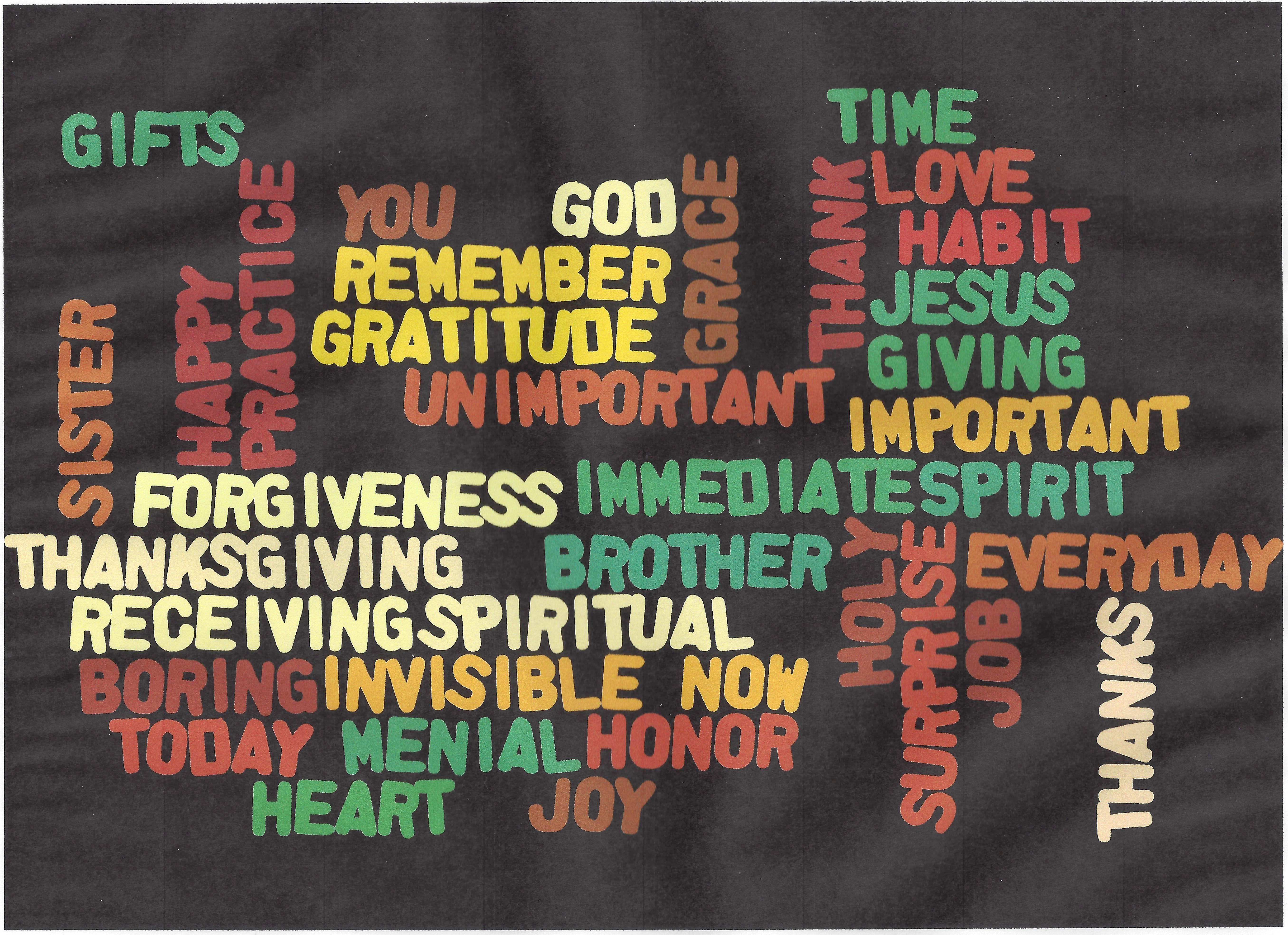
Wordle gratitude

32 Let the afflicted see it and be glad!
You who seek God—
let your hearts beat strong again
— Psalm 69: 32 (CEB)

30 But I will give great thanks to the Lord with my mouth;
among a great crowd I will praise God! 
— Psalm 109:30 (CEB)

This past January John and I visited Boston to celebrate his and our youngest grandson’s birthdays , which fall on the same day.  And, yes I know January is not the ideal time to visit historic Boston and yes we had snow.   However, we just couldn’t miss this celebration of joint Birthdays.

Because the weather was anything but comfortable we all decided to visit the Boston Science Museum and spend the day where it was warm, dry and had lots of exciting things to do and see.  The 2 grandchildren had a great time exploring the human body, looking at dinosaurs and exploring all kinds of interactive exhibits.  For lunch we chose to take our packed lunch to the large busy café and supplement all of our goodies with a few treats.

After making our selections and paying for them I went to get the necessary napkins, forks, spoons and straws needed to eat our lunch.  As I was picking up my things there was a young man restocking the bins as we took things out.  It looked like such an endless job and more than a little boring but he was doing an excellent job of keeping up.   Before I left I turned to him and said “thank you for keeping this area stocked, I’m sure it’s not an easy task.”  Startled he turned and gave me a gruff “thank you.”

After we had finished our lunch and were preparing to leave the area the same young man pushed his way through the crowded exit area and called to me, “Miss, I just wanted to tell you how much I appreciate your thanks.  No one has ever spoken to me that way before and I was afraid I might have offended you so I wanted to make sure you knew how happy I was.”

First of all, I really liked being called miss, no one has called me that in a very long time so he won me over just with that one word.  Well I was happy to bring a little joy into his otherwise boring day with just a few words of thanks from me.  But, what saddened me was his statement NO ONE HAD EVER COMPLIMENTED HIM for doing his job well!  No one ever said thank you! That is one of the saddest things I have ever heard.  It took me all of 2 seconds to express my thanks to the young man and those 2 seconds made his day.  For 2 seconds he wasn’t invisible and unimportant.  No he had been seen, he was important enough for someone to say thank you.  As we were separated by the ever shifting crowd he waved and gives me the biggest, toothiest grin I have ever seen.

Two seconds out of my day added joy to someone else’s.  Gratitude isn’t an emotion or attitude we are to keep to ourselves, no, gratitude is to be given away freely at every opportune moment, even when you yourself are not grateful.  We hear so often we are to be grateful for what God has given us, to express gratitude by thanking God.  Well being grateful for God’s grace comes in many forms.  It was a grace of God that a young man did his boring job well, it was a grace of God that allowed me to see the face of God in the young man and his courage to continue performing a rather menial task even when no noticed how well he did it.  Gratitude for the grace of God comes in many forms, big and small, all are important in the eyes of God.

The Psalms tell us to seek God’s face and to offer our thanks for God’s gifts.  Each one of us is a gift, each one of us has a gift to give, each one of us is the reflection of God, and each one of us carries God within.  So doesn’t it make sense to give thanks to those who reflect the grace of God?

Over the next week begin the habit of saying thank you for the little graces of God.  Offer thanks to the bus driver as you exit, say thank you to the young woman who hands you your morning coffee or say thank you to the washroom attended and see the smiles grow around you.  Offering thanks is an easy spiritual practice and one that brings great joy to the receiver and the giver alike and it is free to give.  It costs you no more than 2 to 5 seconds of your day, surly we can spend 5 seconds to bring hours of joy to someone who feels they are invisible to the rest of the world. Surly we can learn to do that every day, for every person we meet.

Thank you for reading my blog post.  Your presence on my site has made my day and I am grateful for your interest.

Ruth Jewell, ©February 25, 2014

Salt and Light

Salt light

Sermon, Queen Anne Christian Church
February 9, 2014

I was supposed to preach yesterday, but because of snow all of the streets to the church were closed.  You see Queen Anne Christian Church is at the top of Queen Anne Hill and the wise DOT decided it was too dangerous for people to drive up either side of the hill, therefore church was cancelled. So instead I will offer my sermon here.  Enjoy

Matthew 5:13-20 (NRSV)

13 “You are the salt of the earth; but if salt has lost its taste, how can its saltiness be restored? It is no longer good for anything, but is thrown out and trampled underfoot.

14 “You are the light of the world. (Isa. 49:6) A city built on a hill cannot be hid. 15 No one after lighting a lamp puts it under the bushel basket, but on the lamp stand, and it gives light to all in the house. 16 In the same way, let your light shine before others, so that they may see your good works and give glory to your Father in heaven.

17 “Do not think that I have come to abolish the law or the prophets; I have come not to abolish but to fulfill. 18 For truly I tell you, until heaven and earth pass away, not one letter, [a] not one stroke of a letter, will pass from the law until all is accomplished. 19 Therefore, whoever breaks[b] one of the least of these commandments, and teaches others to do the same, will be called least in the kingdom of heaven; but whoever does them and teaches them will be called great in the kingdom of heaven. 20 For I tell you, unless your righteousness exceeds that of the scribes and Pharisees, you will never enter the kingdom of heaven.

In one of the early classes I took with Father Raschko at STM there was this long discussion about the differences between each of the 4 Gospels.  You know, Mark was written first, then Matthew and Luke, who used Mark as a blue print, and John was last and totally different.  Now Father Raschko is a Mark scholar and he loves Mark.  The Gospel of Matthew is OK, but in the words of Father Raschko Matthew was out to correct all of the mistakes Mark had made.  I, in my first or second year enthusiasm decided to sit down and compare them to see if he was right.  Silly me

I have to admit after reading both of them I discovered I loved the Gospel of Mark.  I mean there is that whole messianic message mystery thing he has going on.  You get to the end, all the endings, and it says go back to the beginning, it’s a mystery and who doesn’t love a mystery.  But I found I truly loved the Gospel of Matthew.

Matthew doesn’t write about mystery, well not the way Mark does anyway. He writes about an itinerate Jewish Rabbi, he places Jesus within the historical and cultural landscape of God’s very own people.  In Matthew’s Gospel he connects the Hebrew Scriptures and the peoples own history to what Jesus did to fulfill the scripture.  He writes about doing: about being intentional as a follower of Jesus. In a lot of ways the Gospel Matthew is a Do-It-Yourself manual for how to become a follower of Jesus. Matthew connects the actions of Jesus to the law and the prophets. He expected his own community of first century Christians to do the same.

In today’s scripture Jesus gives an introduction to what the mission of his disciples and followers will be. With the words “you are salt, and you are light” He identifies the ground rules for someone who wishes to become one of his followers. Jesus doesn’t say you should be salt, or you might be light, no, he is telling his disciples, the crowd and us, we are salt and we are light for the communities we live in.  It was the disciples and now it is you and I that is to add the goodness into the lives of those we meet, provide balance and savoriness in our communities, just as salt does for the foods we eat. It is us, you and me, who are to intentionally disrupt the status quo and care for the dispossessed, and those who are hungry and ill.  We are to work for justice and show mercy, and be peacemakers, other words we are to stand up for what we believe with no expectations of ever being rewarded. Just as salt does its job without announcing its presence in the food we eat we are to do all these things not to bring ourselves recognition but because that is just what we are supposed to do.  Just as salt is hidden within our food bringing brightness and goodness to the final product, Jesus wants us as his followers to hide within the community and bring brightness and goodness to the world around us. To do otherwise means we have lost our saltiness and not helpful to the work needed by the Kingdom of God.

Jesus then recalls the prophet Isaiah who says:

I will give you as a light to the nations,
that my salvation may reach to the end of the earth.” (49:6b)

Jesus tells his disciples “you are the light of the world, to both Jew and Gentile, and you can’t hide the light. We too are to let the light shine. This means we are not just salt and supposed to care for others, fight for justice, extend mercy and be peacemakers without an expectation of a reward we are to be the mirror that reflects God’s light into the darkness we humans so frequently to gather within and around us. We are to reflect the graciously given gift of God’s light within ourselves to illuminate the darkness in our own souls. To recognize and open the dark spaces within our souls so that we are better able to reflect God’s light outward to those around us so they too may live in Gods loving light.

We are to let the light shine without focusing the light on ourselves. We are to care for those around us and to carefully walk with God, not in front, but alongside.  We have to take all the good acts we see being done in the world and go one step farther.  And that means it is not in what we say we do, it is in what we DO that is important. Jesus wants us to be intentionally active in whatever way we are called to be, not sitting on the couch or watching others. We are to be the advocate for the voiceless, the homeless, and the dispossessed. It also means just like a mirror we are only the glass that reflects the glory of God and the Kingdom of God. We are to be behind the light being the lens that focus’ the beam on who those needing the light.

We are to be advocates for social justice, advocates for the hungry, the homeless, the incarcerated, and advocates for peace but we are to say “we have done nothing; it is God working through us that has done these things.”   This is where those Matthew called “scribes and Pharisees” got it wrong. Yes they did good works but they made sure everyone knew it. God’s command is we are to do good acts because it’s the right thing to do, not inflate our own ego’s

Today we have modern “scribes and Pharisees” who do the same thing and sometimes I’m one of them.  The hardest thing for me to do is setting aside my own ego and let God stand in front of me, you see I don’t always like taking a back seat.  I must admit that I am all too often a card carrying member of the Pharisee club and I am not proud of that.  I am sure I am not alone in being a member we are, after all, humans, who make choices sometimes there are good ones and sometimes not so good.  It is a good day when I intentionally start it with the words “today I am the mirror, I am the salt.

Ruth Jewell, © February 10, 2014
Intention as a Spiritual Practice – Prayerful Tuesday


Brokenbread

Matthew 5:13-20: (NRSV) 

 13You are the salt of the earth; but if salt has lost its taste, how can its saltiness be restored? It is no longer good for anything, but is thrown out and trampled underfoot.
   14You are the light of the world. A city built on a hill cannot be hid. 15No one after lighting a lamp puts it under the bushel basket, but on the lampstand, and it gives light to all in the house. 16In the same way, let your light shine before others, so that they may see your good works and give glory to your Father in heaven.
17Do not think that I have come to abolish the law or the prophets; I have come not to abolish but to fulfill. 18For truly I tell you, until heaven and earth pass away, not one letter, not one stroke of a letter, will pass from the law until all is accomplished.
   19Therefore, whoever breaks one of the least of these commandments, and teaches others to do the same, will be called least in the kingdom of heaven; but whoever does them and teaches them will be called great in the kingdom of heaven. 20For I tell you, unless your righteousness exceeds that of the scribes and Pharisees, you will never enter the kingdom of heaven.

I am preaching on Matthew 5:13-20 next Sunday, February 9th, and as I have read and re-read this scripture I have discovered Jesus is talking about a spiritual practice, the spiritual practice of intention.  Everything Jesus did was intentional. He started every day knowing he was going to do the will of the Father, his Father, his Abba.  In this portion of his Sermon on the Mount he is trying to teach all of us we must be intentional about our actions in the world.  It isn’t good enough to say we believe in justice and kindness, rather we are commanded to actually get up out of our chairs and actively walk with God as God continually creates our world and DO justice and kindness. So my spiritual practice for this week is “Intention as a Spiritual Practice.”

You are probably saying right now “well duh” everyone knows that.  If we all know that we are to do justice, kindness, and mercy then why don’t we?  It is because it is easy to say we are going stand up to injustice but it is much harder to actually get out there and get your hands dirty.  So I am going to give you a few suggestion that are simple everyday things you can do just to get you started and in the habit of living an intentional life.

In his book Everyday Spiritual Practice, Simple Pathways for Enriching Your Life Scott Alexander explains why a spiritual practices is different from a casual hobby, and “the answer is intentionality, regularity, and depth . . . what shapes your efforts into an everyday spiritual practice is your commitment to making the activity a regular and significant part of your life.”[1]
In addition an everyday practices doesn’t have to be complicated, take a great deal of time, or be physically or economically challenging, it just has to be done every day.

Alexander’s book offers many different activities from the very simple to the more difficult and I am going to suggest only a couple of the less difficult ones to get you started.  I also suggest you find Alexander’s book and read some of the practices if these do not appeal to you.

Everyday Spiritual Practice number 1 is probably the simplest of all to start but can be a hard one to carry out.  Every morning when you arise from sleep say the following:  “Today I will offer kindness to each person and creature I meet this day.”  Then follow through, no matter how frustrated you become during an event.  My suggestion is to repeat your intention several times during the day until the act of offering kindness becomes second nature to you.

Everyday Spiritual Practice number 2 involves caring for the world we live in.  Begin each day with the following state: “I will conserve energy by turning out the lights when I leave a room.” Or you might use recycling, bicycling and/or use city transportation instead of driving as your goal.  What you do is important but it doesn’t have to be difficult and if your way to care for the earth is to eat more foods from the lower end of the food chain instead of taking a bus to work, good for you.

Ok just one more to begin.  Everyday Spiritual Practice number 3 involves the relationships we have with others.  Repeat throughout your day: “I will treat those I live, work, and play with with the respect and kindness they deserve as family members, co-workers, friends, for all are my brothers and sisters of God.”

You might be saying these don’t feel very spiritual to me.  But, what I am saying is that to BE a spiritual being and the being God desires us to be is to approach everything we do, every moment, every day as if we were doing it for the one we call God because in reality we are.

Jesus tells us “as you do it for the least of these you do it for me.”  So when you offer a heartfelt word of thanks to the harried checkout clerk in Safeway you are behaving as Jesus would want you behave and who knows maybe, just maybe, that was Jesus and you didn’t know it.

You see the Spiritual Practice of Intention is basic to walking in the Way of Jesus. Whether you are preparing dinner for your family, taking a casserole to someone who is ill or grieving, or stopping to help a homeless person by offering them half of the sandwich you are carrying all of those are Spiritual Practices. When we place the love of the Divine in front row of the action we are doing a spiritual practice.  Jesus said “let your light shine before others” and how we do that is by gifting our light to those who are struggling in darkness.  Our light will not diminish by giving it away; it grows brighter because more people are shinning with its glow.

Ruth Jewell, © February 4, 2014


[1] Alexander, Scott W.(editor): Everyday Spiritual Practice, Simple Pathways for Enriching Your Life, Skinner House  Books, Boston, MA 1999 Pg. 5

Liturgy as Spiritual Practice – Prayerful Tuesday

Kneeling in Prayer
Kneeling in Prayer

According to my old college American Heritage Dictionary “liturgy is a noun defined as a fixed set of ceremonies, words, etc., that are used during public worship in a religion; ritual.” [1] As followers of faith traditions we most often encounter liturgies when we attend religious services.  But all rituals having a set order to the words spoken and are also liturgies. Graduation ceremonies, inaugurations, State Union Addresses, weddings any ritual using an set order of service uses a liturgy.

We may also use liturgies in our private prayer and spiritual practice’s.  Some traditions have small books with liturgies for each day of the week that include morning, mid-day, and evening prayers.  Each meditation includes a prayer, scripture, maybe a written meditation, and sometimes poetry or pictures to contemplate.  In addition to a traditions individual prayer books there are also many other books that provide written rituals for private prayer.  (You will find a short list of a few of my favorites at the end of this meditation.) Today I am going to introduce you to a liturgy from one of my all time favorite prayer books and offer how I use these resources in my prayer life. One of the advantages of having a liturgy already written out for you is you may adapt them to fit your day and your lifestyle.

I most often use prayer books when I am very stressed out and can’t find a way to sit still and listen for the still small voice of God.  Using a liturgy that includes a blessing or poem, scripture and a prayer calms my heart and open a door into soul allowing me to find my still point and open up to what God is trying to tell me.  If you are new to prayer, any kind of prayer, these pre-written liturgies may provide you with a stepping stone into a regular prayer life.  They allow you to slow down and step across a threshold to you own sacred space.  But, just as with every spiritual practice, you must set a regular time aside each day to read the liturgy.  Most are short and may be read in only a few minutes.  However, setting aside 10 to 15 minutes as a starting place will allow you to sit with the written prayers and scripture in silent contemplation.

Today I offer a liturgy I’ve adapted from a meditation for Tuesday from the Earth Gospel, a guide to prayer for God’s creation written by Sam Hamilton-Poore.   It is an adaption I have used before in my own private prayer and one that allows me to go deeper into that sacred space of my heart.  As you read may you also find a blessing within the words.

Opening Blessing: Edmund Banyard

Holy is the soil we walk on,
Holy everything that grows,
Holy all beneath the surface,
Holy every stream that flows.

A moment of silence

Scripture: Psalm 23 Common English Bible (CEB)

The Lord is my shepherd.
I lack nothing.
He lets me rest in grassy meadows;
he leads me to restful waters;
   he keeps me alive.
He guides me in proper paths
for the sake of his good name.

Even when I walk through the darkest valley,
I fear no danger because you are with me.
Your rod and your staff—
they protect me.

You set a table for me
right in front of my enemies.
You bathe my head in oil;
my cup is so full it spills over!
Yes, goodness and faithful love
will pursue me all the days of my life,
and I will livein the Lord’s house
as long as I live.

Reflection:  “The Avowal” by Denise Levertov (1923-1997)

As swimmers dare
to life face to the sky
and water bears them,
as hawks rest upon air
and air sustains them,
so would I learn to attain
freefall, and float
into Creator Spirit’s deep embrace,
knowing no effort earns
that all-surrounding grace

Closing Prayer:

Into your arms, loving Lord, let me “free-fall,”
upheld by your goodness and mercy.
Secure in your embrace,
show me how to love without effort,
trust without fear,
and live with abandon.  Amen

Resources:

  1. Deleon, Roy ObiSB, Praying with the Body, Bringing the Psalms to Life, Paraclete Press, Bewster, MA, 2009
  2. Hamilton-Poore, Sam, Earth Gospel, a guide to prayer for God’s creation, Upper Room Books, Nashville, TN , 2008 (my offered liturgy will be found on pages 106 and 107)
  3. Newell, J. Philip; Celtic Prayers from Iona, Paulist Press, Mahwah, NJ, 1997
  4. Rohr, Richard, YES, AND . . . Daily Meditations, Franciscan, Media, Cincinnati, OH, 2013

Ruth Jewell, ©January 28, 2014


[1] The American Heritage  Dictionary, 2nd College Edition, Houghton Mifflin Company, Boston MA, 1982


God’s Surprise — Prayerful Tuesday

73c89ea0157c3905290f6a706700dc8a


God’s Surprise
Paraphrase of Luke 2:26-33

God sent a Messenger to a virgin engaged
to a man named Joseph, of the house of David.
The virgins name was Mary.
As he entered the Messenger greeted Mary:

Greetings!
You are beautiful with God’s beauty,
beautiful inside and out,
God be with you.

Mary was confused by these words
and wondered what this could mean,
but the Messenger said:

Mary, you have nothing to fear.
God has a surprise for you;
You will become pregnant
and give birth to a son
and you will name him Jesus

Ruth Jewell, ©December 24, 2013
(I used the NRSV, The Voice and The Message)

Prayerful Tuesday – Through Acts of Faith

DSCF0547a

Reflection:  Hebrews 11:32-34 (The Message) 

32-34 I could go on and on, but I’ve run out of time. There are so many more—Gideon, Barak, Samson, Jephthah, David, Samuel, the prophets. . . . Through acts of Faith, they toppled kingdoms, made justice work, took the promises for themselves.  They were protected from Lions, fires, and sword thrusts, turned disadvantage to advantage, won battles, routed alien armies.

I have always found this chapter of Hebrews somewhat difficult and these 3 verses when read outside the context of the whole chapter are, I think, somewhat confusing. These 3 verses are also often used to justify the idea of “G-d is on my side in this war because I am more faithful than you are.”  But I do not believe that is what the author had in mind.

The writer of Hebrews is making a case for faith, a faith in what we cannot see.  Now that I get, and, for me the writer could have stopped at verse 3 of chapter 11 and his argument would have been made.

Hebrews 11:1-3 – The Message (MSG)Faith in What We Don’t See  1-2 The fundamental fact of existence is that this trust in God, this faith, is the firm foundation under everything that makes life worth living. It’s our handle on what we can’t see. The act of faith is what distinguished our ancestors, set them above the crowd. By faith, we see the world called into existence by God’s word, what we see created by what we don’t see.

But he didn’t and so now I am left with chapter and verse that could be problematic when read outside the context of the whole chapter 11 and in fact the complete Letter to the Hebrews.  My difficulty isn’t with its premise it is with how it is interpreted and used in today’s world, the 21st century.  Yes Gideon, Barak, Samson, and the rest had faith in G-d and they used that faith to give them the courage to defend themselves and fight for a place to live.  Yes they are told by G-d and Moses they are G-d’s chosen people and that G-d would be right there beside them through thick and thin.  At least that is what is told in the Pentateuch, which was written during the Babylonian Exile sometime between 600 BCE and 580 BCE and not by Moses.

Now don’t get me wrong I actually love the Letter to the Hebrews.  The Letter’s central idea of Jesus as the High Priest, our representative who stands before G-d in our name as our advocate means we have a spokesperson on our side, something the disadvantaged throughout history rarely have.  That is an important metaphor to keep in mind.  It is also the root meaning of Chapter 11.

In the first three verses of Chapter 11 the author of Hebrews lays out the important points he wants to make: “By faith, we see the world called into existence by God’s word, what we see created by what we don’t see.”  The remainder of this chapter is a litany of heroes from the Jewish Bible.  They are examples of faith, combined with trust, obedience, and hope that supports the desire for a better place to live, a place to call their own where G-d is the planner and builder, a place where G-d is the central focus.  The memory of the prophets, kings and soldiers the author invokes is not about “whose side G-d is on,” it’s about being true to G-d’s teaching and message.  It is not the act of fighting or going to war that the author is writing about. The important point it is the faithfulness of those who were fighting to build a homeland and country.  Would Gideon have lost if they hadn’t had faith?  That is a possibility because they might not have had the courage to stand up for what they believed in. And, by invoking the heroes  of his Jewish faith the author is placing Jesus among the great and small who throughout history have listened  to G-d’s  call to stand up and speak G‑d’s message of justice, mercy, and  compassion (Micah 6:8).  To walk with G-d does not mean the road will be easy rather it means G-d walks with us into the “lion’s den” offering support and not making smoothing out the potholes.

As I contemplate these verses at  the dawning of Advent I am hearing G-d’s call to respond as Isaiah, Moses, Jesus, Paul, and the author of Hebrews to speak out in G-d’s name for justice, mercy, and compassion for those who cannot speak for themselves.   In the next 4 weeks as I, we, wait for the celebration of the birth of love in human form we need to remember why Jesus came.  He didn’t come so we could give gifts, or eat ourselves sick, or spend money with no thought of consequences.  Jesus came to bring us a way of life.  We are called by G-d to respond to those who are in need, to give out of our abundance. Because we have enough to live comfortably it is our responsibility to ensure that everyone has enough to live comfortably.   To give joyfully and generously, whether it is material, monetary, or spiritually is to practice the teaching of Jesus when he walked among us.

Spiritual Practice

So this week’s spiritual challenge is not an easy one but one worth doing.  What would you life be like if you examined where you are on your spiritual journey and choose what you can give, how you might serve or where you can answer G-d’s call of service and walk in the path of Jesus?  In what acts of faith will G-d recognize your footprints

Ruth Jewell, ©December 3, 2013

Prayerful Tuesday, November 12, 2013

Prayers for the Philippines 

(Bullit Marquez/AP/NBC News) Bea Joy Ortega and her Mother Emily
(Bullit Marquez/AP/NBC News)
Bea Joy Ortega and her Mother Emily

As Typhoon Hayian struck the Philippines this last weekend I, like so many others, sent my prayers flying that the people would be safe.  Of course not everyone was.  People in the millions have had everything they know ripped from them by this storm, which so many say is the largest ever to form.  More than 10,000 people have lost their lives.  The survivors have little food or water, and no shelter.  As people from all over the world respond with aid the people of the Philippines, as people try to leave the islands for safer places a miracle occurs.  A woman gives birth in an airport. Bea Joy Ortega is born after her Mother Emily swims to safety.  A baby is always a sign of hope, a gift of promise.  In the hardest of times with death all around life still grows and makes her presence known.

I know there will be those who will say the people of the Philippines must have done something horrible to deserve this act of G-d.  I know there will be those who say G-d only does such acts to punish the evil deeds people do.  Well I say Bologna!  G-d doesn’t punish innocent people in such brutal ways.  No one ever deserves to be in the middle of a disaster.  We are not uneducated people who have to ascribe to everything that goes wrong in our lives, or the life of our planet, to some mysterious force we happen to call god.  G-d is much bigger than that.  G-d was with Emily holding her up and helping her swim to a safer place to give birth to a miracle, Bea Joy.

G-d was with each victim who died during the storm and heard their cries of fear and cried with them.  The G-d I know is with them still, in the lines waiting for food and water, in the hearts of mothers and fathers who hold their surviving children and family members, in the hearts of those who come bringing food, water, and medicines.  The G-d I know is in the hearts of people across the world reaching out with their donations.  G-d is in bodies of the volunteers, giving them strength and courage with support and comfort.

No G-d has not abandoned the Philippines rather G-d is in every hand that offers help in some way to a people who are in. So this Prayerful Tuesday I ask that each of you offer up a prayer of your own for the Philippines. G-d will hear and deliver those prayers.

This week the following prayer was posted on Facebook by Christians Tired of Being Misrepresented, a prayer that in the midst of disaster we hear the voice of G-d even in the worst of places and most difficult of times. I offer it to you as my prayer. It is a prayer of peace, a reminder that G-d is not punishing or delivering vengeance, rather G-d is there in your pain and sorry and when you are still you will hear G-ds voice and feel G-ds presence.

God Speaks to Man

I speak to you. Be still – Know I am God.
I spoke to you when you were born. Be still – Know I am God.
I spoke to you at your first sight. Be still – Know I am God.
I spoke to you at your first word. Be still – Know I am God.
I spoke to you at your first thought. Be still – Know I am God.
I spoke to you at your first love. Be still – Know I am God.
I spoke to you at your first song. Be still – Know I am God.
I speak to you through the grass of the meadows. Be still – Know I am God.
I speak to you through the trees of the forests. Be still – Know I am God.
I speak to you through the valleys and the hills. Be still – Know I am God.
I speak to you through the Holy Mountains. Be still – Know I am God.
I speak to you through the rain and snow. Be still – Know I am God.
I speak to you through the waves of the sea. Be still – Know I am God.
I speak to you through the dew of the morning. Be still – Know I am God.
I speak to you through the peace of the evening. Be still – Know I am God.
I speak to you through the splendor of the sun. Be still – Know I am God.
I speak to you through the brilliant stars. Be still – Know I am God.
I speak to you through the storm and the clouds. Be still – Know I am God.
I speak to you through the thunder and lightning. Be still – Know I am God.
I speak to you through the mysterious rainbow. Be still – Know I am God.
I will speak to you when you are alone. Be still – Know I am God.
I will speak to you through the Wisdom of the Ancients. Be still – Know I am God.
I will speak to you at the end of time. Be still – Know I am God.
I will speak to you when you have seen my Angels. Be still – Know I am God.
I will speak to you throughout Eternity. Be still – Know I am God.
I speak to you. Be still – Know I am God.

[God Speaks to Man – Essene Gospel of Peace]

Ruth Jewell, ©November 12, 2013

One Body

DSCF0716

1 Corinthians 12:12-13: 12For just as the body is one and has many members, and all the members of the body, though many, are one body, so it is with Christ. 13For in the one Spirit we were all baptized into one body—Jews or Greeks, slaves or free—and we were all made to drink of one Spirit.

This last week I have been giving a great deal of thought to the importance of all of the parts of the body. And, it has given me completely new insights on Paul’s words in 1 Corinthians 12:12-31. You see I had a blocked gland removed from the underside of my tongue on Thursday and I have learned just how dependent I am on every part of my body. I mean you try drinking, talking, even breathing without using your tongue for awhile and you will understand what I mean! However, given what has been happening in our nation’s capital it seems ironic that it is my tongue that is giving me a problem.

But enough of the gory details! Paul of course is writing to his wayward community in Corinth, which has a few problems getting along with each other. Does that sound familiar? Paul is telling his young Corinthian faith community they need each other because all of them are important and all are equal in the eyes of Christ. Not unlike the conflict we’ve been seeing in our nation’s capital this past week and I am afraid it will take another Apostle Paul for a resolution to this crisis to be resolved.

What might Paul tell our community today? Well one line he might repeat is “the body does not consist of one member but of many” and that each of the members is needed to perform some task that sustains the whole body. No part of the body could say “I do not belong to the body,” the tongue cannot say “I am in pain, so let the eye take my place,” trust me that isn’t going to happen. Just as the fireman cannot say to the man whose house is on fire I am to important to get my hands dirty, therefore I will not help you. That man’s house will burn down you can be pretty certain of that.

Today in Washington DC and in the rest of this country we have people who are saying just that. “I am to important to feed the hungry, or clothe the poor, or help the sick and elderly, or do anything that would make me see you as important in G-d’s eyes. I have my house with all of my barns stuffed with grain and produce that I have worked for and if you can’t take care of yourself, well that’s not my problem.” What these so called “important” people forget is that someone else prepared the ground, sowed the grain, harvested it and stacked it in his barn, they didn’t do it themselves. Just as in Jesus’ story of the rich man with all those full barns, G-d will come and say “Fool! This night your soul is required of you; and the things you have prepared, whose will they be?” (Luke 12:20) and it will be too late.

Paul told his community, “the members of the body that seem to be weaker are indispensable, and those members of the body that we think less honorable we clothe with greater honor, and our less respectable members are treated with greater respect: whereas our more respectable members do not need this.” (1 Corinthians 12:22-23) Paul’s words ring with the same authority today as they did in the First Century, for those we hold in low esteem in our community are the ones who are harvesting our food, making our clothes and building our houses. Just because they don’t wear a suit and tie, or nice dresses doesn’t make them less valuable to the whole body of our communities. I would love to see the Speaker of the House in the fields of California harvesting lettuce; it would do him and the rest of our politicians good to do some really hard labor. There perspective on what is important would change dramatically, that is if they survive the 14-18 hour, 7 day a week job. Let them live for a year as an elderly person on Medicare and Social Security trying to make ends, trying to pay for food, rent and medical care on the little they have. Or, they could choose to take care of a family whose child has cancer or some other debilitating disorder. Let’s see if they could do any better with the medical bills and all the rest of the needs of a family on $50,000 a year.

Each of the “unimportant people” are part of the body of this country, and of the body of G-d. In fact according to G-d they are more important than those who sit in the “great halls of government.” For G-d tells us all “do not abuse any widow or orphan,” (Exodus 22:22) or “oppress a resident alien.” (Exodus 23:9) But those verses are conveniently forgotten.

We are all part of the body of G-d, of creation and the creator. We are all part of our country and world, whether you are a business person, a working person, a widow, a widower, orphan, or an immigrant to this country or any country. Each and every one of us is important to the wellbeing of us all and the Creator’s purpose for us as a whole people. No one is more important than the other; we all have our tasks to do in this life that will lead us into the next life. This week I learned a lesson that every part of the body is important no matter how insignificant I might think it is.

The tongue can be an instrument for good will, or a sword that hurts and divides us all. My tongue hasn’t always been a good instrument. Just like ever one else there here have been times when I have said hurtful things to others and I can’t take those words back, as much as I might wish too. Yet I have also spoken words of kindness and caring that I hope in the eyes and ears of G-d outweigh the bad.

This week has made me aware of the incredible gift of all parts of the body, the seemingly insignificant, and the ones that I erroneously hold in high honor. We all have the power to be good gifts of the body, the body of our country and world, and the body of the Spirit. No matter how insignificant each of us seems to be each is important to the functioning of this grand creation gifted to us by the creator. Paul ends his short discourse on gifts of the body with the words: “But strive for the greater gifts. And I will show you a still more excellent way.” Each of us has the potential within to do even greater things than we do. It takes each of us to encourage those gifts in each other such that we all prosper, just as the Creator wants.

Ruth Jewell, ©October 5, 2013