For the last couple of days I have been using a prayer book of a collection of Julian of Norwich’s writings as my meditation focus and I would like to share this morning’s prayer with you.
Now our Lord reminded me
of the desire for him I had earlier.
I saw that nothing stood in my way but sin,
and I realized that this is the same for all of us.
And I thought that if there were no sin,
we would all be pure and akin to our Lord
Just as we had been created sinless.
But in my vision, Jesus informed me
of everything necessary for me to know.
And he told me: Sin is necessary,
but everything will turn out for the good,
and all will be well,
and everything will be well.
by the simple word, ”sin”
God reminded me of all that is not good
and of the suffering and grief of all creation,
and above all of the utter shame and sacrifice
he endured for our salvation.
We have all suffered woe and sorrow
as we follow our master Jesus,
and we shall do so until we are utterly purified,
I did not see sin itself,
for it has no real substance,
it is not real:
it can be known only by the suffering it causes,
and even that pain lasts but a while.
And during the woe
we might take consolation in our Lord’s suffering.
And out of his tender love, he consoles us, saying:
True, sin caused this pain, but all will be well.
In his voice I never hear a hint of blame,
and since we who are guilty are not blamed,
why should we in turn blame God?
Julian of Norwich
All will be well, that is a powerful statement of faith, of trust in G-d to always be there. Sometimes it is hard for me to hold onto those words. Sometimes they don’t seem true especially in these days when violence and disasters dominate our world. But Julian of Norwich says “but everything will turn out for the good, and all will be well, and everything will be well” and somehow in this morning’s meditation I find the space to believe that and to trust G-d knows what she is doing.
For this week’s spiritual practice to consider the sins of the world war, pollution, global warming and to hold the victims in your heart and offer prayers for their well being. As you sit with your prayers listen for a call to work in some way to right an injustice you see this week.
Luke 6:12 During that time, Jesus went out to the mountain to pray, and he prayed to God all night long.
Deception Pass, August 15, 2014
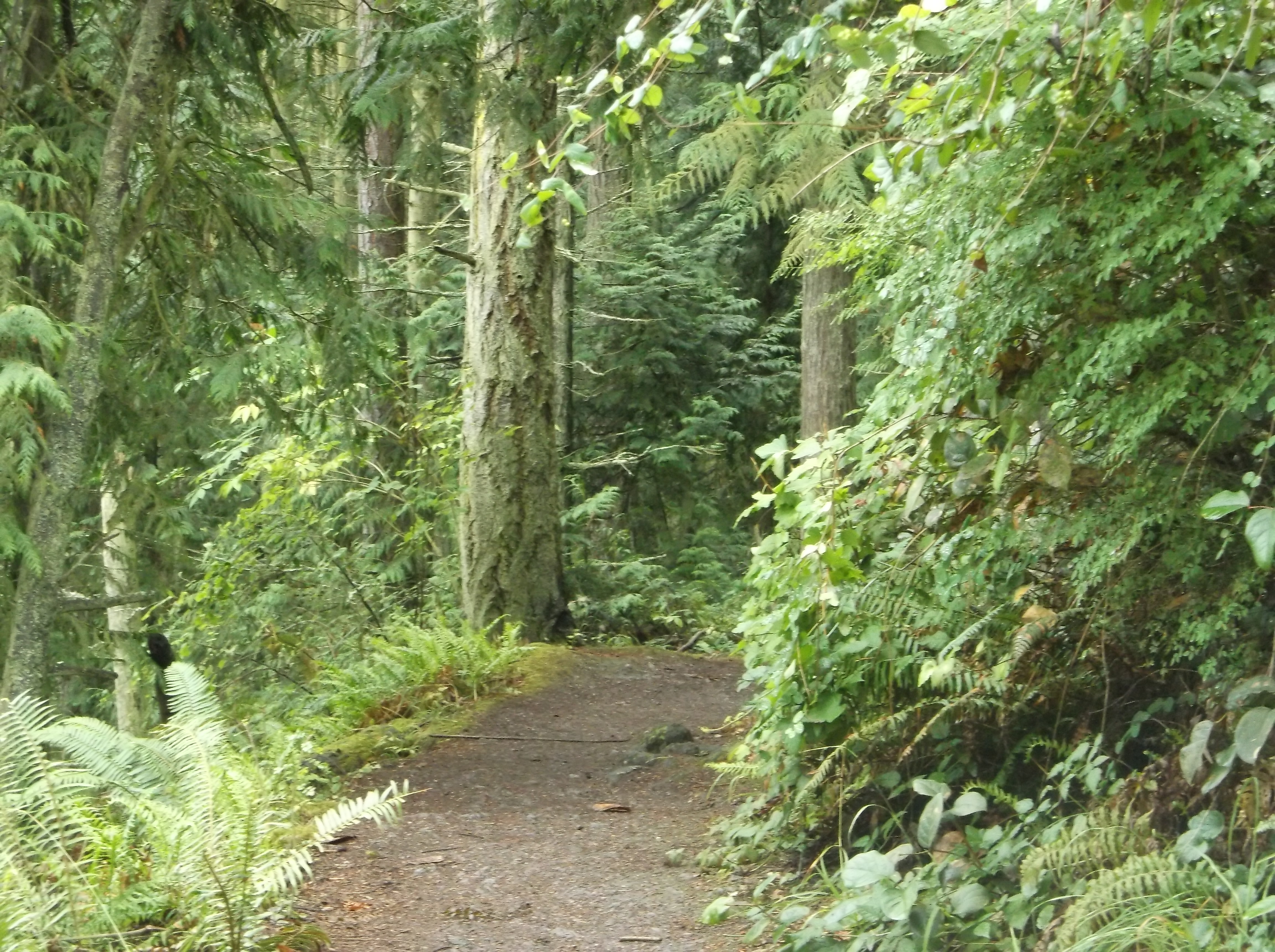
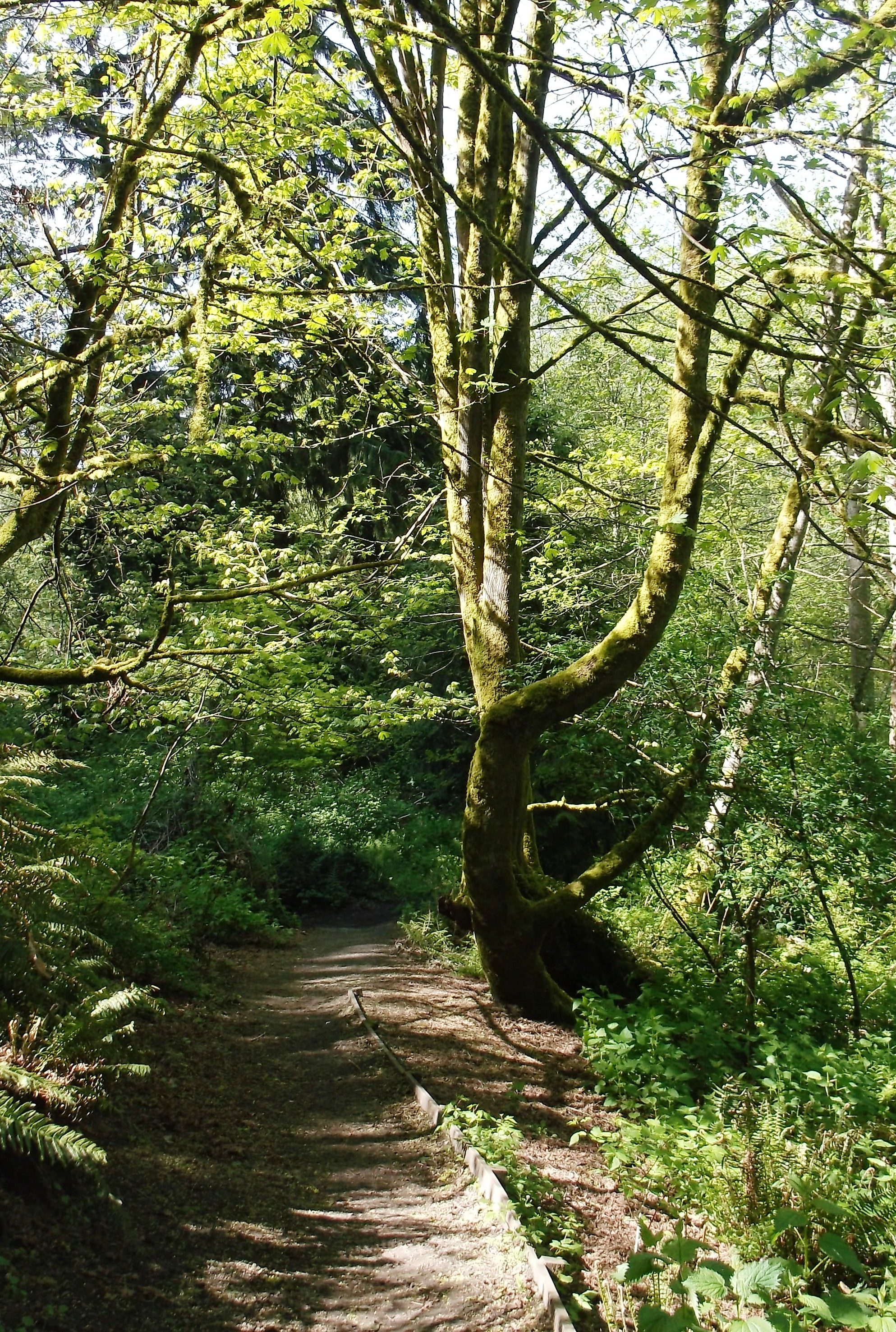
God speaks to us in many ways–through relationships, our experiences, sacred texts such as the Bible and many more. Today I am asking you to “read” a photograph using the practice of Visio Divina, Latin for divine seeing, which is praying with images to listen to God’s words. Todays focus of our pray is a picture of a woodland path. Using the following four steps explore the images and emotions that the picture brings up for you. Let the God speak to you through those images and remembered experiences.
Slowly gaze at the picture, taking a first glance noting the colors, places and things. Remain with the image for one to two minutes.If you would like, jot down a few words about the image.
Take a second, deeper, look. Where is there movement? What relationships do you see? Engage your imagination.Where are you in the in the picture? What do you see from that perspective? What do you think lies around the corner? Do you want to continue on the path? Would you walk this path alone or would you rather have a friend along? Why? What deeper meaning emerges?
Respond to the image with prayer. Did the image remind you of an experience, person or issue for which you’d like to offer thanksgiving or intercession? Offer that prayer to God.
Find your quiet center. Breathe deeply. Relax your shoulders, arms and legs. Rest in this quiet. Let God pray in you. God prays beyond words.
Divine Mother surround us in the love of your embrace
Divine Father guide us through the trials of life
Divine Brother walk with us in light and shadow
Divine Sister Spirit breathe your strength into our hearts
In the midst of the Divine Grace we spend our days
Matthew 14:25-33 And early in the morning he came walking toward them on the sea. But when the disciples saw him walking on the sea, they were terrified, saying, “It is a ghost!” And they cried out in fear. But immediately Jesus spoke to them and said, “Take heart, it is I; do not be afraid.” Peter answered him, “Lord, if it is you, command me to come to you on the water.” He said, “Come.” So Peter got out of the boat, started walking on the water, and came toward Jesus. But when he noticed the strong wind, he became frightened, and beginning to sink, he cried out, “Lord, save me!” Jesus immediately reached out his hand and caught him, saying to him, “You of little faith, why did you doubt?”When they got into the boat, the wind ceased. And those in the boat worshiped him, saying, “Truly you are the Son of God.”
Nearly 40 years ago I went on a camping trip that included riding a horse 20 miles every day. The horse I rode was a rather smallish black mare with a lot of quarter horse in her background. She was gentle and quiet and when I learned she didn’t have a name I named her Sweet Pea.
One day we came to place where the trail all but disappeared and developed a tilt of maybe 30 to 40° as it extended across the lip of the canyon. The distance to the bottom of canyon was maybe 100 to 150 ft down. I needed to trust that my horse would safely carry me across the steep incline without falling to the bottom of the canyon. I took a deep breath and started across and promptly halted Sweet Pea and froze about ¼ of the way on the path. We were in very precarious position, on a steep incline and just inches from the edge of the canyon wall and a drop to the bottom would most likely have killed both of us. I held Sweet Pea in place until she pulled the reins loose in my hand, turned her head as if to say trust me we can do this and she walked the rest of the way across. As I look back over the years I have begun to learn this moment with Sweet Pea was a turning point for me. I now realize that it was here on a narrow trail in Mexico that I turned onto the path leading to this place in my life. For that first step to happen I had to let go of my fear and anxiety and trust someone else to take control of my life, it just happened to be that a small black horse was the one I put my trust in.
Peter too takes a step of trust when he steps out of the boat and starts to walk toward Jesus but something happened to him and he started to sink. Yes Jesus saved him and before they get into the boat tells him he needs faith. Ah, but what is faith and how does Peter or any of us get more of it? I can’t answer the “how” question because for each of us the way to faith will be different. But I can explore with you what it means to have faith.
The modern definition of faith is not the definition that was understood in the days of Jesus and Peter. Today we equate faith with religious belief; if you believe in specific religious doctrines you are said to have faith in it. But, Marcus Borg in Speaking Christian, says in the 1st century faith was expressed by the Latin words fidelitas, faithfulness, and fiducia, trust.
To have faithfulness meant you were committed to, loyal to, held allegiance to, and were attentive to a relationship, Such as our relationship with God. Faith as faithfulness does not just mean you are not going to follow other gods, but that you are committed and loyal to your relationship with God, and God known as Jesus, and that you attend to that relationship to keep it strong and healthy.
Faith as trust is more than a commitment; it is also a deep trust in God and Jesus. That trust is so deep that you are willing to get out of your nice safe boat and walk on water, or, ride your horse across a dangerous trail. The opposite of faith is not infidelity, but “mistrust”—that is anxiety, and that is what happened to Peter. One moment Peter was striding above the waves, just as Jesus was, and then his fears build into anxiety and he began to mistrust Jesus, so he started sinking. Jesus is not telling Peter, “You of little faith, why did you doubt?” No, what Jesus was really saying was “Peter, why didn’t you trust me to keep you on the surface of the water, why did you mistrust me?”
Isn’t that what we all do? Don’t we all mistrust God and Jesus to fulfill our needs? And, don’t our plans all too often sink, just as Peter did? I know it is true for me. My first steps out of the safety of my boat into the abyss of trust were with Sweet Pea and I froze. I wasn’t sure I could trust her to carry me across that narrow path to safety. But something in her eyes told me all would be well and you know what, 40 years later I’m still here. Since that horseback camping trip in Mexico I have had many moments when I let my mistrust of Jesus keep me from achieving goals I know I could have achieved if I had had faith, if I had trusted, in the one leading me and I know that there will be more of them in my future.
You see I am human and to mistrust God is part of a being human because I have a strong sense of my own independence which wants to rule the day. And having independence isn’t bad, nor is saying “No” to God and Jesus. The choice of following or not following must always be mine. It is when my independent voice says “Yes” that my trust in God and Jesus is the strongest and deepest for then I know with certainty that I am not alone. I know then that nothing will shake by commitment to, my faithfulness in, the One All Surrounding Presence.
Have any of you ever read John Ortberg’s book If You Want To Walk on Water, You’ve Got to Get out of the Boat? Well Ortberg is right, you do have to step out of the boat, or onto the narrow path, and trust that everything will be all right. I often wonder if we, if I, can sustain my trust in God long enough to get out of the boat on that raging sea called life and walk across the water? More often than not we will set ourselves up for failure by allowing our hearts to mistrust Jesus’ promise that He “is with us always.”
Life can be hard task master and the main reason we don’t succeed is often how we see failure and loss of trust. Losing our trust, our faith does not have to shape who we, you and me, are; it is the way we respond to that loss that shapes us. Jesus wasn’t ridiculing Peter when he asked why he failed. Rather he was asking a question of Peter, ‘why did you lose your trust.’ Peter may not have understood the question at the time but following the resurrection he did and he stepped out of his nice safe boat big time. For Peter, learning to walk on water and being rescued by Jesus was his turning point, his moment that began his trip to his own cross.
We too don’t understand the questions Jesus asks us and I am no different. Right now I am struggling with so many questions that I don’t know which ones I’m asking and which ones God is asking. All I know is the answers are not forthcoming.
One of the first lessons in trust happens to be learning to wait on God to guide us in the right direction. We have to wait for the power to be given to us to walk on water. We have to wait for Jesus to calm the seas for us. Only then will we make it across that treacherous path or across the water’s surface. The problem is all of us are impatient; we want results now, not tomorrow, but yesterday. We want to move forward in our lives and we don’t care how we do it. One of my favorite phrases is “Give me patience Lord, but hurry” and for many years that fit me to a “T.” Slowing down and opening my heart and mind, trusting that Jesus will come is extremely hard. It is putting myself, in utter vulnerability, into Jesus’ hands. It is letting go of what I want and trusting and having faith that Jesus will bring me what I need.
The idea that any of us are self made individuals is a myth. We all need others in order to survive and thrive in our world. We have always needed the other, not just in today’s world where we are globally connected, but in all of time we have been in need of the other in our lives. That other might be our brothers and sisters, it might be the food we hunt or grow but what and who ever it is we cannot survive alone. We have always needed to choose who to trust, who we would have faith in and be faithful to. We look for what will guide us in ways that will allow us to flourish and let our children flourish. We look to pass on our understanding of the world in a way that teaches our children to trust in something other than themselves or those who only think like them. We look to trust someone who will honor our independent yes as much as our independent no. We want to have faith in someone who will show us how to walk on water and skip across dangerous paths.
Peter lost his trust and began to sink but Jesus was there to lift him up and into the safety of the boat. I lost my trust for a moment but the Holy Spirit said trust in the guide I have given you and together Sweet Pea and I made it safely across. It has always amazed me as to the number of different ways the Holy Spirit makes herself known to me. Sometimes I simply have to go with the flow of energy and trust that what will be is what is supposed to happen. It is all about trust. That is what faith is all about.
13 People were bringing little children to him in order that he might touch them; and the disciples spoke sternly to them. 14But when Jesus saw this, he was indignant and said to them, ‘Let the little children come to me; do not stop them; for it is to such as these that the kingdom of God belongs. 15Truly I tell you, whoever does not receive the kingdom of God as a little child will never enter it.’ 16And he took them up in his arms, laid his hands on them, and blessed them.
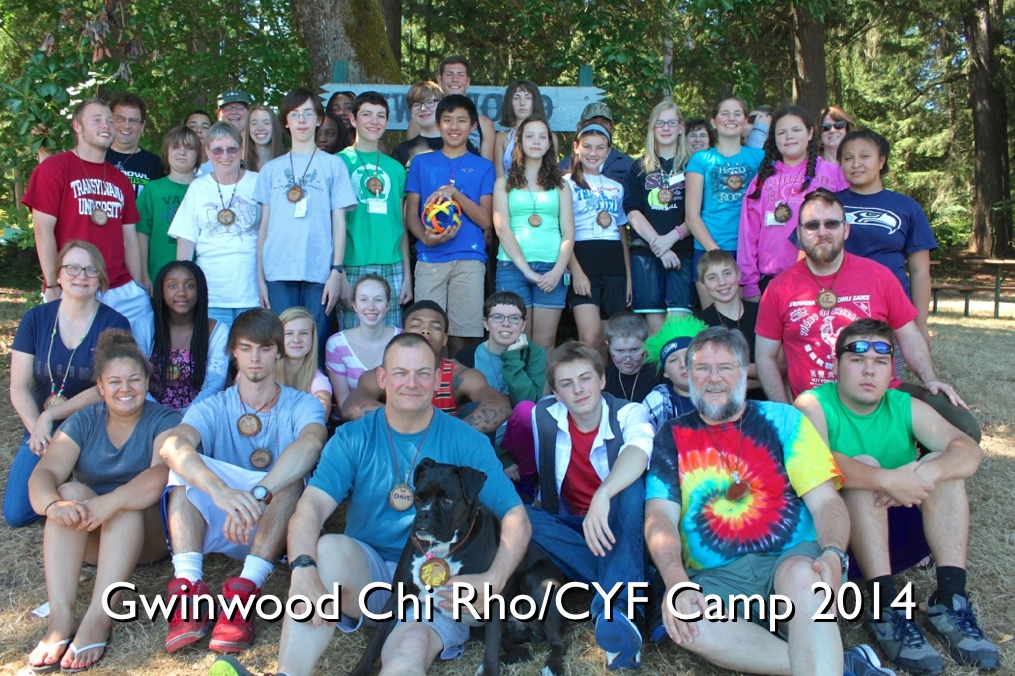
I spent last week at Gwinwood Christian Retreat Center, [(Christian Church (Disciples of Christ)] as one of the Chi Rho (Jr. High) counselors. The whole week was a wonderful experience and not just for the kids. Spending time with children and young people is a prayerful time. In the voices and faces of the young G-d is evident in all that they do, even the mischief. Jesus loved children and young people, he tells his disciples they are important to the breaking out of Kingdom of God; time spent with young people is time spent with G-d.
When you are with kids’ prayer comes in many shapes and sizes, in still and playful moments, in laughter and in tears, and in soccer and in worship. The joy of seeing a young person open their eyes to a new experience of G-d, in priceless. Hearing their voices around the campfire singing “Peace Like a River” will make you’re your heart swell.
Being a Camp Counselor is an experience you should not miss and if you are offered that opportunity please consider the prayer that is our Young People.
In the last couple of weeks I have been reading a book by Jay Michaelson, Everything is God, The Radical Path of Nondual Judaism[1], who described a prayer practice I have been using for many years but didn’t know it was a prayer practice, Non-Distracted, Non-Meditation. This prayer practice, as Michaelson describes it, has no focus, no sense of meditation, where you simply become very aware that you are aware. This is not exactly mindfulness rather this is simply opening up and letting the world around impact your senses in sound, sight, smell, taste and touch. It is becoming aware of who you are. Sounds a bit contradictory doesn’t it?
I have been practicing this manner of prayer for many years not knowing I was opening up to the Divine and letting Her in to the deep places of my heart. Sometimes I am just plain clueless about what I am really doing and who I am! I am by nature an introvert, a strong introvert, who is often very unwilling to let anyone into my space and awareness. This practice, however, opens doors, well maybe a window, where I become aware of the beauty of what surrounds me. The beauty of my grandchildren playing, my husband fussing in the other room, the softness of Suzies fur or the way sunlight plays on the water in Puget Sound. Most times I push those things away but when I sit and relax and open up for just a moment I am amazed by how they sweep over me in gentle waves. I am astounded by what I discover that I have been hiding from my own awareness. It has allowed me to rest in this place and simply be. It is being aware that I am part of the universe, becoming aware that my DNA sings the same song the stars do. It is awakening all of my senses to what G-d has created and knowing I belong here, in this place.
So how does the practice work? Well Michaelson says it best, “ … sit with eyes open, just relax into awareness, with nothing to do and nowhere to go … just, for a moment drop what is in your mind and become aware of awareness itself; inhabiting it, and [letting it] speak” It’s like sitting in your backyard with nice cold drink in your hand, not thinking, nowhere to go, nothing to do, just being.
You can practice this at anytime, anywhere, whenever you want, just stop, take a deep breath, and for a moment become aware of your surroundings, relaxing your body and refreshing your mind. You might say it’s a 5 minute vacation for heart, mind and soul.
May you find peace where ever you are, may the Holy Spirit sit with you as you both enjoy the view.
But you are not in the flesh; you are in the Spirit, since the Spirit of God dwells in you. Romans 8:9a
Matthew 13:1-9, 18-23
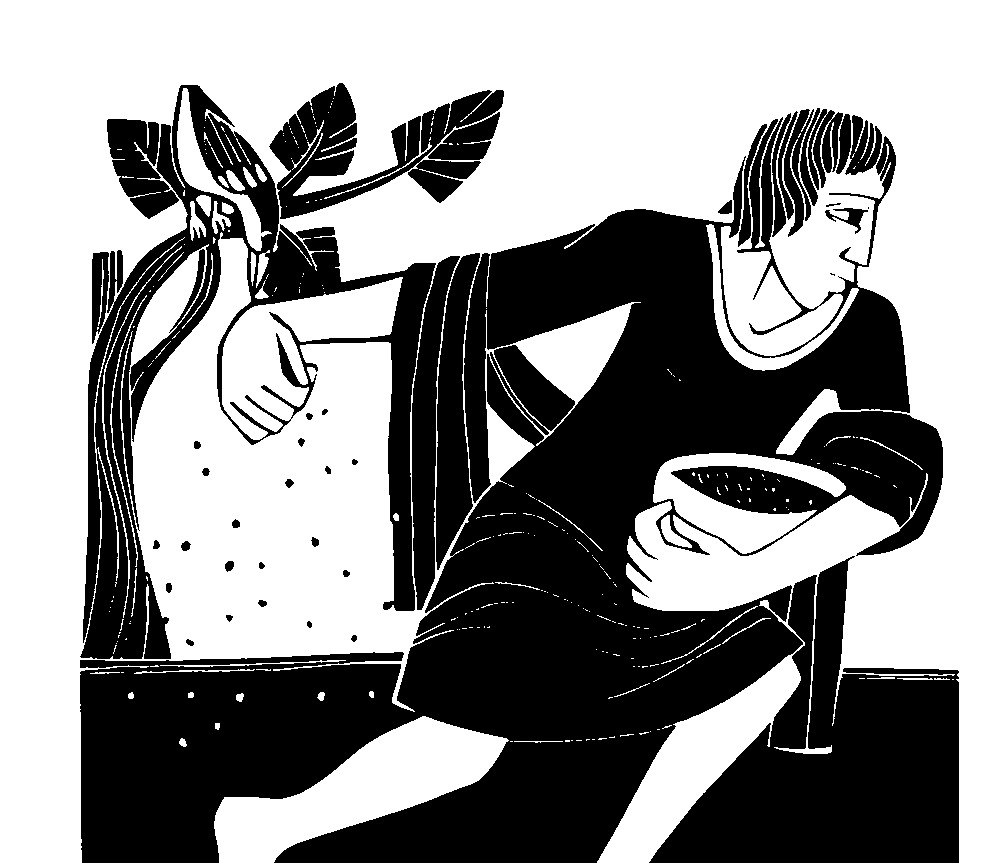
1That same day Jesus went out of the house and sat beside the lake.2Such great crowds gathered around him that he got into a boat and sat there, while the whole crowd stood on the beach.3And he told them many things in parables, saying: ‘Listen! A sower went out to sow.4And as he sowed, some seeds fell on the path, and the birds came and ate them up.5Other seeds fell on rocky ground, where they did not have much soil, and they sprang up quickly, since they had no depth of soil.6But when the sun rose, they were scorched; and since they had no root, they withered away.7Other seeds fell among thorns, and the thorns grew up and choked them.8Other seeds fell on good soil and brought forth grain, some a hundredfold, some sixty, some thirty.9Let anyone with ears – listen!’
18 ‘Hear then the parable of the sower.19When anyone hears the word of the kingdom and does not understand it, the evil one comes and snatches away what is sown in the heart; this is what was sown on the path.20As for what was sown on rocky ground, this is the one who hears the word and immediately receives it with joy;21yet such a person has no root, but endures only for a while, and when trouble or persecution arises on account of the word, that person immediately falls away.22As for what was sown among thorns, this is the one who hears the word, but the cares of the world and the lure of wealth choke the word, and it yields nothing.23But as for what was sown on good soil, this is the one who hears the word and understands it, who indeed bears fruit and yields, in one case a hundredfold, in another sixty, and in another thirty.’
The word of the Lord
Please join me in prayer:
Source of Life may all that offer this today be acceptable in your sight, Amen.
———
Today’s scripture is a popular one among biblical storytellers and so all of us have heard this many times in many ways. We have heard many interpretations as well, so many in fact that in all likelihood we all think “Oh I know that one, it’s an old one and I like what it says.” I thought the same thing, at first, but then I began to look more closely at what was being said and what I thought I heard and what I was actually hearing. I was surprised to realize, I hadn’t heard it all.
Parables are multi-layered, like a Russian doll, you think there is only one doll until you start opening it up and discover many little dolls hiding within. Parables are like that, layers wrapped in layers. I didn’t read the middle portion of this scripture where Jesus tells his disciples one very important lesson, and that is those who want knowledge will open his parables up to discover the many layers, messages, hidden within, and those who don’t will simply hear a story about a really bad farmer. So I am going to try and open this story up bit, and, maybe we will find a layer within we didn’t expect.
Because this is such a familiar story to all of us I am going to try something a little different this morning and hope that we all see this story in a new light. Because this is such a visual story I am going to lead you in a guided meditation. I am going to read only verses 1-17; so get comfortable, with both feet on the floor.
Now close your eyes and take a deep slow breath, let it out slowly, … take another deep slow breath, … let it out slowly.
You are one of the disciples of the teacher Jesus and after spending the night in the home of a friend Jesus goes out early in the morning to the shore of the Sea of Galilee. … Many people come to see and listen to this teacher of yours and to hear what he has to say, … so many in fact that there is no room for Jesus … to sit or stand on the beach. … Jesus asks one of your fellow disciples to get a boat and pull it up on the shore. … He gets in and asks everyone to sit. … You and the other disciples sit in the sand forming a half circle around the boat and the crowd finds their places behind you. … As you sit and wait for the crowd to become silent you are aware of your surroundings, … of the sound of the water lapping gently on the shore, shore birds calling, … a gentle breeze blows across the water, … and there is the pleasant smell of fresh fish coming from the boat. … The sun hasn’t yet climbed far into the sky but it is warm on your back and the sand is still comfortably cool.
Jesus begins to speak.
“‘Listen! A sower went out to sow. … 4And as he sowed, some seeds fell on the path, … and the birds came and ate them up. 5Other seeds fell on rocky ground, … where they did not have much soil, and they sprang up quickly, since they had no depth of soil. 6But … when the sun rose, they were scorched; and since they had no root, … they withered away. 7Other seeds fell among thorns, and the thorns grew up and choked them. … 8Other seeds fell on good soil and brought forth grain, … some a hundredfold, some sixty, some thirty. … 9Let anyone with ears – listen!’”
You and your fellow disciples are confused by the story … it seems simple yet you know there has to be more to it … or Jesus wouldn’t have told it. … So one of the disciples ask a question; … “Teacher, … ‘Why do you speak in parables? … We are confused but we know there is more to this than a simple story’”
Jesus smiles at you and says:
‘To you it has been given to know the secretsof the kingdom of heaven, … but to crowds … it has not been given. … 12For to those who have, will be given more, … and they will have an abundance; … but from those who have nothing, … even what they have will be taken away. … 13The reason I speak to them in parables is that … “seeing they do not perceive, … and hearing they do not listen, … nor do they understand.” … 14With them indeed is fulfilled the prophecy of Isaiah that says:
“You will indeed listen, but never understand,
and you will indeed look, but never perceive. 15 For this people’s heart has grown dull,
and their ears are hard of hearing,
and they have shut their eyes;
so that they might not look with their eyes,
and listen with their ears,
and understand with their heart and turn—
and I would heal them.” 16But blessed are your eyes, … for they see, … and your ears, … for they hear. … 17Truly I tell you, … many prophets and righteous people … longed to see what you see, but did not see it, … and to hear what you hear, … but did not hear it.
[Pause for moment and then ring the chime]
Well did you hear a new message in the story? Did you hear the story open up in a new way and did you find a new layer that you hadn’t seen or heard before? I cannot speak for you I can only speak of my own heart. I can only speak of what I have heard. And, I would like to offer my budding new understanding of this parable, a new layer for me. Your new layer maybe different from mine and that’s ok, we learn from each other and my layer of this story may or may not resonate with yours but it might be a layer you hadn’t seen before and cause you to think. I hope you will tell me yours sometime so that you will cause me think.
So here is the new layer I discovered as I listened to Jesus. I didn’t feel like a disciple in the story, rather I felt like one of the crowd who was thinking about following Jesus. When I heard the story I thought Jesus was comparing me to the seed being sown and I wasn’t sure I liked what I heard. I was close enough to hear the question of the disciples and Jesus answer and my first thought is “How rude of Jesus not to make the message plain to all of us.” Then I thought again, “OK, if there is a hidden message, what is it? And, how do I tease it out?”
As you can see this internal conversation has caused me to almost miss the rest of the Jesus’ answer so I listen again and hear.
“18 ‘Hear then the parable of the sower. 19When anyone hears the word of the kingdom and does not understand it, the evil one comes and snatches away what is sown in the heart; this is what was sown on the path. 20As for what was sown on rocky ground, this is the one who hears the word and immediately receives it with joy; 21yet such a person has no root, but endures only for a while, and when trouble or persecution arises on account of the word, that person immediately falls away. 22As for what was sown among thorns, this is the one who hears the word, but the cares of the world and the lure of wealth choke the word, and it yields nothing. 23But as for what was sown on good soil, this is the one who hears the word and understands it, who indeed bears fruit and yields, in one case a hundredfold, in another sixty, and in another thirty.’”
Ah … the story isn’t about being a careful farmer and planting the seed in good, rich and well watered soil after all. Rather it’s about who will have the staying power to follow Jesus and spread more seeds. OK, I get. But I still have questions. You see I do some farming, and yes my harvest is best when the seed is grown in the right place, but like all good farmers I’ve learned that seed that falls in difficult soil has its good qualities as well, it is often more hardy and will survive when no other seed would. What would it look like if considered for a moment the seed in this story and thought about how what the seed does and how that helps the sower? If I am going to be a seed for the Kingdom don’t I need to be strong?
Don’t I really need to work hard and build up my strength because this won’t be an easy task? So maybe falling on dry hard ground where I have to quickly dig deep into soil, taking up as much water as I can and learn to make efficient use of nutrients when they are available in order to grow. Wouldn’t that be a good thing? I know seeds that do that and they do well in dry places.
Or, what about the seed that falls on thorny ground and to prevent being overrun by thorns adapts and develops protection that would keep the thorns from killing me. I’ve seen plants do that as well so I know it works and such plants thrive. Or, consider the seed that falls on rocky ground. Here I have to learn to extend my roots around obstacles, breaking down some of the rocks into new soil. With deep, strong roots, I will do quite well, I know that because I’ve seen plants that do. So while I’ve not landed in an ideal place, I learned to survive and I may have produced only 10% compared to the 30 or 60% of the seeds planted in good soil. But that’s still something and there will be seeds for the sower to spread around in the next year. And if there is a draught, or someone seeds the farmers field with weeds, or he has to sow his seed in a rocky field I know that the seed that has had to struggle will do very well and produce a crop, which could mean the difference for the farmer between eating and starving.
How do I compare that scenario to Jesus answer? Well being a seed on the dry, hard ground of kingdom means I have to work hard at understanding. Not giving up but keep digging for the treasure found within me and those around me even when it seems hopelessly dry. When, I land in an area where the temptations of the world try to tear me away from my path to follow Jesus, I have to work harder to keep the message of the kingdom in front of me while I work within the world. And, when I hear the kingdoms message and find it sweet like honey but the world lays obstacles in my path I have to remember to let my roots grow with study and contemplation in order to break down the rocks in my path so that I am able to spread my seed-children, the good news of the Kingdom, in new soil.
Why wouldn’t I want to be planted in nice rich soil, with plenty of nutrients, in other words, why would I not like the task of spreading the word of the kingdom to be easy? Well, from a farmer’s perspective, seed that is always grown in nice rich soil does produce a lot of seed; however, a lot of that seed will not have the ability to fight off disease, or draught. That means if there is any kind of environmental stress your crop will most likely fail. However, if you harvest seed from plants that have had to withstand stress the resulting plants will be strong and healthy even under stressful conditions and the farmer has a crop to sell and eat.
It’s the same with the seed of the kingdom. If receiving the word is easy and you don’t have to work for it then when something challenges you, you and your community will struggle and maybe not survive. It has been my experience that working hard for anything means I value it more and I learn to distinguish what is false and what is true because I need to do it to live into the message Jesus taught me.
Jesus told this story because he knew what his disciples, and anyone else who followed him, would need strength in order to stand against the world’s trials, temptations, and obstacles as they spread the word of the kingdom of God. He knew they were going to be tested with many trials and how they responded to those trials would test their resolve and determine whether or not the Good News was spread. So his disciples were going to have to dig deep into inner territory, sending down strong roots into their soul to anchor their faith and learn to protect themselves from thorny individuals by loving instead of hating them. So you see it wasn’t the easy road and productive communities that defined the movement called THE WAY, it was those who experienced suffering, struggle, trials, doubts, who loved their enemies despite persecution that defined the followers of Jesus.
That definition of struggle and hardship is what defines us today, or should be anyway. Maybe in years past some of us have had it so easy to be “Christian” that we have forgotten what it means to be a follower of THE WAY. Those who cannot bring themselves to dig deep within, to doubt, question and be willing to live into mystery and paradox may fall by the way side. But some will strike out into the wilderness and learn how to thrive and how to spread the Good News despite draught, thorns or obstacles.
So my question to each of you is what do you identify with in this parable? Mine was the seed on less than ideal ground. Are you the seed on good soil, but when disaster strikes you are unable to go on? Or, are you the seed that lands in dry, thorny, rocky land, are you the seed that fights and struggles bringing into fruition the best fruit you can? We all have choices; I’ve chosen what I will do. How do you choose?
Roman 6:1-11 What then are we to say? Should we continue in sin in order that grace may abound? 2By no means! How can we who died to sin go on living in it? 3Do you not know that all of us who have been baptized into Christ Jesus were baptized into his death? 4Therefore we have been buried with him by baptism into death, so that, just as Christ was raised from the dead by the glory of the Father, so we too might walk in newness of life. 5For if we have been united with him in a death like his, we will certainly be united with him in a resurrection like his. 6We know that our old self was crucified with him so that the body of sin might be destroyed, and we might no longer be enslaved to sin. 7For whoever has died is freed from sin. 8But if we have died with Christ, we believe that we will also live with him. 9We know that Christ, being raised from the dead, will never die again; death no longer has dominion over him. 10The death he died, he died to sin, once for all; but the life he lives, he lives to God. 11So you also must consider yourselves dead to sin and alive to God in Christ Jesus.
Matthew 10:24-39 ‘A disciple is not above the teacher, nor a slave above the master;25it is enough for the disciple to be like the teacher, and the slave like the master. If they have called the master of the house Beelzebul, how much more will they malign those of his household! 26 ‘So have no fear of them; for nothing is covered up that will not be uncovered, and nothing secret that will not become known. 27What I say to you in the dark, tell in the light; and what you hear whispered, proclaim from the housetops. 28Do not fear those who kill the body but cannot kill the soul; rather fear him who can destroy both soul and body in hell.* 29Are not two sparrows sold for a penny? Yet not one of them will fall to the ground unperceived by your Father. 30And even the hairs of your head are all counted. 31So do not be afraid; you are of more value than many sparrows. 32 ‘Everyone therefore who acknowledges me before others, I also will acknowledge before my Father in heaven; 33but whoever denies me before others, I also will deny before my Father in heaven.34 ‘Do not think that I have come to bring peace to the earth; I have not come to bring peace, but a sword. 35 For I have come to set a man against his father,and a daughter against her mother, and a daughter-in-law against her mother-in-law; 36 and one’s foes will be members of one’s own household. 37Whoever loves father or mother more than me is not worthy of me; and whoever loves son or daughter more than me is not worthy of me; 38and whoever does not take up the cross and follow me is not worthy of me. 39Those who find their life will lose it, and those who lose their life for my sake will find it.
For 10 years I was an environmental consultant performing Human Health and Ecological risk assessments for the military and private concerns. One of the uses of my reports was to define what would be the cost of a cleanup of a contaminated site both as risk of exposure and monetary cost of cleanup. The EPA has a basic cleanup target of 1 in 10000 chances of illness or death from exposure to contaminated soil, water, or air. Of course all is negotiable but that is what is desired. The EPA doesn’t really care about cost but companies do and so does the military. Cleanup is not popular with those who own the property. There is a balancing act that goes on at the negotiation table between the EPA and the owners of the property. The property owners want to remove as little as possible to keep cost down and the EPA wants as much removed as possible to keep risk down. When you add in resident and ecological groups to the mix you probably get some idea of how complicated such negotiations can be. But the key word is negotiable.
Matthew writes in this passage what the cost of discipleship will be for those who follow in the path of Jesus. He tells his community what the risks are when you commit to following Jesus’ teaching and he doesn’t mince any words and the cost is not negotiable. For those who are faithful to God and Christ will face criticism, be misunderstood, run out town, and face death at the hands of the Romans just as Jesus did. How is that for a recruiting statement? I can hear the thought of a potential follower now. “Ok, my family will disown me, I will most likely be run out of town on rail, I will have my words twisted around to mean something other than what I said, and the Romans are going to kill me, tell me again why I should sign up for this.” If a follower of the WAY ever thought about the risks they wouldn’t sign up. I mean would you give up everything to go out and teach others about the WAY of Jesus. Would you give up the king-size bed, the running water, the clean clothes, or 3 meals a day? What is amazing to me is that anyone actually did and I am grateful to those who had, and have, the courage to walk that difficult path.
Matthew wanted his community to understand those risks while having the courage to choose a way of life that would be difficult but result in a life lived within God as found in the life of Jesus. Matthew’s words challenge us to stand up for injustice just as Jesus did. To use our voice to speak for those who are silenced. To live a life of compassion and peace towards everyone no matter how different they may be from us; from a different culture or socio-economic class, differently abled, or differently gendered, or (and this is the hard part) even if they have done harm to us or someone we love. Matthew says we are called to right injustice even at the expense of our own comfort, reputation, relationships, financial security, or even our lives. That is a hard decision to make and I know I (as a risk assessor and a seminary student) that discernment before that decision to be baptized and commit to that life is often very difficult. And let’s face it the reasons to proceed are not all that well laid out. So where do we find some answers.
Well before Matthew wrote his Gospel Paul wrote a letter of introduction to the Roman community and in that letter we have this short passage that summarizes reasons for following the WAY and those reasons are just as valid today as they were in the 1st century. Following the WAY was dangerous and even Paul doesn’t deny that but the benefit is a life lived into love.
Paul tells the Romans, and us, that when we commit ourselves to being baptized we are baptized into the death and resurrection of Christ. Just as Christ died to sin and lives to God we are to recognize our baptism as dying to sin and living into God. Notice I didn’t say Christ died FOR our sins, Paul did not believe Jesus died because God wanted a sacrifice for our sins. No, Jesus death on the cross saves us because God overcame and said No to sin through his resurrection of Christ. God’s message of Jesus’ life, death, and resurrection was to reconcile those who are separated from God back into those loving arms. Called Atonement, or better still “at-one-ment,” reconciliation is the means of re-membering those who have spent their lives lost in a wilderness far from God back into the body of God through Christ.
When Paul writes “So you also must consider yourselves dead to sin and alive to God in Christ Jesus” he is talking about saying no to sin and moving toward God as experienced in the life, death, and resurrection of Jesus. Marcus Borg and John Dominic Crossan in their book Meeting Paul open the verse 6:3-4 to a new insight
“all of us who have been baptized into Christ Jesus were baptized into his death? 4Therefore we have been buried with him by baptism into death, so that, just as Christ was raised from the dead by the glory of the Father, so we too might walk in newness of life.”
We are graced with newness of life that includes a transformed way we see our world. A commitment leading to the ritual sacrament of Baptism results in a “renewing of [our] minds.” We being to see the world differently, living our lives into a richer and fuller life in love. We no longer see the world as other and different from ourselves but rather we see ourselves and the world as part of the body of God and Christ.
For Matthew, for Paul and for us these changes and commitments have political implications. It means we as followers of the WAY are to stand against the “wisdom of this world” as it is known today. We are to refuse to follow a path that results in harm, injustice, or death for anyone, whether we agree with them or not.
That is hard to do, I know it is hard for me. I too have watched the news and read the papers about mass shootings, people who demonize the poor and needy and I get angry. Sometimes I say things I might regret because I want them punished; you see I also forget they are part of God’s body. As a consultant I tried to tell the truth as I calculated it and saw it but I dealt with people who had very different agendas from mine. I grew frustrated and angry at people who only looked at the “bottom line” or a single unachievable number instead of considering how what they had done, and will do, affects those who live in the area, human and ecological. I wanted things to change and it wasn’t until I realized that the change must begin with me that I knew what I would do. I had to stop seeing the world with a “bottom line” perspective because all of creation, human and non-human are simply too important..
In Matthew Jesus says “Those who find their life will lose it and those who lose their life for my sake will find it.” The life I lost is the one that holds tight to the world I see in the news reports while the life I gain is a life lived in relationship with God. While I often forget that I try to remember, what all of us need to remember are these words of Jesus’ “Do not be afraid … I am with you always, to the end of the age.”
I have been reading a book titled Never Pray Again[1] that explores prayer leading into action. I have always been an advocate of prayer that gets me moving in the right direction. I want prayers that get me up out of my chair, out of my house, out into my neighborhood and community to do my small part in fighting injustice, cleaning up creation, or sitting with someone in need of a friend. Like the authors I believe that when we say those magic words “I will pray for you” all to often we think that is all we have to do, and that isn’t quite right. God does answer prayers, but God cannot do it alone. God needs our arms and legs, and yes even our imagination, to get the job done. We are to not just offer prayers of intercession but also intercede on behalf of those who cannot act by themselves. We are not to just offer prayers of healing but also enable and encourage those who are wounded so that they may become whole members of the community. We are not to just to offer prayers of support but also get out on the street and offer ourselves in support of those in need. We are to shower the love God has gifted us with onto everyone we meet, whether they are friend or enemy.
Just imagine what the world would look like if this became the radical new trend. I can hardly contain myself because it is such an exciting thought. But reality will and does set in to temper my enthusiasm. Because I know, and you know, that isn’t happening anytime soon, but we have to start somewhere. Here are 2 possible things to do that are suggested by the authors:
The next time you someone begging go and grab a couple of meals and sit down with that person and listen to them talk about their problems. When you both have finished your meal thank them and the next time you see them acknowledge them instead of passing them by. If you can’t sit down with them then, at the very least, give them the meal and ask for their name so you might respond to them as a fellow traveler.
Invite and outsider in. Find a new person, in your apartment building, neighborhood, workplace or school and invite them to lunch or tea and coffee. Even if they may not “fit-in” with your normal social group listen to them and get to know them as a person, someone with their own dreams and aspirations. You might invite them to something you do regularly with others, not as a token, but as a real invitation.
Both of these activities are prayer in action, reaching out to those who we might never have met, sharing ourselves, offering respect, leading to a new wholeness in all. This is what Jesus did. If we are to call ourselves followers of Jesus aren’t we obligated to do what he taught us?
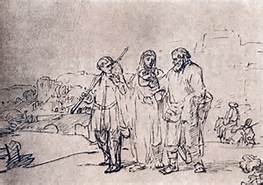
The story of the two disciples on their way to Emmaus who meet the resurrected Jesus is a familiar story to us all, maybe to familiar. I found this drawing of Rembrandts and it touched me in a way some finished painting cannot. If you look closely you will see it is not a complete drawing, you have the basic outlines some detail is included but most of the fine detail is missing. In a way that is what the scriptural story is for me, the fine details are left out. For instance Rembrandt portrays a young and an older disciple with Jesus but I don’t remember ages being given. For some reason I always pictured the road they were walking on as being isolated but in the background here you see other travelers, is that possible. Jesus is in deep conversation with the two and I often wondered why these two were they the only ones of his disciples not afraid to go out? I could go on forever but then you wouldn’t have a chance to meditate on this drawing.
So today, I offer this drawing for Visio Divina practice. Gaze at the picture and as you focus on the images place yourself in the role of one of the disciples. Ask yourself the following questions:
The other disciples are afraid of leaving the upper room but you have chosen to travel. If you had been one of these disciples what would you have thought of this stranger interposing himself on you and your companion? Would you have been afraid?
In what ways does this the teaching of the stranger peak your curiosity.
What is it about the stranger that draws you to him? Does he somehow feel familiar?
Given that some of the women in your group have come back from the tomb telling everyone that Jesus was alive, can you entertain the possibility that you are talking to your risen Lord even if you are afraid to say so out loud.
May Christ meet you on the road and offer you comfort.
I’m so sorry this post is late but life just seems to interfere at times, especially during Holy Week. But I did want to talk about “life.” No, not the meaning of life but rather how fragile life is. In the last two weeks two friends have passed on to next life. One was in his late 80’s and had lived a long, happy, and productive life. The second was in his early 50’s and had so much more life to live. I was unable to say good bye to these friends before died and a part of me is sad because I never had the chance to tell them face to face how much they meant to me.
I am blessed that I was able to visit a friend who has been ill for a long time and while he is doing quite well considering health concerns there is a fear I might not see him again. The chance to tell him how much he means to me and how much he has touched and influenced my life was very important to me. So often we don’t get that chance. One day someone we love is sitting next to and the next they are in the arms of God.
Love transcends death and my friends are still with me in my memories but they have moved on to a new life, one I will not know until I too pass those doors. I no longer can call upon them for advice, or companionship. They are beyond helping me problem solve or sitting with me when I am confused and lonely. What I feel is grief, a grief at the loss of the physical person and grief at my own inability to tell them how much I loved them when they were here beside me.
This week, this Holy Week, I would encourage you to reach out to those you love and draw them into your arms, hug them and tell them you love them. Tell them how much they mean to you. Let them know they have made a difference in your life. That too is a spiritual practice, letting others know the love for them and how much they mean to you. Don’t let a moment go by without saying “thank you” to those who touch your life. It is never too early in life to recognize our mentors, our role models, and those who care for us, who love us; however, it can be too late.













 A Quiet Walk