Road to Emmaus — Prayerful Tuesday

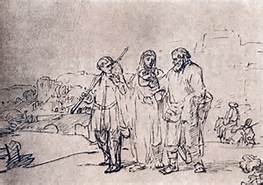
Road to Emmaus, Rembrandt

Road to Emmaus, Rembrandt


The story of the two disciples on their way to Emmaus who meet the resurrected Jesus is a familiar story to us all, maybe to familiar. I found this drawing of Rembrandts and it touched me in a way some finished painting cannot. If you look closely you will see it is not a complete drawing, you have the basic outlines some detail is included but most of the fine detail is missing. In a way that is what the scriptural story is for me, the fine details are left out. For instance Rembrandt portrays a young and an older disciple with Jesus but I don’t remember ages being given. For some reason I always pictured the road they were walking on as being isolated but in the background here you see other travelers, is that possible. Jesus is in deep conversation with the two and I often wondered why these two were they the only ones of his disciples not afraid to go out? I could go on forever but then you wouldn’t have a chance to meditate on this drawing.

So today, I offer this drawing for Visio Divina practice. Gaze at the picture and as you focus on the images place yourself in the role of one of the disciples. Ask yourself the following questions:

  1. The other disciples are afraid of leaving the upper room but you have chosen to travel. If you had been one of these disciples what would you have thought of this stranger interposing himself on you and your companion? Would you have been afraid?
  2. In what ways does this the teaching of the stranger peak your curiosity.
  3. What is it about the stranger that draws you to him? Does he somehow feel familiar?
  4. Given that some of the women in your group have come back from the tomb telling everyone that Jesus was alive, can you entertain the possibility that you are talking to your risen Lord even if you are afraid to say so out loud.

May Christ meet you on the road and offer you comfort.


Ruth Jewell, ©April 29, 2014


Intention as a Spiritual Practice – Prayerful Tuesday


Brokenbread

Matthew 5:13-20: (NRSV) 

 13You are the salt of the earth; but if salt has lost its taste, how can its saltiness be restored? It is no longer good for anything, but is thrown out and trampled underfoot.
   14You are the light of the world. A city built on a hill cannot be hid. 15No one after lighting a lamp puts it under the bushel basket, but on the lampstand, and it gives light to all in the house. 16In the same way, let your light shine before others, so that they may see your good works and give glory to your Father in heaven.
17Do not think that I have come to abolish the law or the prophets; I have come not to abolish but to fulfill. 18For truly I tell you, until heaven and earth pass away, not one letter, not one stroke of a letter, will pass from the law until all is accomplished.
   19Therefore, whoever breaks one of the least of these commandments, and teaches others to do the same, will be called least in the kingdom of heaven; but whoever does them and teaches them will be called great in the kingdom of heaven. 20For I tell you, unless your righteousness exceeds that of the scribes and Pharisees, you will never enter the kingdom of heaven.

I am preaching on Matthew 5:13-20 next Sunday, February 9th, and as I have read and re-read this scripture I have discovered Jesus is talking about a spiritual practice, the spiritual practice of intention.  Everything Jesus did was intentional. He started every day knowing he was going to do the will of the Father, his Father, his Abba.  In this portion of his Sermon on the Mount he is trying to teach all of us we must be intentional about our actions in the world.  It isn’t good enough to say we believe in justice and kindness, rather we are commanded to actually get up out of our chairs and actively walk with God as God continually creates our world and DO justice and kindness. So my spiritual practice for this week is “Intention as a Spiritual Practice.”

You are probably saying right now “well duh” everyone knows that.  If we all know that we are to do justice, kindness, and mercy then why don’t we?  It is because it is easy to say we are going stand up to injustice but it is much harder to actually get out there and get your hands dirty.  So I am going to give you a few suggestion that are simple everyday things you can do just to get you started and in the habit of living an intentional life.

In his book Everyday Spiritual Practice, Simple Pathways for Enriching Your Life Scott Alexander explains why a spiritual practices is different from a casual hobby, and “the answer is intentionality, regularity, and depth . . . what shapes your efforts into an everyday spiritual practice is your commitment to making the activity a regular and significant part of your life.”[1]
In addition an everyday practices doesn’t have to be complicated, take a great deal of time, or be physically or economically challenging, it just has to be done every day.

Alexander’s book offers many different activities from the very simple to the more difficult and I am going to suggest only a couple of the less difficult ones to get you started.  I also suggest you find Alexander’s book and read some of the practices if these do not appeal to you.

Everyday Spiritual Practice number 1 is probably the simplest of all to start but can be a hard one to carry out.  Every morning when you arise from sleep say the following:  “Today I will offer kindness to each person and creature I meet this day.”  Then follow through, no matter how frustrated you become during an event.  My suggestion is to repeat your intention several times during the day until the act of offering kindness becomes second nature to you.

Everyday Spiritual Practice number 2 involves caring for the world we live in.  Begin each day with the following state: “I will conserve energy by turning out the lights when I leave a room.” Or you might use recycling, bicycling and/or use city transportation instead of driving as your goal.  What you do is important but it doesn’t have to be difficult and if your way to care for the earth is to eat more foods from the lower end of the food chain instead of taking a bus to work, good for you.

Ok just one more to begin.  Everyday Spiritual Practice number 3 involves the relationships we have with others.  Repeat throughout your day: “I will treat those I live, work, and play with with the respect and kindness they deserve as family members, co-workers, friends, for all are my brothers and sisters of God.”

You might be saying these don’t feel very spiritual to me.  But, what I am saying is that to BE a spiritual being and the being God desires us to be is to approach everything we do, every moment, every day as if we were doing it for the one we call God because in reality we are.

Jesus tells us “as you do it for the least of these you do it for me.”  So when you offer a heartfelt word of thanks to the harried checkout clerk in Safeway you are behaving as Jesus would want you behave and who knows maybe, just maybe, that was Jesus and you didn’t know it.

You see the Spiritual Practice of Intention is basic to walking in the Way of Jesus. Whether you are preparing dinner for your family, taking a casserole to someone who is ill or grieving, or stopping to help a homeless person by offering them half of the sandwich you are carrying all of those are Spiritual Practices. When we place the love of the Divine in front row of the action we are doing a spiritual practice.  Jesus said “let your light shine before others” and how we do that is by gifting our light to those who are struggling in darkness.  Our light will not diminish by giving it away; it grows brighter because more people are shinning with its glow.

Ruth Jewell, © February 4, 2014


[1] Alexander, Scott W.(editor): Everyday Spiritual Practice, Simple Pathways for Enriching Your Life, Skinner House  Books, Boston, MA 1999 Pg. 5

God’s Surprise — Prayerful Tuesday

73c89ea0157c3905290f6a706700dc8a


God’s Surprise
Paraphrase of Luke 2:26-33

God sent a Messenger to a virgin engaged
to a man named Joseph, of the house of David.
The virgins name was Mary.
As he entered the Messenger greeted Mary:

Greetings!
You are beautiful with God’s beauty,
beautiful inside and out,
God be with you.

Mary was confused by these words
and wondered what this could mean,
but the Messenger said:

Mary, you have nothing to fear.
God has a surprise for you;
You will become pregnant
and give birth to a son
and you will name him Jesus

Ruth Jewell, ©December 24, 2013
(I used the NRSV, The Voice and The Message)

Prayerful Tuesday, October 29, 2013

Sunset 08.22.2013

The Lord’s Prayer

These past two week have been difficult.  There are wildfires again in Australia, cyclones in the India, conflict in Chile, an early winter storm in Colorado, and the unwillingness of our government to govern, to name just a few.  All of these crises make my unhappiness with the gloomy skies that have settled over western Washington for more than a week seem pretty puny in comparison.

As I was praying about what to write for today I honestly couldn’t offer anything better than what Jesus gave his disciples when they asked him “teach us to pray.”  You see sometimes all you can do is pray, and when I can’t find the words I remember what my father always told me; “Ruth, you don’t have to say anything, G-d knows what’s in your heart, just sit and let your heart speak.”

So this week with no words to describe our hearts ache I ask that each of you to take five minutes out of your day and just sit, letting your heart speak.  If you wish you may end with the prayer Jesus taught his disciples so long ago.  Below is an English translation from the Aramaic, the language Jesus spoke, of the Lord’s Prayer.  In addition I have included a link to a beautiful singing of the Lord’s Prayer in Aramaic From the album, Sacred Ragas, by IndiaJiva. May you draw comfort from the Lord’s blessing and may they bless your day and coming week.

Shalom, Ruth Jewell

The Lord’s Prayer

(An English transliteration from the original Aramaic of Jesus)

 O Breathing Life, your Name shines everywhere!
Release a space to plant your Presence here
Envision your “I can” now
Embody your desire in every light and form.
Grow through us this moment’s bread and insight.
Untie the knots of failure binding us,
as we release the strands we hold of others’ faults
Help us not forget our Source.
Yet free us from (all unripeness) of not being in the Present.
From you arises every Vision, Power, and Song
From gathering to gathering

Amen.

May our future actions grow from here!

Breaking Bread

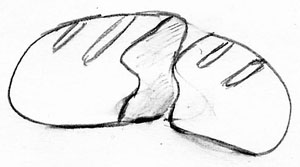
The Broken Loaf
The Broken Loaf

Luke 24:30-31a When he was at the table with them, he took bread, blessed and broke it, and gave it to them. Then their eyes were opened, and they recognized him;

[This was my Spiritual Practice offering this week for Prayerful Tuesday on the Cloaked Monk Blog]

I attended the 2013 Turner Lectures in Yakima this week and the focus of study was the Road to Emmaus. I have always been struck by the above words of Luke. The disciples recognized Jesus “in the breaking of the bread,” . . . a simple act, an everyday act! And, just like Cleopas and his friend, it is in the sharing of a common meal that Jesus becomes real to us. Not s special meal, rather an everyday meal where you sit down with family and friends, inviting the stranger into your close community. What a marvelous way to remember the one who always invites us to sit down and join him in a cup of tea, mug of beer, or maybe a nice glass of wine. Today when you go on your break, or maybe for lunch, look around you who would you never think to invite into your circle? Consider asking that person to join you, for in the encounter with the stranger you may just receive Jesus without knowing it.

The table is set
The food prepared
Who will come
Who will break the bread
Who will.pour the cup
Stranger, friend
Both are welcome
Poor, rich, healthy, ill
I call all to the feast
Come sing, laugh
With the joy of each other
So what if we sometimes
Disagree. Today
We sit at the table
And share a meal.
Grace in abundance
Poured out and
Running over.

Ruth Jewell ©October 8, 2013

Who’s Cross

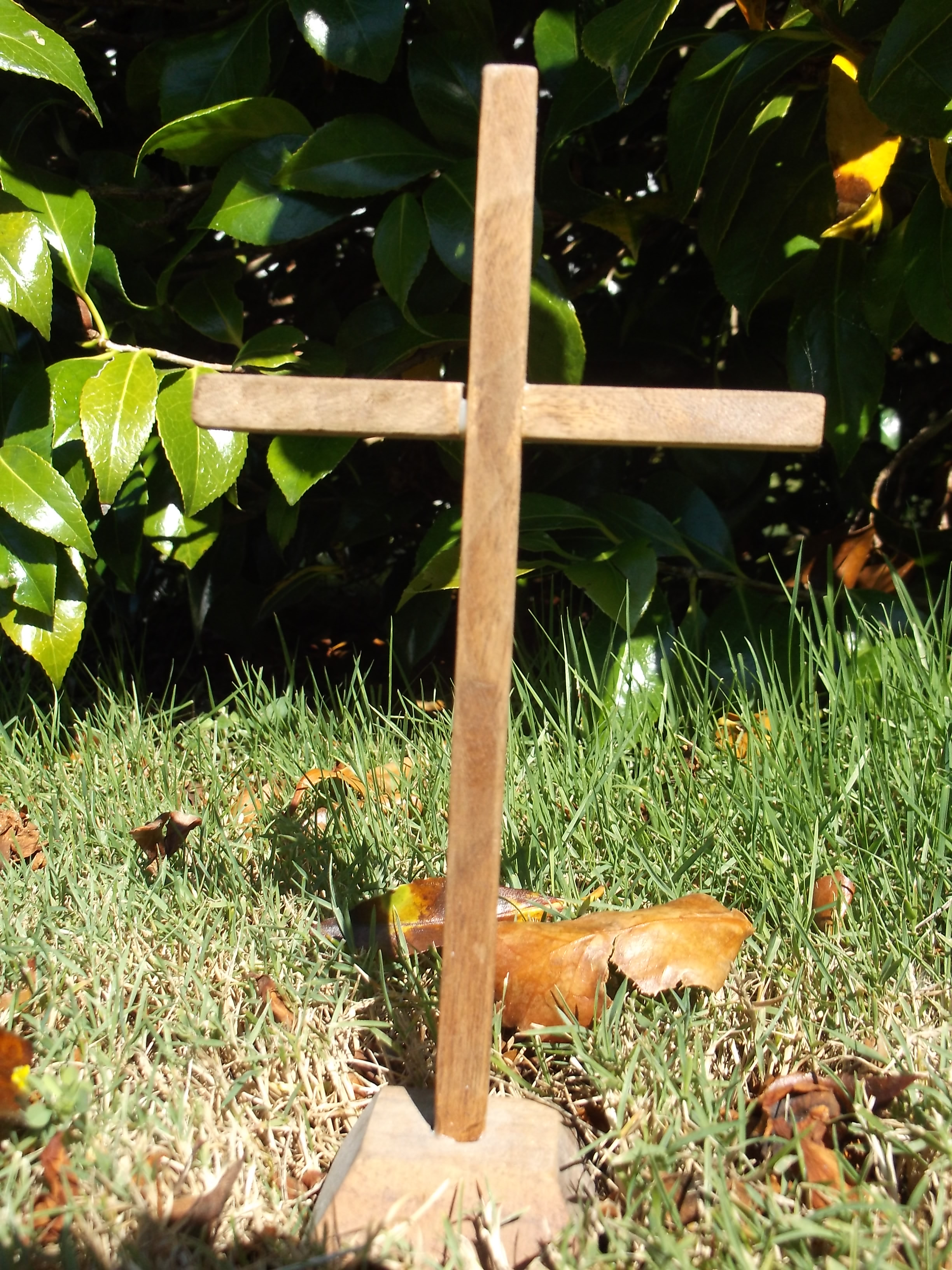
Who's Cross
Who’s Cross

Mark 8:34 And he called to him the multitude with his disciples, and said to them, “If any man would come after me, let him deny himself and take up his cross and follow me.

I love the Gospel of Mark, it encourages me to ask questions and this verse in his gospel is one of those that drives me crazy with questions.  The reason is I’m not sure whose cross I’m supposed to carry.  If I take it literally, which is how it is most often interpreted, then I am to bear “my” cross and follow Jesus.  But If I look at this scripture from the way Jesus responded to all of those who did follow him and surrounded him as he taught, then, this verse takes on new meaning for me.

What if, just what if, Jesus is telling us to carry the cross of someone who is suffering and not our own cross.  Yes I know that flies in the face of orthodox interpretation but then I’m not orthodox.  Those in my ecclesial tradition of the Christian Church (Disciples of Christ) read and interpret scripture and Holy Writings for ourselves.  We do have to defend our interpretation and in that defense we either modify or enlarge our understanding of what scripture has to say.  So here is my defense of my interpretation Mark 8:34 that “the cross Jesus is asking us to pick up is not ours but the cross of my neighbor and both of us then follow Jesus.”

First of all these words of Jesus are recorded in all three of the synoptic Gospels, but not in John.  Now it could be that Matthew and Luke simply copied Mark, after all they used Mark as their blueprint for their own Gospels.  But, the fact that it appears almost word for word in each of three synoptic Gospels leads me to believe this was something Jesus did say or could have said.  Jesus also never said anything that would contradict what he “did” throughout his life of a servant to the disadvantaged, displaced, ill, elderly and disabled. Jesus’ life as it was recorded in the synoptic Gospels was less about what he said and all about what he did.

It is also one of the verses that is almost always misused or misquoted to, or by, those who are having a difficult time.  How often have you heard the words “well that is my (your) cross to bear.”   Something about that phrase has always bothered me.  It’s used to trivialize suffering or difficult times for people and I think that is wrong.  I don’t believe that Jesus would have ever told anyone that and I believe the “traditional” interpretation of this verse of carrying my own cross  may not be what Jesus had in mind when he called to his disciples and the multitude.

Jesus always cared for those who could not care for themselves.  His ministry was to those who had been discarded by society, bringing them back into relationship with their communities and with God.  We often see him tired and totally worn out from giving of himself to those who needed him.  And my question is; is that not carrying the cross of the other long?  In fact we see death in so many ways in the ministry of Jesus, and not just Lazarus (John 11:41-43), a widow’s son (Luke 7:14), or Jairus’ little girl (Matthew 9:25, Mark 5:41, Luke 8:54).  We see those who are dead and buried simply because they don’t fit society’s profile of “normal,” the blind, the infirm, and the mentally disabled and we see them resurrected from their death to life by Jesus who returns them to their communities.  Every story of healing is a story of death and resurrection and it is Jesus who takes the burdens, i.e. their crosses, of those who have died to life restoring them to family and community. Jesus was teaching a Way of Life, and, one in which we as his followers were to emulate.  That means caring for those who have died to society, bringing them back to life by restoring them to God, their families, and their communities.  If we are going to be followers of Jesus then it is not our salvation that we are to be concerned with.  No, it is the resurrection and life of those who have been pushed outside of society and left to die to life.

Now don’t get me wrong, I don’t believe the way I reach God is the only way.  I believe there are many paths to God and each person will find their own path in their own good way and time.  But If I am carrying the cross of those who are disadvantaged than I do it in the name of my faith in Jesus and give the space for those who are in my care to find the best way forward in their own way.  To relieve the suffering of others, carrying their cross, is enough for my task. I can’t make the decisions as to how the move forward for them that is their choice.  It could be that they choose to refuse my help and that is OK, they then have chosen to remain where they are in their spiritual lives.

Jesus never forced his pathway on anyone so why should I.  Remember the story of the 10 Lepers (Luke 17:12-19)? Jesus healed ten but only one returned to thank him.  Jesus asks where the other nine were but that’s as far as it goes. He doesn’t take revenge on them by making them lepers again just because they didn’t return to follow him. He let them choose their own path so that is what we are to do as well.  (Here is a side note from this former statistician: actually 10% isn’t a bad response, in most instances you can expect only a 10% to 20% return on anything you put forward.)

So carrying the cross of someone else means opening a door for them, or clearing a pathway that allows them to return to a right relationship with God, no matter what that may look like for any particular individual.  It means walking along side someone supporting their burdens while they sort out their lives and relationship with God no matter how they worship, or name God.  Not an easy task for sure.  We can see the effects on Jesus throughout scripture in his perpetual fatigue.  Yet Jesus never complained and that too is a goal we are to reach for and it too is very difficult.

Now the next question is, if I am carrying someone else’s cross who is carrying mine.  And that’s a tricky question.  Do you remember that during the trip to Golgotha Simon of Cyrene (Matthew 27: 32, Mark 15:21, Luke 23:26) was conscripted into carrying Jesus cross?  This, for means me, Simon supported Jesus’ burdens and Jesus was now the one who was in need of life. Jesus find life in his own resurrection, a resurrection had had given to so many others throughout his lifetime.

My lesson of the scripture is someone else is walking with me and supporting my burdens while I support the burdens of those who are disadvantaged.  The person supporting my burdens is Jesus and I am supporting Jesus’ burdens in my walking in the way He taught.  Now that is a big cross to carry! I am not sure I know how to fulfill this task, but I do know that I’m not alone; in fact I am never alone.  I have others on the same pathway and I always have the presence of Christ and the Holy Spirit to hold me up and cheer me on.  I am not perfect at following the teaching of Jesus but grateful that He’s not too picky and forgives me my all too often mistakes and stumbles.  While I strive to be Jesus like I often miss the mark and that means I’m not always helpful.  All I am asked to do is to keep trying and moving forward on the path.  I mean after all he taught those 12 male disciples and they never got it right so I figure I’m in good company.

Life is what I want, for me and for all that I meet.  It’s not my job or task to determine what that life will look like for someone else, I only need to worry about what mine looks like.  That is sufficient unto the day.  All Christ, God, and Holy Spirit want is for me to try, that’s all, and I am forgive my wanderings from the path and am welcomed back when I find it again.  That is all I can do, that is all any of us can do.

May your journey be a joyful one, but if it’s not then I pray that you let someone support you and help you back into life.

©Ruth Jewell, July 3, 2013

It Was In Prayer

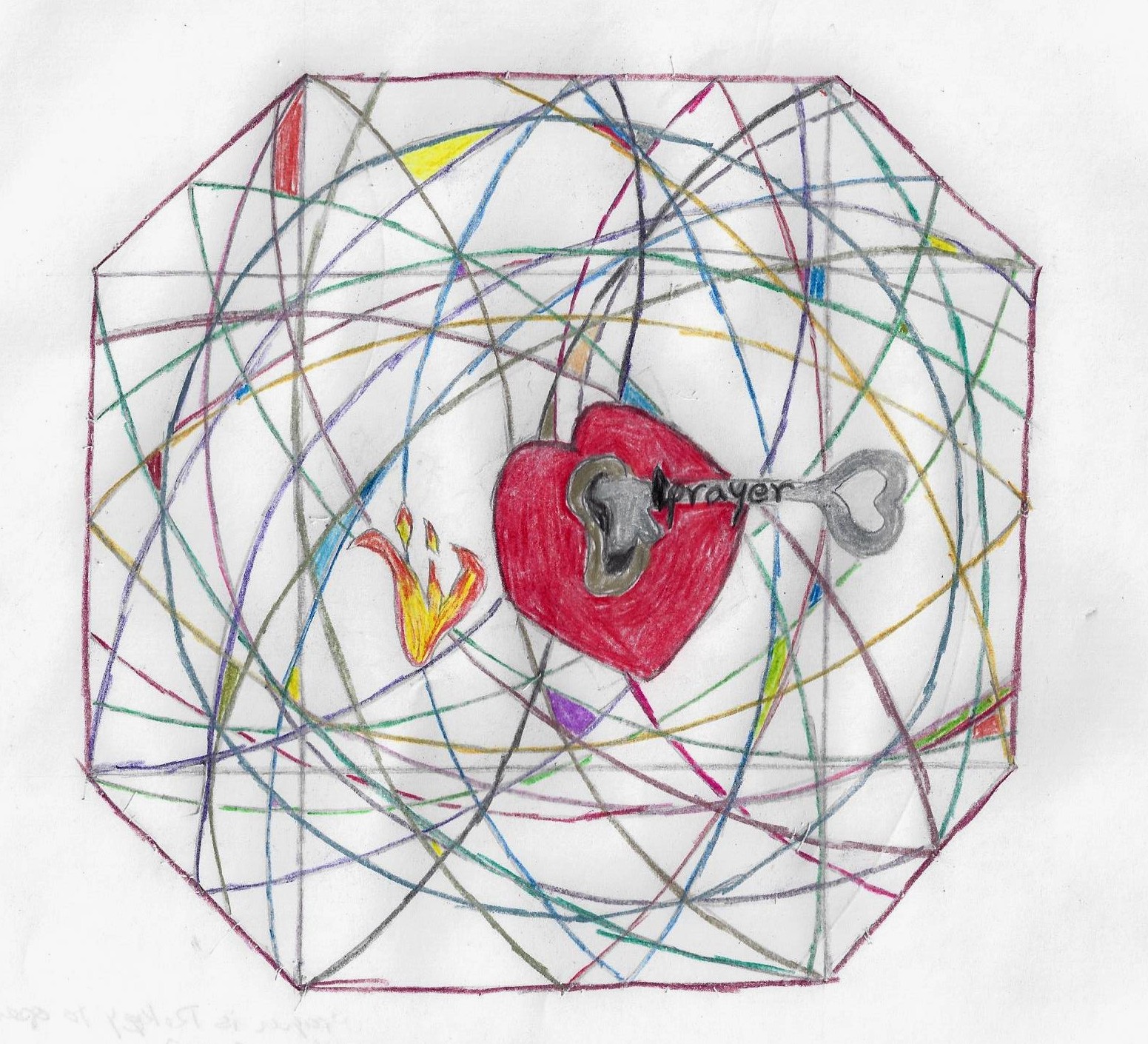
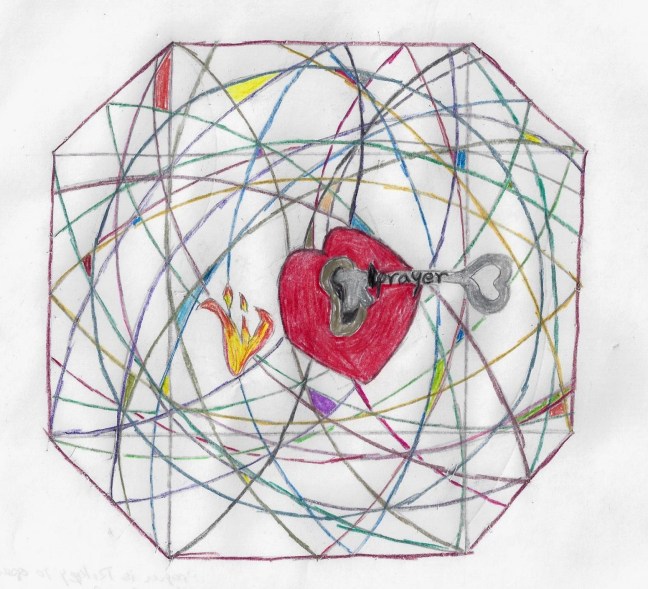
Prayer is the KeySermon preached at Queen Anne Christian Church, January 13, 2013

Acts 8:14-17    14 Now when the apostles at Jerusalem heard that Samaria had accepted the word of God, they sent Peter and John to them. 15The two went down and prayed for them that they might receive the Holy Spirit 16(for as yet the Spirit had not come upon any of them; they had only been baptized in the name of the Lord Jesus). 17Then Peter and John* laid their hands on them, and they received the Holy Spirit.

Luke 3:15-22     15 As the people were filled with expectation, and all were questioning in their hearts concerning John, whether he might be the Messiah, 16John answered all of them by saying, ‘I baptize you with water; but one who is more powerful than I is coming; I am not worthy to untie the thong of his sandals. He will baptize you with* the Holy Spirit and fire. 17His winnowing-fork is in his hand, to clear his threshing-floor and to gather the wheat into his granary; but the chaff he will burn with unquenchable fire.’

18 So, with many other exhortations, he proclaimed the good news to the people. 19But Herod the ruler,* who had been rebuked by him because of Herodias, his brother’s wife, and because of all the evil things that Herod had done, 20added to them all by shutting up John in prison.

21 Now when all the people were baptized, and when Jesus also had been baptized and was praying, the heaven was opened, 22and the Holy Spirit descended upon him in bodily form like a dove. And a voice came from heaven, ‘You are my Son, the Beloved; with you I am well pleased.’

As I was reading the many different stories of Jesus’ baptism this past week I was reminded of my own baptism and the story surrounding it.  I was 10 years old when I attended the class that would prepare me, and my entire Sunday school class, for baptism.  While I had attended church all my young life, for me, this baptism was more about how cool it would be to suddenly become “Holy” and have all my sins forgiven. I mean my thoughts were, “Wow all of my sins were going to be forgiven, even the ones mom and dad didn’t know about, how cool was that.”  

I wasn’t disappointed when the sky didn’t open up and I didn’t hear a voice or see a dove, but I was disappointed that I didn’t “feel” any different. I didn’t feel as if I had been forgiven.  However, knowing, at the wise age of 10, that I should feel something I was afraid to say anything because everyone else seemed so darned happy.  It would be another 20 years before I felt I was beginning to understand what baptism meant and felt a tug to renew that commitment and asked to be re-baptized.  This time I knew that something was different; I just didn’t know what it was. It would take another 20 years of trying to live a good life, failing most times, but, sometimes coming close before I experienced what I call an intervention by the Holy Spirit and had a new enlightenment about what it meant to be part of a faith community. 

At the time this happened I was at a very difficult place in my life and my “ah-ha” moment was the most dramatic event to ever happen to me.  It changed how I viewed myself and everyone and everything around me in relation to how I envisioned my life with God, Spirit and Christ.   Now, events like that do not happen every day or for every person. But, I am grateful for what I experienced and feel blessed to have been given something I feel is special and I try to live into the promise given me that day. 

You are probably calculating in your mind “let see 10+20+20=50, she was fifty when baptism finally made sense!”  All I can say is I’m a really slow learner.  But yes, I didn’t I understand what it meant to be baptized until I was well into my adult years. Your own stories may say you understood before, during or right after you entered and exited the waters of baptism.  Every person is different and the Spirit picks the time it will act, we don’t tell the Holy Spirit.  Nor do we pick the moment when all of it comes together.  In my tradition of the Christian Church (Disciples of Christ) Baptism is believer’s baptism by immersion, just as it was for Jesus.  That means we are supposed to know why we do it and for most part I think most of us do, for some of us it just takes a little longer. As Luke tells the story it didn’t come together even for Jesus until after he was baptized and in prayer.

You know we have heard the stories of Jesus’ baptism so often we don’t actually ‘hear’ it when it is read.  It is actually only in Mark and Matthew where we have a retelling of John baptizing Jesus.  How many of you unconsciously substituted Mark’s or Matthew’s story in the above Luke scripture when you read it and missed the focus of Luke’s telling of the story? 

First of all Luke does tell us Jesus was baptized. He doesn’t actually say it was John the Baptist, although most likely it was. But in Verse 3:21, Luke’s story of Jesus’ baptism is almost an afterthought.  Jesus was baptized with all of those who came to the Jordan River.  He was baptized just like any other person seeking repentance and forgiveness.  Nothing special, it was an act of commitment and faith just like every person coming to John at the Jordan River.  What is highlighted is that sometime after the baptism when Jesus was in prayer the Spirit descends upon him “like a dove” and he hears God’s voice say “You are my Son, the Beloved; with you I am well pleased.”  

Luke doesn’t focus much on the commitment, repentance and forgiveness of the act of baptism.  Instead his focus is on the baptism of the Spirit, just as John tells his audience in Verse 16; “… He will baptize you with the Holy Spirit and fire.”  Jesus’ baptism is with the Holy Spirit and the Spirit decides when that will happen, and, for Luke prayer plays a huge role in when the Holy Spirit comes. 

In the first scripture reading from Acts we read that a Samaritan Community had been baptized but “the Spirit had not yet come upon … them,”  so Peter and John travel to Samaria pray for the Holy Spirit and lay “their hands on them, and they received the Holy Spirit.”  Jesus was in prayer, Peter and John prayed and the Holy Spirit came.    Does this mean that the Spirit will always come in response to prayer … ah … probably not? As I said the Spirit picks the moment when it gives enlightenment, not us.

But Luke’s focus on the act of prayer is the key to our spiritual doors; prayer has a special place in Luke’s Gospel.  The Evangelist tells us Jesus is constantly going away to be in prayer, he prays with his disciples, he prays for the sick, the lame, and the possessed.  Jesus prays in the garden and on the cross. Jesus’ entire life is a model of a life lived in prayer and the relationship with his Abba that prayer fostered.  For Luke the most important thing Jesus taught his disciples was prayer.  The way to talk to and build relationship with God is in prayer.

Luke continues his theme of prayer in his second book, the Acts of the Apostles. Following Jesus’ ascension the disciples returned to Jerusalem and devoted their time to prayer.   They prayed when they replaced Judas with Matthias.  When the Holy Spirit descends on them they were all sitting together, my guess is they were praying, as that would have been their practice.  The first converts were taught by the Apostles to pray and when the community became too great to lead by themselves, they appointed Stephen and Philip to do community management, so they, the Apostles, could devote themselves to teaching, baptizing and prayer. 

I am not saying that Luke ranked baptism as second to prayer, for he doesn’t. Baptism is and will always be the first sacrament. For us Disciples baptism is one of only two sacraments we have, the other being the Lord’s Supper.  However, Luke is explaining to his community of Gentile converts that it takes the two together, baptism plus prayer, to fully understand the commitment made in Christ’s name.  He is also trying to explain to his community that the Holy Spirit does not always come in direct response to baptism.  Sometimes it comes before or after baptism, it is the Spirits choice.  Paul experiences Christ and the Spirit on the road to Damascus and is baptized after that dramatic event.  As Luke describes Paul and as Paul writes in his letters the act of prayer is an important part of being in a Christian Faith Community.  Baptism is the commitment to God and community often in response to prayer.  Baptism plus prayer is the key that opens the door of our heart, into that inner place of the Spirit and shows us the way to live a life that is Christ filled, God filled and Spirit filled. 

One isn’t more important than the other, in fact, we need both for the key to work, but some of us have locks where the Spirit connects with us first and then we are baptized, sometimes it’s the other way around and sometimes it’s all at the same moment.  It is a little like an analogy I picked up from my biologist research days using DNA, RNA and enzymes in comparing how they work in our bodies to how our spiritual DNA, RNA and enzymes might work in our spiritual bodies.

Our Spiritual DNA determines the shape of the RNA and how it will fit together with the enzymes in our bodies.  Each has to be a specific shape in order for both to fit together like a lock and key.  The enzyme only fits one way in each person and when it does the two together create something new and important to keep us living.  I don’t know which of the two, baptism or pray, is the RNA and which the enzyme. I do know that how they fit together in each of us is a specific characteristic for each individual.  Both parts are needed in order for the spiritual life to come awake. 

Luke knows baptism is important; everyone who comes to Christ is baptized.  Everyone who is baptized will have their own experience of Spirit, often whether they recognize it as such or not. The Holy Spirit often speaks so quietly that only a quiet new awareness begins to guide us without our knowing why.  Prayer is the tool used by the Spirit to teach us the meaning of baptism and how to be in relationship with God, Christ and Holy Spirit. 

How we respond to baptism will be an individual act, how the Spirit guides us is the result of prayer.   We can’t have one without the other if we are to live into a Faith Filled Community of God.  Baptism is the recognition of our humanness, our humanity and our commitment to something greater than who we are.  Prayer is the part that leads to our understanding of what our humanity and commitment means.  The two together are the Key that unlocks the door to the Kingdom.

Ruth Jewell, ©January 13, 2013
The Innkeeper, a Christmas Story

innkeeperJacob was in a delighted panic, there were more people in his Inn than he had ever had before.  While giving thanks to the Romans would be condemned by the Temple authorities he was certainly thankful for this emperor’s whim.  Now if only he could find time to sit down to enjoy all of those shekels he was collecting.  Sara, his wife, was busy in the kitchen cooking a meal for their paying guests and for their own abundant family who weren’t paying because his wife wouldn’t let him charge them.  Family, sometimes you can’t live without them but tonight he would like to try.

Now Jacob loved his kind and gentle Sara, but sometimes her kindness was irritating. After all Jacob had to provide for his family. His son, Isaiah, had only just reached manhood, although he was a big help to him tonight.  Isaiah was carrying water to all of the paying guests (let his relatives get their own) and taking care of the animals.  Jacob’s two girls were busy in the kitchen with their mother and while Elizabeth was still a little small she was working just as hard as her older sister, Rebecca.  Over all Jacob was very happy, his Inn was full and he had a box full of money. He should not only be able to pay the tax collector (May YHWH rain fire down on his head!) but also have sufficient money for the next several months.  There might even be enough left over to put a little aside for his daughters dowries.

Jacob was suddenly shaken out of his revere by a call from his son.

“Father, there are two more in the courtyard.”

Jacob threw up his hands and ran out to tell them that he had no more room and that they should move on.   When Jacob opened the door a tall man greeted him. A very pregnant young woman was perched on a donkey behind him.  Jacob had to admit she looked very tired and uncomfortable.

“Excuse me, my wife and I would like a room to spend the night.  If you don’t have a room a corner would do.  Mary, my wife, is expecting and she is very tired.  We have money to pay and I will take care of the donkey myself.”

“I’m sorry we don’t have any rooms,’ Jacob said, “and to be honest with you I don’t think there are rooms free anywhere else in Bethlehem right now.  This mandated census has filled all the Inns.  My suggestion would be that you go up into the hills above the city and find a cave.  At least it would be out of the wind.  Good night to you.”

“Jaaa…cob, Isaiah tells me there is a woman with child out there”.

Jacob turned around and groaned as he faced his wife Sara.   “Sara we don’t have any room! Where would we put them?”  Taking one look at his wife’s face he said “Oh no! I am not giving up my bed! I am tired and will need to get some sleep tonight if I am to deal with all of these people tomorrow!”

Sara patiently looked at her red-faced husband; she knew he wasn’t as hard-hearted as some thought he was, he just had to be nudged once in a while.  “Well we can’t turn out a pregnant woman (may the LORD bless her child!), she looks like she is going to deliver any time now!  This census is bringing people out on the roads that shouldn’t be there!  Don’t you dare send them to the caves!  She’s pregnant Jacob, there are thieves up there and they will be robbed or worse!  Do you really want that on your hands?  Jacob, money isn’t everything.”

Jacob groaned again.  “Well, where do you propose we put them?”

“Isaiah”, Sara called, “get me some blankets and a lamp.  Jacob, the stable has a corner that is warm and dry, and you won’t charge them either!”

The man at the door had been looking on as the Innkeeper and his wife argued and now said, “Please, we will be glad to pay, we have some of our own supplies, we just need a place to rest.”

“No,” Jacob sighed, “Sara’s right, we can’t charge you for a night in the stable.  Isaiah will take you around the back and help his mother get you settled.”  Isaiah ran up with the bedding.  “Take them around to the stable and fix the stall on the west wall, it’s the driest and warmest.  Then come back and help Rebecca take some warm food and wine out to our guests.”

The gentlemen started to protest, “No, sir, it is the least we can do.  If you need anything during the night just knock on the door at the back, Isaiah will be sleeping there tonight and he will do what he can.”

The man looked very relieved, “thank you all so very much, you are very kind.  This is Mary’s first child and we have traveled so very far today.  My name is Joseph and I am a carpenter, if you need anything repaired or need any work done while we are here I will be glad to do it.”   Talking softly to his young wife, who turns and smiles her thanks at the innkeeper, Joseph turns, takes the donkey’s lead and follows Isaiah.

Sara looks lovingly at her husband. “You old softy, I knew you couldn’t turn them away.”

“Go, woman, and prepare some food for these people.  At least I’ll be able to get that back room lintel fixed.  Oh yes, I’ll take him up on his offer, he is an honorable man and I won’t embarrass him, go, go!”  Jacob looks outside as he turns to close the door, “my goodness it is bright outside, almost like daylight, there must be a full moon.”

©Ruth Jewell, November 29, 2009

Blessings and Peace to all this Christmastide!

This story was written for the 2009 Christmas Eve Service and I offer it here to all of you as my Christmas Gift.

Family

A Story of Three Women

Three Women drink tea in the morning
Each on their own Terraces
Secure within their walls
They offer the daily morning wave

The Elder, the Middle, the Younger
Careful not to offend
They talk each day
Across a Chasm filled with white still Fog

One day things changed
A breeze stirred the Fog
A path was revealed leading
Into a place of uncertainty

The women looked down, pointing
Each looked at the other and
Moved to the path
Down into the swirling Fog

Lost … calling … WHERE ARE YOU?
Questions of the journey
ARE YOU THERE?
Is it right for us to meet?

The Fog lightens revealing
A space with light and three chairs
The women emerge
The Elder, The Middle, The Younger

Now what do we do?
I don’t know your name
Hannah … Mary … Mary
Smiles, the stories begin

Discovery, sisters all
Lost in time
Grown apart
Yet family still

I know your story!
I know your son!
I know your grandfather!
Family still

High on a hill
Three empty terraces sit
The sun still shines there
The tea still served, waiting

Three Women
The Elder, Hannah
The Middle, Mary
The younger, Mary

Walk hand in hand
Back into the Fog
Back into the uncertainty
Back to ask more questions

©Ruth Jewell, December 3, 2009, written for a class titled from Abraham to Mohammad  

Advent has begun, it is the time of expectations.  This is a time when small children excitedly wait for that magical moment on Christmas morning when they discover the gifts left by Santa Clause.   Yet there is more to Advent than shopping trips to the mall or preparing a big family dinner.  I wrote the above poem at the close of a class that went through the scriptural history of our Judeo, Christian and Islamic traditions and as a result discovered just how much alike we three sibling religious traditions are.  I think it is because we share so much history that we continue to fight over details just as any family of brothers and sisters do.

Did you know that Hannah’s story is much like the story of the birth of Mary as told in the Infancy Gospel of James written in the 2nd century?  Did you also know that The Qur’an also retells the birth of Mary with a story very close to what is said in James’ Infancy Gospel?  Hannah, Mary from the Christian tradition and Mary from the Islamic tradition are sisters, or maybe mothers and daughters, of our shared faith.  Mary is the most honored woman in The Qur’an, even more so than in our own Christian traditions.

We three faiths are related as People of the Book, of the Bible.  Our shared history is more than simply battles fought to get the attention of the Creator, we are family.  The scriptural blood that flows through my spiritual veins and pushed around by my spiritual heart is the same blood and same heart as my Judaic and Islamic brothers and sisters.  Christians are the middle spiritual child and our older spiritual brothers and sisters have much to teach us about God’s commitment to all of creation, just as we have much to teach our younger spiritual brothers and sisters about the love and compassion of God.

My heart aches because each of us spiritual children seems to only want to compete with the others.  So every Advent I offer prayers that we three family members will sit down and share a cup of tea and take the time to offer apologies and forgiveness.  Because we three siblings have much to teach and offer the whole world, not as the only right paths to God but rather as models of cooperation in showing all paths lead to God no matter what path we take.  All paths are sacred.

I have a pot of tea brewing and a plate of shortbread cookies.  So I invite you to a time of tea in the fog uncertainty.  Let’s begin a conversation that could just change the world.

©Ruth Jewell, December 5, 2012

SURRENDER

Evening Over Puget Sound

Mark 14:36 36He said, ‘Abba,* Father, for you all things are possible; remove this cup from me; yet, not what I want, but what you want.’

I know Advent is only a few weeks away (have you done your Christmas shopping yet?) but it is this verse from Mark that has played over and over in my mind for weeks now.  Jesus is in the garden and asking that he be spared but he surrenders to what will happen and for that reason we have the resurrection and our Faith Tradition. 

Now I am not one who believes that G-d incarnated Himself just to be hung on a cross for my sins or anyones sins.  My belief is that G-d had hoped, we, his most recalcitrant creation would listen to the Word of Jesus and transform our lives and the world.  I believe that for two reasons: first, Jesus repeatedly tells his disciples and anyone who was listening that the Kingdom of G-d was now, not in some future date, but now.  And, I believe today the Kingdom is now if only we open eyes and ears to see and listen as G-d intends.  But we don’t because, well, we don’t. 

The second reason is the G-d I know and love would never deliberately send a beloved child to their death.  Yes I know we have lots of stories in the Bible of G-d using violence but we have even more stories and words that express how much G-d loves and cares for us, especially those who are marginalized.  So Jesus was hung on the cross because of the blindness and deafness of the people he only wanted to transform.  We today are still pounding those nails into Jesus hands and feet because we are still blind and deaf.  We have yet to transform and recognize the Kingdom all around us.

And, that brings me to my latest meditation.  First of all the imagery of the cup has been an important one for me for over a year.  I have wrestled with the cup placed before me and realized how bitter that can be.  I also know just how sweet the cup is. I was devastated when a small minded official denied me a temporary visa to study in Switzerland and that was a bitter cup to swallow.  But I have discovered how sweet the cup has been in the last number of  week’s as I have come to new insights about who I am as a spiritual being, and what my future ministry will be with God.

But the primary image is of Jesus’ surrender to the path laid before him, saying not my will but yours.  Surrender, that word is loaded with many images.  There is the image of a soldier standing in front of his company waving a white flag as they surrender to an enemy.  Or, picture a child being held down by a bully and crying “uncle” in order to get away from their tormentor.  But it also has some wonderful positive images.  Surrendering can also mean release from suffering.  I have been with the elderly who have surrendered to the inevitable and come to a time of peace about the end of their lives.  I was with my father in the last days of his life as he lay dying from cancer and I watched his face as it became peaceful and accepting of his discovery he wasn’t going to overcome the illness, but instead was headed toward something sweet, even if he didn’t know what that was. 

But it is the image of an individual who has reached rock bottom in their lives from substance abuse or something they have done or has been done to them when the ultimate surrender happens that has the most importance for me.  It is the image of someone who has nowhere else to go but up that holds my attention.  I have been in that place partly of my own doing and partly of the worlds.  I know what it means to be at the bottom of a well and yelling at G-d, “I give up; you fix it because I can’t.”  It took a great deal of faith and trust for me to let go and let G-d take over.  I am a control freak, at least over my own life, and always want, and still do, to take the reins and run with them.  I want to tell G-d what I will do rather than wait and listen for what G‑d wants.

But there is a liberating feeling to that surrender to G-d’s plan.  While I have to keep reminding myself that I surrendered remembering it opens me to the possibilities of seeing and hearing in a totally new way. I see everything around me differently, everything becomes new.  It is as if I have put on a new pair of glasses and now I see clearly for the first time in many years. Does that analogy sound familiar to you? It should.

In each of the Gospels we have stories of Jesus healing the blind and opening the ears of the deaf.  These may or may not have been factual healings.  Jesus was known as a healer and I have no doubt that he was an exceptional one.  But these may also have been metaphorical stories about people who are spiritually blind and deaf who reconnect with G-d and creation.  They find the path that lead back to G-d and life. 

I want to say I have again found the path, but I must admit I seem to keep losing it.  Mostly because of my own ego and arrogance that tells me I can do better by myself.  But I am blessed that G-d has had so much patience with me. Letting me stray and then return with a bruised and humbled ego, kissing my wounds and saying “welcome home.”   This prodigal daughter must constantly pray, ‘I surrender,” because otherwise I forget. 

I am currently in a period of discernment about what direction my life and ministry will take.  It is hard waiting for G-d to speak, but I am praying over and over again, “I surrender, let not my will but yours be my life.”  I am beginning to see a path again and it is in the feeling of being surrounded by loving arms that is keeping me pointed towards that path.  I don’t know if I am ‘seeing’ correctly yet but I have time to figure that out.  There will be a cup at the path I will have to drink from, sweet or bitter, I don’t know which it will be, but if I have true faith.  If I am committed, loyal, hold my allegiance to, and grow my relationship with, G-d I know I will be Ok; more than Ok, sweetly happy. 

“I surrender to you Oh Holy One,
in you I put my trust,
in you I give my loyalty and allegiance,
my life is in your hands.

If I should stray from your arms
guide me back with your love.
Open my eyes to see your light,
open my ears to hear your voice.

Love holds the key,
life is the door,
surrender turns the handle.
You oh Beloved wait on the other side.

Ruth Jewell, ©November 13, 2012

NOTE: I did not request the highlighted words, they just appeared.  I am trying to find out how to remove them, but if I can’t please know that Wordpress added them not me.