An Elder’s Meditation: Accepting and Giving Thanks

Mark 4:26-29  He also said, ‘The kingdom of God is as if someone would scatter seed on the ground, and would sleep and rise night and day, and the seed would sprout and grow, he does not know how. The earth produces of itself, first the stalk, then the head, then the full grain in the head. But when the grain is ripe, at once he goes in with his sickle, because the harvest has come.’

Walking though the  Huon Valley & Tahune Forest Hobart, Tasmania, Australia April 15, 2015, ©Ruth Jewell
Walking though the
Huon Valley & Tahune Forest
Hobart, Tasmania, Australia
April 15, 2015, ©Ruth Jewell

This past spring John and I were on a 6½ week pilgrimage of sorts.   Unfortunately 2 hours before we were to be picked up by Shuttle Express I fell in my office and tore or badly bruised the calf muscle of my left leg and also  I refused to go to the emergency room because we would have missed our flight. Well, along with back issues, that fall meant I spent our holiday with a cane and walking as if I was 250 years old.

The fall and my, seemingly forever back problems, meant modifying some of our activities and learning to depend on the graciousness of people in New Zealand and on board our cruise ship..  I was helped by strangers I would never see again to walk up hills, across sand dunes, into cars, buses, and boats.  All they asked for was a simple thank you and a smile.  I cannot begin to express my gratitude to these angels in disguise.  They made our visit to NZ and back to the states a trip of a life time.

Now many of you may also have noticed that I often have a motor mouth (in the case of blogging, motor writing) and when I offer thanks to someone I will chatter on nervously for 10 minutes.  It took 6½ weeks for me to figure out that saying ‘thank you’ or ‘you are a blessing’ was all that was needed.

Learning to stop talking and listen has always been hard for me but what I have discovered this late in my life is when I stop with a smile and thank you I SEE the face of the angel who helped me.  It doesn’t matter what nationality, or skin color, or language they speak, the light shines through.  It isn’t just their job anymore it’s that they have been recognized for who they are.  If I am not speaking or thinking of more to say, I see them for who they are.

You have also probably noticed I have just as much trouble, maybe more, in receiving gratitude.  I am self-deprecating to the extreme.  Probably because I was taught that nothing I did was to be done for any expectation of thanks. But on this trip I was more aware of not just offering thanks but of receiving the gift of graciousness and help.  You see to offer thanks you have to have received something and that gift is hard one for me to accept.  But I learned to stop explaining that I fell, or have a back giving out on me.  I learned to simply take someone’s hand and lean on them for help without explaining how independent I normally am.

The scripture of Mark is one of giving and receiving.  It is giving your time to sow and the harvest is the receiving of God’s blessing (didn’t think I’d work that in did you).  What has finally sunk into my rather thick brain is giving and receiving God’s blessings comes in many forms and I am grateful for the giving and receiving of all the blessings from God’s hands I have received not just on our trip but in my whole lifetime.  It may seem like a small thing but graciously accepting the assistance from a stranger gives me a gift of love and the giver a gift of grace.  The Importance of keeping the ‘thank you’ short and sweet is that it focuses on the gift and the giver rather than my own ego.  It works the other way as well.  Keeping assistance I give to someone else also focuses on the gift I give and the receiver of the gift instead of me.  The giver and the receiver receive the gift of grace and love.  That is a beautifully thing and passing that gift on grows the grace between me and you and opens wider the door of the Kingdom of God.

To all of you, Thank you for being who you are, and many blessing on your many journeys.

Ruth Jewell, ©June 15, 2015

The Angel’s Voices

Mt. Baker, WA, from Artist Point, Photo by Ruth Jewell, 14.09.15
Mt. Baker, WA, from Artist Point,
Photo by Ruth Jewell, 14.09.15

Prepared for a Sermon at Queen Anne Christian Church, Seattle WA
January 18th, 2015

Scripture: Psalm 139:1-6, 13-18

Have you ever had that feeling you are being watched and you turn around and around to see who is there?   I have and I must admit it often feels creepy!  Someone is watching me, why, who are they, what do they want, will they hurt me?  Some might say these are the questions of a paranoid mind, but, given the status of our world today, not uncommon in these days of uncertainty, fear, and, let’s be honest, at least a little hate, ok a lot of hate.

So when I read the Psalm for this week I had to really think what it means to be “watched,” “known,” by God.  This Psalm is telling me that I am being watched, by God no less.  Is that a good thing or should I be afraid, really afraid.  As I was contemplating these verses I remembered an incident out of my childhood.  It was a memory of being known by God and knowing it was keeping me safe.

Nearly 62 years ago I was severely burnt and spent 6 months in hospital healing and having reconstructive surgery.   In reality I am blessed to be here, because I should have died that summer, but didn’t.  However, I did spend a great deal of time on a children’s ward of a Cleveland Hospital.  There were number of other children there as well, just as injured and ill as me and one little boy and I became good friends.  I do not remember his name; I do remember he was dying.   He was a little older than I was but could not walk; I could get up and walk a little but couldn’t read as well as he could.  I would get books and games to play with and he would read the harder books.

Children will often tell another child something important when they aren’t sure their parents would understand or listen.  So one day he told me that he knew he didn’t have long to live and he wanted me to tell his parents he was ok with it.  You see he had a guardian angel who stayed by his side and the angel had told him he would be going soon and no longer in pain, his parents would be sad for awhile but they would remember him forever.

One night I awoke to a great deal of crying and saw the mother holding the little boy.  I remembered what he had asked me to do so I crawled out of my bed and tried to tell them that the boy was OK, and that he was with his angel now.  However, before I got very far with that a nurse scooped me up and put me back in my bed saying something patronizing.  I never really talked about that incident again; I understood what I had to say was pretty unimportant to adults and not worth listening to. It was the thought of the time that children didn’t understand death or God and it was, and is, a wrong thought.

Being known by God, being watched by God, children understand that, after all they are always being watched.  By parents, teachers, friends, family members who want to keep them safe.  So knowing God is watching them is no big deal, just one more person on the list to keep them safe.  Besides isn’t there something comforting knowing you have a guardian angel nearby, how cool is that.

From the time they are formed in the dark, cavern of their mother’s womb they are cradled and whispered to by angels.  By 18 weeks of pregnancy the embryo begins to hear his first sounds, Mom’s heart beat, the movement of her blood, and bowel sounds.  He also hears His Mom’s and Dad’s voice, music, laughter, and tears.  To him it’s, Angels voices coming from, everywhere.  Children know they are being watched, searched out as they are being formed in the dark.

After birth we are still connected to those angels, only now they have blurry faces, but they can see the angels smile at them and hear their whispers and while breast feeding they still hear the comforting sound of Mom’s heartbeat.

It is a sad fact that as we grow we forget those connections to the mystery of our beginnings.  We let other sounds carry us away from the angel’s voices, the whispers that we are beloved and we are watched over. We, who were made so carefully, struggle to be free of the binders, free of being hemmed in from behind and before. We, who in secret were made so wonderfully and woven of star dust and love, want to run free of the restrictions of God, angels, or anyone else.

Yet there is a part of us that yearns to be known.  Oh we may fight it, rebel and run away because we want to “do it our way.”  But really, at some level, isn’t it comforting to know just how beloved we are?  The Psalmist said “My days are all inscribed in Your Ledger; Days not yet shaped—each one of them is counted.”[1] Those counted days are from the moment we are conceived in flesh to the moment we let go of this body and return to God.  Yes we still have days that God has counted that we know nothing about, yet.  But God is still watching and still planning, or more likely, revising our life plan based on our latest actions.

You see I’ve never been a big proponent of predestination, were God has planned our lives out before we are born.  No I am a firm believer in free will and our obligation to choose life over death.  We, you and I, must choose to follow one path over another and depending on our choices our life is rewritten again and again.  I know that because I have had my life rewritten all because I’ve made some rather dumb choices in my life.  My guess is we all have, because we are human, we are embodied; we are separated from that light of God and God deliberately put us on our own resources for a purpose we do not know.  (My first question for God when I return is “what were you thinking.”)

What the Psalmist tells us is even in our bad choices we are watched, cared for, beloved, held safe, and not alone.  God keeps us in God’s thoughts; we are never far from the Divine mind.  “How weighty to me are your thoughts, O God! How vast is the sum of them! I try to count them—they are more than the sand; I come to the end—I am still with you.”  “I am still with You,” God is with me.  Matthew writes that Jesus’ last words to his disciples were, “And remember, I am with you always, to the end of the age.”  We have that promise.  God has not left us alone, Jesus has not left us alone, the angels are still whispering, if, only we listen.

Rabbi Schachter-Shalomi translated verse 14 as follows, “I am overcome with thanks at Your awesome wonders, Your astonishing works, of which my soul is aware.”  Our souls know what God does, what Jesus does, even when we are unconscious to those actions.  Our souls know even when we reject God’s call that we are not alone.  That we are watched over and having our lives rewritten again and again based on whether we chose life or death.

Those angel whispers, messages of comfort from the Holy, still hold for each and every one of us.   That first sound we heard in our mothers’ wombs, the first whisper of life from the sacred, was a heartbeat.  It still is the whisper of life for all of us.  Without our hearts beating strong and level life will fade.  But it is not just the heart of our flesh that we need.  We also need the voice of the heart of our souls, our spirit, to truly live life as God intended.  Remember Moses’ last words “choose life.”  The messengers of God, the angels voices all whisper, “choose life.”

Ruth Jewell, ©January 17, 2015

[1] Schachter-Shalomi, Rabbi Zalman, Psalms in a translation for praying, Alliance for Jewish Renewal, Philadelphia, PA, 2014.

For Unto Us – Prayerful Tuesday

John 1:1-5  In the beginning was the Word, and the Word was with God, and the Word was God. He was in the beginning with God. All things came into being through him, and without him not one thing came into being. What has come into being in him was life, and the life was the light of all people. The light shines in the darkness, and the darkness did not overcome it.

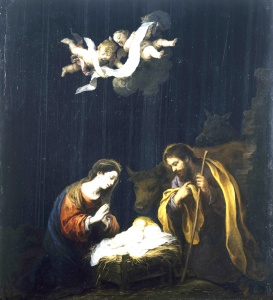
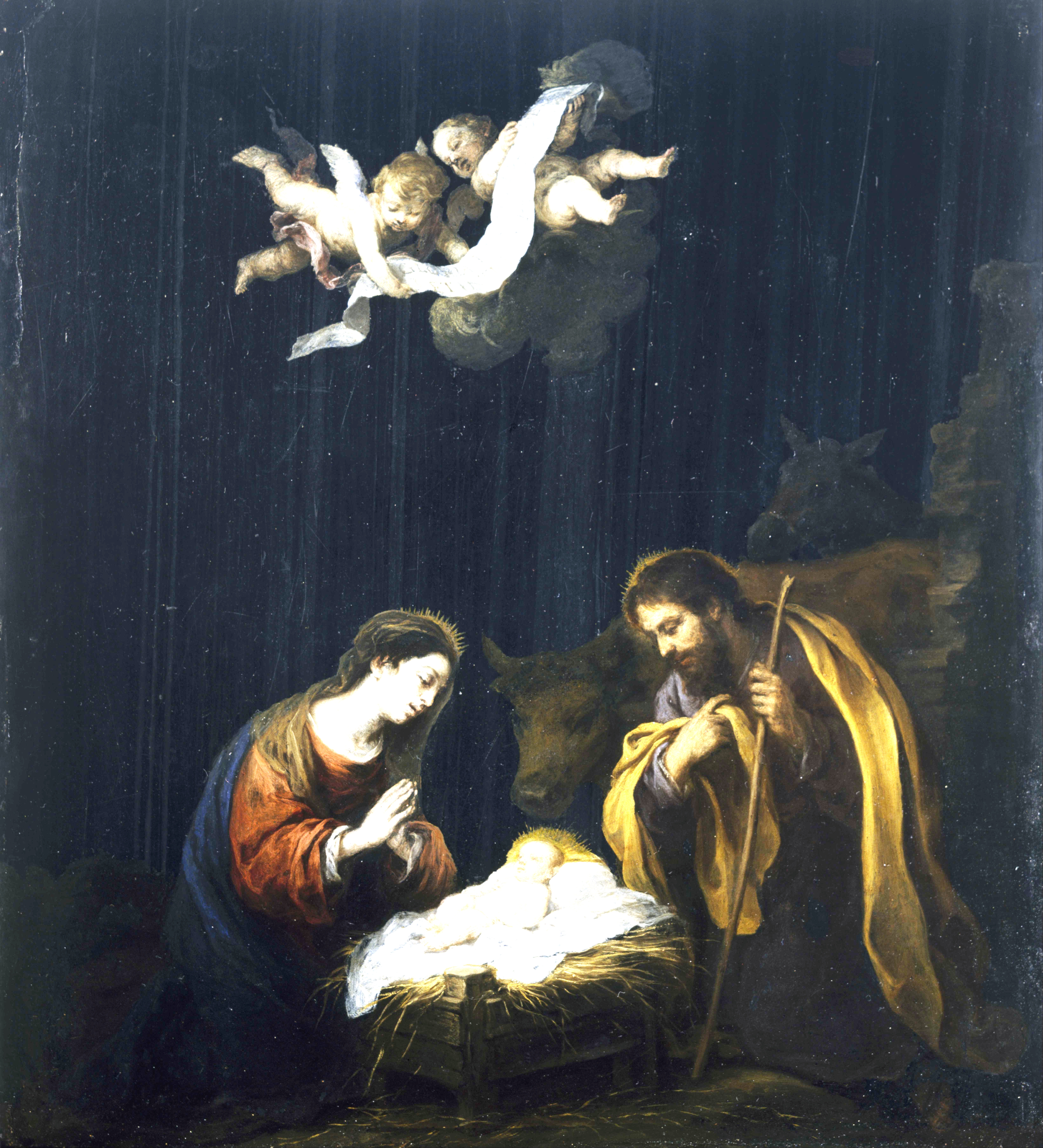
The Nativity, Bartolomé Estaban Murillo, (1617-1682)
The Nativity,
Bartolomé Estaban Murillo, (1617-1682)


This is one of my favorite paintings of the birth of Jesus.  There is just something about the expressions on Mary and Josephs faces as they look at the new small being in their life that draws me in.  I once saw the original in the Boston Museum of Art and this tiny painting on black slate captivated me as no others have.

However, I must admit that despite loving this painting, I don’t see the nativity as an actual historical event.  It has been a long time since I believed in the virgin birth. I am a scientist by training and I know that while ‘virgin’ births do happen in nature, it’s called parthenogenesis, they only occur in certain species of worms and small crustaceans called daphnids.   So this event was a no go for me not long after my first serious biology class. But the importance of the birth story is not in history, it is in the symbolism of new life breaking into the world in the form of God within the person of Jesus of Nazareth.  New life, not of a baby’s, rather a new life lived in a world where all achieve their God given potential. Living in the world as Jesus did, with limitless love and compassion, offering justice and mercy to those who are in need, and offering a peace that fills the soul. Well then again maybe it is like the birth of a baby, for we all experience new insights as new birth within us.

So why I may not believe Jesus was born in an actual stable I do believe he was been born in the stables, and dark corners of our minds, societies, and cultures.  Jesus is the one who birthed new life in those dark recesses of our hearts and minds.  Who lit up the alley ways where suffering, pain, and violence reside bringing the light of love to those who were the unlovable.  In prayer and action we, you and I, continue to carry that light.  We take it to prisons, hospitals, hospice rooms, to the homeless, to the hungry, to anyone in need of the light provided by “The Way.”  At least we are supposed to.

Today I ask you to use the above painting for your Prayerful Tuesday Meditation using Visio Divina.

Visio Divina

  1. Look at the painting slowly, taking a first glance and noting the colors, people, places and things.  Remain with the image for one to two minutes. If you would like, jot down a few words about the image.
  2. Take a second, deeper, look. Where is there movement? What relationships do you see? Engage your imagination. Where are you in the artwork? What do you see from that perspective? What deeper meaning emerges? What moves you in this painting? Does it draw you in or call to you in any particular way?
  3.  Respond to the image with prayer. Did the image remind you of an experience, person or issue for which you’d like to offer thanksgiving or intercession? Offer that prayer to God.
  4. Find your quiet center. Breathe deeply. Relax your shoulders, arms and legs. Rest in this quiet. Let God pray in you. God prays beyond words.

May you be blessed with the birthing of new life within you.  Merry Christmas everyone.

Ruth Jewell, ©December 23, 2014

What would you do? – Prayerful Tuesday

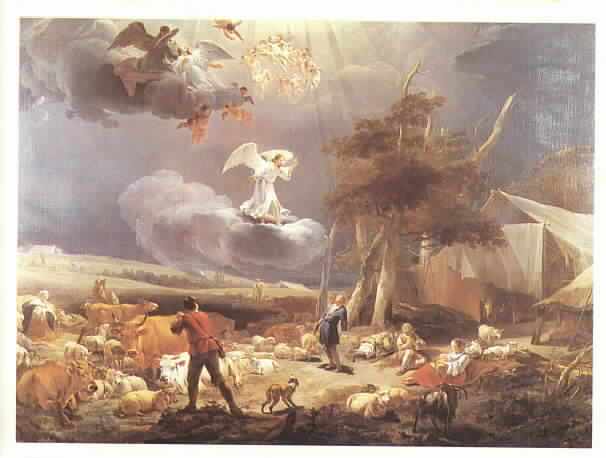
  13And suddenly there was with the angel
a multitude of the heavenly host,* praising God and saying,
14 ‘Glory to God in the highest heaven,
and on earth peace among those whom he favours!’*

Luke 2:13-14

Nicolaes Berchem, Annunciation to the Shepherds, 1656

God speaks to us in many ways–through relationships, our experiences, sacred texts such as the Bible and many more. Like Lectio Divina is Latin for divine reading, Visio Divina is Latin for divine seeing, praying with images to listen to God’s words. Think of Visio Divina as if you were putting on God-glasses to see how an image illuminates the Christ within you.  Like Lectio Divina, Latin for divine reading, Visio Divina has four steps: Use the  above painting by a Dutch artist Nicolaes Berchem painted around 1650, titled Annunciation to the Shepherds.

  1. Look slowly and carefully at the painting, taking a first glance noting the colors, people, places and things.  Remain with the image for one to two minutes. We are preparing for the celebration of the birth of the Christ Child, how does the paint help you prepare? If you would like, jot down a few words about the image in your journal.
  2. Now take deeper second look. Where is there movement? What relationships do you see? Engage your imagination. Place yourself in the painting; are you a shepherd, a sheep, or angel? What do you see from that perspective? What emotions rise up for you? If you were a sheep what might you feel? If you were a shepherd how would you respond to the message of the angels? What else do you feel, or see in the painting? If you would like jot down your thoughts and feelings in your journal
  3.  Respond to the image with prayer. Did the image remind you of an experience, person or issue for which you’d like to offer thanksgiving or intercession? Offer that prayer to God.
  4. Find your quiet center. Breathe deeply. Relax your shoulders, arms and legs. Rest in this quiet. Let God pray in you. God prays beyond words.

May the song of the angels be with you as you go about your preparations for Christmas.

Ruth Jewell, ©December 9, 2014