Thank You – Prayerful Tuesday

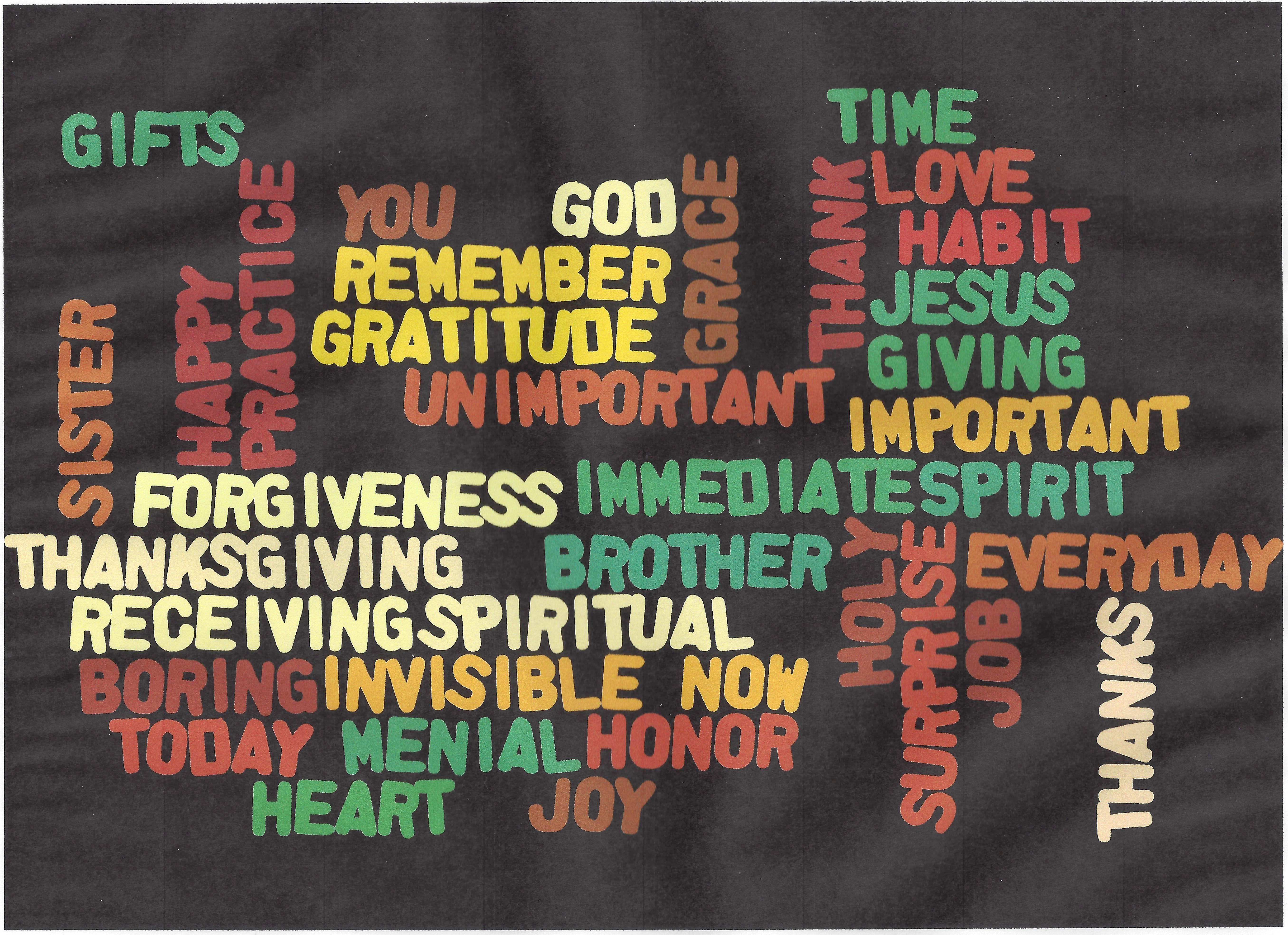
Wordle gratitude

32 Let the afflicted see it and be glad!
You who seek God—
let your hearts beat strong again
— Psalm 69: 32 (CEB)

30 But I will give great thanks to the Lord with my mouth;
among a great crowd I will praise God! 
— Psalm 109:30 (CEB)

This past January John and I visited Boston to celebrate his and our youngest grandson’s birthdays , which fall on the same day.  And, yes I know January is not the ideal time to visit historic Boston and yes we had snow.   However, we just couldn’t miss this celebration of joint Birthdays.

Because the weather was anything but comfortable we all decided to visit the Boston Science Museum and spend the day where it was warm, dry and had lots of exciting things to do and see.  The 2 grandchildren had a great time exploring the human body, looking at dinosaurs and exploring all kinds of interactive exhibits.  For lunch we chose to take our packed lunch to the large busy café and supplement all of our goodies with a few treats.

After making our selections and paying for them I went to get the necessary napkins, forks, spoons and straws needed to eat our lunch.  As I was picking up my things there was a young man restocking the bins as we took things out.  It looked like such an endless job and more than a little boring but he was doing an excellent job of keeping up.   Before I left I turned to him and said “thank you for keeping this area stocked, I’m sure it’s not an easy task.”  Startled he turned and gave me a gruff “thank you.”

After we had finished our lunch and were preparing to leave the area the same young man pushed his way through the crowded exit area and called to me, “Miss, I just wanted to tell you how much I appreciate your thanks.  No one has ever spoken to me that way before and I was afraid I might have offended you so I wanted to make sure you knew how happy I was.”

First of all, I really liked being called miss, no one has called me that in a very long time so he won me over just with that one word.  Well I was happy to bring a little joy into his otherwise boring day with just a few words of thanks from me.  But, what saddened me was his statement NO ONE HAD EVER COMPLIMENTED HIM for doing his job well!  No one ever said thank you! That is one of the saddest things I have ever heard.  It took me all of 2 seconds to express my thanks to the young man and those 2 seconds made his day.  For 2 seconds he wasn’t invisible and unimportant.  No he had been seen, he was important enough for someone to say thank you.  As we were separated by the ever shifting crowd he waved and gives me the biggest, toothiest grin I have ever seen.

Two seconds out of my day added joy to someone else’s.  Gratitude isn’t an emotion or attitude we are to keep to ourselves, no, gratitude is to be given away freely at every opportune moment, even when you yourself are not grateful.  We hear so often we are to be grateful for what God has given us, to express gratitude by thanking God.  Well being grateful for God’s grace comes in many forms.  It was a grace of God that a young man did his boring job well, it was a grace of God that allowed me to see the face of God in the young man and his courage to continue performing a rather menial task even when no noticed how well he did it.  Gratitude for the grace of God comes in many forms, big and small, all are important in the eyes of God.

The Psalms tell us to seek God’s face and to offer our thanks for God’s gifts.  Each one of us is a gift, each one of us has a gift to give, each one of us is the reflection of God, and each one of us carries God within.  So doesn’t it make sense to give thanks to those who reflect the grace of God?

Over the next week begin the habit of saying thank you for the little graces of God.  Offer thanks to the bus driver as you exit, say thank you to the young woman who hands you your morning coffee or say thank you to the washroom attended and see the smiles grow around you.  Offering thanks is an easy spiritual practice and one that brings great joy to the receiver and the giver alike and it is free to give.  It costs you no more than 2 to 5 seconds of your day, surly we can spend 5 seconds to bring hours of joy to someone who feels they are invisible to the rest of the world. Surly we can learn to do that every day, for every person we meet.

Thank you for reading my blog post.  Your presence on my site has made my day and I am grateful for your interest.

Ruth Jewell, ©February 25, 2014

Re-Membering our God Connection, Prayerful Tuesday

Lighting our Fire reconnecting with God
Lighting our Fire
reconnecting with God

For the Celtic Christian their religious life and their everyday life were tightly bound together.  They filled their days with prayer beginning with prayers of thanksgiving for waking up and continuing on to making the fire and milking the cow, all the way to prayers of thanks for the day as they went to their rest.  Today we call their life style of acknowledging the Presence of the Divine the Spiritual Practice of Presence.  This is probably one of the easiest of the spiritual practices because all you have to do is remember to pause when you begin and end a task and pay attention to your surroundings, letting your thoughts travel to God, breathing in grace and breathing out gratitude.  The whole exercise may take no longer than one minute to re-member yourself to the Holy Spirit.

Here are a few examples of when you might mentally pause and turn your thoughts to God.

  1. Before you even rise from your night’s sleep, thank God for a restful night and a new day to be in the presence of the Holy.
  2. As you walk into your place of business, offer a prayer for the people you will meet and work with, asking God for patience and kindness when interact with others.
  3. As you prepare breakfast give thanks for the abundance God has graced you with and offer gratitude for the opportunity to share it with your family or friends.
  4. During your day occasionally pause, breathe deeply and extend gratitude toward God
  5. Before you go to sleep offer a prayer of thanks for a day spent with the Spirit and if there are difficulties during the day (I mean who doesn’t have those rough spots) ask for guidance for the coming day.

Those are just a few of the times you might briefly stop and re-member your place alongside the creator.  I am sure you could name many more.

One of the early prayers of the Celtic people was offered as they laid the morning fire to begin the day and the one below is one of my favorites for it has a double meaning.  It prays not just for lighting the homes hearth, but also the lighting of the hearts’ fire.  Today this is my prayer for each and everyone one of you.

Kindling the Morning Fire

This morning, as I kindle the fire upon my
hearth, I pray that the flame of God’s
love may burn in my heart, and the
heart of all I meet today.

I pray that no envy and malice, no hatred,
or fear, may smother the flame.

I pray that indifference and apathy,
contempt and pride, may no pour
like cold water on the fire.

Instead, may the spark of God’s love light
the love in my heart, that it may burn
brightly through the day.

And may I warm those that are lonely,
whose hearts are cold and lifeless,
so that all may know the comfort of God’s love.[1]

Ruth Jewell, ©February 18, 2014
http://www.aquietwalk.wordpress.com


[1] Van De Weyer, Robert, Celtic Prayers, a book of Celtic devotion, daily prayers and blessings, Abingdon Press, Nashville, TN, 1997, pg 26


To Offend the Pharisees – Prayerful Tuesday

Matthew 5;20 For I tell you, unless your righteousness exceeds that of the scribes and Pharisees, you will never enter the kingdom of heaven.

For some reason one of the major meanings of Matt 5: 20 keeps popping up on FaceBook, newspapers, lots of places.  I keep seeing cartoons and memes like these all over the place:

live like Jesus    Wm Wordsworth

Do you think someone is trying to tell us something.

To exceed righteousness of the Pharisees was to be the mirror for the light of God, which meant you don’t see the mirror only the light it reflects.  Living like Jesus is a spiritual practice.  Doing kind and loving acts for others is a spiritual practice.  We don’t have to be thanked for what we do, in fact it is best and most satisfying when such acts are not noticed by anyone other than the Divine.

I challenge each of you this week to do the random act of kindness for someone without letting them know it was you.  Or stop and give a sandwich to a homeless person on the street and simply walk away without thanks.  Give graciously of yourself without asking for anything in return.  Little things, such as smiling to a busy checkout clerk, can make someone’s world a better place to live in. Starting with little acts gives us the courage to do larger acts of justice and kindness. They are one step on the road to a life lived like Jesus.

I have only one request, PLEASE, let me know what you have done and how it made you feel.  I know that this sounds counterintuitive but it isn’t really.  What you are doing will be witnessing to others that they too can change the world, maybe not the whole world but someone’s world.  Think of it this way, if the Gospel writers hadn’t recorded what Jesus did we wouldn’t know how to live like Him. Pass on the gift so others can continue to move it forward.

Ruth Jewell, ©February 11, 2014-02-14


Intention as a Spiritual Practice – Prayerful Tuesday


Brokenbread

Matthew 5:13-20: (NRSV) 

 13You are the salt of the earth; but if salt has lost its taste, how can its saltiness be restored? It is no longer good for anything, but is thrown out and trampled underfoot.
   14You are the light of the world. A city built on a hill cannot be hid. 15No one after lighting a lamp puts it under the bushel basket, but on the lampstand, and it gives light to all in the house. 16In the same way, let your light shine before others, so that they may see your good works and give glory to your Father in heaven.
17Do not think that I have come to abolish the law or the prophets; I have come not to abolish but to fulfill. 18For truly I tell you, until heaven and earth pass away, not one letter, not one stroke of a letter, will pass from the law until all is accomplished.
   19Therefore, whoever breaks one of the least of these commandments, and teaches others to do the same, will be called least in the kingdom of heaven; but whoever does them and teaches them will be called great in the kingdom of heaven. 20For I tell you, unless your righteousness exceeds that of the scribes and Pharisees, you will never enter the kingdom of heaven.

I am preaching on Matthew 5:13-20 next Sunday, February 9th, and as I have read and re-read this scripture I have discovered Jesus is talking about a spiritual practice, the spiritual practice of intention.  Everything Jesus did was intentional. He started every day knowing he was going to do the will of the Father, his Father, his Abba.  In this portion of his Sermon on the Mount he is trying to teach all of us we must be intentional about our actions in the world.  It isn’t good enough to say we believe in justice and kindness, rather we are commanded to actually get up out of our chairs and actively walk with God as God continually creates our world and DO justice and kindness. So my spiritual practice for this week is “Intention as a Spiritual Practice.”

You are probably saying right now “well duh” everyone knows that.  If we all know that we are to do justice, kindness, and mercy then why don’t we?  It is because it is easy to say we are going stand up to injustice but it is much harder to actually get out there and get your hands dirty.  So I am going to give you a few suggestion that are simple everyday things you can do just to get you started and in the habit of living an intentional life.

In his book Everyday Spiritual Practice, Simple Pathways for Enriching Your Life Scott Alexander explains why a spiritual practices is different from a casual hobby, and “the answer is intentionality, regularity, and depth . . . what shapes your efforts into an everyday spiritual practice is your commitment to making the activity a regular and significant part of your life.”[1]
In addition an everyday practices doesn’t have to be complicated, take a great deal of time, or be physically or economically challenging, it just has to be done every day.

Alexander’s book offers many different activities from the very simple to the more difficult and I am going to suggest only a couple of the less difficult ones to get you started.  I also suggest you find Alexander’s book and read some of the practices if these do not appeal to you.

Everyday Spiritual Practice number 1 is probably the simplest of all to start but can be a hard one to carry out.  Every morning when you arise from sleep say the following:  “Today I will offer kindness to each person and creature I meet this day.”  Then follow through, no matter how frustrated you become during an event.  My suggestion is to repeat your intention several times during the day until the act of offering kindness becomes second nature to you.

Everyday Spiritual Practice number 2 involves caring for the world we live in.  Begin each day with the following state: “I will conserve energy by turning out the lights when I leave a room.” Or you might use recycling, bicycling and/or use city transportation instead of driving as your goal.  What you do is important but it doesn’t have to be difficult and if your way to care for the earth is to eat more foods from the lower end of the food chain instead of taking a bus to work, good for you.

Ok just one more to begin.  Everyday Spiritual Practice number 3 involves the relationships we have with others.  Repeat throughout your day: “I will treat those I live, work, and play with with the respect and kindness they deserve as family members, co-workers, friends, for all are my brothers and sisters of God.”

You might be saying these don’t feel very spiritual to me.  But, what I am saying is that to BE a spiritual being and the being God desires us to be is to approach everything we do, every moment, every day as if we were doing it for the one we call God because in reality we are.

Jesus tells us “as you do it for the least of these you do it for me.”  So when you offer a heartfelt word of thanks to the harried checkout clerk in Safeway you are behaving as Jesus would want you behave and who knows maybe, just maybe, that was Jesus and you didn’t know it.

You see the Spiritual Practice of Intention is basic to walking in the Way of Jesus. Whether you are preparing dinner for your family, taking a casserole to someone who is ill or grieving, or stopping to help a homeless person by offering them half of the sandwich you are carrying all of those are Spiritual Practices. When we place the love of the Divine in front row of the action we are doing a spiritual practice.  Jesus said “let your light shine before others” and how we do that is by gifting our light to those who are struggling in darkness.  Our light will not diminish by giving it away; it grows brighter because more people are shinning with its glow.

Ruth Jewell, © February 4, 2014


[1] Alexander, Scott W.(editor): Everyday Spiritual Practice, Simple Pathways for Enriching Your Life, Skinner House  Books, Boston, MA 1999 Pg. 5

From Strangers to Family

Vancouver BC, October 21, 2014

Ruth 1:16-17 (CEB)

16But Ruth said,

“Do not urge me to leave you,
to turn back from following you.
Wherever you go, I will go;
and wherever you stay, I will stay.
Your people will be my people,
and your God will be my God.
17Wherever you die, I will die,
and there I will be buried.
May the Lord do this to me
and more so,
if even death separates me from you!”

Just over 13 years ago these beautiful words from scripture were read at my wedding.  I have always loved the book of Ruth, and yes one reason is because I was named for her, but, primarily I love it because Ruth took her destiny into her own hands and made a place for herself among strangers.  Like the biblical Ruth my own life has been one of making my place in strange places and with strangers all around me.  My wedding was just one of the many steps along my journey to find the face of God.

Now I really don’t want this rambling to be about John and me rather I want to tell you the best part of my marriage, our grandchildren.  Ok, so they are John’s grandchildren not mine, but the youngest ones have known only me as Grammy Ruth and I love them and their parents as much as if they were my blood relations.  And, I have watched with great joy as the two older ones Granddaughter S and Grandson A grow into loving adults.

Recently John, me and our little Chihuahua Suzie spent a joyous week in Boston with John’s son M and daughter-in-law LB and the littlest grandchildren, Grandson L and Granddaughter A.  John’s birthday is January 17th and he shares it with L who turned 7 this year, so for the first time they decided to celebrate their birthdays together.  Watching L as he opened gifts, as he gently held our little dog Suzie, and talked excitedly about everything was a pleasure all its own.  Holding little A and reading a story to her, playing games, watching as she and her brother played, and squabbled, and listening to giggles, laughter and tears put me in a place of bliss that I can’t really describe to you.

I watched as M and LB did a ballet of sorts as they prepared breakfast and got the kids ready for school.  As I listened I realized just how much M and John sound alike and how much grandson L is growing into a young man so like his father and grandfather.  Granddaughter A has inherited her mother’s artistic talents which she combines with her father’s and Papa John’s determination to succeed and do it well.  Even though she is only 4½ she is determined to dance and draw her life in her own way.

I said my journey was to find the face of God and I do, in all of creation including people.  The most important Faces of God I see is when I look at John early in the morning just before rising, in the faces of M and LB when I spot them waiting for us to come from the plane.  I see God’s face in the sleeping, laughing, crying, and determined faces of Grandson L and Granddaughter A.  I hear God laugh and giggle when Granddaughter A dances and runs in play.  I hear God’s voice when I listen to LB and John talk in the kitchen doing clean up from dinner.  I hear God’s voice as Grandson L talks with so much certainty about how something works in his 7 year old world and see God at work as he figures out how to build a new structure of some sort.

This is the wedding gift that never stops giving. I have found a place here in the midst of strangers.  I have found people I love.  After much searching I have found where I belong.  I have been welcomed and accepted as family and been blessed with the love from John’s 3 sons and 4 grandchildren.  I have watched the two oldest grow into strong adults where a future of unknown adventures lies before them.  I have held in my arms Grandson L and Granddaughter A as newborns and offered my blessings and prayers for God to watch over them.

I have watched each of the grandchildren grow into people I want know.  All of them are young people who question everything and when no one can give them an answer they go in search for it.  Even if Grandson L and Granddaughter A might not believe in a Divine force, they know they have a Grammy who sees that Divine force whenever she looks into their eyes.  It is in the question of why does Grammy believes what she does that opens a door to their own journey of discovery of who they are and where they fit in.

My blessed babies, who are babies no longer, have begun their own journeys.  Someday they too will say “wherever you go, I will go; and wherever you stay, I will stay.”   That day lies long in the future but time passes quickly and before you know it they will be searching for what they believe.  My prayer for all four of the Grandchildren is they find what feeds their souls with love, compassion, mercy and a passion for justice.  I pray they build a life that gives more than it takes, a life open to the blessings of God whether they call Her God or not.

Ruth Jewell, ©January 25, 2014

Seeking God’s Face

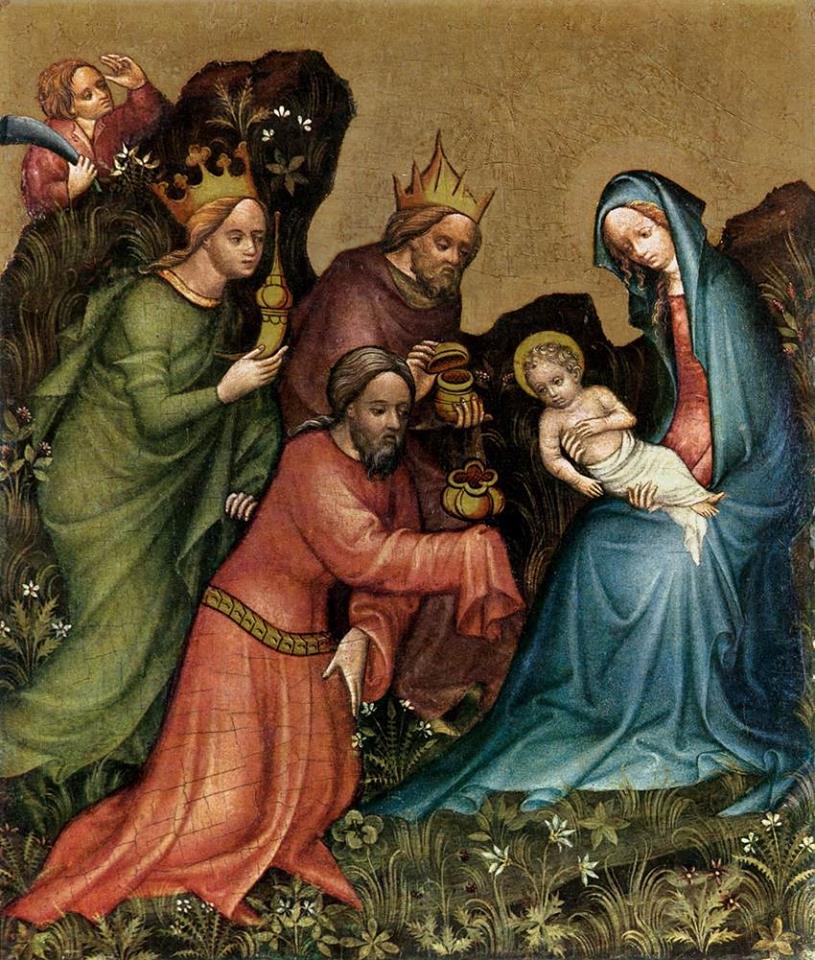
Master of Vienna, Adoration (1410), FB Page The Celtic Christian Tradition

Sermon – Epiphany Sunday
January 5, 2014
Queen Anne Christian Church Seattle, WA

Matthew 2:1-12 (Common English Bible [CEB])

Coming of the magi

1After Jesus was born in Bethlehem in the territory of Judea during the rule of King Herod, magi came from the east to Jerusalem. They asked, “Where is the newborn king of the Jews? We’ve seen his star in the east, and we’ve come to honor him.”

When King Herod heard this, he was troubled, and everyone in Jerusalem was troubled with him. He gathered all the chief priests and the legal experts and asked them where the Christ was to be born. They said, “In Bethlehem of Judea, for this is what the prophet wrote:

You, Bethlehem, land of Judah,
by no means are you least among the rulers of Judah,
because from you will come one who governs,
who will shepherd my people Israel.”

Then Herod secretly called for the magi and found out from them the time when the star had first appeared. He sent them to Bethlehem, saying, “Go and search carefully for the child. When you’ve found him, report to me so that I too may go and honor him.” When they heard the king, they went; and look, the star they had seen in the east went ahead of them until it stood over the place where the child was. 10 When they saw the star, they were filled with joy. 11 They entered the house and saw the child with Mary his mother. Falling to their knees, they honored him. Then they opened their treasure chests and presented him with gifts of gold, frankincense, and myrrh. 12 Because they were warned in a dream not to return to Herod, they went back to their own country by another route.

Greek derivation of Magi, (Strongs Hebrew, Chaldee, and Greek Dictionary)

3097. magos mag’-os  (of foreign origin (7248); a Magian, i.e. Oriental scientist; by implication, a magician:–sorcerer, wise man, [interpreter of dreams, prophet].   (plural, could refer to a male or female wise person)

The story of the Magi is such a familiar story. We have heard this story so many times before and I am sure all of us are able to repeat it without difficulty, at least the surface story.   I was confronted with this simple story, which is anything but simple, when I chose to meditate on it for Epiphany Sunday’s Sermon. Sitting in silence, letting the words of Matthew settle into my subconscious I realized there is so much more to this tale than I first believed. There are also way too many questions to address in a single sermon.  If you ever wanted to experience an abundance of graces just read this story carefully.   I could go into the fact that the gender and number of the Magi is never mentioned in the scripture and that the Magi were gentiles; or the Magi don’t visit the stable, they come to the home of Joseph and Mary; and because the story of the killing of the Bethlehem’s children that follows the Magi’s visit lead scholars to believe Jesus could have been as old as 2. And, that’s just few of the questions I found in these 12 verses of Matthew Chapter 2.  What did intrigue me, and what I will discuss, was never addressed by all of the learned theologians I perused. What I wanted to know was the reason these learned gentiles come in search of a child, a child born to a carpenter and his wife.  And, what unknown gifts still hides in this story for me, and all of us, beyond the pretty tale of rich strangers visiting a destitute baby?

First of my questions was what did the Magi expect to find when they arrived in Jerusalem.  Since they came to the city of the kings of Judea they must have expected to find the child born there, and to parents with more than a lineage to David. My guess is they had expected to find a somewhat wealthy family, or at least fairly well off.  After all they were looking for a King and you normally don’t find one living in the home of working class people. They must also have been confused and terribly disappointed that no one knew what they were talking about. I mean, the birth of a King is big news isn’t. Doesn’t everyone celebrate the birth of a King? It isn’t until King Herod calls them for an audience do they learn that the prophets foretell the birth of “the anointed one,” “the Christ,” was to happen in Bethlehem.  I have no doubt they left somewhat confused. But, eventually they find the baby living in the home with his mother and father. They even bring gifts, and while Mary might have preferred diapers, the gifts they gave were costly and fit for a King.  (By the way Bethlehem and the gifts are never mentioned again, why? Another question to confound me.)

They were seeking a child, an infant King, someone who would turn the Roman world upside down and I can only imagine their surprise at finding the child in such humble circumstances. They brought gifts Herod would have drooled over, gold, frankincense, myrrh.  Wonderful gifts but not really practical for the family they found, well the gold was probably most welcome.  But frankincense and myrrh those aren’t baby gifts.  Frankincense and myrrh were used to perfume oils and ointments for the purification of worship spaces and the anointing of the dead.

Now I know what Matthew was implying by the gifts: Gold was the symbol of Jesus’ kingship, frankincense the symbol for the priestly role Jesus would be called to live, and myrrh a foretaste of what he would endure at the end of his life.   But I think these gentile scholars brought something else and it has been bequeathed to us today and our children. The Magi brought the gift of “seeking God’s face.”

God has always welcomed us and longed for our inquisitive search for the face of the Divine, and She encourages us to reach for her Holy arms.  One of David’s Psalms says it well:

30 I will praise God’s name with song;
I will magnify him with thanks
31     because that is more pleasing to the Lord than an ox,
more pleasing than a young bull with full horns and hooves.
32 Let the afflicted see it and be glad!
You who seek God—
let your hearts beat strong again
— Psalm 69:30-32 (CEB)

And in the Book of Acts Paul tells the Athenians “27 God made the nations so they would seek him, perhaps even reach out to him and find him. In fact, God isn’t far away from any of us.” (Acts 17:27)  No God is never far away, we are.  And, seeking the face of God is one of the joys of creation we should do more often.

The Magi were the first to seek God’s face in its incarnated form, the face of a child.  For Matthew the Magi represent the mission Jesus gives his disciples to reach out to all peoples but especially gentiles, and those born within the great humble mass of humanity, in all its lovely diversity; poor and rich, young and old, all genders, all races, and all people.

For me the Magi represent the longing to see God in the face of my beloved, my grandchildren, best friend, and all creation.  I too want to see the incarnated God, I too long to see the ever present being in the first light of dawn, and I do see it in the face of my beloved when he first opens eyes in the morning.  The Magi have passed this longing down to us and I am grateful for the gift and grateful to pass it on to the next generation.

The Magi’s gift of presence to a child in a humble home was passed on to us through Jesus’ presence in his life, death and resurrection.  Now it is our mission to be present to the incarnated child born to humble parents.   To recognize and honor the incarnation born in each of us, through our gifts to the world whatever they may be; caring for each other, the environment, our nation, and our world.  It is up to us to be the Magi of today and visit the child in a humble home, to offer the gold of our love, to purify our mistakes with the frankincense of compassion; and to anoint those who pass on to the next world with the myrrh of God’s blessings and praise.   In a Judean desert David writes:

God! My God! It’s you—
I search for you!
My whole beingthirsts for you!
My body desires you
in a dry and tired land,
no water anywhere.
Yes, I’ve seen you in the sanctuary;
I’ve seen your power and glory.
My lips praise you
because your faithful love
is better than life itself!
So I will bless you as long as I’m alive;
I will lift up my hands in your name.
— Psalm 63:1-4 (CEB)

So too are we called to offer our praises to God, honor the child that lives today, in each one of us, and in all of creation.  Seek the face of God in all you meet, child, adult, male or female, and all of God’s marvelous creation.  Look in the eyes of your loved ones, your companion animals, see the face of God looking back.  Amen

Ruth Jewell, ©January 7, 2014


pray without ceasing – Prayerful Tuesday

Sunrise, Dec. 25, 2013


1 Thessalonians 5:12-18 (NRSV)  12But we appeal to you, brothers and sisters, to respect those who labor among you, and have charge of you in the Lord and admonish you; 13esteem them very highly in love because of their work. Be at peace among yourselves. 14 . . ., encourage the faint hearted, help the weak, be patient with all of them. 15See that none of you repays evil for evil, but always seek to do good to one another and to all.  16Rejoice always, 17pray without ceasing, 18give thanks in all circumstances; for this is the will of God in Christ Jesus for you. 

There is an ancient story in the Orthodox Christian Tradition concerning a Pilgrim who searches for a deep communion with God, for an understanding of prayer and the spiritual practice of “prayer without ceasing.”  In his travels and conversations with people of the church he discovers the writings of the Christian writers where he learns how to let his life be a witness to the teachings of Christ through unceasing prayer.   Using the words of the blind beggar Bartimaeus who calls out to Jesus “Jesus, Son of God, have mercy on me, a sinner,” and timing his breath and steps to the rhythm of the prayer the Pilgrim repeated the prayer without stop as he journeyed from place to place.  He found that even when he wasn’t literally speaking the prayer it was playing in the back of his mind and guided him in his actions towards all he me.

The prayer the Pilgrim used is called the “Jesus Prayer” and often used in a form of contemplative prayer called the Breath Prayer.  By repeating the Jesus Prayer in a daily prayer practice the mind learns to become still and your being centered in order for the still small word of G-d to be heard and the presence of G-d to be felt.  But the pilgrim wasn’t just praying a breath prayer; he was using an ancient form of prayer called chanting.

A chant is defined as a “short, simple series of syllables or words that are sung on/or intoned to the same note or a limited range of notes; A canticle or prayer is sung or intoned in this manner, or to sing or intone to a chant such as chant a prayer.  It is the repetitive speaking or singing a single tone, word, or phrase that the one praying uses to open the door into G-ds presence.  And, chanting has an eclectic past.  It is used by almost every religion in some form or other.  The far Eastern Tradition often uses a single tone, pronounced “ohm,” to draw their minds into stillness and into oneness with the universe.  Those in the Judaic faith repeat the Shema, “Hear, O Israel, the Lord is our God, the Lord is One. Blessed be the Name of His glorious kingdom forever and ever. And you shall love the Lord your God with all your heart and with all your soul and with all your might,” traditionally as they rise in the morning and as they go to bed at night.  But it is also used as a prayer chant.  Those in the Roman Catholic Faith have many chants which they use to draw their minds into stillness and their hearts into G-ds presence.  One type, Gregorian chants, were psalms set to music in which medieval Monks used for the same purpose, creating stillness.   I became interested in chanting many years ago when I heard my first Gregorian chant and found the cadence and sound of the notes lifted my heart into a new place that it had never been before.  I have been chanting ever since.

In the scripture quoted above from 1 Thessalonians Paul calls us to pray without ceasing.  When I was a teenager and heard those words my first thought was that is impossible.  After all, I have class work to do, problems to figure out, chores to do, people to talk to, games to play, work to do, you name it and  I could find a reason why such a task would be difficult. I’m betting you could add to this list, after all our lives are busy with living.  So how on earth can we pray constantly?  Well it has taken me a little while, Ok, OK, a long while, to figure that conundrum out.  I realized that Paul wasn’t asking us to give up our lives.  Rather he was calling us to center our lives in prayer.  For me chanting has been the way to accomplish that task.

Now you might be asking how chanting helps me pray unceasingly?  A while back I was laid off from my job and I was truly afraid of what could happen if I didn’t find another one.  Every evening, following a day of unsuccessful job searching, I took long walks with my dog and tried to come to grips with what was happening to me.  The problem was I was the only one talking.  In fact I realized I was talking so much that if G-d was there she was never going to get a word in edgewise.  One evening a friend invited me to a Taizé service and I rediscovered the peacefulness of singing chants in order to quiet my mind and offer the simple prayer of myself.

My Spiritual Practice of Chanting

So how does chanting help G-d enter, well the steps are pretty easy really. First of all there are really no hard and fast rules. You begin by identifying a word or phrase that draws your attention and has significance for you.  This is a trial and error processes so don’t worry if it doesn’t quite fit and you have to change it.  You will discover your chants will change over time as your needs change.

To begin a spiritual practice of prayer chanting set aside 15 to 20 minutes in your day and repeat your chant, rhythmically, timing it to your breath or your step as you walk.  You may chant out loud or you may do it silently it all depends on where you are and what is happening around you at any given moment.  The major thing is to practice it every day.  Learning a Spiritual practice means you must do it every day just as if you were learning to play an instrument or play a game, it takes commitment.

You have a wide choice of times to choose when to practice your chants.  You may set aside a quiet time as you would for any meditation or you may chant while preparing for you day in the morning or rest at night; waiting and riding public transit; doing dishes, laundry, or other housework.  The key is to do it every day. Gradually, just like the ancient Pilgrim, the prayer will begin to “play” in the background of you mind all the time, providing comfort and guidance in all your daily activities.

You may chant using whatever method you are most comfortable with such as a single tone, as those in the Far Eastern traditions do; a single spoken word or phrases, such as the Jesus Prayer; or, and this is my preferred way, a musical chant. Whatever you choose the process is pretty much the same. Musical chants are often short scriptures or spiritual phrases set to a simple tune that is easily remembered and sung.  Because I love music, even though I no longer am able to sing well, and I find musical chants the easiest for me to remember and repeat when I am praying.  I find that music triggers a sense of stillness the spoken word alone cannot do.

I mentioned my chants change from to time to time and it is because my relationship with G-d changes over time.  As my relationship deepens I become more comfortable with certain chants because they draw me deeper into the mystery that is G-d.  You will know when that happens and you will also simply know what chants deepen your experience with G-d and other don’t.  I have a number of different chants that I am particularly fond of that I use depending on where I am emotionally and spiritually that day.  Most often I use scripture passages that have been set to music but occasionally I will use a phrase that means something to me at that time in my chants.  Currently one of my favorites is based on Matthew 28:10, 20 “Do not be afraid, I am with you always.”   The music is written by Harpist Linda Larkin and the arraignment is by John P. Newell.  This chant reminds me I am not alone and I find comfort in it when I am confused and frustrated.  I also often use the Taizé chant Ubi Caritas (Live in Charity) written by Jacques Berthier of the founder of the Taizé community. Currently these are very meaningful for me but you may use whatever chant fits your current spiritual journey.

My prayer for you journey is you will find comfort in G-ds presence as you sing words of peace, prayer, love.

Resources

Since rediscovering chanting I have discovered the many modern sources for chants, which I find useful in my own search for unceasing prayer.  Some of my favorite resources are the “Iona Community” web site, http://iona.org.uk; the “Taizé Community” web site  http://www.taize.fr/en ; “John Bell & Wild Resource groups,” http://www.ionabooks.com/books/john-bell-wild-goose-resource-group.html ; and John Phillip Newell’s website “Heartbeat a Journey towards Earths Wellbeing,” http://heartbeatjourney.org .

I have included a YouTube© video of Do Not Be Afraid from the CD Chanting for Peace, Meditative Chants by Linda Larkin, (available on her website http://blog.santafeharps.com ).


Ruth Jewell ©December 31, 2013


Prayerful Tuesday – “I the God of Israel will not forsake them”


God moves in a mysterious way his wonders to perform; by Wm Cowper Picture by NASA
God moves in a mysterious way his wonders to perform        words by Wm Cowper
Picture by NASA

Isaiah 41:17-20
17
When the poor and needy seek water,
and there is none,
and their tongue is parched with thirst,
I the Lord will answer them,
I the God of Israel will not forsake them.

18I will open rivers on the bare heights,
and fountains in the midst of the valleys;
I will make the wilderness a pool of water,
and the dry land springs of water.

19I will put in the wilderness the cedar,
the acacia, the myrtle, and the olive;
I will set in the desert the cypress,
the plane and the pine together,

20so that all may see and know,
all may consider and understand,
that the hand of the Lord has done this,
the Holy One of Israel has created it. 

Advent, a time of waiting, a gestation time of new beginnings, I have heard those words many times over many Advents.  And, while all this waiting is important I have a confession to make, I hate waiting!  Yes, my impatience frequently gets me into trouble, with G-d and with those around me.  I begin before the preparation has been completed and my task, while not a total failure, does not live up to its potential.  Patience is not one of the gifts G-d has seen fit to give me. It is something I have been trying to learn for 66 years and I am still not very good at it.

I admit to being one of those thirsty people in the desert who wants to have water and I want now!  If I had been with the Israelites in the Sinai I would have marched right up to Moses and said “I’m thirsty, I need water and I need it now!”  And I am sure Moses would have looked at me with a jaundiced eye and said “get a grip; learn some patience for crying out loud.  You are out of Egypt so be grateful for what you have and quite complaining!”  Yep that would have been me hearing those words.   Yet in Isaiah we hear that G-d will provide water and more to those who are poor and in need and it is not lost on me that G-d came through with food and water during the Exodus.  So yes I do believe G-d, in Her own good Time and Way, will provide.

The key to this waiting is “in Her own good Time and Way” G-d will offer the drink and food we need and it’s always in that perfect moment.  The moment when we not only need it the most but the moment when we are open the widest for hearing G-d’s voice speak the Word we so desperately thirst and hunger for.

For the last two and half years I have been in my own time of Advent, walking in a wilderness of my own making as I waited for G-d to give me a Word I could respond to about where my ministry would take me.  And in that time there have been many impatient moments.  Many times I have tried to hurry G‑d.  I have tried to guess what She will speak and tried starting a task with no direction from Her.  It rarely works out because you cannot hurry G-d.  G-d will speak when the time is right, when my heart is open the widest to hear G-d speak and not before.

Through out this time G-d has been allowing a ministry to begin gestating within me.  To grow in concept piece by piece, step by step while at the same time letting G-d open me up to whom I am and who She is. I am learning that G‑d is my greatest counselor, friend, lover, supporter, confidant, comforter, and confessor.  All I have to do is live a life that puts G-d first, keep our relationship strong and allowing the counselor, friend, lover, supporter, confidant, comforter, and confessor work through me in a working partnership with Her.

It seems as if it would be easy to do what G-d asks of us doesn’t it?  But it is not.  Ask the Israelites how hard it was to follow the path G-d laid before them.  Ask the disciples how hard it was to walk the path Jesus laid before them.  Each one will tell you it is not easy.  Yes G-d will provide for the poor and needy but verse 41:20 of Isaiah says it best.  We are to “… see and know … consider and understand, that the hand of the Lord has done this, the Holy One of Israel has created it.” We fail hopelessly in that understanding.  All too often we take G-d’s handiwork for granted and do not see what the Lord does for us.  I, just like the rest of the human race, all too often think we are entitled to the abundance we see around us.  We forget just where and who it comes from, where and from whom we come from.  It has taken me a life time to understand in a small way the meaning of verse 20.  And, it has only been in the last year and half that I have worked hardest to be patient and to let G-d speak when She is ready and not me.

And now G-d is bringing me closer to an understanding of what my role as Her partner will be.  And, somehow I feel it is appropriate that G-d picked Advent for this to happen, the time for me to begin to feel the movement of a baby ministry within me.  I am excited and scared about bringing into reality this ministry of my very own.  It takes courage for me to step out and claim my role as G-d partner a courage I do not always have.  I have many fears; will I be worthy of G-ds trust, will I hurry this up and as a result rush to completion what needed time to grow, will I give up saying “sorry G-d this to hard for me,” will I simply not be enough for the task.  There are so many fears, so much excitement, and so many hopes.  The future I do not know, only G-d does, so I will keep waiting, and listening, and moving with G-d’s time and moments.  Patience is really hard but I continue to learn to lean into the open arms and let G-d teach me.

This Week’s Spiritual Practice

Do you have something waiting to emerge from you?  Waiting is hard (just ask any 4 year old) but it can be done. So this week I simply ask that each day you find yourself a quiet place and sit in silence for 5 to 20 minutes.  Listen for a Word from G-d.  It might be a Word about doing something, or it might be G-d whispering “I love you.”  Just remember whatever happens let it happen in G-d’s time not yours and be grateful for the time spent with G-d.

Ruth Jewell, ©December 10, 2013

Prayerful Tuesday – An Attitude of Gratitude

Psalm 100 (The Message)

A Thanksgiving Psalm

 1-2 On your feet now—applaud God!
Bring a gift of laughter,
sing yourselves into his presence.

Know this: God is God, and God, God.
He made us; we didn’t make him.
We’re his people, his well-tended sheep.

Enter with the password: “Thank you!”
Make yourselves at home, talking praise.
Thank him. Worship him.

For God is sheer beauty,
all-generous in love,
loyal always and ever.

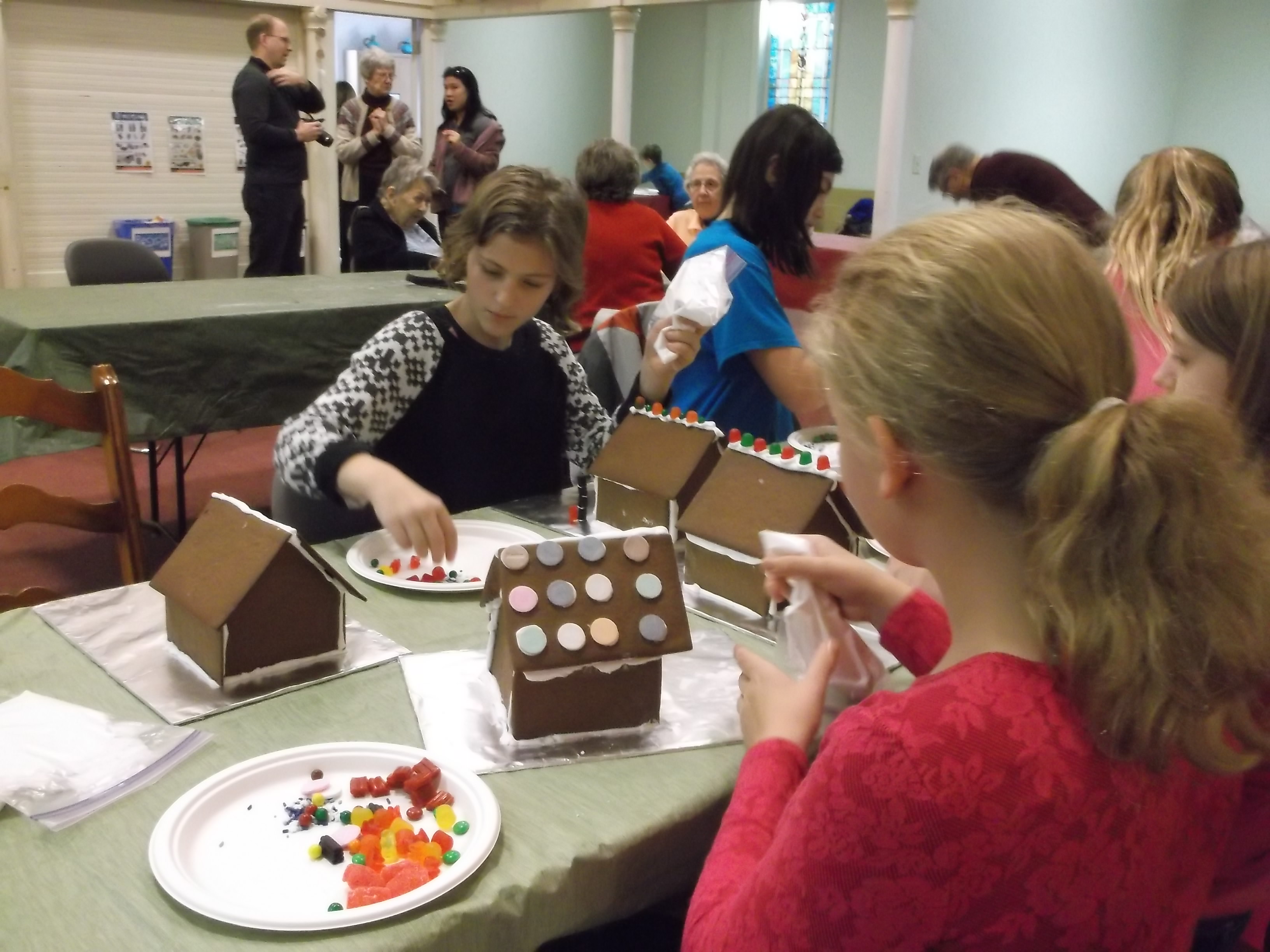
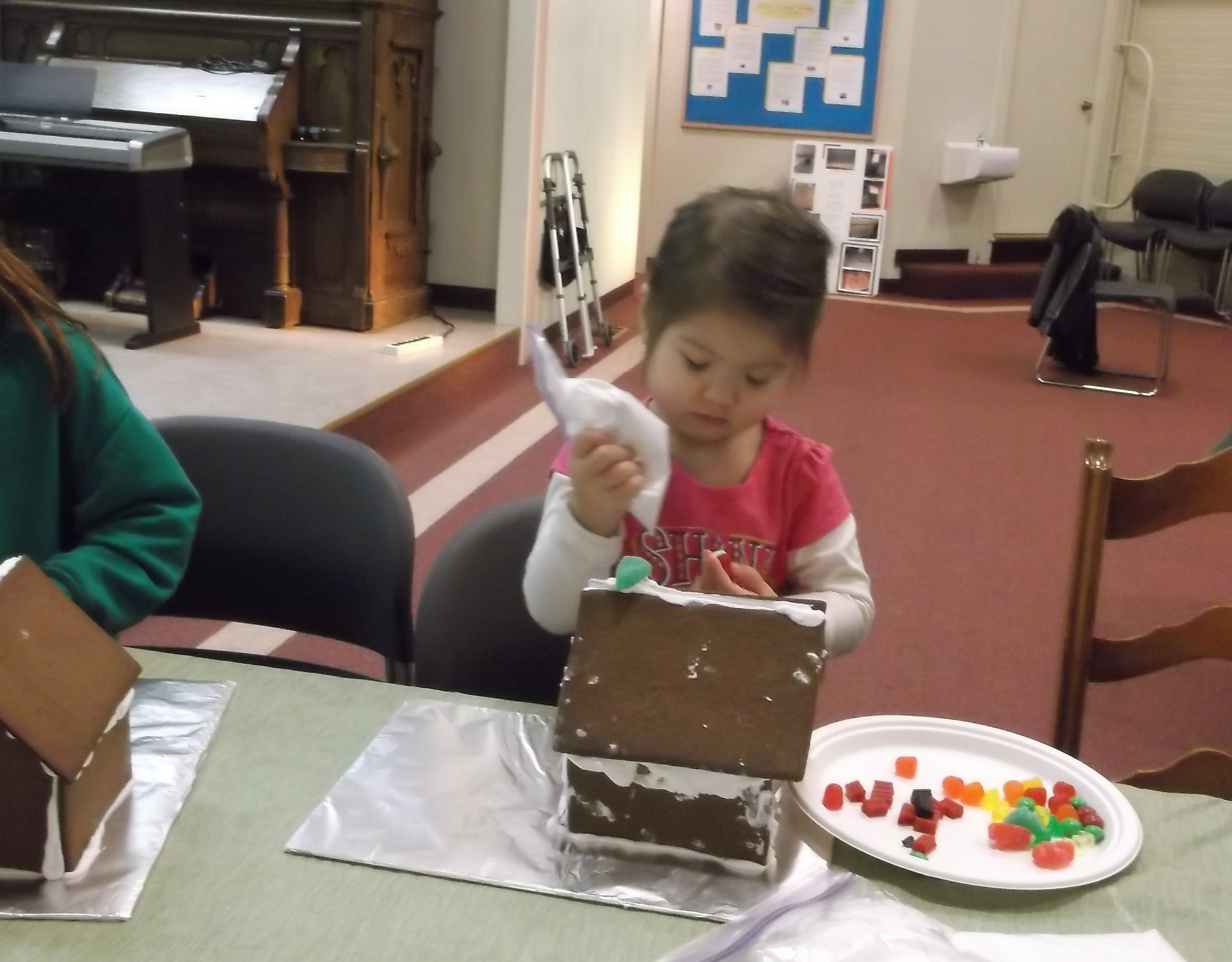
This past Sunday at Queen Anne Christian Church, we celebrated in song, word, prayer Thanksgiving.  We also decorated the church for Advent, which starts next Sunday.  And we have a new and tasty tradition at Queen Anne; the kids decorate gingerbread houses, while the parents enviously look on.  Cherry S is a baker first class and she makes the gingerbread, puts together the houses, parents bring the candy for decorating and then we turn our budding artists loose.  I must say they have a great time and the houses look wonderful.

DSCF0860 DSCF0864 Morgan

As I sat and watched the kids, took video and a few pictures I couldn’t help but think about the worship service.  The Scripture was Psalm 100 and Pastor Laurie’s reading from The Message gave me much to think about.  First of all Psalm 100 was my father’s favorite and it was read, from the King James Version (KJV), at the beginning of every Thanksgiving meal in our house.  But when I heard Pastor Laurie’s reading I was struck by the joy and celebration that resides in this Psalm that I hadn’t heard before.  I felt the celebration inherent in this Psalm. However the words in Verse 4 jolted me upright.  “4 Enter with the password: “Thank You!” Make yourselves at home, talking praise, Thank him. Worship him.”  I thought what you have to have a password to enter G-ds presence, is not my gratitude and thanks enough, now I have to know a password.  Well it is a simple password, and one I learned to use when I was a child.  Still I have to say “thank you” to enter into G-d’s home!  Why would G-d want my gratitude?

What does it mean to acknowledge your gratitude, out loud, and/or in writing? Well the expression is a witnessed event; people hear or read of your gratitude.  They learn you are capable of good will by acknowledging the works of others.  They in turn are blessed with your gratitude and that encourages them to also wish to express their thanks for their blessings.  One person expresses thanksgiving for a small act of kindness, and the recipient, or someone who observes it is then empowered to offer their thanks to someone else and the boundary of the circle of kindness extends into infinity.

You might think saying thank you for a job well done, or a gift, does little to help you or anyone else, but you’d be wrong.  Remembering your blessings grows an “attitude of gratitude” within all that you do throughout your life.  In the late 1940’s Bing Crosby sang a simple song in the move “White Christmas,” Count Your Blessings Instead of Sheep, and for many years it was a popular tune.  The premise is an easy one to remember, counting your blessings is more productive than counting all the wrongs you’ve received.  In fact once you begin counting you discover that the hurts and wrongs far fewer than blessings.

For me I have all too often let anger and resentment cloud my vision preventing me from counting my blessings and that has resulted in some very unpleasant times in my life.  One of the spiritual practices I have been doing on my life journey is to change that pattern of behavior.  Now every morning I offer a gratitude to the Divine Spirit before I even get out of bed to start my busy day.  And every evening I end my day with a review of the blessings I received during the day.  It has made my life much more joyful and I am now more likely to see the face of the Divine in all that I do.  So I have two questions for you to ponder this week:

1. What gets in your way of expressing gratitude?  And . . .
2. Have you counted your blessings lately?

It is a joyful practice to count your blessings and say thank you.  It is not really a password; it’s a way of life, to live in gratitude for the blessings we receive day in and day out, offering our lives as a blessing to those around us.  Can you imagine the kind of world we’d live if everyone just counted their blessings?

So my gratitude for this Tuesday Morning is that I am grateful for the ability to write to each of you, I am grateful for the blessings I’ve received from my loving husband and family.  I am grateful for the comforting presence of my companion animals, the fur kids Fred and Suzie, and the feathered kids Cuddles and George. And I am simply grateful for my life, for being alive today, at this moment.  May all of you remember all of your blessings this week.

 Happy Thanksgiving everyone!

Ruth Jewell, ©November 25, 2013

Prayerfull Tuesday, November 19, 2013

Suzie
Suzie

Prayer

Yesterday seemed like a perfect day to read poetry.  The rain was coming down, the wind was blowing, Suzie was snuggled in my lap so I opened up two of my favorite books of poetry, Thirst by Mary Oliver,[1] and a book of Celtic prayers collected by Alexander Carmichael titled New Moon of the Seasons, Prayers from the Highlands and Islands.[2] A poem of Mary Oliver’s and a prayer collected by Alexander Carmichael struck me as I read them.  The first was a Celtic Prayer:

The Three
The Three who are over me,
The Three Who are below me,
The Three Who are above me here,
The Three Who are above me yonder;
The Three Who are in the earth,
The Three Who are in the air,
The Three Who are in the heaven,
The Three Who are in the great pouring sea

The Celtic people lived close to land and they cherished it as a gift from G-d. They saw the creator in every plant and animal and rock. They saw the grace of G-d in rain and snow, the roar of the sea and in the breath of spring air.  This simple prayer is an acknowledgment that G-d, Christ, and the Holy Spirit surround them.  G-d wasn’t “out there” looking down at them, no G-d was surrounded them in grace and blessings of many shapes and colors.  As I watch the rain fall outside my window and feel Suzie’s warm breathing in my lap I understood what this prayer of gratitude meant to fisherman, a farmer, a mother tending the hearth.  G-d is here, now, with me, with you, with us all.  For the Celts and for us today G-d lives beside and within each of us.

Mary Oliver’s poem Praying is a lovely companion to the Celtic prayer.  Praying reminds us that prayer doesn’t have to be framed with elaborate words.  Prays really happen in those moments when your mind has no words so your heart speaks.  Some of the greatest prayers are never written down; simple words of gratitude for the healing of a friend, or gasp of awe at the beauty of a sunrise, or joy of a laughing child are beloved prayers of the heart.  Here is;

 Praying
by Mary Oliver

It doesn’t have to be
the blue iris, it could be
weeds in a vacant lot, or a few
small stones; just pay attention, then patch

a few words together and don’t try
to make them elaborate, this isn’t
a contest but the doorway

into thanks, and a silence in which
another voice may speak.

I invite you to read the Celtic prayer, and Mary Oliver’s poem.  Look around you; do you see the work of G-d, Christ, and Holy Spirit in the everyday living of your life?   Where does your heart speak when your mind has no words?  Let the simple words of gratitude, sorrow, or joy shaped in your heart form the bases for a prayer that speaks to the Divine that walks beside you.  May the all surrounding presence of The Three be your comforter in times of crises and dance with them when joy rings in heart.

Ruth Jewell, ©November 19, 2013


[1] Mary Oliver; Thirst, Beacon Press, Boston, MA, 2006, pg 37

[2] Alexander Carmichael; New Moon of the Seasons, Prayers from the Highlands and Islands, Floris Books, Edinburgh, Scotland, Great Britain, 1986, pg 74