“. . . too often we resist the urge to turn our hearts to God, for this might entail some serious and inconvenient changes in our lives.” Jamal Rahman, Out of Darkness into Light
This past week has been interesting. You see I am coming to a place where I have to let go of some goals and turn my resulting life, that will be, over to God. Now I am a stubborn person, and I LIKE being in control of my journey, but, I am discovering I control nothing. Nothing in my life is predictable, except when I surrender my will to God.
The above words of Jamal Rahman really hit home for me, because surrendering to God does mean my life changes dramatically. The number one in my life can no longer be me, but God. It means everything I do take’s on a sacred attribute because I’m not doing it for myself; I am doing nothing, because you see everything is for and through God.
When I give up and let go of the reins I am clutching in my white knuckled hand my life focus changes from “it’s all about me” to it is all about what God wants of me; doing justice, loving kindness, and walking humbly with God (Micah 6:8). While Micah’s words sound simple they are not easy and I am consciously, continually, moving into them bit by painful bit.
One of my first steps in surrendering to God began with (or I should say begins with) a practice of examining the unease I have with my life and then holding it to as I find the root cause. I allow myself to kind to me as I acknowledge and hold the energy the cause has over me, offering it up in prayer for God’s mercy and forgiveness.
So I offer Surrender as our spiritual practice of the week. When you feel something is wrong in your life do not ignore or deny it. Instead sit quietly and hold the feeling in your heart, listen to it and search from where it comes. Then as you hold the feelings in your heart pray to God for strength and mercy, asking for God to walk with you as you go deeper into the feeling and surrender the cause to God in prayer. Over time as you repeat this practice you may discover your connection and relationship with God growing ever stronger.
Surrender may be difficult but not impossible when you remember the words of Jesus who said “do not be afraid, for I am with you always.” (Matthew 28:10).
1 Thessalonians 5:12-18 (NRSV) 12But we appeal to you, brothers and sisters, to respect those who labor among you, and have charge of you in the Lord and admonish you; 13esteem them very highly in love because of their work. Be at peace among yourselves. 14 . . ., encourage the faint hearted, help the weak, be patient with all of them. 15See that none of you repays evil for evil, but always seek to do good to one another and to all. 16Rejoice always, 17pray without ceasing, 18give thanks in all circumstances; for this is the will of God in Christ Jesus for you.
There is an ancient story in the Orthodox Christian Tradition concerning a Pilgrim who searches for a deep communion with God, for an understanding of prayer and the spiritual practice of “prayer without ceasing.” In his travels and conversations with people of the church he discovers the writings of the Christian writers where he learns how to let his life be a witness to the teachings of Christ through unceasing prayer. Using the words of the blind beggar Bartimaeus who calls out to Jesus “Jesus, Son of God, have mercy on me, a sinner,” and timing his breath and steps to the rhythm of the prayer the Pilgrim repeated the prayer without stop as he journeyed from place to place. He found that even when he wasn’t literally speaking the prayer it was playing in the back of his mind and guided him in his actions towards all he me.
The prayer the Pilgrim used is called the “Jesus Prayer” and often used in a form of contemplative prayer called the Breath Prayer. By repeating the Jesus Prayer in a daily prayer practice the mind learns to become still and your being centered in order for the still small word of G-d to be heard and the presence of G-d to be felt. But the pilgrim wasn’t just praying a breath prayer; he was using an ancient form of prayer called chanting.
A chant is defined as a “short, simple series of syllables or words that are sung on/or intoned to the same note or a limited range of notes; A canticle or prayer is sung or intoned in this manner, or to sing or intone to a chant such as chant a prayer. It is the repetitive speaking or singing a single tone, word, or phrase that the one praying uses to open the door into G-ds presence. And, chanting has an eclectic past. It is used by almost every religion in some form or other. The far Eastern Tradition often uses a single tone, pronounced “ohm,” to draw their minds into stillness and into oneness with the universe. Those in the Judaic faith repeat the Shema, “Hear, O Israel, the Lord is our God, the Lord is One. Blessed be the Name of His glorious kingdom forever and ever. And you shall love the Lord your God with all your heart and with all your soul and with all your might,” traditionally as they rise in the morning and as they go to bed at night. But it is also used as a prayer chant. Those in the Roman Catholic Faith have many chants which they use to draw their minds into stillness and their hearts into G-ds presence. One type, Gregorian chants, were psalms set to music in which medieval Monks used for the same purpose, creating stillness. I became interested in chanting many years ago when I heard my first Gregorian chant and found the cadence and sound of the notes lifted my heart into a new place that it had never been before. I have been chanting ever since.
In the scripture quoted above from 1 Thessalonians Paul calls us to pray without ceasing. When I was a teenager and heard those words my first thought was that is impossible. After all, I have class work to do, problems to figure out, chores to do, people to talk to, games to play, work to do, you name it and I could find a reason why such a task would be difficult. I’m betting you could add to this list, after all our lives are busy with living. So how on earth can we pray constantly? Well it has taken me a little while, Ok, OK, a long while, to figure that conundrum out. I realized that Paul wasn’t asking us to give up our lives. Rather he was calling us to center our lives in prayer. For me chanting has been the way to accomplish that task.
Now you might be asking how chanting helps me pray unceasingly? A while back I was laid off from my job and I was truly afraid of what could happen if I didn’t find another one. Every evening, following a day of unsuccessful job searching, I took long walks with my dog and tried to come to grips with what was happening to me. The problem was I was the only one talking. In fact I realized I was talking so much that if G-d was there she was never going to get a word in edgewise. One evening a friend invited me to a Taizé service and I rediscovered the peacefulness of singing chants in order to quiet my mind and offer the simple prayer of myself.
My Spiritual Practice of Chanting
So how does chanting help G-d enter, well the steps are pretty easy really. First of all there are really no hard and fast rules. You begin by identifying a word or phrase that draws your attention and has significance for you. This is a trial and error processes so don’t worry if it doesn’t quite fit and you have to change it. You will discover your chants will change over time as your needs change.
To begin a spiritual practice of prayer chanting set aside 15 to 20 minutes in your day and repeat your chant, rhythmically, timing it to your breath or your step as you walk. You may chant out loud or you may do it silently it all depends on where you are and what is happening around you at any given moment. The major thing is to practice it every day. Learning a Spiritual practice means you must do it every day just as if you were learning to play an instrument or play a game, it takes commitment.
You have a wide choice of times to choose when to practice your chants. You may set aside a quiet time as you would for any meditation or you may chant while preparing for you day in the morning or rest at night; waiting and riding public transit; doing dishes, laundry, or other housework. The key is to do it every day. Gradually, just like the ancient Pilgrim, the prayer will begin to “play” in the background of you mind all the time, providing comfort and guidance in all your daily activities.
You may chant using whatever method you are most comfortable with such as a single tone, as those in the Far Eastern traditions do; a single spoken word or phrases, such as the Jesus Prayer; or, and this is my preferred way, a musical chant. Whatever you choose the process is pretty much the same. Musical chants are often short scriptures or spiritual phrases set to a simple tune that is easily remembered and sung. Because I love music, even though I no longer am able to sing well, and I find musical chants the easiest for me to remember and repeat when I am praying. I find that music triggers a sense of stillness the spoken word alone cannot do.
I mentioned my chants change from to time to time and it is because my relationship with G-d changes over time. As my relationship deepens I become more comfortable with certain chants because they draw me deeper into the mystery that is G-d. You will know when that happens and you will also simply know what chants deepen your experience with G-d and other don’t. I have a number of different chants that I am particularly fond of that I use depending on where I am emotionally and spiritually that day. Most often I use scripture passages that have been set to music but occasionally I will use a phrase that means something to me at that time in my chants. Currently one of my favorites is based on Matthew 28:10, 20 “Do not be afraid, I am with you always.” The music is written by Harpist Linda Larkin and the arraignment is by John P. Newell. This chant reminds me I am not alone and I find comfort in it when I am confused and frustrated. I also often use the Taizé chant Ubi Caritas (Live in Charity) written by Jacques Berthier of the founder of the Taizé community. Currently these are very meaningful for me but you may use whatever chant fits your current spiritual journey.
My prayer for you journey is you will find comfort in G-ds presence as you sing words of peace, prayer, love.
God moves in a mysterious way his wonders to perform words by Wm Cowper Picture by NASA
Isaiah 41:17-20
17When the poor and needy seek water,
and there is none,
and their tongue is parched with thirst,
I the Lord will answer them,
I the God of Israel will not forsake them.
18I will open rivers on the bare heights,
and fountains in the midst of the valleys;
I will make the wilderness a pool of water,
and the dry land springs of water.
19I will put in the wilderness the cedar,
the acacia, the myrtle, and the olive;
I will set in the desert the cypress,
the plane and the pine together,
20so that all may see and know,
all may consider and understand,
that the hand of the Lord has done this,
the Holy One of Israel has created it.
Advent, a time of waiting, a gestation time of new beginnings, I have heard those words many times over many Advents. And, while all this waiting is important I have a confession to make, I hate waiting! Yes, my impatience frequently gets me into trouble, with G-d and with those around me. I begin before the preparation has been completed and my task, while not a total failure, does not live up to its potential. Patience is not one of the gifts G-d has seen fit to give me. It is something I have been trying to learn for 66 years and I am still not very good at it.
I admit to being one of those thirsty people in the desert who wants to have water and I want now! If I had been with the Israelites in the Sinai I would have marched right up to Moses and said “I’m thirsty, I need water and I need it now!” And I am sure Moses would have looked at me with a jaundiced eye and said “get a grip; learn some patience for crying out loud. You are out of Egypt so be grateful for what you have and quite complaining!” Yep that would have been me hearing those words. Yet in Isaiah we hear that G-d will provide water and more to those who are poor and in need and it is not lost on me that G-d came through with food and water during the Exodus. So yes I do believe G-d, in Her own good Time and Way, will provide.
The key to this waiting is “in Her own good Time and Way” G-d will offer the drink and food we need and it’s always in that perfect moment. The moment when we not only need it the most but the moment when we are open the widest for hearing G-d’s voice speak the Word we so desperately thirst and hunger for.
For the last two and half years I have been in my own time of Advent, walking in a wilderness of my own making as I waited for G-d to give me a Word I could respond to about where my ministry would take me. And in that time there have been many impatient moments. Many times I have tried to hurry G‑d. I have tried to guess what She will speak and tried starting a task with no direction from Her. It rarely works out because you cannot hurry G-d. G-d will speak when the time is right, when my heart is open the widest to hear G-d speak and not before.
Through out this time G-d has been allowing a ministry to begin gestating within me. To grow in concept piece by piece, step by step while at the same time letting G-d open me up to whom I am and who She is. I am learning that G‑d is my greatest counselor, friend, lover, supporter, confidant, comforter, and confessor. All I have to do is live a life that puts G-d first, keep our relationship strong and allowing the counselor, friend, lover, supporter, confidant, comforter, and confessor work through me in a working partnership with Her.
It seems as if it would be easy to do what G-d asks of us doesn’t it? But it is not. Ask the Israelites how hard it was to follow the path G-d laid before them. Ask the disciples how hard it was to walk the path Jesus laid before them. Each one will tell you it is not easy. Yes G-d will provide for the poor and needy but verse 41:20 of Isaiah says it best. We are to “… see and know … consider and understand, that the hand of the Lord has done this, the Holy One of Israel has created it.” We fail hopelessly in that understanding. All too often we take G-d’s handiwork for granted and do not see what the Lord does for us. I, just like the rest of the human race, all too often think we are entitled to the abundance we see around us. We forget just where and who it comes from, where and from whom we come from. It has taken me a life time to understand in a small way the meaning of verse 20. And, it has only been in the last year and half that I have worked hardest to be patient and to let G-d speak when She is ready and not me.
And now G-d is bringing me closer to an understanding of what my role as Her partner will be. And, somehow I feel it is appropriate that G-d picked Advent for this to happen, the time for me to begin to feel the movement of a baby ministry within me. I am excited and scared about bringing into reality this ministry of my very own. It takes courage for me to step out and claim my role as G-d partner a courage I do not always have. I have many fears; will I be worthy of G-ds trust, will I hurry this up and as a result rush to completion what needed time to grow, will I give up saying “sorry G-d this to hard for me,” will I simply not be enough for the task. There are so many fears, so much excitement, and so many hopes. The future I do not know, only G-d does, so I will keep waiting, and listening, and moving with G-d’s time and moments. Patience is really hard but I continue to learn to lean into the open arms and let G-d teach me.
This Week’s Spiritual Practice
Do you have something waiting to emerge from you? Waiting is hard (just ask any 4 year old) but it can be done. So this week I simply ask that each day you find yourself a quiet place and sit in silence for 5 to 20 minutes. Listen for a Word from G-d. It might be a Word about doing something, or it might be G-d whispering “I love you.” Just remember whatever happens let it happen in G-d’s time not yours and be grateful for the time spent with G-d.
32-34 I could go on and on, but I’ve run out of time. There are so many more—Gideon, Barak, Samson, Jephthah, David, Samuel, the prophets. . . . Through acts of Faith, they toppled kingdoms, made justice work, took the promises for themselves. They were protected from Lions, fires, and sword thrusts, turned disadvantage to advantage, won battles, routed alien armies.
I have always found this chapter of Hebrews somewhat difficult and these 3 verses when read outside the context of the whole chapter are, I think, somewhat confusing. These 3 verses are also often used to justify the idea of “G-d is on my side in this war because I am more faithful than you are.” But I do not believe that is what the author had in mind.
The writer of Hebrews is making a case for faith, a faith in what we cannot see. Now that I get, and, for me the writer could have stopped at verse 3 of chapter 11 and his argument would have been made.
Hebrews 11:1-3 – The Message (MSG) – Faith in What We Don’t See1-2 The fundamental fact of existence is that this trust in God, this faith, is the firm foundation under everything that makes life worth living. It’s our handle on what we can’t see. The act of faith is what distinguished our ancestors, set them above the crowd.3 By faith, we see the world called into existence by God’s word, what we see created by what we don’t see.
But he didn’t and so now I am left with chapter and verse that could be problematic when read outside the context of the whole chapter 11 and in fact the complete Letter to the Hebrews. My difficulty isn’t with its premise it is with how it is interpreted and used in today’s world, the 21st century. Yes Gideon, Barak, Samson, and the rest had faith in G-d and they used that faith to give them the courage to defend themselves and fight for a place to live. Yes they are told by G-d and Moses they are G-d’s chosen people and that G-d would be right there beside them through thick and thin. At least that is what is told in the Pentateuch, which was written during the Babylonian Exile sometime between 600 BCE and 580 BCE and not by Moses.
Now don’t get me wrong I actually love the Letter to the Hebrews. The Letter’s central idea of Jesus as the High Priest, our representative who stands before G-d in our name as our advocate means we have a spokesperson on our side, something the disadvantaged throughout history rarely have. That is an important metaphor to keep in mind. It is also the root meaning of Chapter 11.
In the first three verses of Chapter 11 the author of Hebrews lays out the important points he wants to make: “By faith, we see the world called into existence by God’s word, what we see created by what we don’t see.” The remainder of this chapter is a litany of heroes from the Jewish Bible. They are examples of faith, combined with trust, obedience, and hope that supports the desire for a better place to live, a place to call their own where G-d is the planner and builder, a place where G-d is the central focus. The memory of the prophets, kings and soldiers the author invokes is not about “whose side G-d is on,” it’s about being true to G-d’s teaching and message. It is not the act of fighting or going to war that the author is writing about. The important point it is the faithfulness of those who were fighting to build a homeland and country. Would Gideon have lost if they hadn’t had faith? That is a possibility because they might not have had the courage to stand up for what they believed in. And, by invoking the heroes of his Jewish faith the author is placing Jesus among the great and small who throughout history have listened to G-d’s call to stand up and speak G‑d’s message of justice, mercy, and compassion (Micah 6:8). To walk with G-d does not mean the road will be easy rather it means G-d walks with us into the “lion’s den” offering support and not making smoothing out the potholes.
As I contemplate these verses at the dawning of Advent I am hearing G-d’s call to respond as Isaiah, Moses, Jesus, Paul, and the author of Hebrews to speak out in G-d’s name for justice, mercy, and compassion for those who cannot speak for themselves. In the next 4 weeks as I, we, wait for the celebration of the birth of love in human form we need to remember why Jesus came. He didn’t come so we could give gifts, or eat ourselves sick, or spend money with no thought of consequences. Jesus came to bring us a way of life. We are called by G-d to respond to those who are in need, to give out of our abundance. Because we have enough to live comfortably it is our responsibility to ensure that everyone has enough to live comfortably. To give joyfully and generously, whether it is material, monetary, or spiritually is to practice the teaching of Jesus when he walked among us.
Spiritual Practice
So this week’s spiritual challenge is not an easy one but one worth doing. What would you life be like if you examined where you are on your spiritual journey and choose what you can give, how you might serve or where you can answer G-d’s call of service and walk in the path of Jesus? In what acts of faith will G-d recognize your footprints
1-2 On your feet now—applaud God!
Bring a gift of laughter,
sing yourselves into his presence.
3 Know this: God is God, and God, God.
He made us; we didn’t make him.
We’re his people, his well-tended sheep.
4 Enter with the password: “Thank you!”
Make yourselves at home, talking praise.
Thank him. Worship him.
5 For God is sheer beauty,
all-generous in love,
loyal always and ever.
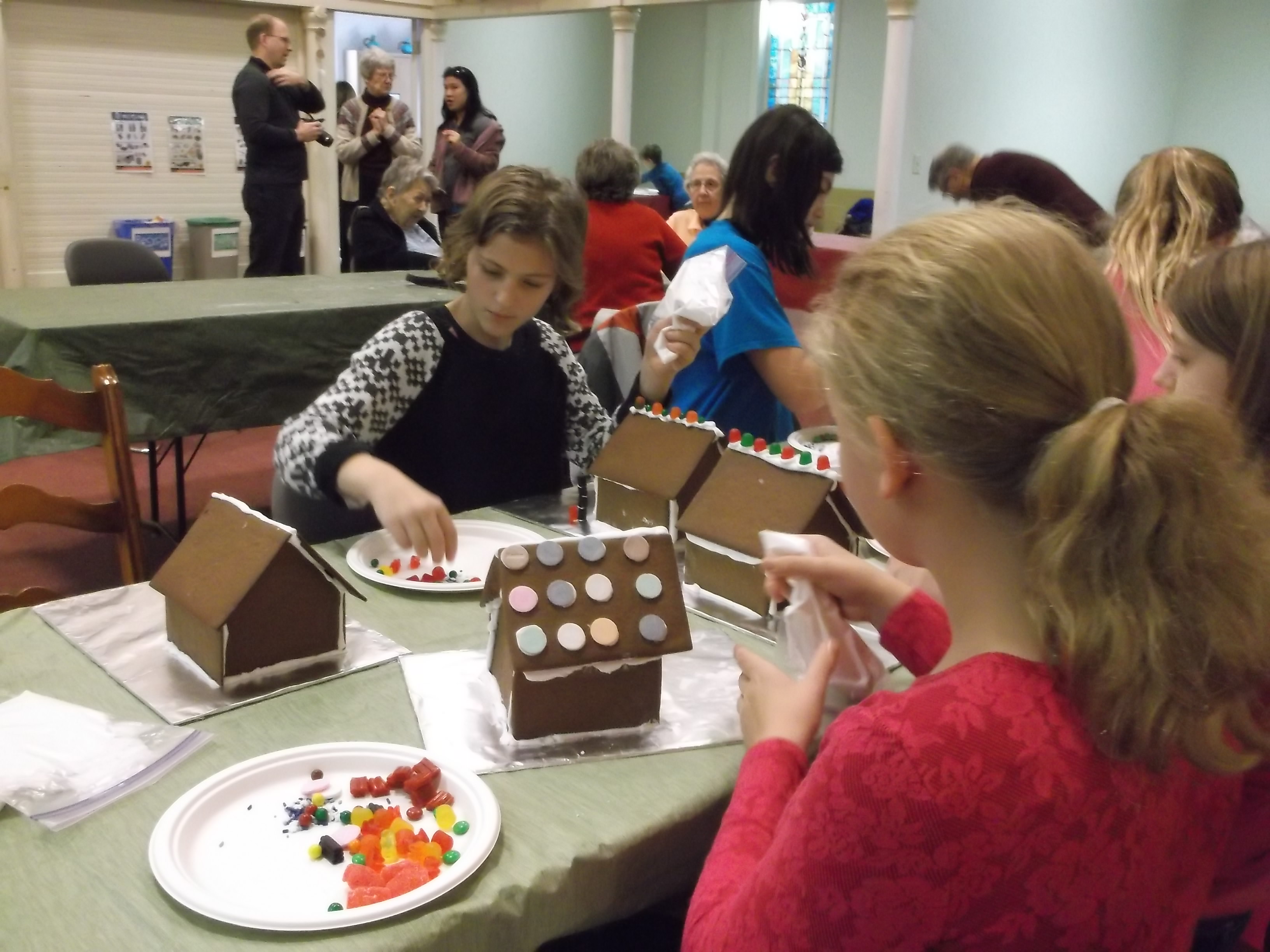
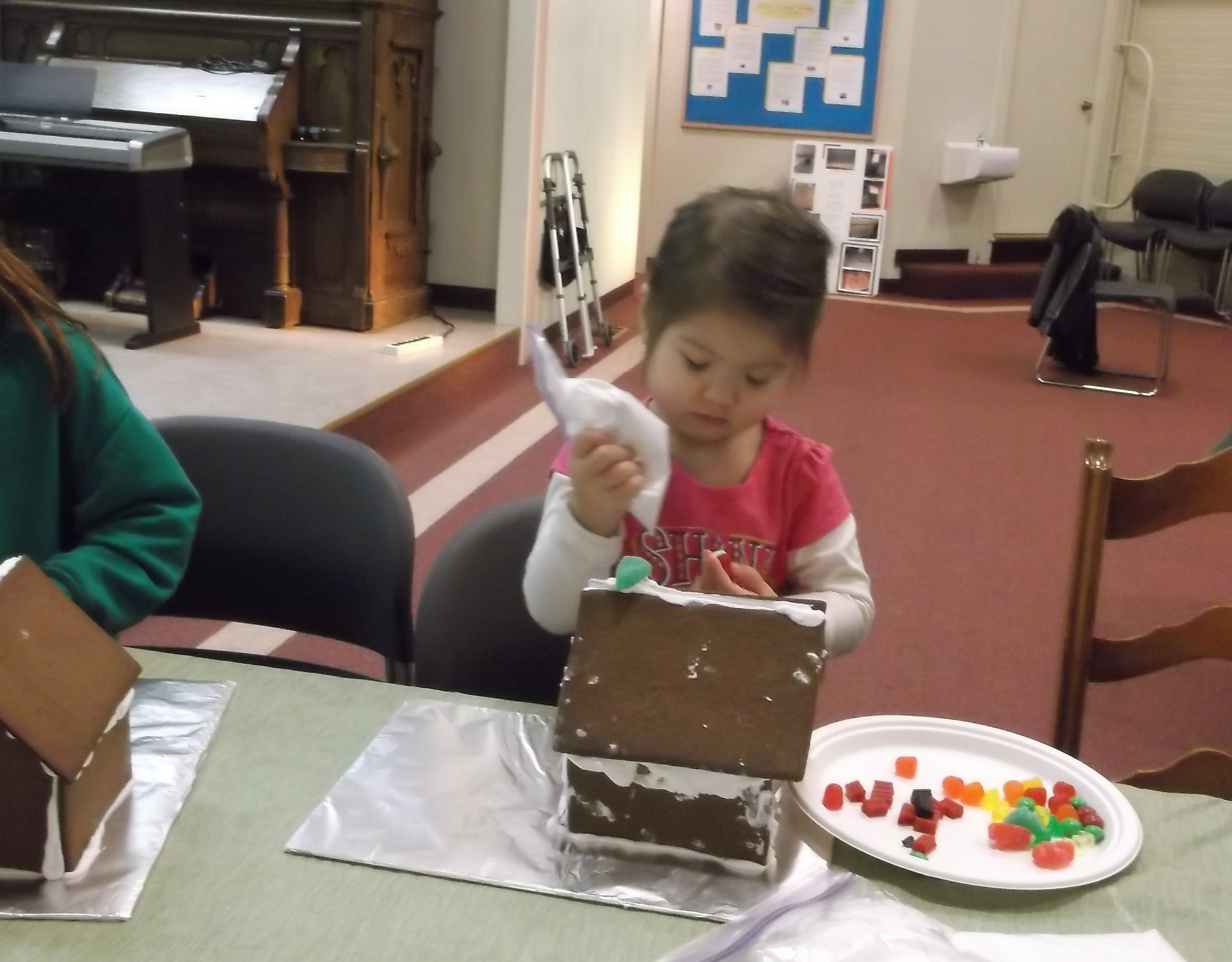
This past Sunday at Queen Anne Christian Church, we celebrated in song, word, prayer Thanksgiving. We also decorated the church for Advent, which starts next Sunday. And we have a new and tasty tradition at Queen Anne; the kids decorate gingerbread houses, while the parents enviously look on. Cherry S is a baker first class and she makes the gingerbread, puts together the houses, parents bring the candy for decorating and then we turn our budding artists loose. I must say they have a great time and the houses look wonderful.
As I sat and watched the kids, took video and a few pictures I couldn’t help but think about the worship service. The Scripture was Psalm 100 and Pastor Laurie’s reading from The Message gave me much to think about. First of all Psalm 100 was my father’s favorite and it was read, from the King James Version (KJV), at the beginning of every Thanksgiving meal in our house. But when I heard Pastor Laurie’s reading I was struck by the joy and celebration that resides in this Psalm that I hadn’t heard before. I felt the celebration inherent in this Psalm. However the words in Verse 4 jolted me upright. “4 Enter with the password: “Thank You!” Make yourselves at home, talking praise, Thank him. Worship him.” I thought what you have to have a password to enter G-ds presence, is not my gratitude and thanks enough, now I have to know a password. Well it is a simple password, and one I learned to use when I was a child. Still I have to say “thank you” to enter into G-d’s home! Why would G-d want my gratitude?
What does it mean to acknowledge your gratitude, out loud, and/or in writing? Well the expression is a witnessed event; people hear or read of your gratitude. They learn you are capable of good will by acknowledging the works of others. They in turn are blessed with your gratitude and that encourages them to also wish to express their thanks for their blessings. One person expresses thanksgiving for a small act of kindness, and the recipient, or someone who observes it is then empowered to offer their thanks to someone else and the boundary of the circle of kindness extends into infinity.
You might think saying thank you for a job well done, or a gift, does little to help you or anyone else, but you’d be wrong. Remembering your blessings grows an “attitude of gratitude” within all that you do throughout your life. In the late 1940’s Bing Crosby sang a simple song in the move “White Christmas,” Count Your Blessings Instead of Sheep, and for many years it was a popular tune. The premise is an easy one to remember, counting your blessings is more productive than counting all the wrongs you’ve received. In fact once you begin counting you discover that the hurts and wrongs far fewer than blessings.
For me I have all too often let anger and resentment cloud my vision preventing me from counting my blessings and that has resulted in some very unpleasant times in my life. One of the spiritual practices I have been doing on my life journey is to change that pattern of behavior. Now every morning I offer a gratitude to the Divine Spirit before I even get out of bed to start my busy day. And every evening I end my day with a review of the blessings I received during the day. It has made my life much more joyful and I am now more likely to see the face of the Divine in all that I do. So I have two questions for you to ponder this week:
1. What gets in your way of expressing gratitude? And . . .
2. Have you counted your blessings lately?
It is a joyful practice to count your blessings and say thank you. It is not really a password; it’s a way of life, to live in gratitude for the blessings we receive day in and day out, offering our lives as a blessing to those around us. Can you imagine the kind of world we’d live if everyone just counted their blessings?
So my gratitude for this Tuesday Morning is that I am grateful for the ability to write to each of you, I am grateful for the blessings I’ve received from my loving husband and family. I am grateful for the comforting presence of my companion animals, the fur kids Fred and Suzie, and the feathered kids Cuddles and George. And I am simply grateful for my life, for being alive today, at this moment. May all of you remember all of your blessings this week.
Last week John and I took a train ride to Vancouver, BC and while we hoped for some sun it was even cloudier there that at home. As we walked through Stanley Park I was afraid all my pictures would be gray and drab and then I saw this one. Yes, if the day had been bright and sunny I suppose this picture would have been brighter. But, the trees in their autumn finery reflecting in the pool made a light all their own. I just had to “open” my eyes to see it.
Today for Prayerful Tuesday I am inviting you to open your eyes and open your hearts and minds as we practice Visio Divina using the above picture. There is no set time frame for the guided prayer, but I do suggest at least 15 minutes and up to thirty minutes.
As your prayer begins, take a few moments to open your heart and mind to God.
When you are ready, slowly look and notice the image, taking your time to let feelings and thoughts come to you as you take in forms, colors, lines, textures, and shapes.
What does it look like, or remind you of?
What do you find yourself drawn to?
What do you like and not like?
What are your initial thoughts?
What feelings are evoked?
At this point in your prayer simply notice your responses without judgment or evaluation. If you don’t like the image, or the feelings it evokes, notice that this is your initial response and continue to stay open to the image and the prayer.
If you have an immediate idea as to what the image means, again, simply acknowledge that this is your initial response and stay open to “the more” as the prayer unfolds.
As you expand your prayer, return to the image with an open heart and mind. What new thoughts, meanings, and/or feelings arise for you; what initial impressions have expanded deepened.
Explore more fully the meanings that have risen up within you, and the feelings associated with the image and its colors and forms.
Be aware of any assumptions or expectations you bring to the image. No how you responded to the image — delight, disgust, indifference, confusion — prayerfully ponder the reason for your various responses and what they might mean for you.
As you go deeper into your prayer, open yourself to what the image might reveal to you.
What does it and the Holy Spirit want to say, evoke, make known, or express to you as you attend to it in quiet meditation?
Become aware of your feelings, thoughts, desires, and meanings brought up by the image: how they are directly connected to your life.
Does the image hold an important meaning or value for you: does it remind you of an important event or season, or suggest a new or different way of being?
What desires and longings are evoked in your prayer?
How do you find yourself wanting to respond to what you are experiencing?
Offer a prayer to G-d in ways that the image evokes: gratitude, supplication, wonder, lament, confession, dance, song, praise, etc.
As bring your prayer to close, bring to mind or jot down in a journal (whatever way is most helpful for you) the insights you want to remember, any actions you are invited to take, wisdom you hope to embody, or any feelings or thoughts you wish to express and remember.
Close your prayer by resting for a moment in God’s grace and love. May you see with newly open eyes, heart and mind many new images of G-d in the coming week.
1 Corinthians 12:12-13: 12For just as the body is one and has many members, and all the members of the body, though many, are one body, so it is with Christ. 13For in the one Spirit we were all baptized into one body—Jews or Greeks, slaves or free—and we were all made to drink of one Spirit.
This last week I have been giving a great deal of thought to the importance of all of the parts of the body. And, it has given me completely new insights on Paul’s words in 1 Corinthians 12:12-31. You see I had a blocked gland removed from the underside of my tongue on Thursday and I have learned just how dependent I am on every part of my body. I mean you try drinking, talking, even breathing without using your tongue for awhile and you will understand what I mean! However, given what has been happening in our nation’s capital it seems ironic that it is my tongue that is giving me a problem.
But enough of the gory details! Paul of course is writing to his wayward community in Corinth, which has a few problems getting along with each other. Does that sound familiar? Paul is telling his young Corinthian faith community they need each other because all of them are important and all are equal in the eyes of Christ. Not unlike the conflict we’ve been seeing in our nation’s capital this past week and I am afraid it will take another Apostle Paul for a resolution to this crisis to be resolved.
What might Paul tell our community today? Well one line he might repeat is “the body does not consist of one member but of many” and that each of the members is needed to perform some task that sustains the whole body. No part of the body could say “I do not belong to the body,” the tongue cannot say “I am in pain, so let the eye take my place,” trust me that isn’t going to happen. Just as the fireman cannot say to the man whose house is on fire I am to important to get my hands dirty, therefore I will not help you. That man’s house will burn down you can be pretty certain of that.
Today in Washington DC and in the rest of this country we have people who are saying just that. “I am to important to feed the hungry, or clothe the poor, or help the sick and elderly, or do anything that would make me see you as important in G-d’s eyes. I have my house with all of my barns stuffed with grain and produce that I have worked for and if you can’t take care of yourself, well that’s not my problem.” What these so called “important” people forget is that someone else prepared the ground, sowed the grain, harvested it and stacked it in his barn, they didn’t do it themselves. Just as in Jesus’ story of the rich man with all those full barns, G-d will come and say “Fool! This night your soul is required of you; and the things you have prepared, whose will they be?” (Luke 12:20) and it will be too late.
Paul told his community, “the members of the body that seem to be weaker are indispensable, and those members of the body that we think less honorable we clothe with greater honor, and our less respectable members are treated with greater respect: whereas our more respectable members do not need this.” (1 Corinthians 12:22-23) Paul’s words ring with the same authority today as they did in the First Century, for those we hold in low esteem in our community are the ones who are harvesting our food, making our clothes and building our houses. Just because they don’t wear a suit and tie, or nice dresses doesn’t make them less valuable to the whole body of our communities. I would love to see the Speaker of the House in the fields of California harvesting lettuce; it would do him and the rest of our politicians good to do some really hard labor. There perspective on what is important would change dramatically, that is if they survive the 14-18 hour, 7 day a week job. Let them live for a year as an elderly person on Medicare and Social Security trying to make ends, trying to pay for food, rent and medical care on the little they have. Or, they could choose to take care of a family whose child has cancer or some other debilitating disorder. Let’s see if they could do any better with the medical bills and all the rest of the needs of a family on $50,000 a year.
Each of the “unimportant people” are part of the body of this country, and of the body of G-d. In fact according to G-d they are more important than those who sit in the “great halls of government.” For G-d tells us all “do not abuse any widow or orphan,” (Exodus 22:22) or “oppress a resident alien.” (Exodus 23:9) But those verses are conveniently forgotten.
We are all part of the body of G-d, of creation and the creator. We are all part of our country and world, whether you are a business person, a working person, a widow, a widower, orphan, or an immigrant to this country or any country. Each and every one of us is important to the wellbeing of us all and the Creator’s purpose for us as a whole people. No one is more important than the other; we all have our tasks to do in this life that will lead us into the next life. This week I learned a lesson that every part of the body is important no matter how insignificant I might think it is.
The tongue can be an instrument for good will, or a sword that hurts and divides us all. My tongue hasn’t always been a good instrument. Just like ever one else there here have been times when I have said hurtful things to others and I can’t take those words back, as much as I might wish too. Yet I have also spoken words of kindness and caring that I hope in the eyes and ears of G-d outweigh the bad.
This week has made me aware of the incredible gift of all parts of the body, the seemingly insignificant, and the ones that I erroneously hold in high honor. We all have the power to be good gifts of the body, the body of our country and world, and the body of the Spirit. No matter how insignificant each of us seems to be each is important to the functioning of this grand creation gifted to us by the creator. Paul ends his short discourse on gifts of the body with the words: “But strive for the greater gifts. And I will show you a still more excellent way.” Each of us has the potential within to do even greater things than we do. It takes each of us to encourage those gifts in each other such that we all prosper, just as the Creator wants.
I am on a journey, a long journey
Begun before I entered my mother’s womb
To be carried on long after
I am finished with this clay pot
I stand on the moving head
of the pin of the now
Behind me is my past
In front of me my future
With every moment my now moves into my future of shifting possibilities
Leaving behind what was for. . . what is
Shadows of my life follow
Hazy outlines of what could be lie before me
I am like a piece in a strange board game
I cannot move backwards
Into the safe yesterday
I can only move forward into uncertainty
G-D the uncertainty frightens me
I want to go back, to the places that I know
I cannot see into the gray tomorrow
I want to know you will be there
My friend, do not be afraid, I am with you
now as I was in your past
I am in the now and travel with you,
I am there already
Ancient of Days I make my choice
I will take your hand
I will go into the shifting sands of uncertainty
My spirit will journey on, my friend calls, I come
I have set my bow in the clouds and it will serve as a sign
of the covenant between Me and the Earth Genesis 9:13 (Torah)
This last past week has been especially disturbing with gun violence in so many places that I have lost track of where they all are. I can’t even be sure that all have been reported by the ever present Sad News Division of our national media. There have been simply too many acts of violence to report.
All I can do is offer prayers of comfort and safety for every person on the planet because I can’t name all the communities, families and individuals affected by gun violence this week. I don’t think that has ever happened before. One of my greatest fears is that massive gun violence, or violence in any form will become the “new normal” for our lives and we will begin to ignore these incidents because they become common.
Every day I pray to the Divine Spirit of us all that we will stop killing each other long enough to recognize we are brothers and sisters. I pray that, knowing that while my prayers may be heard by the Spirit there is little hope of them being answered unless we all of us, hear that prayer and yell “ENOUGH!” The killing will not stop until we, the people, say we have had our fill of guns in the hands of the mentally ill, of the glorifying war and banditry to entice our children into these acts as play, and of having our children shot, bombed, starved, and abused all for the glory of some pathetic so called religious or political despot. So today on this our Prayerful Tuesday I would like to offer the following prayer of peace, petition and intercession. It is called the Caim, the encircling prayer, a form of prayer used by early Celtic Christians.
Circle Prayer of Peace, Petition and Intercession
Putting Ourselves in the Holy Spirit’s presence
Circle me, O Holy Spirit;
encircle me with your presence.
Keep joy within, keep bitterness out;
Keep generosity within, keep greed out;
Keep wholeness within, keep sickness out;
Keep wisdom within, keep folly out;
Keep strength within, keep weariness out;
Keep truth within, keep falsehood out;
Keep compassion within, keep hard-heartedness out;
Keep hope within, keep despair out;
Keep peace within, keep turmoil out;
Keep love within, keep self-seeking out;
Keep light within, keep darkness out.
In the name of the Sacred Three, the Parent, Child and Holy Spirit, Amen
In the name of the Sacred Three, the Parent, Child and Holy Spirit, Amen
Prayer for Peacemakers
Circle, O Holy Spirit, those who work for peace,
encircle them with your presence.
Keep wisdom within, keep folly out;
Keep strength within, keep weariness out;
Keep generosity within, keep greed out;
Keep truth within, keep falsehood out;
Keep compassion within, keep hard-heartedness out;
Keep hope within, keep despair out;
Keep love within, keep self-seeking out;
Keep light within, keep darkness out.
In the name of the Sacred Three, the Parent, Child and Holy Spirit, Amen
Circle those who are victims of violence and injustice
Circle, O Holy Spirit, (name people and places),
encircle them with your presence.
Keep truth within, keep falsehood out;
Keep compassion within, keep hard-heartedness out;
Keep strength within, keep weariness out;
Keep truth within, keep falsehood out;
Keep compassion within, keep hard-heartedness out;
Keep courage within, keep fear out;
Keep peace within, keep turmoil out;
Keep love within, keep hatred out;
Keep light within, keep darkness out.
In the name of the Sacred Three, the Parent, Child and Holy Spirit, Amen
Circle those who commit acts of violence and injustice
Circle, O Holy Spirit, (offer name[s]),
encircle them with your presence.
Help them to see the truth and to turn away from falsehood;
Help them to learn compassion and leave hard-heartedness behind;
Help them find the courage to turn away from evil;
May they feel your love in a world filled with hate;
Help them to see your light in the darkness.
In the name of the Sacred Three, the Parent, Child, and Holy Spirit, Amen.
Prayer of Blessing
The peace of the earth be upon you
The peace of the sky be upon you
The peace of the sea be upon you
The peace of the holy Spirit be upon you
upon you and all of G-ds creation
The love of the earth be yours
The love of the sky be yours
The love of the sea be yours
The love of G-d, Christ, and Holy Spirit be yours
and all of children of the Holy One.
An old Hebrew root for wilderness means “to speak,” {dabar – meaning “to speak” is a primitive root of midbar – meaning wilderness, a place where you can hear G-d speak}. Those who traveled into the wilderness were outsiders, minorities, women and Judean peasants and they were the ones that heard G-d speak. All too often we believe we have to be on the “inside” to hear G-d’s voice, we must “do it the right way” in order for G-d to notice us and accept us. Yet that isn’t the way I’ve observed G-d work. It is the outsider, the minority, the woman, the one who seems to be doing it all wrong that is called by G‑d.
How often do feel as if you are on the outside? Might G-d be calling to you, inviting you into the wilderness, to hear the voice of the Creator? Today I invite to take this moment and breathe deeply. Breathe out your burdens, worries, your cares and the responsibilities that weigh on you. Sit in stillness and open up to G-d’s voice. G-d will take your concerns and tend to them while you rest in G-d’s loving kindness and grade. Breathe in G-d’s presence and love for you. Remain still for 5 or 10 minutes in your inner silence and breathe the breath of G-d.
My prayer for you this day is that the stillness of this moment will remain within your heart all day letting you see G-d’s grace and blessings in all of the days tasks.



















 A Quiet Walk