Trust in God? – Prayerful Tuesday

Exodus 14:10-11, 13-14, 21:  10As Pharaoh drew near, the Israelites looked back, and there were the Egyptians advancing on them. In great fear the Israelites cried out to the Lord. 11They said to Moses, “Was it because there were no graves in Egypt that you have taken us away to die in the wilderness? What have you done to us, bringing us out of Egypt?

13But Moses said to the people, “Do not be afraid, stand firm, and see the deliverance that the Lord will accomplish for you today; for the Egyptians whom you see today you shall never see again. 14The Lord will fight for you, and you have only to keep still.”

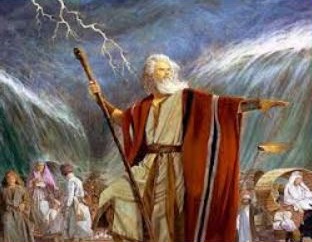
21Then Moses stretched out his hand over the sea. The Lord drove the sea back by a strong east wind all night, and turned the sea into dry land; and the waters were divided.
Clip art by Microsoft

I have begun a yearlong meditation discipline with the book A Year with God[1] by Richard J. Foster and Julia L Roller, which I am very excited about.  Yesterday the above Scripture from Exodus was my morning reading.  As I read it I thought about what it means to trust in God.  In Speaking Christian[2] Marcus Borg says trust and faith mean essentially the same thing.  So Moses was asking the Israelites to have faith that God would provide help.  What Moses wanted the Israelites to understand was they needed to let go of their idea of planning ahead and of knowing what will happen next. God may have a plan but we don’t know what that is and God is not going to tells us what the plan is, until the moment it happens. In this case God’s plan was to divide the waters of the Red Sea, which allowed the Israelites to escape the Egyptians.  Fundamentally to have faith/trust in God means we must let go of the control of our own lives and let God provide, for most people that is a scary thing to do. Usually we only let go when we are at a point when nothing else has worked.  All our plans have fallen through, and we are at a dead end with no place to go except call on God.  For most people God is the safety net we rely on and I for one am grateful of that net.

The meditation questions provided with the lesson brought back uncomfortable memories in my life when I had reached my own dead ends and didn’t know where to turn next.  I remember feeling lost, frightened, terrified really, at the prospects I imagined lay before me.  In the dark night of my soul I called out to God and said “I give up, I can’t do this anymore, help me.” I wanted God to be there, I needed God to be there, because I felt alone.  For me giving up and trusting in God and letting God plan the next move was scary but not as scary as the alternatives.  Letting go of the reins of my life released something inside of me and eventually things improved.  I can’t say what I experienced will happen for everyone but I can say giving to God what stresses us and beats us down improves the way we see the world.  Faith and trust are hard spiritual practices but are the foundation of all spiritual practices.  It doesn’t matter how you envision God, or what name you call the Divine letting the All Encompassing Presence be your safety net when you are troubled will give you hope in life.  The process may be slow; God works in God’s own time, but slow is better than not moving at all.

Spiritual Practice:  this week reflect on when in your life you have been able to trust God wholly when things fall apart.  If you haven’t had one of those moments do you think you could stand back and let God take over provide the solution?

As you journey on your path this week, may Christ be there to give you courage, may the Holy Spirit smooth your road, and when you are weary may God hold you in the palm of God’s hand.

Ruth Jewell, ©January 5, 2016

[1] Foster, Richard J. and Julia L. Roller editors, A Year With God, Harper One, New York, NY, 2009.

[2] Borg, Marcus J: Speaking Christian, Harper Collins Publishers, New York, NY, 1989, pg 120-123.

Shouting Stones – Prayerful Tuesday

Luke 19:40: He answered, “I tell you, if these were silent, the stones would shout out.”

Power of 10 Are We Alone in the Universe,
Updated May 3, 2011 by Securityscience

Several years ago someone sent me this video that imagines going out from a 1 meter distance by a power of 10 up to 1020 Km or 10 million light years, then coming back to earth to 1 meter starting point and doing a reverse trip into a leaf by a power of ten to 10-16 meters or 100 Atómeters (that’s 0.0000000000000001 meters).  What has always fascinated me we could have kept going forever if we are traveling away from earth, there is no limit that we know of to the distance we can travel.  However, 10-16 is the smallest we can get if we reverse the trip.  After this point all is mystery.  What lies beyond that limit of 10-16?

While this video imagines going into leave they could just have easily imagined entering an atom of a rock.  You see that place of mystery is found in all things, living or what we call non-living.  Whether rock or human both are made of atoms and that means that this place of mystery is found in rocks, humans, our pets, trees, and air.  What mystery does this place hold? What if our connection to all things created is found within this gigantic, tiny, place. What if, this is where the Divine can be found and how would that idea change the way you think about our planet, our universe.

When George Lucas created the story of Star Wars he consulted with the author Joseph Campbell about mythology and how it explains the unexplainable. From those conversations Lucas developed the concept of the “Force” surrounding and being within all things, not unlike this place of mystery in every atom. So might our search for the unexplainable be present within each of us?

Might it be that developing a relationship with the Creator requires us to look within ourselves, to listen to the inner “voice” that whispers to us at the edge of our consciousness. That is what the mystics tell us we should do.  What if we should recognize the presence of the Creator in more than each other? That we should respect all created things, even rocks because the Creator, or however you name or depict the Divine, will be found there.

This week’s meditation

After you watch this video look at your hand and contemplate how the molecules and atoms that make up your hand resemble the greater universe.  Then contemplate how the place of mystery compares to the limitlessness of space. Where might you find the greatest mystery of life?  Contemplate how we as humans are connected to more than each other. Then ask yourself “what can I do, no matter how small, to help reconnect each of us to the Divine?”

Ruth Jewell, ©December 29, 2015.

I Choose . . .

Microsoft ClipArt
Microsoft ClipArt


For the past two years I have been wrestling with how my ministry would be expressed in the world.  This discernment journey has taken me “around the block” and back again many times and during this past summer I had finally made my decision, I choose not to be ordained in my denomination of the Christian Church (Disciples of Christ), I choose not to be a pastor, or a chaplain, or even a spiritual director. I choose to be something else, what that something is has only just begun to take shape.

This may seem inconsequential to most of you but for me it has been a difficult decision.  I graduated in 2013 with my Masters of Divinity (MDiv.) degree and it was with the intention of being ordained, primarily because I believed that is what one did when one received an MDiv. But you see it wasn’t my intention when I entered the School of Theology and Ministry (STM) at Seattle University in 2007.  At that time I just wanted to be better informed in order to conduct Labyrinth retreats with more meaning.  What happened as I progressed through my degree programs of Spiritual Transformation and MDiv I discovered I had talent and passion for learning and I wanted to share what I learned with others. And the truth of the matter is as an ordained pastor I would not be able to share all that I learned simply by the constraints of the job.  I actually would have a greater voice if I wasn’t ordained.

So I chose to be a scholar, a learner of faith with the purpose of spreading what I learn back in to the world.  This is important because we aren’t 1st century people; we live in the 21st century. That means we have a perspective on our faith that those living in the 1st and 2nd and 3rd centuries did not have. We have a history of being, or not being, people of God, just as the Jewish people of the 1st century had a history of being, or not being, a people of God.  We have had our moments of living as God asked and we have had our moments when we have forgotten God, just as the Jewish people had and have. It is the task of the scholar to educate the people of God of their past and how can we do that if no one studies it?

In the last two years I have become interested in how our Christian faith is connected to our Jewish roots and to our younger sibling in the faith Islam and that interest has led me into the differences in how we read Holy Scripture as compared to our 1st to 3rd century faith ancestors, and the differences are striking. Those differences in perspective has shown me it is important for people to understand what the writings of Paul, Gospel Writers, Jewish Prophets, and Muslim Writers actually wanted their listeners to know, what was the message they were transmitting and how does that message resonate with us today.  All those authors wrote and spoke was revolutionary in their time and I want to recover, at least for myself, that revolutionary message.  I want to know what they wrote that was specific to their time and not relevant in the 21st century and what part of their message guides us forward into our own future. And, I want to share that news, that revolutionary news. I have no illusions that I am going to be another Marcus Borg, or a John Caputo, or anyone else who is way more learned in theology than I will ever be.  But I can read what they have learned and pass it on to those who will listen.

You see scholars are often, well nearly always, not thought of as being relevant to world.  When anyone envisions a scholar it is as a stuffy old man or woman who is a bit rumpled and surrounded by books and papers.  It is someone who is absent minded and lost in the past, with no idea about what is going on in the world today.  But that is not who learners/scholars are.

Scholars are connected to the world by stories, and threads of the past that live in the present and the future.  The old quotation “if we don’t remember the past we are doomed to repeat it,” has never had more meaning than in today’s world.  We are currently reliving a past history where the disadvantaged and those who are different from us are forgotten and made the objects of hate and fear.  It is the role of the scholar to remind the people of who they are, and whose they are.  It was the role of the prophets in Jewish History, it was the role of John the Baptist, and it was the role of Jesus of Nazareth and Muhammad.  All of them called to their people to see each other, everyone, as themselves.  Today we have and had  people like President Carter, Desmond Tutu, and Martin Luther King who have called to us to remember and just like those who went before us too many are not listening.

I will never be an exalted a scholar like Desmond Tutu, or Elisabeth Johnson, Sallie McFague or Elisabeth Schüssler Florenza.  But in my small part maybe I can pass on their learning’s to someone who will become exalted. That is enough for me. As the saying goes I am a very small fish in a very large pond and I am happy with that. To give back what I have been blessed to receive is more than enough.

There are many others like me out there, people who read, and study waiting for the opportunity to pass on what they have discovered beyond academics or a very small circle of friends. What each has is a nugget of truth and bit wisdom that needs to be heard. This choice is not prestigious, very few scholars make it to super star status and I am grateful for that.  But the time has come for the telling of the past mistakes and success’. To help everyone remember that the eyes of the other are your eyes and to harm or denigrate the other is to harm and denigrate yourself. Scholars have a role to play in the world that is greater than writing dusty tomes that will be read by only a few.  The past is relevant to the present and the future and it is important that we remember that.  I would like to add my very small part to that story. To offer a tiny bit of knowledge that just might help someone else see the world differently.

My choice, my decision, my path not the easiest of routes to take, and it wasn’t an easy choice but I choose to be a learner, a scholar, a passer on of knowledge.

My prayer for all of you to listen with open mind and heart to what the teaching says, it just might change your life.

Ruth Jewell, ©December 15, 2015