
Intention as a Spiritual Practice – Prayerful Tuesday


Brokenbread

Matthew 5:13-20: (NRSV) 

 13You are the salt of the earth; but if salt has lost its taste, how can its saltiness be restored? It is no longer good for anything, but is thrown out and trampled underfoot.
   14You are the light of the world. A city built on a hill cannot be hid. 15No one after lighting a lamp puts it under the bushel basket, but on the lampstand, and it gives light to all in the house. 16In the same way, let your light shine before others, so that they may see your good works and give glory to your Father in heaven.
17Do not think that I have come to abolish the law or the prophets; I have come not to abolish but to fulfill. 18For truly I tell you, until heaven and earth pass away, not one letter, not one stroke of a letter, will pass from the law until all is accomplished.
   19Therefore, whoever breaks one of the least of these commandments, and teaches others to do the same, will be called least in the kingdom of heaven; but whoever does them and teaches them will be called great in the kingdom of heaven. 20For I tell you, unless your righteousness exceeds that of the scribes and Pharisees, you will never enter the kingdom of heaven.

I am preaching on Matthew 5:13-20 next Sunday, February 9th, and as I have read and re-read this scripture I have discovered Jesus is talking about a spiritual practice, the spiritual practice of intention.  Everything Jesus did was intentional. He started every day knowing he was going to do the will of the Father, his Father, his Abba.  In this portion of his Sermon on the Mount he is trying to teach all of us we must be intentional about our actions in the world.  It isn’t good enough to say we believe in justice and kindness, rather we are commanded to actually get up out of our chairs and actively walk with God as God continually creates our world and DO justice and kindness. So my spiritual practice for this week is “Intention as a Spiritual Practice.”

You are probably saying right now “well duh” everyone knows that.  If we all know that we are to do justice, kindness, and mercy then why don’t we?  It is because it is easy to say we are going stand up to injustice but it is much harder to actually get out there and get your hands dirty.  So I am going to give you a few suggestion that are simple everyday things you can do just to get you started and in the habit of living an intentional life.

In his book Everyday Spiritual Practice, Simple Pathways for Enriching Your Life Scott Alexander explains why a spiritual practices is different from a casual hobby, and “the answer is intentionality, regularity, and depth . . . what shapes your efforts into an everyday spiritual practice is your commitment to making the activity a regular and significant part of your life.”[1]
In addition an everyday practices doesn’t have to be complicated, take a great deal of time, or be physically or economically challenging, it just has to be done every day.

Alexander’s book offers many different activities from the very simple to the more difficult and I am going to suggest only a couple of the less difficult ones to get you started.  I also suggest you find Alexander’s book and read some of the practices if these do not appeal to you.

Everyday Spiritual Practice number 1 is probably the simplest of all to start but can be a hard one to carry out.  Every morning when you arise from sleep say the following:  “Today I will offer kindness to each person and creature I meet this day.”  Then follow through, no matter how frustrated you become during an event.  My suggestion is to repeat your intention several times during the day until the act of offering kindness becomes second nature to you.

Everyday Spiritual Practice number 2 involves caring for the world we live in.  Begin each day with the following state: “I will conserve energy by turning out the lights when I leave a room.” Or you might use recycling, bicycling and/or use city transportation instead of driving as your goal.  What you do is important but it doesn’t have to be difficult and if your way to care for the earth is to eat more foods from the lower end of the food chain instead of taking a bus to work, good for you.

Ok just one more to begin.  Everyday Spiritual Practice number 3 involves the relationships we have with others.  Repeat throughout your day: “I will treat those I live, work, and play with with the respect and kindness they deserve as family members, co-workers, friends, for all are my brothers and sisters of God.”

You might be saying these don’t feel very spiritual to me.  But, what I am saying is that to BE a spiritual being and the being God desires us to be is to approach everything we do, every moment, every day as if we were doing it for the one we call God because in reality we are.

Jesus tells us “as you do it for the least of these you do it for me.”  So when you offer a heartfelt word of thanks to the harried checkout clerk in Safeway you are behaving as Jesus would want you behave and who knows maybe, just maybe, that was Jesus and you didn’t know it.

You see the Spiritual Practice of Intention is basic to walking in the Way of Jesus. Whether you are preparing dinner for your family, taking a casserole to someone who is ill or grieving, or stopping to help a homeless person by offering them half of the sandwich you are carrying all of those are Spiritual Practices. When we place the love of the Divine in front row of the action we are doing a spiritual practice.  Jesus said “let your light shine before others” and how we do that is by gifting our light to those who are struggling in darkness.  Our light will not diminish by giving it away; it grows brighter because more people are shinning with its glow.

Ruth Jewell, © February 4, 2014


[1] Alexander, Scott W.(editor): Everyday Spiritual Practice, Simple Pathways for Enriching Your Life, Skinner House  Books, Boston, MA 1999 Pg. 5

From Strangers to Family

Vancouver BC, October 21, 2014

Ruth 1:16-17 (CEB)

16But Ruth said,

“Do not urge me to leave you,
to turn back from following you.
Wherever you go, I will go;
and wherever you stay, I will stay.
Your people will be my people,
and your God will be my God.
17Wherever you die, I will die,
and there I will be buried.
May the Lord do this to me
and more so,
if even death separates me from you!”

Just over 13 years ago these beautiful words from scripture were read at my wedding.  I have always loved the book of Ruth, and yes one reason is because I was named for her, but, primarily I love it because Ruth took her destiny into her own hands and made a place for herself among strangers.  Like the biblical Ruth my own life has been one of making my place in strange places and with strangers all around me.  My wedding was just one of the many steps along my journey to find the face of God.

Now I really don’t want this rambling to be about John and me rather I want to tell you the best part of my marriage, our grandchildren.  Ok, so they are John’s grandchildren not mine, but the youngest ones have known only me as Grammy Ruth and I love them and their parents as much as if they were my blood relations.  And, I have watched with great joy as the two older ones Granddaughter S and Grandson A grow into loving adults.

Recently John, me and our little Chihuahua Suzie spent a joyous week in Boston with John’s son M and daughter-in-law LB and the littlest grandchildren, Grandson L and Granddaughter A.  John’s birthday is January 17th and he shares it with L who turned 7 this year, so for the first time they decided to celebrate their birthdays together.  Watching L as he opened gifts, as he gently held our little dog Suzie, and talked excitedly about everything was a pleasure all its own.  Holding little A and reading a story to her, playing games, watching as she and her brother played, and squabbled, and listening to giggles, laughter and tears put me in a place of bliss that I can’t really describe to you.

I watched as M and LB did a ballet of sorts as they prepared breakfast and got the kids ready for school.  As I listened I realized just how much M and John sound alike and how much grandson L is growing into a young man so like his father and grandfather.  Granddaughter A has inherited her mother’s artistic talents which she combines with her father’s and Papa John’s determination to succeed and do it well.  Even though she is only 4½ she is determined to dance and draw her life in her own way.

I said my journey was to find the face of God and I do, in all of creation including people.  The most important Faces of God I see is when I look at John early in the morning just before rising, in the faces of M and LB when I spot them waiting for us to come from the plane.  I see God’s face in the sleeping, laughing, crying, and determined faces of Grandson L and Granddaughter A.  I hear God laugh and giggle when Granddaughter A dances and runs in play.  I hear God’s voice when I listen to LB and John talk in the kitchen doing clean up from dinner.  I hear God’s voice as Grandson L talks with so much certainty about how something works in his 7 year old world and see God at work as he figures out how to build a new structure of some sort.

This is the wedding gift that never stops giving. I have found a place here in the midst of strangers.  I have found people I love.  After much searching I have found where I belong.  I have been welcomed and accepted as family and been blessed with the love from John’s 3 sons and 4 grandchildren.  I have watched the two oldest grow into strong adults where a future of unknown adventures lies before them.  I have held in my arms Grandson L and Granddaughter A as newborns and offered my blessings and prayers for God to watch over them.

I have watched each of the grandchildren grow into people I want know.  All of them are young people who question everything and when no one can give them an answer they go in search for it.  Even if Grandson L and Granddaughter A might not believe in a Divine force, they know they have a Grammy who sees that Divine force whenever she looks into their eyes.  It is in the question of why does Grammy believes what she does that opens a door to their own journey of discovery of who they are and where they fit in.

My blessed babies, who are babies no longer, have begun their own journeys.  Someday they too will say “wherever you go, I will go; and wherever you stay, I will stay.”   That day lies long in the future but time passes quickly and before you know it they will be searching for what they believe.  My prayer for all four of the Grandchildren is they find what feeds their souls with love, compassion, mercy and a passion for justice.  I pray they build a life that gives more than it takes, a life open to the blessings of God whether they call Her God or not.

Ruth Jewell, ©January 25, 2014

Seeking God’s Face

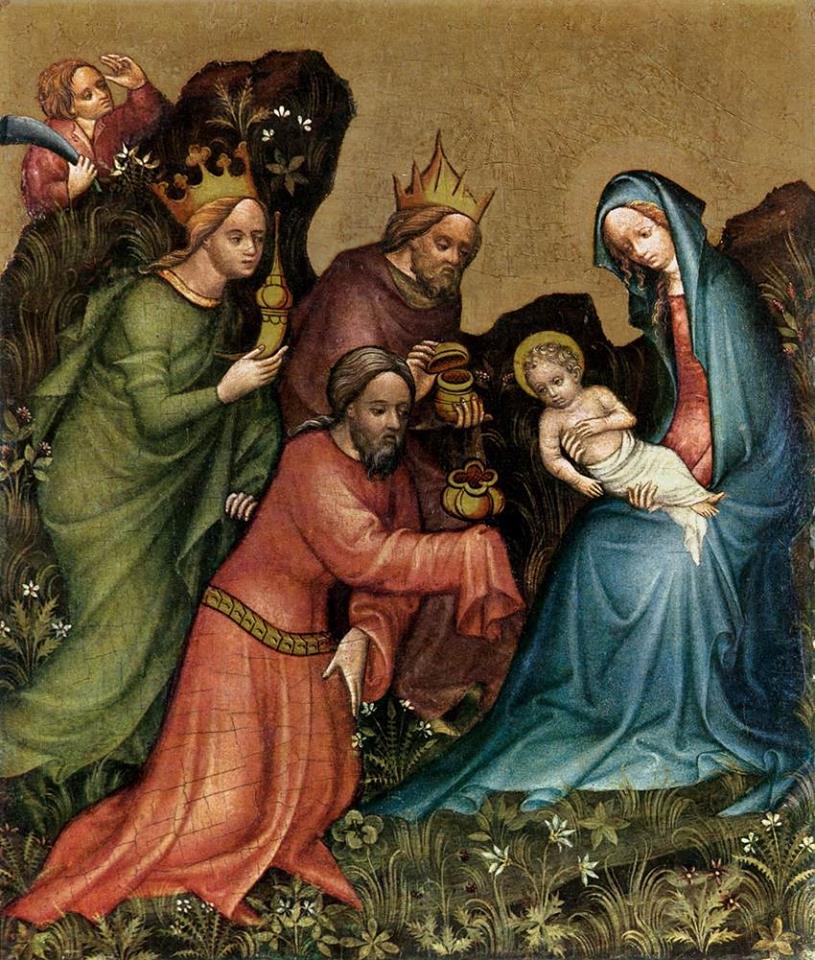
Master of Vienna, Adoration (1410), FB Page The Celtic Christian Tradition

Sermon – Epiphany Sunday
January 5, 2014
Queen Anne Christian Church Seattle, WA

Matthew 2:1-12 (Common English Bible [CEB])

Coming of the magi

1After Jesus was born in Bethlehem in the territory of Judea during the rule of King Herod, magi came from the east to Jerusalem. They asked, “Where is the newborn king of the Jews? We’ve seen his star in the east, and we’ve come to honor him.”

When King Herod heard this, he was troubled, and everyone in Jerusalem was troubled with him. He gathered all the chief priests and the legal experts and asked them where the Christ was to be born. They said, “In Bethlehem of Judea, for this is what the prophet wrote:

You, Bethlehem, land of Judah,
by no means are you least among the rulers of Judah,
because from you will come one who governs,
who will shepherd my people Israel.”

Then Herod secretly called for the magi and found out from them the time when the star had first appeared. He sent them to Bethlehem, saying, “Go and search carefully for the child. When you’ve found him, report to me so that I too may go and honor him.” When they heard the king, they went; and look, the star they had seen in the east went ahead of them until it stood over the place where the child was. 10 When they saw the star, they were filled with joy. 11 They entered the house and saw the child with Mary his mother. Falling to their knees, they honored him. Then they opened their treasure chests and presented him with gifts of gold, frankincense, and myrrh. 12 Because they were warned in a dream not to return to Herod, they went back to their own country by another route.

Greek derivation of Magi, (Strongs Hebrew, Chaldee, and Greek Dictionary)

3097. magos mag’-os  (of foreign origin (7248); a Magian, i.e. Oriental scientist; by implication, a magician:–sorcerer, wise man, [interpreter of dreams, prophet].   (plural, could refer to a male or female wise person)

The story of the Magi is such a familiar story. We have heard this story so many times before and I am sure all of us are able to repeat it without difficulty, at least the surface story.   I was confronted with this simple story, which is anything but simple, when I chose to meditate on it for Epiphany Sunday’s Sermon. Sitting in silence, letting the words of Matthew settle into my subconscious I realized there is so much more to this tale than I first believed. There are also way too many questions to address in a single sermon.  If you ever wanted to experience an abundance of graces just read this story carefully.   I could go into the fact that the gender and number of the Magi is never mentioned in the scripture and that the Magi were gentiles; or the Magi don’t visit the stable, they come to the home of Joseph and Mary; and because the story of the killing of the Bethlehem’s children that follows the Magi’s visit lead scholars to believe Jesus could have been as old as 2. And, that’s just few of the questions I found in these 12 verses of Matthew Chapter 2.  What did intrigue me, and what I will discuss, was never addressed by all of the learned theologians I perused. What I wanted to know was the reason these learned gentiles come in search of a child, a child born to a carpenter and his wife.  And, what unknown gifts still hides in this story for me, and all of us, beyond the pretty tale of rich strangers visiting a destitute baby?

First of my questions was what did the Magi expect to find when they arrived in Jerusalem.  Since they came to the city of the kings of Judea they must have expected to find the child born there, and to parents with more than a lineage to David. My guess is they had expected to find a somewhat wealthy family, or at least fairly well off.  After all they were looking for a King and you normally don’t find one living in the home of working class people. They must also have been confused and terribly disappointed that no one knew what they were talking about. I mean, the birth of a King is big news isn’t. Doesn’t everyone celebrate the birth of a King? It isn’t until King Herod calls them for an audience do they learn that the prophets foretell the birth of “the anointed one,” “the Christ,” was to happen in Bethlehem.  I have no doubt they left somewhat confused. But, eventually they find the baby living in the home with his mother and father. They even bring gifts, and while Mary might have preferred diapers, the gifts they gave were costly and fit for a King.  (By the way Bethlehem and the gifts are never mentioned again, why? Another question to confound me.)

They were seeking a child, an infant King, someone who would turn the Roman world upside down and I can only imagine their surprise at finding the child in such humble circumstances. They brought gifts Herod would have drooled over, gold, frankincense, myrrh.  Wonderful gifts but not really practical for the family they found, well the gold was probably most welcome.  But frankincense and myrrh those aren’t baby gifts.  Frankincense and myrrh were used to perfume oils and ointments for the purification of worship spaces and the anointing of the dead.

Now I know what Matthew was implying by the gifts: Gold was the symbol of Jesus’ kingship, frankincense the symbol for the priestly role Jesus would be called to live, and myrrh a foretaste of what he would endure at the end of his life.   But I think these gentile scholars brought something else and it has been bequeathed to us today and our children. The Magi brought the gift of “seeking God’s face.”

God has always welcomed us and longed for our inquisitive search for the face of the Divine, and She encourages us to reach for her Holy arms.  One of David’s Psalms says it well:

30 I will praise God’s name with song;
I will magnify him with thanks
31     because that is more pleasing to the Lord than an ox,
more pleasing than a young bull with full horns and hooves.
32 Let the afflicted see it and be glad!
You who seek God—
let your hearts beat strong again
— Psalm 69:30-32 (CEB)

And in the Book of Acts Paul tells the Athenians “27 God made the nations so they would seek him, perhaps even reach out to him and find him. In fact, God isn’t far away from any of us.” (Acts 17:27)  No God is never far away, we are.  And, seeking the face of God is one of the joys of creation we should do more often.

The Magi were the first to seek God’s face in its incarnated form, the face of a child.  For Matthew the Magi represent the mission Jesus gives his disciples to reach out to all peoples but especially gentiles, and those born within the great humble mass of humanity, in all its lovely diversity; poor and rich, young and old, all genders, all races, and all people.

For me the Magi represent the longing to see God in the face of my beloved, my grandchildren, best friend, and all creation.  I too want to see the incarnated God, I too long to see the ever present being in the first light of dawn, and I do see it in the face of my beloved when he first opens eyes in the morning.  The Magi have passed this longing down to us and I am grateful for the gift and grateful to pass it on to the next generation.

The Magi’s gift of presence to a child in a humble home was passed on to us through Jesus’ presence in his life, death and resurrection.  Now it is our mission to be present to the incarnated child born to humble parents.   To recognize and honor the incarnation born in each of us, through our gifts to the world whatever they may be; caring for each other, the environment, our nation, and our world.  It is up to us to be the Magi of today and visit the child in a humble home, to offer the gold of our love, to purify our mistakes with the frankincense of compassion; and to anoint those who pass on to the next world with the myrrh of God’s blessings and praise.   In a Judean desert David writes:

God! My God! It’s you—
I search for you!
My whole beingthirsts for you!
My body desires you
in a dry and tired land,
no water anywhere.
Yes, I’ve seen you in the sanctuary;
I’ve seen your power and glory.
My lips praise you
because your faithful love
is better than life itself!
So I will bless you as long as I’m alive;
I will lift up my hands in your name.
— Psalm 63:1-4 (CEB)

So too are we called to offer our praises to God, honor the child that lives today, in each one of us, and in all of creation.  Seek the face of God in all you meet, child, adult, male or female, and all of God’s marvelous creation.  Look in the eyes of your loved ones, your companion animals, see the face of God looking back.  Amen

Ruth Jewell, ©January 7, 2014