
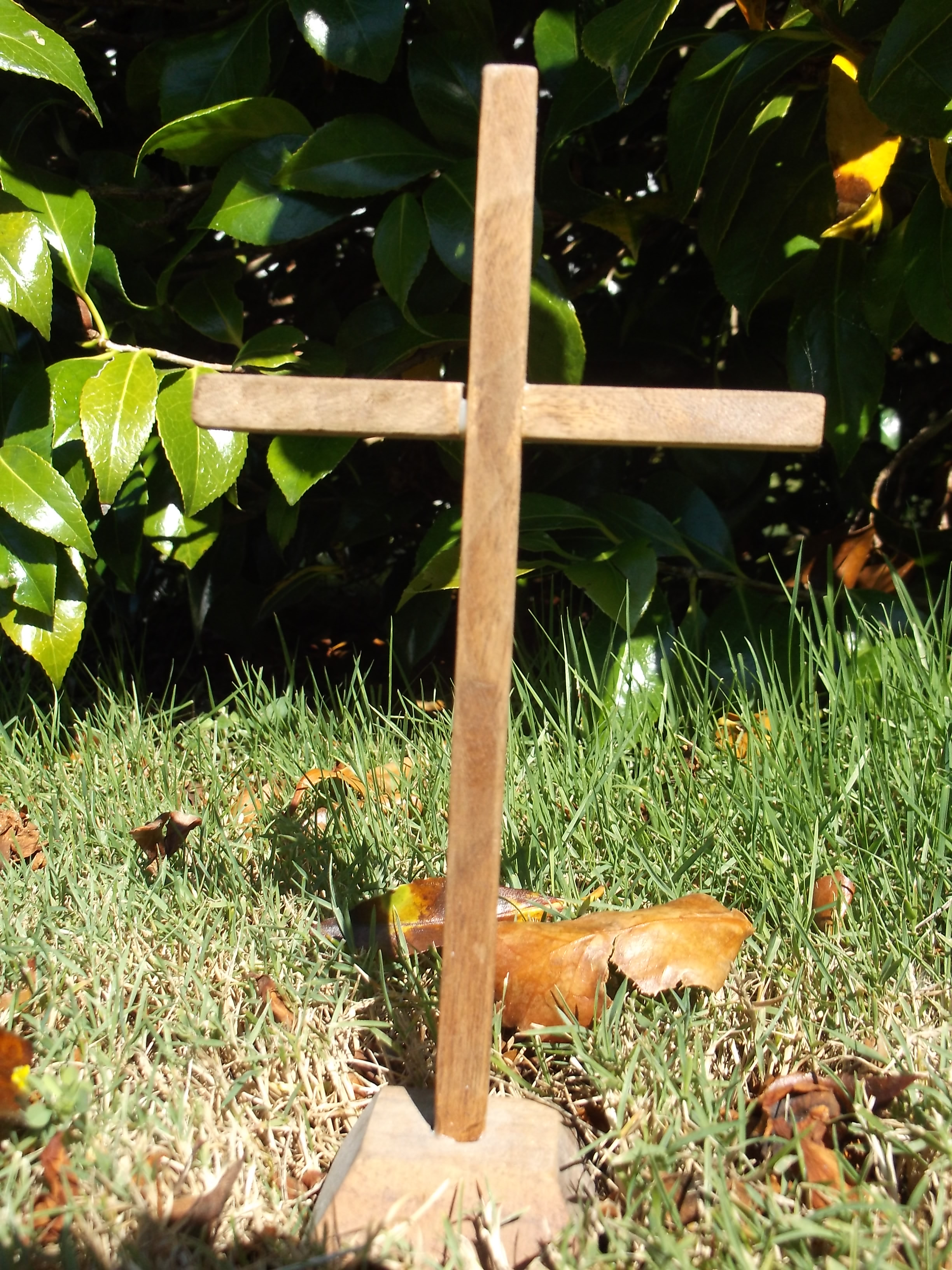
Who’s Cross

Who's Cross
Who’s Cross

Mark 8:34 And he called to him the multitude with his disciples, and said to them, “If any man would come after me, let him deny himself and take up his cross and follow me.

I love the Gospel of Mark, it encourages me to ask questions and this verse in his gospel is one of those that drives me crazy with questions.  The reason is I’m not sure whose cross I’m supposed to carry.  If I take it literally, which is how it is most often interpreted, then I am to bear “my” cross and follow Jesus.  But If I look at this scripture from the way Jesus responded to all of those who did follow him and surrounded him as he taught, then, this verse takes on new meaning for me.

What if, just what if, Jesus is telling us to carry the cross of someone who is suffering and not our own cross.  Yes I know that flies in the face of orthodox interpretation but then I’m not orthodox.  Those in my ecclesial tradition of the Christian Church (Disciples of Christ) read and interpret scripture and Holy Writings for ourselves.  We do have to defend our interpretation and in that defense we either modify or enlarge our understanding of what scripture has to say.  So here is my defense of my interpretation Mark 8:34 that “the cross Jesus is asking us to pick up is not ours but the cross of my neighbor and both of us then follow Jesus.”

First of all these words of Jesus are recorded in all three of the synoptic Gospels, but not in John.  Now it could be that Matthew and Luke simply copied Mark, after all they used Mark as their blueprint for their own Gospels.  But, the fact that it appears almost word for word in each of three synoptic Gospels leads me to believe this was something Jesus did say or could have said.  Jesus also never said anything that would contradict what he “did” throughout his life of a servant to the disadvantaged, displaced, ill, elderly and disabled. Jesus’ life as it was recorded in the synoptic Gospels was less about what he said and all about what he did.

It is also one of the verses that is almost always misused or misquoted to, or by, those who are having a difficult time.  How often have you heard the words “well that is my (your) cross to bear.”   Something about that phrase has always bothered me.  It’s used to trivialize suffering or difficult times for people and I think that is wrong.  I don’t believe that Jesus would have ever told anyone that and I believe the “traditional” interpretation of this verse of carrying my own cross  may not be what Jesus had in mind when he called to his disciples and the multitude.

Jesus always cared for those who could not care for themselves.  His ministry was to those who had been discarded by society, bringing them back into relationship with their communities and with God.  We often see him tired and totally worn out from giving of himself to those who needed him.  And my question is; is that not carrying the cross of the other long?  In fact we see death in so many ways in the ministry of Jesus, and not just Lazarus (John 11:41-43), a widow’s son (Luke 7:14), or Jairus’ little girl (Matthew 9:25, Mark 5:41, Luke 8:54).  We see those who are dead and buried simply because they don’t fit society’s profile of “normal,” the blind, the infirm, and the mentally disabled and we see them resurrected from their death to life by Jesus who returns them to their communities.  Every story of healing is a story of death and resurrection and it is Jesus who takes the burdens, i.e. their crosses, of those who have died to life restoring them to family and community. Jesus was teaching a Way of Life, and, one in which we as his followers were to emulate.  That means caring for those who have died to society, bringing them back to life by restoring them to God, their families, and their communities.  If we are going to be followers of Jesus then it is not our salvation that we are to be concerned with.  No, it is the resurrection and life of those who have been pushed outside of society and left to die to life.

Now don’t get me wrong, I don’t believe the way I reach God is the only way.  I believe there are many paths to God and each person will find their own path in their own good way and time.  But If I am carrying the cross of those who are disadvantaged than I do it in the name of my faith in Jesus and give the space for those who are in my care to find the best way forward in their own way.  To relieve the suffering of others, carrying their cross, is enough for my task. I can’t make the decisions as to how the move forward for them that is their choice.  It could be that they choose to refuse my help and that is OK, they then have chosen to remain where they are in their spiritual lives.

Jesus never forced his pathway on anyone so why should I.  Remember the story of the 10 Lepers (Luke 17:12-19)? Jesus healed ten but only one returned to thank him.  Jesus asks where the other nine were but that’s as far as it goes. He doesn’t take revenge on them by making them lepers again just because they didn’t return to follow him. He let them choose their own path so that is what we are to do as well.  (Here is a side note from this former statistician: actually 10% isn’t a bad response, in most instances you can expect only a 10% to 20% return on anything you put forward.)

So carrying the cross of someone else means opening a door for them, or clearing a pathway that allows them to return to a right relationship with God, no matter what that may look like for any particular individual.  It means walking along side someone supporting their burdens while they sort out their lives and relationship with God no matter how they worship, or name God.  Not an easy task for sure.  We can see the effects on Jesus throughout scripture in his perpetual fatigue.  Yet Jesus never complained and that too is a goal we are to reach for and it too is very difficult.

Now the next question is, if I am carrying someone else’s cross who is carrying mine.  And that’s a tricky question.  Do you remember that during the trip to Golgotha Simon of Cyrene (Matthew 27: 32, Mark 15:21, Luke 23:26) was conscripted into carrying Jesus cross?  This, for means me, Simon supported Jesus’ burdens and Jesus was now the one who was in need of life. Jesus find life in his own resurrection, a resurrection had had given to so many others throughout his lifetime.

My lesson of the scripture is someone else is walking with me and supporting my burdens while I support the burdens of those who are disadvantaged.  The person supporting my burdens is Jesus and I am supporting Jesus’ burdens in my walking in the way He taught.  Now that is a big cross to carry! I am not sure I know how to fulfill this task, but I do know that I’m not alone; in fact I am never alone.  I have others on the same pathway and I always have the presence of Christ and the Holy Spirit to hold me up and cheer me on.  I am not perfect at following the teaching of Jesus but grateful that He’s not too picky and forgives me my all too often mistakes and stumbles.  While I strive to be Jesus like I often miss the mark and that means I’m not always helpful.  All I am asked to do is to keep trying and moving forward on the path.  I mean after all he taught those 12 male disciples and they never got it right so I figure I’m in good company.

Life is what I want, for me and for all that I meet.  It’s not my job or task to determine what that life will look like for someone else, I only need to worry about what mine looks like.  That is sufficient unto the day.  All Christ, God, and Holy Spirit want is for me to try, that’s all, and I am forgive my wanderings from the path and am welcomed back when I find it again.  That is all I can do, that is all any of us can do.

May your journey be a joyful one, but if it’s not then I pray that you let someone support you and help you back into life.

©Ruth Jewell, July 3, 2013

It Was In Prayer

Prayer is the KeySermon preached at Queen Anne Christian Church, January 13, 2013

Acts 8:14-17    14 Now when the apostles at Jerusalem heard that Samaria had accepted the word of God, they sent Peter and John to them. 15The two went down and prayed for them that they might receive the Holy Spirit 16(for as yet the Spirit had not come upon any of them; they had only been baptized in the name of the Lord Jesus). 17Then Peter and John* laid their hands on them, and they received the Holy Spirit.

Luke 3:15-22     15 As the people were filled with expectation, and all were questioning in their hearts concerning John, whether he might be the Messiah, 16John answered all of them by saying, ‘I baptize you with water; but one who is more powerful than I is coming; I am not worthy to untie the thong of his sandals. He will baptize you with* the Holy Spirit and fire. 17His winnowing-fork is in his hand, to clear his threshing-floor and to gather the wheat into his granary; but the chaff he will burn with unquenchable fire.’

18 So, with many other exhortations, he proclaimed the good news to the people. 19But Herod the ruler,* who had been rebuked by him because of Herodias, his brother’s wife, and because of all the evil things that Herod had done, 20added to them all by shutting up John in prison.

21 Now when all the people were baptized, and when Jesus also had been baptized and was praying, the heaven was opened, 22and the Holy Spirit descended upon him in bodily form like a dove. And a voice came from heaven, ‘You are my Son, the Beloved; with you I am well pleased.’

As I was reading the many different stories of Jesus’ baptism this past week I was reminded of my own baptism and the story surrounding it.  I was 10 years old when I attended the class that would prepare me, and my entire Sunday school class, for baptism.  While I had attended church all my young life, for me, this baptism was more about how cool it would be to suddenly become “Holy” and have all my sins forgiven. I mean my thoughts were, “Wow all of my sins were going to be forgiven, even the ones mom and dad didn’t know about, how cool was that.”  

I wasn’t disappointed when the sky didn’t open up and I didn’t hear a voice or see a dove, but I was disappointed that I didn’t “feel” any different. I didn’t feel as if I had been forgiven.  However, knowing, at the wise age of 10, that I should feel something I was afraid to say anything because everyone else seemed so darned happy.  It would be another 20 years before I felt I was beginning to understand what baptism meant and felt a tug to renew that commitment and asked to be re-baptized.  This time I knew that something was different; I just didn’t know what it was. It would take another 20 years of trying to live a good life, failing most times, but, sometimes coming close before I experienced what I call an intervention by the Holy Spirit and had a new enlightenment about what it meant to be part of a faith community. 

At the time this happened I was at a very difficult place in my life and my “ah-ha” moment was the most dramatic event to ever happen to me.  It changed how I viewed myself and everyone and everything around me in relation to how I envisioned my life with God, Spirit and Christ.   Now, events like that do not happen every day or for every person. But, I am grateful for what I experienced and feel blessed to have been given something I feel is special and I try to live into the promise given me that day. 

You are probably calculating in your mind “let see 10+20+20=50, she was fifty when baptism finally made sense!”  All I can say is I’m a really slow learner.  But yes, I didn’t I understand what it meant to be baptized until I was well into my adult years. Your own stories may say you understood before, during or right after you entered and exited the waters of baptism.  Every person is different and the Spirit picks the time it will act, we don’t tell the Holy Spirit.  Nor do we pick the moment when all of it comes together.  In my tradition of the Christian Church (Disciples of Christ) Baptism is believer’s baptism by immersion, just as it was for Jesus.  That means we are supposed to know why we do it and for most part I think most of us do, for some of us it just takes a little longer. As Luke tells the story it didn’t come together even for Jesus until after he was baptized and in prayer.

You know we have heard the stories of Jesus’ baptism so often we don’t actually ‘hear’ it when it is read.  It is actually only in Mark and Matthew where we have a retelling of John baptizing Jesus.  How many of you unconsciously substituted Mark’s or Matthew’s story in the above Luke scripture when you read it and missed the focus of Luke’s telling of the story? 

First of all Luke does tell us Jesus was baptized. He doesn’t actually say it was John the Baptist, although most likely it was. But in Verse 3:21, Luke’s story of Jesus’ baptism is almost an afterthought.  Jesus was baptized with all of those who came to the Jordan River.  He was baptized just like any other person seeking repentance and forgiveness.  Nothing special, it was an act of commitment and faith just like every person coming to John at the Jordan River.  What is highlighted is that sometime after the baptism when Jesus was in prayer the Spirit descends upon him “like a dove” and he hears God’s voice say “You are my Son, the Beloved; with you I am well pleased.”  

Luke doesn’t focus much on the commitment, repentance and forgiveness of the act of baptism.  Instead his focus is on the baptism of the Spirit, just as John tells his audience in Verse 16; “… He will baptize you with the Holy Spirit and fire.”  Jesus’ baptism is with the Holy Spirit and the Spirit decides when that will happen, and, for Luke prayer plays a huge role in when the Holy Spirit comes. 

In the first scripture reading from Acts we read that a Samaritan Community had been baptized but “the Spirit had not yet come upon … them,”  so Peter and John travel to Samaria pray for the Holy Spirit and lay “their hands on them, and they received the Holy Spirit.”  Jesus was in prayer, Peter and John prayed and the Holy Spirit came.    Does this mean that the Spirit will always come in response to prayer … ah … probably not? As I said the Spirit picks the moment when it gives enlightenment, not us.

But Luke’s focus on the act of prayer is the key to our spiritual doors; prayer has a special place in Luke’s Gospel.  The Evangelist tells us Jesus is constantly going away to be in prayer, he prays with his disciples, he prays for the sick, the lame, and the possessed.  Jesus prays in the garden and on the cross. Jesus’ entire life is a model of a life lived in prayer and the relationship with his Abba that prayer fostered.  For Luke the most important thing Jesus taught his disciples was prayer.  The way to talk to and build relationship with God is in prayer.

Luke continues his theme of prayer in his second book, the Acts of the Apostles. Following Jesus’ ascension the disciples returned to Jerusalem and devoted their time to prayer.   They prayed when they replaced Judas with Matthias.  When the Holy Spirit descends on them they were all sitting together, my guess is they were praying, as that would have been their practice.  The first converts were taught by the Apostles to pray and when the community became too great to lead by themselves, they appointed Stephen and Philip to do community management, so they, the Apostles, could devote themselves to teaching, baptizing and prayer. 

I am not saying that Luke ranked baptism as second to prayer, for he doesn’t. Baptism is and will always be the first sacrament. For us Disciples baptism is one of only two sacraments we have, the other being the Lord’s Supper.  However, Luke is explaining to his community of Gentile converts that it takes the two together, baptism plus prayer, to fully understand the commitment made in Christ’s name.  He is also trying to explain to his community that the Holy Spirit does not always come in direct response to baptism.  Sometimes it comes before or after baptism, it is the Spirits choice.  Paul experiences Christ and the Spirit on the road to Damascus and is baptized after that dramatic event.  As Luke describes Paul and as Paul writes in his letters the act of prayer is an important part of being in a Christian Faith Community.  Baptism is the commitment to God and community often in response to prayer.  Baptism plus prayer is the key that opens the door of our heart, into that inner place of the Spirit and shows us the way to live a life that is Christ filled, God filled and Spirit filled. 

One isn’t more important than the other, in fact, we need both for the key to work, but some of us have locks where the Spirit connects with us first and then we are baptized, sometimes it’s the other way around and sometimes it’s all at the same moment.  It is a little like an analogy I picked up from my biologist research days using DNA, RNA and enzymes in comparing how they work in our bodies to how our spiritual DNA, RNA and enzymes might work in our spiritual bodies.

Our Spiritual DNA determines the shape of the RNA and how it will fit together with the enzymes in our bodies.  Each has to be a specific shape in order for both to fit together like a lock and key.  The enzyme only fits one way in each person and when it does the two together create something new and important to keep us living.  I don’t know which of the two, baptism or pray, is the RNA and which the enzyme. I do know that how they fit together in each of us is a specific characteristic for each individual.  Both parts are needed in order for the spiritual life to come awake. 

Luke knows baptism is important; everyone who comes to Christ is baptized.  Everyone who is baptized will have their own experience of Spirit, often whether they recognize it as such or not. The Holy Spirit often speaks so quietly that only a quiet new awareness begins to guide us without our knowing why.  Prayer is the tool used by the Spirit to teach us the meaning of baptism and how to be in relationship with God, Christ and Holy Spirit. 

How we respond to baptism will be an individual act, how the Spirit guides us is the result of prayer.   We can’t have one without the other if we are to live into a Faith Filled Community of God.  Baptism is the recognition of our humanness, our humanity and our commitment to something greater than who we are.  Prayer is the part that leads to our understanding of what our humanity and commitment means.  The two together are the Key that unlocks the door to the Kingdom.

Ruth Jewell, ©January 13, 2013

Meditation on Luke 24:36-48

A Sermon Offered to Queen Anne Christian Church, Seattle, WA
April 22, 2012

Luke 24:36-48

36While they were talking about this, Jesus himself stood among them and said to them, “Peace be with you.” 37They were startled and terrified, and thought that they were seeing a ghost.38He said to them, “Why are you frightened, and why do doubts arise in your hearts?  39Look at my hands and my feet; see that it is I myself. Touch me and see; for a ghost does not have flesh and bones as you see that I have.” 40And when he had said this, he showed them his hands and his feet. 41While in their joy they were disbelieving and still wondering, he said to them, “Have you anything here to eat?”  42They gave him a piece of broiled fish, 43and he took it and ate in their presence.44Then he said to them, “These are my words that I spoke to you while I was still with you—that everything written about me in the law of Moses, the prophets, and the psalms must be fulfilled.” 45Then he opened their minds to understand the scriptures, 46 and he said to them, “Thus it is written, that the Messiah is to suffer and to rise from the dead on the third day, 47and that repentance and forgiveness of sins is to be proclaimed in his name to all nations, beginning from Jerusalem.48You are witnesses of these things.

Before I begin this meditation I’d like to ask you to take a journey with me back in time.  Back to that Sunday night, with scared Disciples and experience with them the presence of the risen Christ.

So, get comfortable and close your eyes, . . . take a deep,  slow, breath. Now . . . imagine you are one of the Disciples the evening of the resurrection. . . . The room is small and close, . . . the smell of smoke from the cooking fire and broiled fish fill the room. . . . Everyone in the room is excited, . . . fearful, . . . and joyful . . . but also bewildered at the day’s events.  Everyone is talking at once, . . . each voice getting louder than the next in an attempt to be heard. . . .  When suddenly a voice they know so well says . . . “Peace be with you” and there . . . stands Jesus. . . . Silence

How do feel?

What is going through you mind right now?

After all you all saw Jesus’ body laid in the tomb and on Friday and Saturday you thought your movement was at an end with Jesus’ death. Then this morning Mary and the other women have come and said Jesus is risen from the dead, and Cleopas and his friend have returned from Emmaus saying Jesus broke bread with them.   Now, here in this locked, small, smoky, room Jesus stands in front of you.

And Jesus isn’t just standing there he is walking among you, he’s showing his hands and feet and now he’s sitting down and asking for food to eat.  Jesus, the risen Christ, is eating with you!

Tell me you aren’t amazed, . . . that your eyes aren’t as big as saucers,

That your mouth isn’t on the floor,

That, you aren’t a little afraid of what is to come,

tell me that!  . . .

OK it is time to return and reflect, Slowly open your eyes and take a deep breath, your home now in the 21st century.

You know even 2000 years later this story has the power to shake me up, what about you?  I mean if I were one of the Disciples that Friday would have been the worst day of my life. Terrified, of what has happened I would have been in shock and grief.   Saturday morning reality would have begun to set in, I would be beginning to have some fear for my own skin and start asking the questions of “what do we do now, go home and pick up our lives where they left off, preferably before the Romans and temple authorities come after us?”   I’m mean they aren’t in this small locked room because of a crowd of loyal followers outside, they’re in this room hiding in fear of their lives.

So much has changed for this small band of faithful women and men.  One day they are shouting Hosanna and 6 days later they are grieving for the death of a friend, leader and hoped for Messiah.  That’s a lot to comprehend in such short time. It had barely sunk in that Jesus wasn’t there for them anymore and what kind of danger they were in, only to have this miracle happen!  Jesus is alive and Jesus is telling them they are to be the witnesses that spread the Good News, the Gospel!

Have any of you ever been on this crazy kind of merry-go-round life where everything is going just fine, even extraordinarily fine?  Then the world crashes around you and you have to get your life back on track somehow. So you begin to dig your way out only to have God give you another spin on your wild ride. Has that ever happened to you?  It has to me, that’s for sure. When I read this scripture last week I was reading through the glasses of what I thought my life would be, only to have it turned upside down.

Last October I was so excited about graduating this June and being finished with graduate school.  Looking forward to moving on to new things, spending some down time with my family and working with Laurie and Sandy on some great ideas for education and spiritual formation for Queen Anne and our region.  Wow I thought maybe all this will have some meaning after all.

What was I thinking? I had forgotten that none of what I do in this life is about me, it’s about God!  In November God let me know that I wasn’t in control of this show and to stop thinking I was.

My mother used to have this cute little picture over her bed of a little chipmunk holding a daisy with the caption “Be patient, God’s not finished with me yet,” and now I know what that means.  God is not finished with me yet, I still have work to do and things to learn so God told me, “don’t think you can rest on your laurels, . . . ain’t gonna happen.”

That’s what happened to the Disciple (not that I’m putting myself in the same class as those in the upper room), But they, too, thought everything was going just fine and they would rule the world. Then their world is turned upside down and they thought the end of their ride had come. But God comes along and gives them another spin.  Jesus has risen from the dead to offer new life to old ways of thinking and God says “don’t think you can rest on your laurels, ain’t gonna happen.”

In the three days before the resurrection, days of terror and grief the Disciples had given up, and understandably so.  Now just when they are barely getting their wits back Jesus returns and says “you have more work to do, more things to learn.”  He opens their minds to a new reality and finally they understand what Jesus had been trying telling them for all those years. Now they understood what the women had been talking about … ah … wait a minute . . .what did you say Jesus?  We’re to be witnesses for all of this, your teaching, resurrection, everything! We’re to spread the Good News of the Kingdom, that’s a big job.

And Jesus tells them that yes it’s a big job but He and Abba Father would not give it to them if they couldn’t handle it. And that is the good news for us, God doesn’t give anyone more than they can do, But, God does push us to our limits in order for us to reach our potential as spiritual beings.  All of us are being pushed to look at new ways of worship, thinking, being church, at being faithful to the teaching of Jesus.

Each of us (me included) are being pushed to rethink what it means to be follower, companion, and co-creator with God, and not of God.  If there is anything I’ve learned in seminary it is we aren’t to be passive followers just doing what we are told. Nor are we to put God on shelf and only bring God out on Sunday morning.  We are to work alongside God, Jesus and Holy Spirit, just as the Disciples did so long ago, in order to spread the Good News that Jesus taught.

It is not about us; it is about God, Jesus and Holy Spirit and we are to be witnesses, just like the 12, to all we have experienced as partners and friends of God, not servants.

I do not know where I am headed, I dare say you don’t either, nor do we as Faith Communities know, all we can do is go with Gods flow, which is all God is asking,

We can say no, we won’t go, we won’t work with you, but trust me God is incredibly persistent.  You most likely will come around one way or the other.  God cares too much for us, and for what we have to do, to give up on us.

So don’t be surprised on the day you think you have your life all wrapped up in a nice little bow that God shows up and returns you to the merry-go-round and gives it a mighty spin.

All I can say is just enjoy the ride.

Ruth Jewell, ©April 22, 2012

Scripture Meditation: Luke 2:36-40

Queen Anne Christian Church
January 1, 2012

36 There was also a prophet, Anna the daughter of Phanuel, of the tribe of Asher. She was of a great age, having lived with her husband for seven years after her marriage, 37then as a widow to the age of eighty-four. She never left the temple but worshipped there with fasting and prayer night and day. 38At that moment she came, and began to praise God and to speak about the child* to all who were looking for the redemption of Jerusalem.

39 When they had finished everything required by the law of the Lord, they returned to Galilee, to their own town of Nazareth. 40The child grew and became strong, filled with wisdom; and the favour of God was upon him.

Who is this woman Anna and what does she have to do with the circumcision and naming of Jesus.  She is mentioned only once in scripture and the only information we have about her is in these three verses, not a lot to go on.  We don’t even know if Anna really existed, she may be a creation of Luke because the role Anna plays is important in the telling of his story.

When I read these few sentences something stuck out for me.  Here is woman who is living in the temple, praying night and day, fasting night and day, and considered a Prophet, a woman!  In a culture where women had only marginally better status than the household’s donkey this is amazing.  But, Luke does give her great status within the Jewish culture; first of all he names her of the Tribe of Asher who was the seventh son of Jacob, so she has social credibility with temple authorities.  Her husband’s name, Phanuel, which means “Face of God”, seems to foreshadow the very life she has lived all her years in the temple, praying and fasting, focusing her entire life on God.   Her act of devotion and obedience to God appears to be exemplary, and she also appears to be one of kind.   While it isn’t unheard of in scripture, after all there were women judges in the Hebrew Scriptures so women traditionally did play an important role in prophecy, but the impressions we receive from the Christian Scriptures are that a woman’s role had diminished to simple household duties.

So why would Luke even bring up this seemingly insignificant woman?  After all she doesn’t play a role in the ceremony; in fact, she just seems to be at the right place, at the right time to meet Mary, Joseph, and Jesus.  It is her response to that event that Luke is emphasizing here.   Unlike Simeon, Anna doesn’t bless the child, or Mary and Joseph, she doesn’t offer advice, doesn’t even offer a warning about what they will endure.   Rather she understands only one thing her prayers, which she’d been offering for long years, had been answered, because Anna sees the Face of God in Jesus.  Even though this small child is only 40 days old she recognizes his importance to her people.  And, what does she do:  Anna immediately begins to praise God, and tell everyone she knows that she has seen the future of Jerusalem.  Anna, a woman, yes a well respected and honored woman but a woman, becomes the first to spread the Good News.   Anna becomes the voice of the voiceless in the culture of her day.  She’s not telling the Chief Priest, or any other temple big wig, she’s telling those “who were looking for the redemption of Jerusalem,” Anna is telling the ones who had suffered the most under the rule of the Romans and even under their own Jewish authorities.

Anna lived in the temple, she knew how it was run, she understood that many temple authorities were abusing their power, to gather wealth and power to themselves at the expense of the people God had placed in their care.  Yet in all that time Anna never lost her faith, she knew a change was coming and when she saw the first glimmer in the eyes of a baby she could not contain herself, she had to broadcast it.  Anna may not have known how the life of this newborn would alter the world she knew, actually rock the Jewish and Roman world to its core, but that didn’t matter, it didn’t matter because she saw  hope in the eyes of a child, It didn’t even matter that she had no knowledge as to what kind of hope was coming, she simply had to tell what she saw.

Today we start a New Year, a year of promise and yes a year of change.  Traditionally the symbol of the New Year is a child, representing new life and new opportunities for the coming year.  Unfortunately we have come to see the New Year promises as only political, economic and material, but I wonder how Anna would see them.  Would she see hope in the latest gadget to buy, would she make a New Year’s Resolution to lose weight, or to pray more?  I don’t think so, I think she would look into the eyes of the New Year’s Child and see hope of different kind.  A hope of a better tomorrow, redemption of the New Jerusalem, a hope that draws us closer to a relationship with God and God into a closer relationship with us.  Anna never knew what would take place 30 years later, just as we don’t know what will happen in the year, or years,  to come.  That didn’t stop her from being the first to shout out that hope was at hand, and it shouldn’t stop us from shouting out the same thing today.

Today we are some 20 centuries past the birth of Jesus, and yes a lot has happened within the church we aren’t particularly proud of, but, there is also a lot that we should be exclaiming with praise.  Anna was shouting that change was coming and a good change at that, if people listened.  Well I am shouting out that change is coming to us as well.  In the last 5 years I have worshiped and studied with people of many different denominations and there is one very important lesson all of us agree upon and that is Church as we have known it is undergoing a radical change.  Now I don’t mean individual churches, like Queen Anne, we are a part of the greater Church, but we are only one part.   I mean Church, the Greater Body of Christ, God and Holy Spirit. I mean the Church made up of every tradition, whether followers of Christ, Islam, YHWH, Buddha, or any other expression of God that draws people into relationship with the Creator.  If Anna were here today she’d be shouting from the rooftops that how we worship, the ways we express our spirituality, and how we care for the ‘other’ are evolving into a new expression of God in creation.  She would be saying, I see the future in the young and old alike who have awakened to discover they want more than what those of the Baby Boomer Generation have grown comfortable with.  Anna would be telling you, no long will the 1 or 2 hours on Sunday Morning be enough, that a time is coming when all will take their awakened spirituality and apply it to their lives, to live in a new way, where Sunday Morning, or Wednesday Evening, or Tuesday at noon becomes a time to celebrate lives enriched by a living faith. But, the real job, the real life, of being co‑creators’ with the Great Spirit comes in our everyday living together.

Simeon warned Mary and Joseph to be prepared for heart break, and I think he would offer us that very same warning because we too will live through heart break.  It is never easy creating something new and alive.  There will be, there are right now, birth pangs.  Suffering will take place, all of us will have to walk through some dark places, shedding some old ways, adapting others, and creating new ones.  But  like Anna we cannot be worried about that, just as she only wanted to let the world know that something new is coming and to get ready, we too need to tell and help prepare the hearts, minds, and spirits of our fellow travelers for new life.  Anna didn’t know what the future would bring; she was only the harbinger, the robin, or first crocus of a new spring that would rock the World as she knew it.

We have just entered winter, yet deep in what looks like a lifeless ground there are stirrings of new life, ready to be born.  New green shoots will shoot up and spread their leaves and produce the fruit of a new world.  Within the hidden places of the earth there are animals sleeping and preparing for the spring, having their young that will grow up to become the next generation.  Our Churches are like that, we too are ready to send out shoots to grow into new green life, we too are ready to shelter the young so that they will grow into a new strong generation of Christ’s Body.  Luke ends this passage with the young family returning to Galilee where the “child grew and became strong, filled with wisdom; and the favor of God.”  Today we are  the ones to shelter, and fill with wisdom the young who will follow us and take up the new life of the Body of Christ.  More importantly we are the Anna’s of today, shouting out the first good news of a new spring.   It is up to us to shout out “I’ve seen the Face of God, hope is coming and it will be good.”

AMEN

©Ruth Jewell, January 1, 2012

What Does It Mean To Keep Awake?

Sermon: Queen Anne Christian Church, Seattle, WA
November 27, 2011, First Sunday of Advent
Scripture: Mark 13:24–37

The Coming of the Son of Man
24 ‘But in those days, after that suffering,
the sun will be darkened,
and the moon will not give its light,
25 and the stars will be falling from heaven,
and the powers in the heavens will be shaken.
26Then they will see “the Son of Man coming in clouds” with great power and glory.27Then he will send out the angels, and gather his elect from the four winds, from the ends of the earth to the ends of heaven.

28 ‘From the fig tree learn its lesson: as soon as its branch becomes tender and puts forth its leaves, you know that summer is near.29So also, when you see these things taking place, you know that he* is near, at the very gates.30Truly I tell you, this generation will not pass away until all these things have taken place.31Heaven and earth will pass away, but my words will not pass away.

32 ‘But about that day or hour no one knows, neither the angels in heaven, nor the Son, but only the Father.33Beware, keep alert;* for you do not know when the time will come.34It is like a man going on a journey, when he leaves home and puts his slaves in charge, each with his work, and commands the doorkeeper to be on the watch.35Therefore, keep awake—for you do not know when the master of the house will come, in the evening, or at midnight, or at cockcrow, or at dawn,36or else he may find you asleep when he comes suddenly.37And what I say to you I say to all: Keep awake.’

 These verses are some of the most difficult found in the Gospel of Mark. It’s not just the fact this it is apocalyptic in nature, but it is stuffed with meaning, which may or may not have meaning for us in the 21st century.   It is also an odd start to Advent, no angels, no shepherds, just a warning, crazy stuff huh. So, we are going to have to wade through the imagery and history to find what is meaningful for us today.  I wish I had more than 10 minutes or so because there is so much in this scripture and it’s really interesting, but I’m sure you don’t so I will be brief.

The fact of the matter is Jesus isn’t talking about the second coming at all here because He almost immediately says that no one will know when that will happen, not even him!  Mark is writing to a community that needs to flee the Jewish revolt, which began in 66-65 of the Common Era and resulted in the destruction of the temple in 70 of the Common Era.  So much of the imagery Jesus speaks here is related to Jesus’ own prophecy of that event, which came true.  Mark is telling his community that this war isn’t theirs, it’s not the beginning of the end, so Mark’s community needs to “get out of Dodge” before they become enmeshed in the destruction.   What is important to recognize is Jesus is fine without knowing,  it is useless to speculate about the second and Jesus knew God has ensured that history, his and ours, was headed somewhere, we have to be patient and let it unfold.  And, that is the first clue to finding meaning in this scripture; patience.

Let’s take another look, in Mark 13:30-31 Jesus says “Truly I tell you, this generation will not pass away until all these things have taken place. Heaven and earth will pass away, but my words will not pass away.”  Now that surely sounds like the second coming.  Well let’s think about that for a moment, if Mark is warning his community to leave Jerusalem,  telling them that the war wasn’t their war, nor the Messiah’s war, does it not make sense that what Mark is saying is this war will end before they do, Jerusalem may pass away but the words and deeds of Jesus won’t.     Again Mark, through Jesus’ words, is telling his community to be patient.  How do we know that, well in verse 32 Jesus says “But about that day or hour no one knows, neither the angels in heaven, nor the son, only the Father.”  Well if no one knows, not even Jesus or the angels, and the lack of that knowledge doesn’t bother Jesus then we need to stop worrying about the whens and start living the way we are intended.   All we have to do is “be alert,” when the time is right, it will happen.   But what does it mean to be alert?

So what are we to do while we wait, oh ever so patiently, well Jesus has an answer for that as well in verse 34, Jesus always has an answer, well nearly always, sometimes Jesus lets us figure it out.  So here’s the story.  Your employer goes on an extended vacation and he tells you and your fellow workers that each of you have your tasks to complete while he, or she, is gone.  The employer doesn’t expect you to wonder when he or she will return, or to cut short your work days, or take a vacation yourself, the employer expects you to do your job and fulfill your contract.  The employer tells you that she doesn’t know when she will return, so you need to keep awake and do your job or otherwise you will be caught short when she does return.  And that is the second clue to what this scripture means to us, we have a task that needs to be completed before the coming of the Master.

So how do the clues of waiting and working fit us in this season of Advent?  Well first of all we aren’t supposed to sit in our rocking chairs and wait for the day to come,  whether that be Christmas Day or the Second coming.  We Christians have a mission to complete; our waiting is supposed to be active waiting not passive.  Jesus makes that clear when he says “each has his work.”   So just what are we supposed to do; well be a faithful witness and in Mark’s day, and ours, that points to social justice.  We need to be aware of the social justice issues of our day,  which by the way aren’t that different from when Mark’s Gospel was written.   How do I know that, well all I have to do,  and you too,  is LOOK at what Jesus DID, not so much what he said, for Mark, nor Matthew or Luke for that matter, does not record many of Jesus’ words but nearly every page has Jesus doing something.  Jesus heals the sick, chases out demons, feeds the hungry, and offers comfort where comfort is needed. He plays with children and shares his table with those the so-called righteous of his day lock out of their homes.  In other words he made a difference in his world and Jesus calls us to make a difference in our world. While we wait for the day the Kingdom of God is fully expressed WE are to do the best we can to prepare for it.  We are to keep AWAKE and not let the Master find us sleeping in our Lazyboy chairs with the remote in our laps.   We are to continue the ministry Jesus and his Disciples started, opening the doors of compassion, love, mercy and justice for those who have no voice in this world.

It’s not our place to speculate when the Master will return; it is our task to do the work of the Master while we wait for the Kingdom to be fulfilled. God has assured us that history is going places; Jesus was content with letting God take control, so we too must do the same.  Tomorrow will come, of that we have no doubt, and today is all we need to be concerned about.  Do you remember the old television show Mission Impossible?  Well just like the voice on the tape this is your assignment.  “This is your mission if you choose to accept it, take care of the poor, the hungry, the widow, and the stranger amongst you.  Have compassion for the voiceless, offer mercy to all, and let justice and kindness guide you as you walk with God.  This sermon will self destruct in 15 seconds.”

©Ruth Jewell, November 27, 2011

A Story of Openings

I was preparing to leave for class when I suddenly remembered I had the homily for the 8:30 am Morning Prayers, and I hadn’t written anything yet.  As I stood in my office, panic setting in, I grabbed my notebook, and a book on the interpretation of scripture and ran out the door.  I am fortunate, blessed even, in that I ride a bus from my home to the University of Seattle and that was all the time I had to write the homily, a 30 minute ride, but somehow a door opened for me as I rode in that day.  Here is what I offered November 8th at Morning Prayers.

A STORY OF OPENINGS

Matthew 15:21-28
The Canaanite Woman’s Faith

21 Jesus left that place and went away to the district of Tyre and Sidon. 22Just then a Canaanite woman from that region came out and started shouting, ‘Have mercy on me, Lord, Son of David; my daughter is tormented by a demon.’ 23But he did not answer her at all. And his disciples came and urged him, saying, ‘Send her away, for she keeps shouting after us.’ 24He answered, ‘I was sent only to the lost sheep of the house of Israel.’ 25But she came and knelt before him, saying, ‘Lord, help me.’ 26He answered, ‘It is not fair to take the
children’s food and throw it to the dogs.’ 27She said, ‘Yes, Lord, yet even the dogs eat the crumbs that fall from their masters’ table.’ 28Then Jesus answered her, ‘Woman, great is your faith! Let it be done for you as you wish.’ And her daughter was healed instantly.

This is a story opening doors not a story of how rude Jesus could be.  We can compare Matthew to the other three Gospels and Paul all we want but Matthew could care less about the other four writer’s audiences.  Matthew is talking to, writing to, a Jewish community and one more than likely in crisis.  And, because of the makeup of his community (we could say his social analysis) we need to ask what door he is opening.

In Matthew’s community the salvation Jesus offered came first and foremost to the Jew, but something is happening in this community that causes him (or her, we don’t know the author of this Gospel), in this story, to open the door to the Gentiles.  We do not know what that was, we can speculate but that is all it would be.  What I find interesting is how the cracked door may speak to us, today, in the 21st century.

So we have this woman doubly, maybe triply, taboo for Jesus, a Rabbi, to speak to in public.  Rabbis didn’t speak to women, most certainly not to Gentile a woman and probably not to a married woman. But this woman, a Gentile, approaches in an attitude of prayer and Jesus relents, telling her she
has “great faith.”  “Snick,” the door of salvation just opened to the “other.”

Two thousand years have passed since Matthew wrote those words and in all those years many still haven’t opened wide the door to the other.  Matthew is telling us today, just as he told his community that faith without action, without social justice is an unfulfilled faith. We all have individuals we would avoid, after all Jesus was avoiding the religious authorities by going into Gentile territory.  But Matthew was telling his community, and us, that Jesus and God have a plan for the “others” in our lives, just as God has one for us.

How much will it take to open wide the door?  How much will it take to let the
others in not just into our presence, but into our hearts?

Ruth Jewell, ©November 8, 2011

Sermon October 16, 2011, Queen Anne Christian Church

Micah 6:6-8

6‘With what shall I come before the Lord,
and bow myself before God on high?
Shall I come before him with burnt-offerings,
with calves a year old?
7 Will the Lord be pleased with thousands of rams,
with tens of thousands of rivers of oil?
Shall I give my firstborn for my transgression,
the fruit of my body for the sin of my soul?’
8 He has told you, O mortal, what is good;
and what does the Lord require of you
but to do justice, and to love kindness,
and to walk humbly with your God?

Matthew 22.15-22

The Question about Paying Taxes

15 Then the Pharisees went and plotted to entrap him in what he said.16So
they sent their disciples to him, along with the Herodians, saying, ‘Teacher,
we know that you are sincere, and teach the way of God in accordance with
truth, and show deference to no one; for you do not regard people with
partiality.17Tell us, then, what you think. Is it lawful to pay taxes to the emperor, or not?’18But Jesus, aware of their malice, said, ‘Why are you putting me to the test, you hypocrites? 19 Show me the coin used for the tax.’ And they brought him a denarius.20Then he said to them, ‘Whose head is this, and whose title?’21They answered, ‘The emperor’s.’Then he said to them, ‘Give therefore to the emperor the things that are the emperor’s, and to God the things that are God’s.’22When they heard this, they were amazed; and they left him and went away.

Here we have another confrontation between the religious authorities and Jesus and we now see Jesus getting quite testy with these people who won’t listen to what he says and beginning to call them out.  This must have been an important story for all three of the synoptic Gospel writers, Matthew, Mark and Luke, for they offer this story using nearly identical language.  Given that, we may have here the actual words of Jesus and for me that is very exciting.  But why was this story so important to the early church and why should we consider it important for us in the 21st century.

First of all the significance to Jesus’ audience was very evident in the way Jesus responds to these supposed authorities, we see that he is losing patience with them.  They won’t hear what he is really saying and so his temper is getting short, he doesn’t have much time after all and he knows it.  But it is in the way he answers the question that turns the tables on the Pharisees.  He asks for a Roman coin, for that is what Roman taxes were paid with and they produce one.  On the surface this seems like a normal thing to do, except, the only coins allowed in the temple were temple coins.  The reason being under Mosaic Law the Jews were not allowed to have graven images and the image on the coin produced is Caesars, who claims to be a god.  The religious leaders are now the point of a joke, they are shown to be what they really are, people who crave authority at the expense of what they believe.  By having the Roman coin in the temple the Pharisees have been discredited in front of Jesus’ disciples and the crowd.

However, it is the answer Jesus gives the Pharisees that has the greatest significance for us today.  In his answer Jesus told the Pharisees, and the crowd, that it was alright with him to pay taxes, if Rome wants its coins, if that is what they value, then give them to Rome.  But, give to God what belongs to God!

Now there is the answer that raises the greatest of questions, what belongs to God?  The answer of course is everything, including ourselves and everything we have!  If we look at the Book of Job from chapter 38 through 41, you will hear God outlining just what does belong to God, it is rather specific and to the point.  So why do we, today, have such a hard time giving back to God what belongs to God.

I think one of the reasons is we’ve allowed our monetary emblems to become a symbol of authority and power.  Who has the most, is the most powerful.
Michael Raschko in his book A Companion to the Gospel of Mark talks about this scripture as it is written in Mark and he says that “Authority and power do not exist for their own sake.  They exist for the sake of bringing life to other … we are to use authority for the others.  Authentic power gives life to others.”    How we use the abundance we are gifted with determines our real power, that’s an interesting concept and one we all wrestle with every day.

It is in what we do with our money that determines in what way we use power.  Do we use it only for self-absorbed matters, gathering more and more stuff, or do we use it in such a way that we have enough and those in need also have enough.  One of my passions is helping the homeless and indigent so when I walk down the streets of Seattle and I sometimes stopped by a homeless person who asks me for money I have my own way of providing assistance.  Now, I make it policy never to hand over money to people on the street, instead I usually carry and extra sandwich, or if I’m in the car I carry a small bag of grocery essentials and offer those instead.  Sometimes the individual
turns down my offering and in that case I know that they didn’t really want
food they wanted to buy drugs or alcohol so I simply tell them that is all I have and move on.  Despite what some might think I don’t have a lot of money but I try to share what I do have with those in need.

Let me get back to this coin Jesus is holding, are we required to share our monetary abundance?  Micah tells us that God has told us what God wants us to do, “do justice, and love kindness, and to walk humbly with your God?”  Are those acts associated with money in any way?  Yes they are, to ease poverty and hunger requires someone to provide shelter, clothing and food and that means sharing from our monetary abundance.  Does it mean we have to give until we are in poverty, no it doesn’t.  It does mean we are called by God to share from our abundance no matter how small the amount, or how small the act.  But we are called to share.  That coin Jesus was holding was the exchange medium of the Roman Empire and except in the temple would have been used by every member of the crowd to purchase everyday needs.  The crowd knew that, they knew that having money wasn’t evil, nor was spending it.  It was the hoarding, using it as a way to gain excessive power that was wrong.

But what about Faith Communities and in particular our Faith Community here at Queen Anne, what do we give to God that belongs to God?   This Faith Community depends on each and every one of us participating in the life of this organization.  And, I am amazed at how much participation takes place here.   As a group and as individuals we do try to give to God what belongs to God, our work together here within our community does make a difference.  Our young people go and fill bags of frozen vegetables for the food bank.  Our
building is used during the week as a place where children learn and play.   We join in worship and welcome the stranger into our midst.  We have teams of people who teach and work together to pass on our love of God.  We have community members who volunteer, and work, for non-profit organizations that provide services to those in need.  We care about not just those in our building but the other, those who are different from whom we are.   In our own way we bring our authentic power to bear and offer life.

There is enough on this planet to care for all of us, humans and non-humans, IF we only learn to give back what belongs to God.  Letting go of unnecessary power and embracing our authentic power to love kindness, do justice and walk humbly with our God is all that God asks us to do.  Is that so hard, apparently it is for some people. Maybe it is our responsibility, here in our Faith Community, to be the example and to show the way.  The life of Jesus and his disciples demonstrate just how hard that is. We will grow tired, we will want to give up, we will want to say it’s not worth it.  But look into the eyes of a child or hold a puppy and know that we aren’t alone in this struggle, nor have we ever been alone.  And we aren’t along just for a free ride.

Jesus may have had Micah in mind when he offered his answer to the Pharisees.  To walk humbly with your God means living a life that is God like, which means doing justices and loving kindness and it means that we as individuals and as a Community of Faith are called to care for those God cares the most for.  Jesus tells his Disciples “when you do for the least of these, you do for me.”  I know it’s a bad paraphrase but you get the idea.  We as community have much to offer, we have an authentic power to offer life, and I believe it is worth offering.

Ruth Jewell ©October 2011