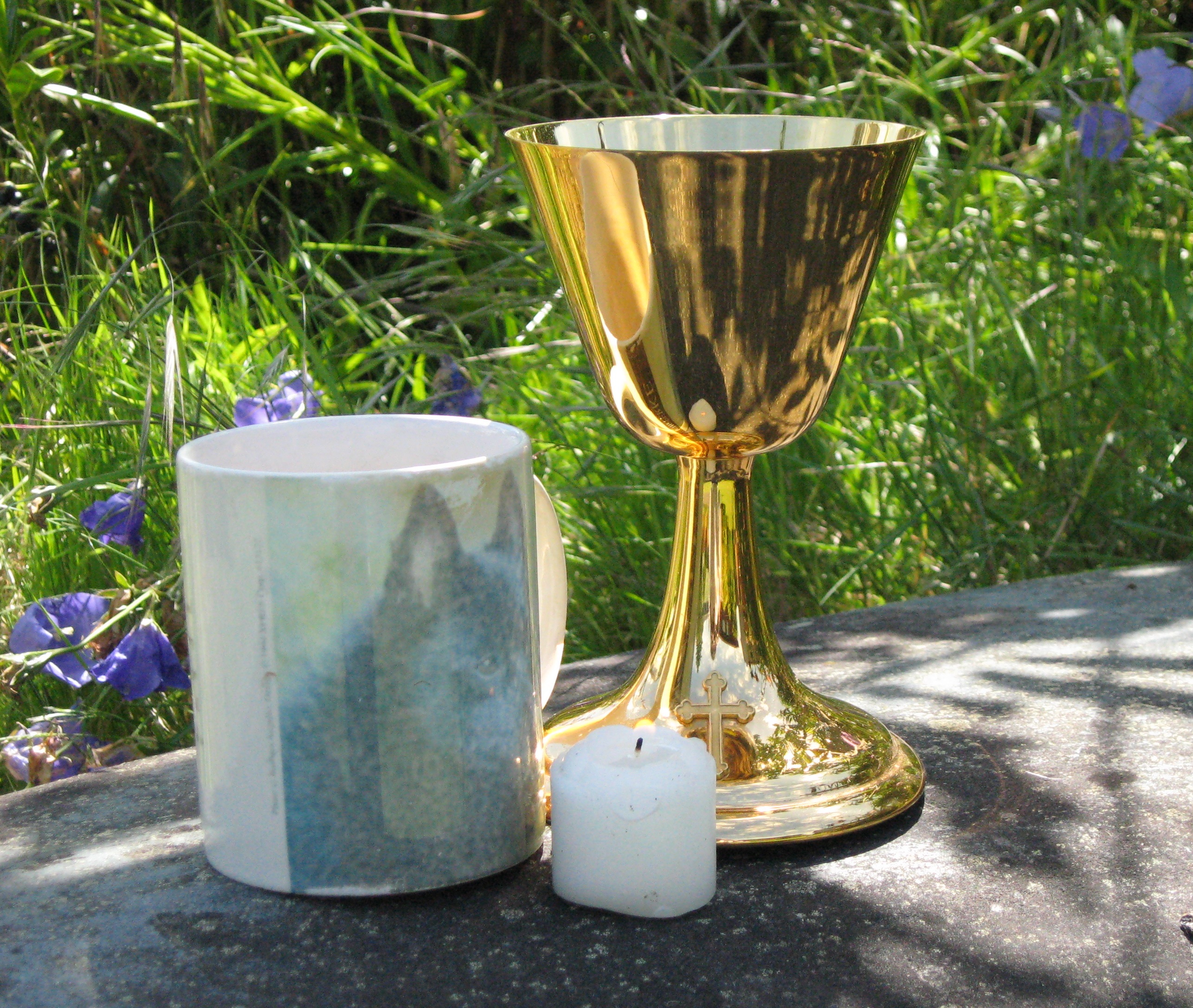
Promises!

filled to the brim

Isaiah 43:5a Do not fear, for I am with you

Promises!

The Lord said:
She created me, formed me
Tells me “Don’t fear”
She calls me by name and I am hers
I will not be overwhelmed
I can walk through all dark shadows,
and dangerous paths,
I will not be harmed
She ransomed me, bought me
Rescued me from my enemies
Because, She loves me, . . . ME!
I will not fear because GOD is with me

©Ruth Jewell, June 26, 2012 Continue reading Promises!

Meditation on Luke 24:36-48

A Sermon Offered to Queen Anne Christian Church, Seattle, WA
April 22, 2012

Luke 24:36-48

36While they were talking about this, Jesus himself stood among them and said to them, “Peace be with you.” 37They were startled and terrified, and thought that they were seeing a ghost.38He said to them, “Why are you frightened, and why do doubts arise in your hearts?  39Look at my hands and my feet; see that it is I myself. Touch me and see; for a ghost does not have flesh and bones as you see that I have.” 40And when he had said this, he showed them his hands and his feet. 41While in their joy they were disbelieving and still wondering, he said to them, “Have you anything here to eat?”  42They gave him a piece of broiled fish, 43and he took it and ate in their presence.44Then he said to them, “These are my words that I spoke to you while I was still with you—that everything written about me in the law of Moses, the prophets, and the psalms must be fulfilled.” 45Then he opened their minds to understand the scriptures, 46 and he said to them, “Thus it is written, that the Messiah is to suffer and to rise from the dead on the third day, 47and that repentance and forgiveness of sins is to be proclaimed in his name to all nations, beginning from Jerusalem.48You are witnesses of these things.

Before I begin this meditation I’d like to ask you to take a journey with me back in time.  Back to that Sunday night, with scared Disciples and experience with them the presence of the risen Christ.

So, get comfortable and close your eyes, . . . take a deep,  slow, breath. Now . . . imagine you are one of the Disciples the evening of the resurrection. . . . The room is small and close, . . . the smell of smoke from the cooking fire and broiled fish fill the room. . . . Everyone in the room is excited, . . . fearful, . . . and joyful . . . but also bewildered at the day’s events.  Everyone is talking at once, . . . each voice getting louder than the next in an attempt to be heard. . . .  When suddenly a voice they know so well says . . . “Peace be with you” and there . . . stands Jesus. . . . Silence

How do feel?

What is going through you mind right now?

After all you all saw Jesus’ body laid in the tomb and on Friday and Saturday you thought your movement was at an end with Jesus’ death. Then this morning Mary and the other women have come and said Jesus is risen from the dead, and Cleopas and his friend have returned from Emmaus saying Jesus broke bread with them.   Now, here in this locked, small, smoky, room Jesus stands in front of you.

And Jesus isn’t just standing there he is walking among you, he’s showing his hands and feet and now he’s sitting down and asking for food to eat.  Jesus, the risen Christ, is eating with you!

Tell me you aren’t amazed, . . . that your eyes aren’t as big as saucers,

That your mouth isn’t on the floor,

That, you aren’t a little afraid of what is to come,

tell me that!  . . .

OK it is time to return and reflect, Slowly open your eyes and take a deep breath, your home now in the 21st century.

You know even 2000 years later this story has the power to shake me up, what about you?  I mean if I were one of the Disciples that Friday would have been the worst day of my life. Terrified, of what has happened I would have been in shock and grief.   Saturday morning reality would have begun to set in, I would be beginning to have some fear for my own skin and start asking the questions of “what do we do now, go home and pick up our lives where they left off, preferably before the Romans and temple authorities come after us?”   I’m mean they aren’t in this small locked room because of a crowd of loyal followers outside, they’re in this room hiding in fear of their lives.

So much has changed for this small band of faithful women and men.  One day they are shouting Hosanna and 6 days later they are grieving for the death of a friend, leader and hoped for Messiah.  That’s a lot to comprehend in such short time. It had barely sunk in that Jesus wasn’t there for them anymore and what kind of danger they were in, only to have this miracle happen!  Jesus is alive and Jesus is telling them they are to be the witnesses that spread the Good News, the Gospel!

Have any of you ever been on this crazy kind of merry-go-round life where everything is going just fine, even extraordinarily fine?  Then the world crashes around you and you have to get your life back on track somehow. So you begin to dig your way out only to have God give you another spin on your wild ride. Has that ever happened to you?  It has to me, that’s for sure. When I read this scripture last week I was reading through the glasses of what I thought my life would be, only to have it turned upside down.

Last October I was so excited about graduating this June and being finished with graduate school.  Looking forward to moving on to new things, spending some down time with my family and working with Laurie and Sandy on some great ideas for education and spiritual formation for Queen Anne and our region.  Wow I thought maybe all this will have some meaning after all.

What was I thinking? I had forgotten that none of what I do in this life is about me, it’s about God!  In November God let me know that I wasn’t in control of this show and to stop thinking I was.

My mother used to have this cute little picture over her bed of a little chipmunk holding a daisy with the caption “Be patient, God’s not finished with me yet,” and now I know what that means.  God is not finished with me yet, I still have work to do and things to learn so God told me, “don’t think you can rest on your laurels, . . . ain’t gonna happen.”

That’s what happened to the Disciple (not that I’m putting myself in the same class as those in the upper room), But they, too, thought everything was going just fine and they would rule the world. Then their world is turned upside down and they thought the end of their ride had come. But God comes along and gives them another spin.  Jesus has risen from the dead to offer new life to old ways of thinking and God says “don’t think you can rest on your laurels, ain’t gonna happen.”

In the three days before the resurrection, days of terror and grief the Disciples had given up, and understandably so.  Now just when they are barely getting their wits back Jesus returns and says “you have more work to do, more things to learn.”  He opens their minds to a new reality and finally they understand what Jesus had been trying telling them for all those years. Now they understood what the women had been talking about … ah … wait a minute . . .what did you say Jesus?  We’re to be witnesses for all of this, your teaching, resurrection, everything! We’re to spread the Good News of the Kingdom, that’s a big job.

And Jesus tells them that yes it’s a big job but He and Abba Father would not give it to them if they couldn’t handle it. And that is the good news for us, God doesn’t give anyone more than they can do, But, God does push us to our limits in order for us to reach our potential as spiritual beings.  All of us are being pushed to look at new ways of worship, thinking, being church, at being faithful to the teaching of Jesus.

Each of us (me included) are being pushed to rethink what it means to be follower, companion, and co-creator with God, and not of God.  If there is anything I’ve learned in seminary it is we aren’t to be passive followers just doing what we are told. Nor are we to put God on shelf and only bring God out on Sunday morning.  We are to work alongside God, Jesus and Holy Spirit, just as the Disciples did so long ago, in order to spread the Good News that Jesus taught.

It is not about us; it is about God, Jesus and Holy Spirit and we are to be witnesses, just like the 12, to all we have experienced as partners and friends of God, not servants.

I do not know where I am headed, I dare say you don’t either, nor do we as Faith Communities know, all we can do is go with Gods flow, which is all God is asking,

We can say no, we won’t go, we won’t work with you, but trust me God is incredibly persistent.  You most likely will come around one way or the other.  God cares too much for us, and for what we have to do, to give up on us.

So don’t be surprised on the day you think you have your life all wrapped up in a nice little bow that God shows up and returns you to the merry-go-round and gives it a mighty spin.

All I can say is just enjoy the ride.

Ruth Jewell, ©April 22, 2012

Scripture Meditation: Luke 2:36-40

Queen Anne Christian Church
January 1, 2012

36 There was also a prophet, Anna the daughter of Phanuel, of the tribe of Asher. She was of a great age, having lived with her husband for seven years after her marriage, 37then as a widow to the age of eighty-four. She never left the temple but worshipped there with fasting and prayer night and day. 38At that moment she came, and began to praise God and to speak about the child* to all who were looking for the redemption of Jerusalem.

39 When they had finished everything required by the law of the Lord, they returned to Galilee, to their own town of Nazareth. 40The child grew and became strong, filled with wisdom; and the favour of God was upon him.

Who is this woman Anna and what does she have to do with the circumcision and naming of Jesus.  She is mentioned only once in scripture and the only information we have about her is in these three verses, not a lot to go on.  We don’t even know if Anna really existed, she may be a creation of Luke because the role Anna plays is important in the telling of his story.

When I read these few sentences something stuck out for me.  Here is woman who is living in the temple, praying night and day, fasting night and day, and considered a Prophet, a woman!  In a culture where women had only marginally better status than the household’s donkey this is amazing.  But, Luke does give her great status within the Jewish culture; first of all he names her of the Tribe of Asher who was the seventh son of Jacob, so she has social credibility with temple authorities.  Her husband’s name, Phanuel, which means “Face of God”, seems to foreshadow the very life she has lived all her years in the temple, praying and fasting, focusing her entire life on God.   Her act of devotion and obedience to God appears to be exemplary, and she also appears to be one of kind.   While it isn’t unheard of in scripture, after all there were women judges in the Hebrew Scriptures so women traditionally did play an important role in prophecy, but the impressions we receive from the Christian Scriptures are that a woman’s role had diminished to simple household duties.

So why would Luke even bring up this seemingly insignificant woman?  After all she doesn’t play a role in the ceremony; in fact, she just seems to be at the right place, at the right time to meet Mary, Joseph, and Jesus.  It is her response to that event that Luke is emphasizing here.   Unlike Simeon, Anna doesn’t bless the child, or Mary and Joseph, she doesn’t offer advice, doesn’t even offer a warning about what they will endure.   Rather she understands only one thing her prayers, which she’d been offering for long years, had been answered, because Anna sees the Face of God in Jesus.  Even though this small child is only 40 days old she recognizes his importance to her people.  And, what does she do:  Anna immediately begins to praise God, and tell everyone she knows that she has seen the future of Jerusalem.  Anna, a woman, yes a well respected and honored woman but a woman, becomes the first to spread the Good News.   Anna becomes the voice of the voiceless in the culture of her day.  She’s not telling the Chief Priest, or any other temple big wig, she’s telling those “who were looking for the redemption of Jerusalem,” Anna is telling the ones who had suffered the most under the rule of the Romans and even under their own Jewish authorities.

Anna lived in the temple, she knew how it was run, she understood that many temple authorities were abusing their power, to gather wealth and power to themselves at the expense of the people God had placed in their care.  Yet in all that time Anna never lost her faith, she knew a change was coming and when she saw the first glimmer in the eyes of a baby she could not contain herself, she had to broadcast it.  Anna may not have known how the life of this newborn would alter the world she knew, actually rock the Jewish and Roman world to its core, but that didn’t matter, it didn’t matter because she saw  hope in the eyes of a child, It didn’t even matter that she had no knowledge as to what kind of hope was coming, she simply had to tell what she saw.

Today we start a New Year, a year of promise and yes a year of change.  Traditionally the symbol of the New Year is a child, representing new life and new opportunities for the coming year.  Unfortunately we have come to see the New Year promises as only political, economic and material, but I wonder how Anna would see them.  Would she see hope in the latest gadget to buy, would she make a New Year’s Resolution to lose weight, or to pray more?  I don’t think so, I think she would look into the eyes of the New Year’s Child and see hope of different kind.  A hope of a better tomorrow, redemption of the New Jerusalem, a hope that draws us closer to a relationship with God and God into a closer relationship with us.  Anna never knew what would take place 30 years later, just as we don’t know what will happen in the year, or years,  to come.  That didn’t stop her from being the first to shout out that hope was at hand, and it shouldn’t stop us from shouting out the same thing today.

Today we are some 20 centuries past the birth of Jesus, and yes a lot has happened within the church we aren’t particularly proud of, but, there is also a lot that we should be exclaiming with praise.  Anna was shouting that change was coming and a good change at that, if people listened.  Well I am shouting out that change is coming to us as well.  In the last 5 years I have worshiped and studied with people of many different denominations and there is one very important lesson all of us agree upon and that is Church as we have known it is undergoing a radical change.  Now I don’t mean individual churches, like Queen Anne, we are a part of the greater Church, but we are only one part.   I mean Church, the Greater Body of Christ, God and Holy Spirit. I mean the Church made up of every tradition, whether followers of Christ, Islam, YHWH, Buddha, or any other expression of God that draws people into relationship with the Creator.  If Anna were here today she’d be shouting from the rooftops that how we worship, the ways we express our spirituality, and how we care for the ‘other’ are evolving into a new expression of God in creation.  She would be saying, I see the future in the young and old alike who have awakened to discover they want more than what those of the Baby Boomer Generation have grown comfortable with.  Anna would be telling you, no long will the 1 or 2 hours on Sunday Morning be enough, that a time is coming when all will take their awakened spirituality and apply it to their lives, to live in a new way, where Sunday Morning, or Wednesday Evening, or Tuesday at noon becomes a time to celebrate lives enriched by a living faith. But, the real job, the real life, of being co‑creators’ with the Great Spirit comes in our everyday living together.

Simeon warned Mary and Joseph to be prepared for heart break, and I think he would offer us that very same warning because we too will live through heart break.  It is never easy creating something new and alive.  There will be, there are right now, birth pangs.  Suffering will take place, all of us will have to walk through some dark places, shedding some old ways, adapting others, and creating new ones.  But  like Anna we cannot be worried about that, just as she only wanted to let the world know that something new is coming and to get ready, we too need to tell and help prepare the hearts, minds, and spirits of our fellow travelers for new life.  Anna didn’t know what the future would bring; she was only the harbinger, the robin, or first crocus of a new spring that would rock the World as she knew it.

We have just entered winter, yet deep in what looks like a lifeless ground there are stirrings of new life, ready to be born.  New green shoots will shoot up and spread their leaves and produce the fruit of a new world.  Within the hidden places of the earth there are animals sleeping and preparing for the spring, having their young that will grow up to become the next generation.  Our Churches are like that, we too are ready to send out shoots to grow into new green life, we too are ready to shelter the young so that they will grow into a new strong generation of Christ’s Body.  Luke ends this passage with the young family returning to Galilee where the “child grew and became strong, filled with wisdom; and the favor of God.”  Today we are  the ones to shelter, and fill with wisdom the young who will follow us and take up the new life of the Body of Christ.  More importantly we are the Anna’s of today, shouting out the first good news of a new spring.   It is up to us to shout out “I’ve seen the Face of God, hope is coming and it will be good.”

AMEN

©Ruth Jewell, January 1, 2012

A Pre-Christmas Meditation

Luke 1:78-79
78By the tender mercy of our God, 
the dawn from on high will break upon us,
79to give light to those who sit in darkness and in the shadow of death,
to guide our feet into the way of peace.”

     It is the first full day of winter, Christmas is just 3 days away and the sun has just broken over the trees to the east of us; it is a bright, cold, winters morning.  I’ve been re-reading the above scripture from Luke as I watch the sun climb into the sky. We used these verses yesterday for our prayer group Lectio Divina and I haven’t been able to get them out of my mind, therefore, I ‘m not supposed to.  I NEED to continue to consider what they mean to me.

These are the last two verses of the prophecy Zechariah speaks when John (the Baptist) is presented to the temple.  Mind you these are the first words Zechariah has spoken for 9 months so he’s put a lot of thought into this moment.  This is part of the Christmas Story we don’t hear much of yet it is a beautiful piece and one worth remembering.  John after all is the one who announces the coming of the Messiah and, in the synoptic Gospels, baptizes him. (Just in case you’ve never noticed there is no baptism in the Gospel of John.) John also recognizes the divinity of Jesus from the womb when the pregnant Mary approaches Elizabeth.  So John has a role in this divine birth narrative.   

     While the prophecy Zechariah speaks tells us his son will be the one to prepare the way for the Messiah, these two verses are really about the coming role of the Messiah, the light that will shine in darkness.  Zechariah knows what it is like to be in darkness; from the day Gabriel announced to him he’d have a son he had been unable to speak.  For a Jewish Priest the inability to speak is a kind of darkness, for being unable to speak the words of God is like putting out the light for those who need the comfort of the WORD.   These two verses don’t refer to sunlight, they refer to Son Light, and the WORD spoken that draws us out of our darkest moments, pulling us away from the death of a life lived in the shadows.

The footnote for verse 78 tells us that there is another ancient interpretation of line two, “… the dawn from on his has broken upon us,”  instead of “… The dawn from on high will break upon us,” and that changes the meaning of the two verses.   I happen to like the ancient version of that line because it means there is no waiting for the Good News, it is now, always has been now.  We have never had to wait for the WORD, all we’ve had to do is open our ears, eyes, hearts, and listen.

The birth of Jesus is the embodiment of the Divine, the Holy Spirit, who wanted us to see the WORD that had been repeated over and over again by messengers throughout the ages.  But Jesus added to the Spirits message, He just didn’t speak the words, and berate those who had fallen away; he acted the WORDS, which was a significant change in the game plan for G-D.  No longer are we to hear the message we are to act it out.  If we are to honor the Child in the manger then we must do more that kneel and give homage. We are to remember Jesus was born homeless and poor, which means that the light, the words we offer, must lead the homeless and poor, in body and spirit, out of the darkness.

I have always had a love/hate relationship with the Christmas Season.  I dislike the gift giving, the hoopla, the commercials, and the insincerity of the greetings people give.  I have always wondered how I will change to make this moment meaningful for myself and for those I love.  I finally have come to the conclusion giving expensive gifts and preparing an overly elaborate dinner is not Christmas.  That does nothing to honor the dawn that has broken upon us.  So this year I offer my gifts to the homeless and the poor.  The money for dinner went to feed the poor.  That is my Christmas gift to family and friends, the light of the WORD acted out. I know I can’t care for all of the poor, homeless, or mentally ill, there are too many and they tug at my heart.  I want to gather them all up, human and non-human, and hold them, give them warm clothes, good meal, and a safe place to rest.  I can only offer what little I have.

Holy Spirit, love was born that night in a stable and the WORD became visible to all who could see.  I pray that now in the messiness of emphatic change in how we hear and see the spirit we will all gather at the manger and offer not gifts of gold, or IPods, or gameboys, but rather offer love, compassion, mercy, and justice for those whose have lived in darkness for too long. My prayer is I will hear you, touch you and listen with an open heart, ear and eye.  May my mouth be opened to offer the overflowing love you have given me, let me be the shepherd to guide people on the path to your peace.

©Ruth Jewell, December 22, 2011

What Does It Mean To Keep Awake?

Sermon: Queen Anne Christian Church, Seattle, WA
November 27, 2011, First Sunday of Advent
Scripture: Mark 13:24–37

The Coming of the Son of Man
24 ‘But in those days, after that suffering,
the sun will be darkened,
and the moon will not give its light,
25 and the stars will be falling from heaven,
and the powers in the heavens will be shaken.
26Then they will see “the Son of Man coming in clouds” with great power and glory.27Then he will send out the angels, and gather his elect from the four winds, from the ends of the earth to the ends of heaven.

28 ‘From the fig tree learn its lesson: as soon as its branch becomes tender and puts forth its leaves, you know that summer is near.29So also, when you see these things taking place, you know that he* is near, at the very gates.30Truly I tell you, this generation will not pass away until all these things have taken place.31Heaven and earth will pass away, but my words will not pass away.

32 ‘But about that day or hour no one knows, neither the angels in heaven, nor the Son, but only the Father.33Beware, keep alert;* for you do not know when the time will come.34It is like a man going on a journey, when he leaves home and puts his slaves in charge, each with his work, and commands the doorkeeper to be on the watch.35Therefore, keep awake—for you do not know when the master of the house will come, in the evening, or at midnight, or at cockcrow, or at dawn,36or else he may find you asleep when he comes suddenly.37And what I say to you I say to all: Keep awake.’

 These verses are some of the most difficult found in the Gospel of Mark. It’s not just the fact this it is apocalyptic in nature, but it is stuffed with meaning, which may or may not have meaning for us in the 21st century.   It is also an odd start to Advent, no angels, no shepherds, just a warning, crazy stuff huh. So, we are going to have to wade through the imagery and history to find what is meaningful for us today.  I wish I had more than 10 minutes or so because there is so much in this scripture and it’s really interesting, but I’m sure you don’t so I will be brief.

The fact of the matter is Jesus isn’t talking about the second coming at all here because He almost immediately says that no one will know when that will happen, not even him!  Mark is writing to a community that needs to flee the Jewish revolt, which began in 66-65 of the Common Era and resulted in the destruction of the temple in 70 of the Common Era.  So much of the imagery Jesus speaks here is related to Jesus’ own prophecy of that event, which came true.  Mark is telling his community that this war isn’t theirs, it’s not the beginning of the end, so Mark’s community needs to “get out of Dodge” before they become enmeshed in the destruction.   What is important to recognize is Jesus is fine without knowing,  it is useless to speculate about the second and Jesus knew God has ensured that history, his and ours, was headed somewhere, we have to be patient and let it unfold.  And, that is the first clue to finding meaning in this scripture; patience.

Let’s take another look, in Mark 13:30-31 Jesus says “Truly I tell you, this generation will not pass away until all these things have taken place. Heaven and earth will pass away, but my words will not pass away.”  Now that surely sounds like the second coming.  Well let’s think about that for a moment, if Mark is warning his community to leave Jerusalem,  telling them that the war wasn’t their war, nor the Messiah’s war, does it not make sense that what Mark is saying is this war will end before they do, Jerusalem may pass away but the words and deeds of Jesus won’t.     Again Mark, through Jesus’ words, is telling his community to be patient.  How do we know that, well in verse 32 Jesus says “But about that day or hour no one knows, neither the angels in heaven, nor the son, only the Father.”  Well if no one knows, not even Jesus or the angels, and the lack of that knowledge doesn’t bother Jesus then we need to stop worrying about the whens and start living the way we are intended.   All we have to do is “be alert,” when the time is right, it will happen.   But what does it mean to be alert?

So what are we to do while we wait, oh ever so patiently, well Jesus has an answer for that as well in verse 34, Jesus always has an answer, well nearly always, sometimes Jesus lets us figure it out.  So here’s the story.  Your employer goes on an extended vacation and he tells you and your fellow workers that each of you have your tasks to complete while he, or she, is gone.  The employer doesn’t expect you to wonder when he or she will return, or to cut short your work days, or take a vacation yourself, the employer expects you to do your job and fulfill your contract.  The employer tells you that she doesn’t know when she will return, so you need to keep awake and do your job or otherwise you will be caught short when she does return.  And that is the second clue to what this scripture means to us, we have a task that needs to be completed before the coming of the Master.

So how do the clues of waiting and working fit us in this season of Advent?  Well first of all we aren’t supposed to sit in our rocking chairs and wait for the day to come,  whether that be Christmas Day or the Second coming.  We Christians have a mission to complete; our waiting is supposed to be active waiting not passive.  Jesus makes that clear when he says “each has his work.”   So just what are we supposed to do; well be a faithful witness and in Mark’s day, and ours, that points to social justice.  We need to be aware of the social justice issues of our day,  which by the way aren’t that different from when Mark’s Gospel was written.   How do I know that, well all I have to do,  and you too,  is LOOK at what Jesus DID, not so much what he said, for Mark, nor Matthew or Luke for that matter, does not record many of Jesus’ words but nearly every page has Jesus doing something.  Jesus heals the sick, chases out demons, feeds the hungry, and offers comfort where comfort is needed. He plays with children and shares his table with those the so-called righteous of his day lock out of their homes.  In other words he made a difference in his world and Jesus calls us to make a difference in our world. While we wait for the day the Kingdom of God is fully expressed WE are to do the best we can to prepare for it.  We are to keep AWAKE and not let the Master find us sleeping in our Lazyboy chairs with the remote in our laps.   We are to continue the ministry Jesus and his Disciples started, opening the doors of compassion, love, mercy and justice for those who have no voice in this world.

It’s not our place to speculate when the Master will return; it is our task to do the work of the Master while we wait for the Kingdom to be fulfilled. God has assured us that history is going places; Jesus was content with letting God take control, so we too must do the same.  Tomorrow will come, of that we have no doubt, and today is all we need to be concerned about.  Do you remember the old television show Mission Impossible?  Well just like the voice on the tape this is your assignment.  “This is your mission if you choose to accept it, take care of the poor, the hungry, the widow, and the stranger amongst you.  Have compassion for the voiceless, offer mercy to all, and let justice and kindness guide you as you walk with God.  This sermon will self destruct in 15 seconds.”

©Ruth Jewell, November 27, 2011

A Story of Openings

I was preparing to leave for class when I suddenly remembered I had the homily for the 8:30 am Morning Prayers, and I hadn’t written anything yet.  As I stood in my office, panic setting in, I grabbed my notebook, and a book on the interpretation of scripture and ran out the door.  I am fortunate, blessed even, in that I ride a bus from my home to the University of Seattle and that was all the time I had to write the homily, a 30 minute ride, but somehow a door opened for me as I rode in that day.  Here is what I offered November 8th at Morning Prayers.

A STORY OF OPENINGS

Matthew 15:21-28
The Canaanite Woman’s Faith

21 Jesus left that place and went away to the district of Tyre and Sidon. 22Just then a Canaanite woman from that region came out and started shouting, ‘Have mercy on me, Lord, Son of David; my daughter is tormented by a demon.’ 23But he did not answer her at all. And his disciples came and urged him, saying, ‘Send her away, for she keeps shouting after us.’ 24He answered, ‘I was sent only to the lost sheep of the house of Israel.’ 25But she came and knelt before him, saying, ‘Lord, help me.’ 26He answered, ‘It is not fair to take the
children’s food and throw it to the dogs.’ 27She said, ‘Yes, Lord, yet even the dogs eat the crumbs that fall from their masters’ table.’ 28Then Jesus answered her, ‘Woman, great is your faith! Let it be done for you as you wish.’ And her daughter was healed instantly.

This is a story opening doors not a story of how rude Jesus could be.  We can compare Matthew to the other three Gospels and Paul all we want but Matthew could care less about the other four writer’s audiences.  Matthew is talking to, writing to, a Jewish community and one more than likely in crisis.  And, because of the makeup of his community (we could say his social analysis) we need to ask what door he is opening.

In Matthew’s community the salvation Jesus offered came first and foremost to the Jew, but something is happening in this community that causes him (or her, we don’t know the author of this Gospel), in this story, to open the door to the Gentiles.  We do not know what that was, we can speculate but that is all it would be.  What I find interesting is how the cracked door may speak to us, today, in the 21st century.

So we have this woman doubly, maybe triply, taboo for Jesus, a Rabbi, to speak to in public.  Rabbis didn’t speak to women, most certainly not to Gentile a woman and probably not to a married woman. But this woman, a Gentile, approaches in an attitude of prayer and Jesus relents, telling her she
has “great faith.”  “Snick,” the door of salvation just opened to the “other.”

Two thousand years have passed since Matthew wrote those words and in all those years many still haven’t opened wide the door to the other.  Matthew is telling us today, just as he told his community that faith without action, without social justice is an unfulfilled faith. We all have individuals we would avoid, after all Jesus was avoiding the religious authorities by going into Gentile territory.  But Matthew was telling his community, and us, that Jesus and God have a plan for the “others” in our lives, just as God has one for us.

How much will it take to open wide the door?  How much will it take to let the
others in not just into our presence, but into our hearts?

Ruth Jewell, ©November 8, 2011

Sermon October 16, 2011, Queen Anne Christian Church

Micah 6:6-8

6‘With what shall I come before the Lord,
and bow myself before God on high?
Shall I come before him with burnt-offerings,
with calves a year old?
7 Will the Lord be pleased with thousands of rams,
with tens of thousands of rivers of oil?
Shall I give my firstborn for my transgression,
the fruit of my body for the sin of my soul?’
8 He has told you, O mortal, what is good;
and what does the Lord require of you
but to do justice, and to love kindness,
and to walk humbly with your God?

Matthew 22.15-22

The Question about Paying Taxes

15 Then the Pharisees went and plotted to entrap him in what he said.16So
they sent their disciples to him, along with the Herodians, saying, ‘Teacher,
we know that you are sincere, and teach the way of God in accordance with
truth, and show deference to no one; for you do not regard people with
partiality.17Tell us, then, what you think. Is it lawful to pay taxes to the emperor, or not?’18But Jesus, aware of their malice, said, ‘Why are you putting me to the test, you hypocrites? 19 Show me the coin used for the tax.’ And they brought him a denarius.20Then he said to them, ‘Whose head is this, and whose title?’21They answered, ‘The emperor’s.’Then he said to them, ‘Give therefore to the emperor the things that are the emperor’s, and to God the things that are God’s.’22When they heard this, they were amazed; and they left him and went away.

Here we have another confrontation between the religious authorities and Jesus and we now see Jesus getting quite testy with these people who won’t listen to what he says and beginning to call them out.  This must have been an important story for all three of the synoptic Gospel writers, Matthew, Mark and Luke, for they offer this story using nearly identical language.  Given that, we may have here the actual words of Jesus and for me that is very exciting.  But why was this story so important to the early church and why should we consider it important for us in the 21st century.

First of all the significance to Jesus’ audience was very evident in the way Jesus responds to these supposed authorities, we see that he is losing patience with them.  They won’t hear what he is really saying and so his temper is getting short, he doesn’t have much time after all and he knows it.  But it is in the way he answers the question that turns the tables on the Pharisees.  He asks for a Roman coin, for that is what Roman taxes were paid with and they produce one.  On the surface this seems like a normal thing to do, except, the only coins allowed in the temple were temple coins.  The reason being under Mosaic Law the Jews were not allowed to have graven images and the image on the coin produced is Caesars, who claims to be a god.  The religious leaders are now the point of a joke, they are shown to be what they really are, people who crave authority at the expense of what they believe.  By having the Roman coin in the temple the Pharisees have been discredited in front of Jesus’ disciples and the crowd.

However, it is the answer Jesus gives the Pharisees that has the greatest significance for us today.  In his answer Jesus told the Pharisees, and the crowd, that it was alright with him to pay taxes, if Rome wants its coins, if that is what they value, then give them to Rome.  But, give to God what belongs to God!

Now there is the answer that raises the greatest of questions, what belongs to God?  The answer of course is everything, including ourselves and everything we have!  If we look at the Book of Job from chapter 38 through 41, you will hear God outlining just what does belong to God, it is rather specific and to the point.  So why do we, today, have such a hard time giving back to God what belongs to God.

I think one of the reasons is we’ve allowed our monetary emblems to become a symbol of authority and power.  Who has the most, is the most powerful.
Michael Raschko in his book A Companion to the Gospel of Mark talks about this scripture as it is written in Mark and he says that “Authority and power do not exist for their own sake.  They exist for the sake of bringing life to other … we are to use authority for the others.  Authentic power gives life to others.”    How we use the abundance we are gifted with determines our real power, that’s an interesting concept and one we all wrestle with every day.

It is in what we do with our money that determines in what way we use power.  Do we use it only for self-absorbed matters, gathering more and more stuff, or do we use it in such a way that we have enough and those in need also have enough.  One of my passions is helping the homeless and indigent so when I walk down the streets of Seattle and I sometimes stopped by a homeless person who asks me for money I have my own way of providing assistance.  Now, I make it policy never to hand over money to people on the street, instead I usually carry and extra sandwich, or if I’m in the car I carry a small bag of grocery essentials and offer those instead.  Sometimes the individual
turns down my offering and in that case I know that they didn’t really want
food they wanted to buy drugs or alcohol so I simply tell them that is all I have and move on.  Despite what some might think I don’t have a lot of money but I try to share what I do have with those in need.

Let me get back to this coin Jesus is holding, are we required to share our monetary abundance?  Micah tells us that God has told us what God wants us to do, “do justice, and love kindness, and to walk humbly with your God?”  Are those acts associated with money in any way?  Yes they are, to ease poverty and hunger requires someone to provide shelter, clothing and food and that means sharing from our monetary abundance.  Does it mean we have to give until we are in poverty, no it doesn’t.  It does mean we are called by God to share from our abundance no matter how small the amount, or how small the act.  But we are called to share.  That coin Jesus was holding was the exchange medium of the Roman Empire and except in the temple would have been used by every member of the crowd to purchase everyday needs.  The crowd knew that, they knew that having money wasn’t evil, nor was spending it.  It was the hoarding, using it as a way to gain excessive power that was wrong.

But what about Faith Communities and in particular our Faith Community here at Queen Anne, what do we give to God that belongs to God?   This Faith Community depends on each and every one of us participating in the life of this organization.  And, I am amazed at how much participation takes place here.   As a group and as individuals we do try to give to God what belongs to God, our work together here within our community does make a difference.  Our young people go and fill bags of frozen vegetables for the food bank.  Our
building is used during the week as a place where children learn and play.   We join in worship and welcome the stranger into our midst.  We have teams of people who teach and work together to pass on our love of God.  We have community members who volunteer, and work, for non-profit organizations that provide services to those in need.  We care about not just those in our building but the other, those who are different from whom we are.   In our own way we bring our authentic power to bear and offer life.

There is enough on this planet to care for all of us, humans and non-humans, IF we only learn to give back what belongs to God.  Letting go of unnecessary power and embracing our authentic power to love kindness, do justice and walk humbly with our God is all that God asks us to do.  Is that so hard, apparently it is for some people. Maybe it is our responsibility, here in our Faith Community, to be the example and to show the way.  The life of Jesus and his disciples demonstrate just how hard that is. We will grow tired, we will want to give up, we will want to say it’s not worth it.  But look into the eyes of a child or hold a puppy and know that we aren’t alone in this struggle, nor have we ever been alone.  And we aren’t along just for a free ride.

Jesus may have had Micah in mind when he offered his answer to the Pharisees.  To walk humbly with your God means living a life that is God like, which means doing justices and loving kindness and it means that we as individuals and as a Community of Faith are called to care for those God cares the most for.  Jesus tells his Disciples “when you do for the least of these, you do for me.”  I know it’s a bad paraphrase but you get the idea.  We as community have much to offer, we have an authentic power to offer life, and I believe it is worth offering.

Ruth Jewell ©October 2011

By What Authority

I am sitting here at my desk listening to the rain fall outside and just mulling over the sermon I gave yesterday.  I keep thinking on authority, what it means
for me and how so many people use and misuse that term.   What I’m trying to figure out is how do I claim my own authority?  What is the authority I have to claim and will I use it not for my own selfish reasons but for the good of all.

Tomorrow is my official start to my last year the School of Theology and
Ministry and so I am thinking where I’m going and what I will do.  I will be 65 when I graduate next fall and for me that was an ages when I believed people retire not start a new career!  I have so many questions of the God and (Hello God) sometimes I think God is just sitting up there giggling at me as She tells me ‘to just wait for the surprises I have for you.’  I love a good mystery, one I have to figure out and laugh when I get it wrong or celebrate when I get it right.  But, it’s not quite so comfortable being the center figure of my own mystery.  Well, I guess I will just have to wait and see how this all ends up; actually I will have to wait because God is talking!

Below is the sermon I preached last Sunday and I offer it to you, as I told my community, as an invitation to the conversation.  I look forward to your comments.

BY WHAT AUTHORITY

Sermon for Queen Anne Christian Church
September 25, 2011

This scripture from the Gospel of Matthew is not only rich in meaning but difficult to open up.  The questions Jesus asks the leaders of his people are difficult ones and not to dissimilar from questions we are asked as Christians or the ones we ask ourselves.  I think to understand what the author of Matthew is trying to get at we need to first understand the scriptures historical context.

First of all the audience for the Gospel of Matthew was a Jewish community.  There may have been a few Gentiles and converts to Judaism but essentially it was a community of Jews who would have known well their Jewish history.  In addition this gospel was written following the destruction of Jerusalem and the temple, so the author of Matthew is talking to a group of displaced Jews who have fled their homes in terror and are now wondering if what they had believed in has any meaning.

The actual story takes place the day after the triumphal entry into Jerusalem when on that day Jesus had cleansed the temple of the money changers, and healed the blind and the lame before escaping the hands of these very leaders now questioning him.  In addition as Jesus and his disciples had entered the city on this morning he had cursed a fig tree for not producing its fruit.  So we have here several miracles and events that the leaders would have seen as a test of their authority to rule.

One interesting note is how the debate between Jesus and the elders takes place.  Did you notice that Jesus asked a question instead of answering the question given him?  Well this was a common technique of rabbinic debate.  When a rabbi was asked a question the response would often be another question.  So while it might look as if Jesus is side stepping the question it is actually what the Elders and Chief Priests would have expected from a fellow Rabbi. However, Jesus is not an “ordained” rabbi; he has no official status with the religious community.  Jesus is an itinerant preacher and charismatic speaker who had a loyal following, not unlike many self-proclaimed preachers on our own frontiers or even today.  Yet the Chief Priests are treating him as if
he is one of their own.

We also need to understand that the Elders and Chief Priests who confront Jesus are members of the priestly aristocracy and are not “the Jews.” Rather they are compromised leaders who collaborate with the Roman Government and are under the control of the Roman Governor.  So it is in the interests of the Priests and Elders to keep the status quo in place for that is where their power comes from, they had a vested interest in not rocking the boat.  Therefore, whenever anyone outside their own select group showed any ability to inspire the people they would have looked at it as a serious threat to their own safety.

Mind you the Chief Priests and Elders weren’t necessarily bad people.  At least some, if not most, probably felt they had no choice but to collaborate with the Roman Government if they were to protect their people.  The issue here is who were the people they were protecting.

So let’s get into the story.  Jesus is teaching in the temple when the Chief Priests and Elders confront him with the question, “who gave you the authority to do what you do?”  On the surface this seemed like a silly question to me. After all the care of the indigent, widows, children, and strangers are mandated by God in the Hebrew Scriptures.  However, this is a very serious question for these leaders because if Jesus’ authority comes from God then what does that reveal about their own authority, for they have not taken God’s charge all that seriously.

Instead of directly answering their question Jesus asks one of his own, “where did John’s authority come from?”  Now this puts these guys into a real pickle for they know they are trapped.  They have three ways they could answer Jesus’ question: a, agree that John’s authority came from God; b, John’s authority came from human origins; or c, they didn’t know.  Recognizing the consequences of the first two they chose C, they didn’t know.  This was a way to save face without actually acknowledging anything about John.  But Jesus, as we soon see, is not about to let them off the hook.

Jesus’ next act is to tell one of his famous stories, and he ups the ante with this story because the Priests and Elders will be unable to side step the final question.  Jesus’ story of the Two Sons is a simple one, but with deadly consequences for Jesus.

A father asks his first son to go and work in the vineyard and the son says NO, then the kid thinks better of it and goes anyway.  Not knowing that his first son has gone to the vineyard the father asks his second son who says YES, but instead hangs around the house playing video games.  Jesus now asks the Elders and the Chief Priests who has done the will of the father?  This is not a multiple choice question, rather there is only one answer and these leaders know it.  They have no option except to say the first son does the will of the father.  They also recognize that Jesus is identifying them with the second son
who says they will do the will of God but don’t, they protect themselves not the people in their charge.  Jesus identifies the first son with the crooks and prostitutes who originally tell God no, only to repent and live changed lives.
This is not what these learned men want to hear.  They have been compromised by their own egos and a wish to survive at all cost, while the authority of the poor has grown as they begin to do the work of God.

So what is the meaning of the words “by what authority” for me, us, today?  How do I, we, respond to the story of the Two Sons, who do you identify with? How do I, we, respond to Jesus’ question?  Most of all, how do I, we, interpret this story in such a way that does justice to the author of Matthew, but still has meaning for all of us in the 21st century?  These are important questions because I need to be honest and recognize I’m not the audience the author of Matthew was writing to.  However, I think I can draw some insight from the story despite the fact that I live in a world 21 centuries beyond the authors Jewish community.

If I examine this event in the context of the whole Gospel of Matthew I recognize that the author of Matthew, more so than the remaining 3 gospel writers, is trying to call his Jewish community back to the original Mosaic Covenant with God in the context of Jesus’ teachings.  That Mosaic covenant called for caring for the widow, the orphan and stranger, to share from abundance graciously given, not just material wealth, but from spiritual wealth, compassion, mercy and justice.  In the Gospel of Matthew Jesus is calling for a way of living where all have “enough” to live whole and healthy
lives, and that all give out of their grace given abundance to those who, for
whatever reason, are in need.  In the Gospel of Matthew Jesus repeatedly tells his followers that the Kingdom of God is here, all we have to do is live in to it.
It is not a Kingdom that will come in some future date but now, all the reader of Matthew has to do is “see and listen” and they will see the Kingdom before them.  I’m not sure what it meant to our First Century reader to “live out” the teachings of Jesus and I am struggling with what that would look like for me.

I recognize and sympathize with the Elders and Chief Priests as they wrestle with this question because it is just as much an issue for me as it was for them.  After all I live a comfortable life, and while my family was never rich, nor am I rich now, I never went hungry, or without clothes or shelter.  Despite what I might say I have lived a privileged life and I would guess that most of us in this room have lived such privileged lives as well, it’s not bad, it’s just who we are.

But if I am honest with myself I can sometimes identify with the second son.  And, while I don’t believe I’ve ever been intentionally cruel or unjust, I know that at times I too have not been as kind and merciful as I like.  All of us have had our moments of brokenness and despair, times when we’ve turned away from God and said NO, or, I am going to take care of just me and leave it at that, our moments of survival.  That is part of being Human, but it is what we do with our lives after such moments that matters.

In the story of the two sons Jesus wanted the Chief Priests and Elders to identify with one of the characters.   He wanted them to see, listen and repent.  He wanted them to recognize their covenantal duty to all of the Jewish people not just the rich and powerful.  In 5 days these same men would prosecute him and it would cost him his life on this world, this was a last ditch effort to get the leaders to see their role in the abuse heaped upon those who have no power.  It obviously did not work.

But what about me, all of us in this room, what does it mean to live our lives as Jesus taught, to see and hear the Kingdom of God.  How do we look at our 21st
century lives and say ‘I want to act like Jesus?’  Does it mean I have to give up modern conveniences’, or modern technology?  I don’t think so, I think if I accept the challenge Jesus gave to the elders and Priests as doing the will of God, then that means I need to respond to those God cares for the most.  If I live my life as if I have “enough” I will have enough, and If I give out of my grace filled abundance, I will always have grace filled abundance, but so will
everyone else.  Jesus tells me not to worry about what I will eat or wear, that will be taken care of.  My survival is assured simply by giving to those who are in need.

What gifts did the elders and priests have: they had money and goods, but they also had compassion and mercy all of which they horded in order to maintain their life style.  I must admit I do that myself, I might be trying to change but I haven’t quite given up something’s, … such as books.  Now, I don’t believe I have to give up everything.  I, we all, have special possessions that link me, all of us, to the past and lead us into the future; Jesus isn’t calling any of us to give away everything.  Rather, I believe that Jesus is calling all of us to be generous with what we have and to remember that while we are fond of some special possessions they are not to become our idols, our stuff isn’t supposed to own us.

Last year I interned at the Chief Seattle Club, a day shelter for Urban Native Americans, and I learned so much about what is important in life.   Community, family and friends top the list for Native Americans.  Those who frequented the Club were the ones that even those in their own culture often didn’t want to acknowledge: the chemical and substance abuser, the sexual offender, the unskilled, the murderer, the mentally ill, and those who just wanted to be left alone to live as their ancestors did.  Yet in this place I found an abundance of spirit.  I found graciousness in that they welcomed me into their midst and accepted me as one on a journey.  These are the people we all rush past on street, the dirty, the smelly and the strung out and I was honored that they called me friend.

I became close with one gentleman in particular who lived on the street by his own choosing, and carried his entire life on his back, yet he went every day to the home of a handicapped lady to cook her meals and make sure she made it to the doctor’s office.  One day he told me a story of sitting on the grass at Seattle U and watching a soccer game when the wind came and circled around him.  He felt that somehow he was being watched over and that this breath from the Great Spirit was to remind him he wasn’t alone.  Was he perfect, no, but his spirit was moving in the right direction, in him I saw the Kingdom of God, kind, gentle, giving, working for the other.  It makes me wonder if people see the Kingdom of God in me.

Laurie and I talked about what authority means, and I said, I didn’t know what authority I have to preach from this pulpit.  Laurie reminded me that preaching isn’t what I’m to do, but rather to invite you into the conversation.  So I’m inviting you into my conversation of what it means to live out the teachings of Jesus, what does that look like for you, and how are you wrestling with all of the questions Jesus asks?  None of us can figure this out by ourselves.  How you view the Kingdom of God maybe, and probably is, different from mine and that’s Ok.  We all have different visions, we will all live out these teachings in our own way, the idea is that we make the effort.  Don’t be like the Elders and the Chief Priests who cop out and do nothing.  Nor would I want any of you to identify with the second son, rather even if you’ve said no, go anyway into the vineyard. While the company you keep may be a bit smelly and dirty, their hearts shine with the light of God.

Ruth Jewell, ©September 25, 2011

Deceptive Scriptures

Lectionary
for July 24, 2011: 
Genesis 29:15-28

Jacob Marries Laban’s Daughters

15 Then Laban said to Jacob, ‘Because you are my kinsman, should you therefore serve me for nothing? Tell me, what shall your wages be?’16 Now Laban had two daughters; the name of the elder was Leah, and the name of the younger was Rachel.17 Leah’s eyes were lovely,* and Rachel was graceful and beautiful.18 Jacob loved Rachel; so he said, ‘I will serve you seven years for your younger daughter Rachel.’19 Laban said, ‘It is better that I give her to you than that I should give her to any other man; stay with me.’20 So Jacob served seven years for Rachel, and they seemed to him but a few days because of the love he had for her.

21 Then Jacob said to Laban, ‘Give me my wife that I may go in to her, for my time is completed.’22 So Laban gathered together all the people of the place, and made a feast.23 But in the evening he took his daughter Leah and brought her to Jacob; and he went in to her.24 (Laban gave his maid Zilpah to his daughter Leah to be her maid.)25 When morning came, it was Leah! And Jacob said to Laban, ‘What is this you have done to me? Did I not serve with you for Rachel? Why then have you deceived me?’26 Laban said, ‘This is not done in
our country—giving the younger before the firstborn.27 Complete the week of this one, and we will give you the other also in return for serving me for another seven years.’28 Jacob did so, and completed her week; then Laban gave him his daughter Rachel as a wife.

When our pastor on July 24 read this scripture I was struck by the deception that Laban plays on Jacob and it started me thinking about all of the deception found in scripture.  There is Abraham’s pretending that Sarah is his sister instead of his wife and get’s the host kings in trouble with God (Sarah must have been one hot 100 year old woman for this to happen, but, that’s another issue altogether).  And of course son Isaac has to imitate good old dad with his wife.  Then of course there’s God who deceives Abraham into taking his son up to the mountain to be the blood sacrifice then just blows it off saying, just joking, didn’t think you take me up on it.  And, don’t forget Jacob deceiving his father into giving him the birth right and all of this is only in Genesis.  I’m not going to catalog all of the deceptions our religious fathers and mothers used.

As I have pondered this revelation that my faith is founded on deception I have to also accept that the Jewish and Islamic traditions are also based on deception andAs I look at other world religions deception is common to all of them. Over the past couple of weeks I have been struggling with what that means for my own faith.   When I did a Google search on Deception in Scriptures I find lots of stuff; about half of it is from conservatives who seem to find the deceptions somehow honorable, one fourth is from those who say the recording of the deceptions are the reasons God doesn’t really exist and the remaining fourth use the deceptions to defend their claims that their sister religions are false.

However, I keep thinking I am missing something here and I’m supposed to learn some kind of lesson from all of all this deception.  If I look at the first story of the Creation in Genesis we see no deception what so ever and everyone seems to ignore that.  God creates the universe and everything in it, and then creates man and woman. God tells the two of them everything was created for them so go for it, just take care of this world and we’re good. No trees you aren’t supposed to touch, no snakes in the grass, no original sin, nothing deceptive, just pretty much straight forward and simple. This is a believable story and I like it! God finds her creation good, including man and woman and trusts them to take care of things.  God was only asking that we be responsible
partners with him.  So what happened in chapter 2 were Adam and Eve switched at birth? Somehow we lost our ability to find the good in each other, and, for several thousand years our lives were lived by finding only the bad in each other.

What strikes me is the 4 Gospels of the New Testament seem to reflect the first chapter of Genesis in that Jesus teaches the message that God finds his creation good and all that is necessary for us to see it is do what the first Adam and Eve were supposed to do and that is take care of each other and the planet and we’re good with God.  But, yet again this message gets set aside and we end up finding only the bad side of each other and everything quickly goes downhill.  Why is it that we can’t accept the message God gives when she say’s that creation Is good?  Whenever someone points this out and calls us to return to the message of Genesis 1 we as a people manage to wipe them out, I just don’t understand.

I am wondering does anyone else find this odd about us humans, are we so simple minded that we can’t seem to learn what God has been trying to teach us all these years.  Have the gods of greed and ego so taken us by the throat that we can’t recognize the teachings of God, Jesus, Mohammed, Buddha or any of the other innumerable messengers sent to us.  Are we really that stupid?

I’d like to think that in the second creation story when Eve went and ate of the Tree of the Knowledge of Good and Bad that she was trying to become what God wanted of her and Adam.  But, after eating it she and Adam blow it by not taking responsibility for what they did.  Are we now trying to learn to be responsible partners with God because if we so we aren’t doing a good job of it?  We have the tools to repair this relationship, given to us over and over again by so many messengers all we have to do is learn, so why is it so hard?  I have no answers to these questions and I really don’t know if I have it right or not and I don’t expect anyone else to have the answers either.   I put this out here for conversation only, surely we can come up with better questions than those who only condemn other traditions and those who make the statement “that my faith is the right one and everyone else is wrong.”

As you can see I have been wrestling with this issue for a couple of weeks before I put this out there.  So if anyone else has something to say I have an open mind.  However, please be respectful of others opinions because I’m not sure any of us has the “right” answer.

Ruth Jewell, ©August 8, 2011

The Power of Prayer

1 Thessalonians 5:16-18  Rejoice always, pray constantly, give thanks in all circumstances; for this is the will of God in Christ Jesus for you.

I don’t think I ever really understood Paul’s words in 1 Thessalonians until the last couple of weeks.  On July 1, 2011 I entered the hospital for surgery due to an old neck injury and in the weeks preceding and the week following the surgery I have felt surrounded by a large dome of something which I can only call prayer.  Even when I was in the worst pain ever and felt all alone I had reminders of those that cared for me were holding my spirit in their hearts.  I was only supposed to be in the hospital for 3 days but due to complications it ended up being there for 5, a discouraging time to be sure. 

Yet, holding on to a set of prayer beads made for me by Pastor Laurie I felt a presence that kept telling me “I won’t leave you alone.”   And you know what … I wasn’t!  There was a nursing staff that came when I need them most and offered not just medical help but words of comfort.  There was a Chaplain, Father John, who came in to offer prayer and a reminder that I wasn’t alone, that people I didn’t even know were there beside me.  I was surrounded by something outside the world of science that enhanced the scientific and medical efforts in ways medical staff and doctors cannot explain but I know exists.    

Paul said to “give thanks in all circumstances,” even when things are darkest and you think that all is lost and no one cares.  I am discovering that Paul is right; now that is hard for me to say because Paul and I have a very uneasy relationship.  Prayer, rejoicing and giving thanks even when the world feels darkest is what keeps me from falling into the abyss.  I love the prayer “God’s Promise” written by Ron Mills (see the previous post) and I kept repeating it during that difficult hospital stay.  It gave me the courage to deal with pain, loneliness and fear, I wasn’t alone. 

And so I rejoice and give thanks for all of the those who offered their prayers of love and healing, I could not have made it through those dark moments without the dome of prayer you surrounded me with.  Blessings and Peace to you all

Ruth Jewell, ©2011